
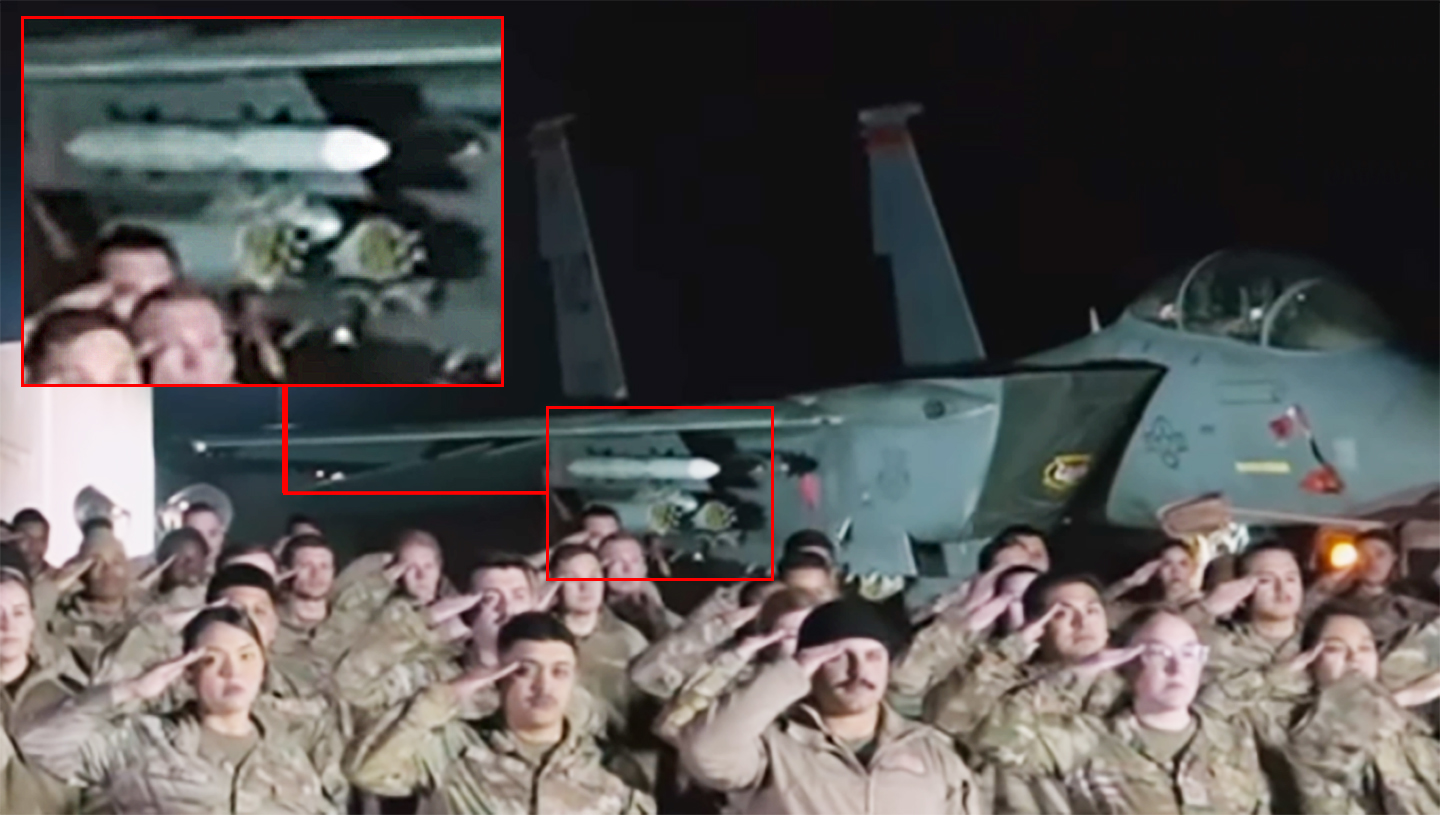
F-15E Strike Eagle multirole fighters armed with drone-killing Advanced Precision Kill Weapon System II (APKWS II) laser-guided rockets that are deployed to the Middle East were displayed in a video during the singing of “America the Beautiful” and the national anthem at Super Bowl LX on Sunday. The appearance of the forward deployed Strike Eagles comes amid escalating tensions with Iran.
While the video did not specify where in the Middle East, the jets belong to the 332 Air Expeditionary Wing, which has been stationed at Muwaffaq Salti Air Base in Jordan. The installation has long been a known hub for U.S. F-15E operations in the region and is the site of an ongoing buildup of U.S. forces as the U.S. postures for potential strikes against Iran.
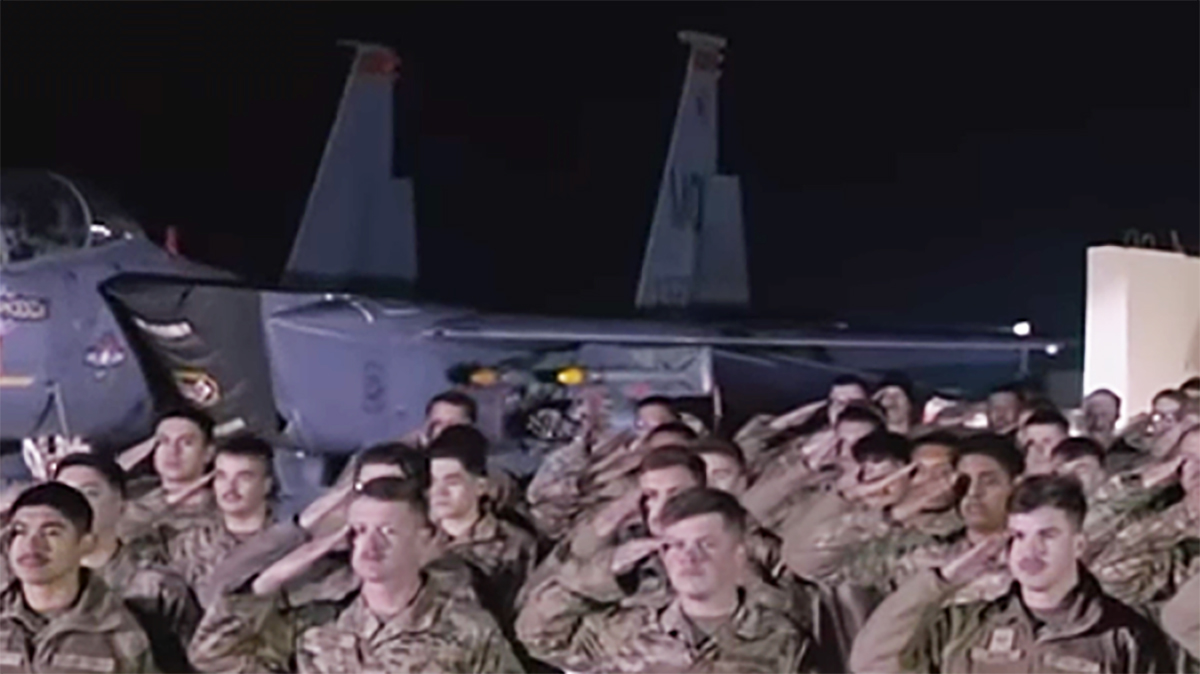
The video shows three F-15Es behind dozens of airmen from the 332nd during the national anthem, which you can see at the 1:37 mark.

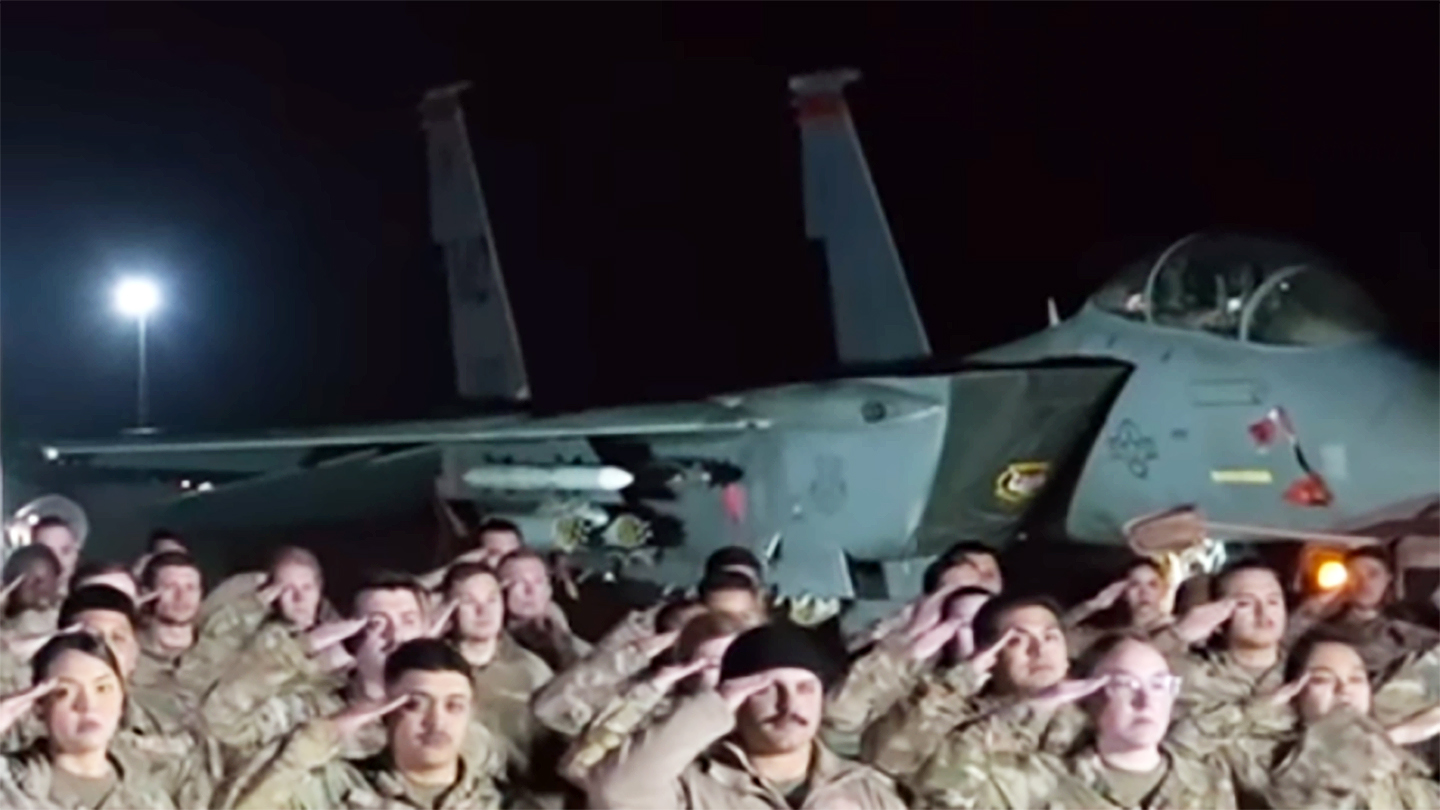
The best view of the APKWS-equipped F-15Es is seen at the 1:23 mark during “America the Beautiful”:

Screen grabs from the video show two of the three Strike Eagles – the ones to the right and left – armed with two seven-shot APKWS pods each on their underwing pylons. AIM-9X and AIM-120 missiles are also mounted on either side of the pylons as is standard for Eagles.
Though F-15Es are world renowned for delivering air-to-ground munitions, in a future war with Iran, defending U.S. bases and large scale long-range attacks on Israel would be at the top of its to do list, as it has in the recent past. These aircraft have borne the brunt of Air Force tactical jet operations in the Middle East over the last decade and F-15E aircrews, especially those based in the UK, have the most experience carrying out this counter cruise missile and drone mission.
After over half a decade of test and development, Air Force F-16 Vipers first began using the rockets operationally in the anti-drone role in 2024, which TWZ was first to report, and that capability was since extended to F-15Es and A-10 Warthogs. You can read more about the importance of these rockets against drones in our story here.
Back in May of 2025, we reported on the emergence of an image of a Strike Eagle down-range in the Middle East with an air-to-air loadout that included six seven-shot 70mm rocket pods, as well as four AIM-9X and four AIM-120 missiles. This marked the beginning of laser-guided rockets as an operational air-to-air weapon for the F-15E community.
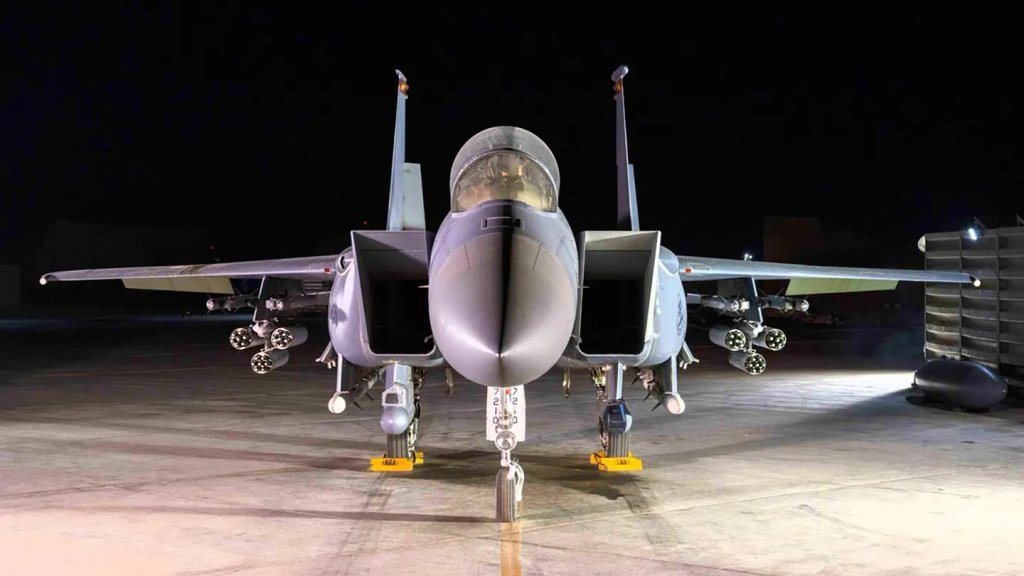
Being armed with these comparatively inexpensive munitions drastically increases the F-15E’s magazine depth, allowing them to engage many aerial targets without rearming. This was an issue that came up last April during the massive Iranian missile and drone barrage against Israel in which Muwaffaq Salti-based F-15Es downed a large number of Iranian drones. With a full load of missiles and rockets, an F-15E can engage up top a whopping 50 aerial targets (42 rockets and eight missiles), and that is without using the gun.
As noted earlier, showing F-15Es in the Middle East during the Super Bowl came as Muwaffaq Salti has become a large hub of the U.S. buildup in the region. Over the past few weeks, the base saw an influx of an additional 12 F-15E Strike Eagles from the 494th Expeditionary Squadron at Lakenheath Air Base in the U.K. The 494th was the squadron that shot down numerous Iranian drones during Tehran’s barrage against Israel last April.
That unit joins two other F-15E units, one from Seymour Johnson Air Force Base in North Carolina and one from Mountain Home Air Force Base in Idaho, that were already at Muwaffaq Salti. As we have previously reported, there are also at least a dozen A-10 close support jets at the base, along with MQ-9 Reapers and other assets. A contingent of EA-18G Growlers also arrived there recently, transferring from their forward station in Puerto Rico.
Now it appears that six F-35A stealth fighters from the Vermont Air National Guard (VANG) may be headed there as well. Online flight trackers show the jets left Vermont today, headed for Lakenheath, which is a hub for transits to the Middle East.
Those jets had been deployed to the Caribbean and took part in the mission to capture Venezuelan dictator Nicolas Maduro. Another six F-35s from VANG had diverted to the U.S. base in Rota, Spain, after a KC-46 Pegasus aerial refueling tanker suffered a mishap at Moron Air Base in Spain. It isn’t clear if or when those aircraft will relocate to the Middle East.
All these flights are in addition to well over 100 cargo jets that have delivered air defense systems and other war material to the Middle East over the past few weeks.
It remains unknown what, if any action, U.S. President Donald Trump will order against Iran. He first threatened military action against Tehran as its crackdown against anti-regime protestors resulted in thousands of killings.
The U.S. and Iran are still working to determine what, if any, follow-up there will be between the countries that held negotiations in Oman last week. On Sunday, Trump said the U.S. and Iran had “very good talks” in Oman and “claimed the Iranian position is more favorable regarding a nuclear deal than it was before the 12-day war last June,” Axios reported.
On Wednesday, Trump is scheduled to meet with Israeli Prime Minister Benjamin Netanyahu at the White House. Israel, a huge wild card in this situation, has been urging the U.S. to strike Iran over its nuclear ambitions as well as its stockpile of thousands of ballistic missiles.
Amid the tension, the U.S. has publicly highlighted its growing force in the Middle East while Iran has countered that with videos, images and statements about its ability to inflict severe harm to U.S. forces and bases in the region as well as Israel.
The appearance of F-15Es during one of the world’s most highly viewed events may be another part of this cycle.
Contact the author: howard@thewarzone.com
Loading comments…
Comments couldn’t be loaded. Please refresh the page.