

A small U.S. Army quadcopter carrying a Claymore mine recently knocked down another small uncrewed aerial system in a test. This comes as drone-on-drone combat is now a daily occurrence in Ukraine, where it is also driving a steady cycle of new developments. For the Army, the Claymore-armed drone, which could also be used against ground targets, has emerged at a time when the service has been facing criticism for being behind the curve on global trends.
The Army released a video of the air-to-air drone combat demonstration on social media today. Members of the 173rd Airborne Brigade Combat Team, the Pennsylvania Army National Guard, and the Army Combat Capabilities Development Command’s Armaments Center (DEVCOM AC) “made history” with the test at Fort Rucker in Alabama earlier this month, according to one post on X. The event was tied to broader work DEVCOM AC has been doing on small weaponized drones as part of an effort called Project Shank.
From the available imagery, it is not immediately clear how the Claymore was attached to the quadcopter or what kind of firing mechanism was used. The operator controlling the drone appears to have manually detonated the mine after maneuvering very close to the target.
First developed in the 1950s, the Claymore is a directional anti-personnel landmine designed to be emplaced on the ground and triggered via tripwire or a manual detonator. The mine’s explosive charge then propels approximately 700 steel ball bearings in a cone-shaped pattern out to an effective range of around 820 feet (250 meters).

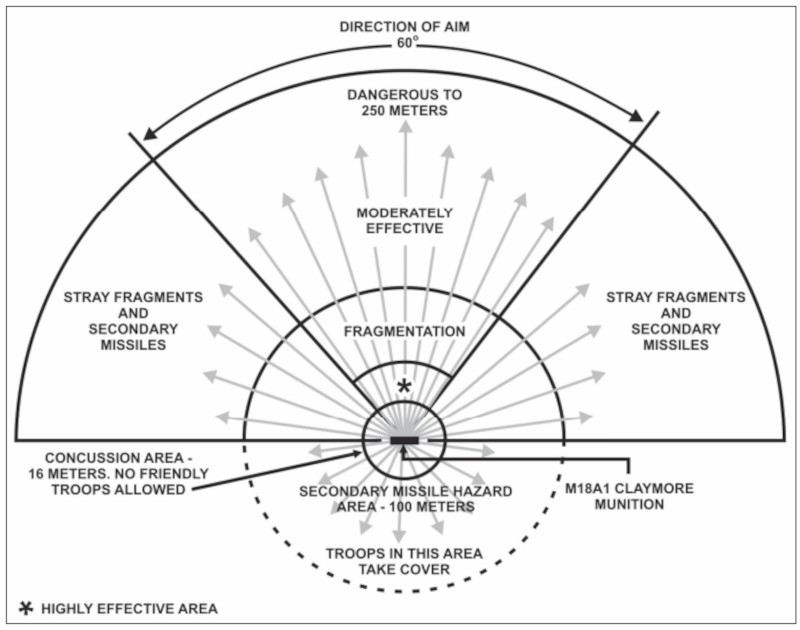
The Claymore is a logical choice of weapon for this kind of very-low-end air-to-air combat. The mine’s blast pattern would help when engaging small and highly maneuverable targets.
Videos of drone-on-drone engagements from Ukraine show that manual intercepts can be challenging to prosecute. Russian forces, in particular, have begun installing rear-facing cameras to help spot incoming threats so that evasive action can then be taken. There are also reports that some form of automated collision detection capabilities may be in use to try to help escape interception.
Just recently, a picture also emerged showing a Russian Supercam S350 surveillance drone with the silhouette of a bird painted on top operating over Ukraine. This could be driven by concerns about the potential use of automated target recognition capabilities to help with interceptions. Russia has already been observed using silhouettes and other tactics intended to confuse image-matching seekers to protect aircraft at air bases, as well as naval vessels in port and at sea. The bird silhouette could also just be a questionable attempt at visual camouflage.
A Claymore mine-armed quadcopter could also be used against ground targets, including personnel and light-skinned vehicles. The drone would have the added benefit of being able to get around certain forms of hard cover or navigate its way inside buildings. Depending on how the Claymore is mounted, the drone might be able to conduct top-down attacks, which can be especially effective against dug-in targets or large area ones out in the open.
Overall, the Army’s recent air-to-air drone-on-drone test is another example of the service’s ongoing efforts to develop and field weaponized uncrewed aerial systems, especially to smaller units. Claymore-armed quadcopters could offer another layer of more localized defense against low-end threats as a complement to other counter-drone capabilities in Army service today, including purpose-built drone-like Coyote interceptors.
At the same time, the test also highlights how the U.S. military as a whole continues to lag behind global trends in this regard. Just last month, the Army faced immense criticism with another round of social media posts, which were subsequently deleted, touting the testing of quadcopters dropping hand grenades. This is something the service has been experimenting with for years now, not to mention the routine use of drones to drop small munitions in Ukraine, as well as in an expanding number of other hot spots globally.
It is also important to stress that the growing threats posed by various tiers of drones, including weaponized commercial types, predate the war in Ukraine, a reality TWZ has been calling attention to for the better part of a decade now. Non-state actors, as well as nation-state armed forces, have been taking advantage of the low bar to entry when it comes to uncrewed aerial systems. Drone developments, broadly speaking, look to be on the verge of a major evolution, if not a revolutionary moment, thanks in large part to increasingly accessible advances in artificial intelligence and machine learning, as you can read more about in this past feature.
This, in turn, has been driving new demand for a slew of counter-drone capabilities to protect forces on battlefields, as well as critical assets and facilities far from them. This is another key area where the U.S. military continues to very much be playing catchup.
In July, the Pentagon took a new and important step forward with the rollout of a host of major policy changes intended to help actually field operational drone capabilities on a broader level across the Army and the rest of the U.S. military. Getting weaponized uncrewed aerial systems into the hands of smaller units is a major focus of this new “Unleashing U.S. Military Drone Dominance” initiative, which you can read more about here.
“Drones are the biggest battlefield innovation in a generation, accounting for most of this year’s casualties in Ukraine. Our adversaries collectively produce millions of cheap drones each year,” Secretary of Defense Pete Hegseth wrote in a memo kicking off the initiative. “While global military drone production skyrocketed over the last three years, the previous administration deployed red tape. U.S. units are not outfitted with the lethal small drones the modern battlefield requires.”
“Drone technology is advancing so rapidly, our major risk is risk-avoidance,” that memo added. “The Department’s bureaucratic gloves are coming off.”
The newly disclosed demonstration of the Claymore-armed drone, as well as the recent grenade-dropping experiments, do present stepping stones to meeting the Pentagon’s current stated goals. Still, the Army needs to make sure it breaks out of the past cycle of seemingly endless testing.
Contact the author: joe@twz.com
Loading comments…
Comments couldn’t be loaded. Please refresh the page.