
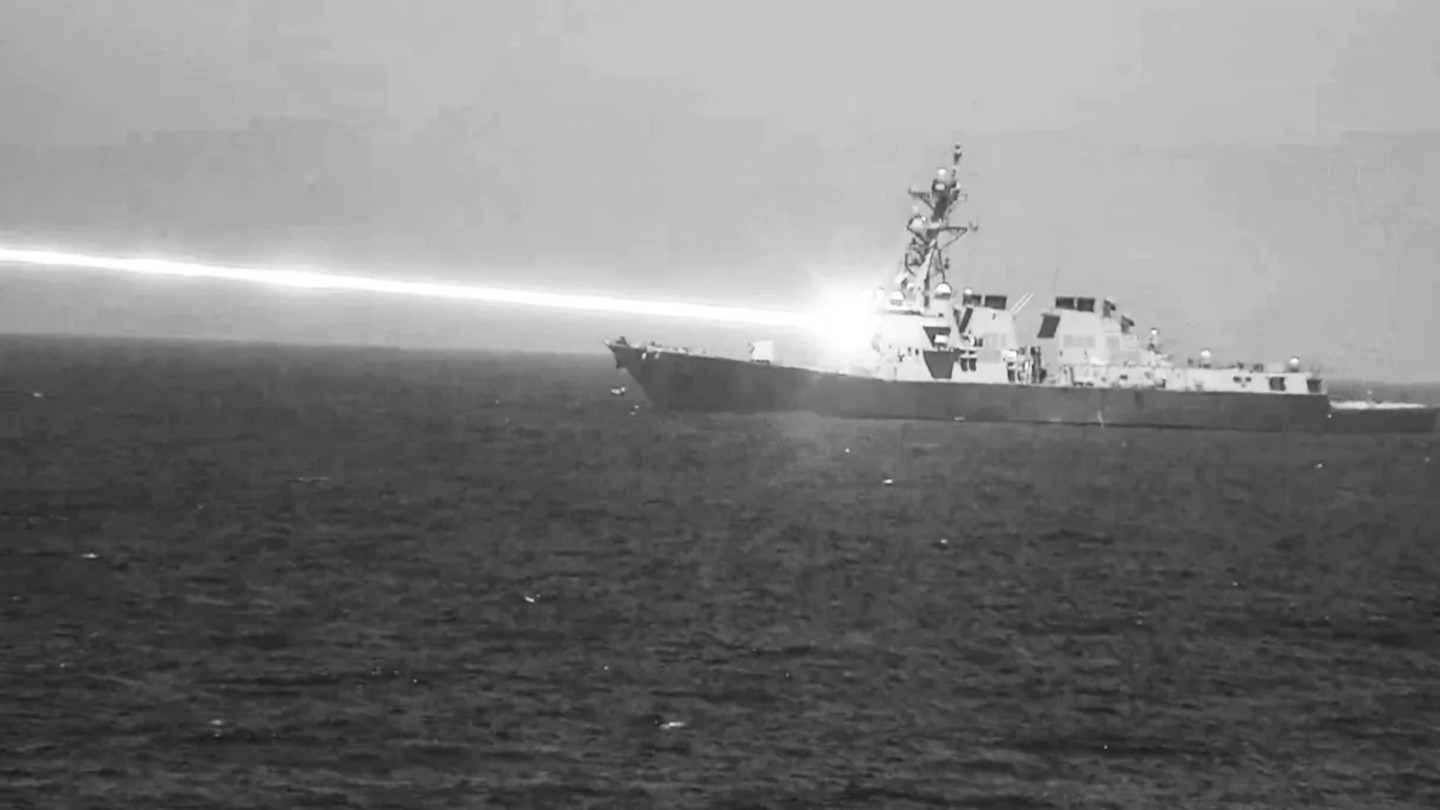
The U.S. Navy’s Arleigh Burke class destroyer USS Preble used its High-Energy Laser with Integrated Optical Dazzler and Surveillance (HELIOS) system to down four drones in a demonstration last year, Lockheed Martin has shared. Earlier this month, the Navy’s top officer said his goal is for directed energy weapons to become the go-to choice for warship crews when it comes to defending against close-in threats. However, the service has continued to face significant hurdles in fielding operational laser weapon systems.
“Speaking of amazing technology, we successfully used a shipboard laser system, Lockheed Martin’s HELIOS, to knock an incoming UAV [uncrewed aerial vehicle] right out of the sky,” the company’s CEO Jim Taiclet said during a quarterly earnings call last week. “The HELIOS weapon system successfully neutralized four drone threats in a U.S. Navy-operated counter-UAS [uncrewed aerial systems] demonstration at sea, showcasing an opportunity to eliminate drone attacks using lasers, and saving U.S. and allied air defense missiles for more advanced threats.”

TWZ reached out to Lockheed Martin, the prime contractor for HELIOS, for more information and was directed to comments from Navy Vice Adm. Brendan McLane at the Surface Navy Association’s (SNA) annual symposium in January. McLane is the commander of Naval Surface Force, U.S. Pacific Fleet. As the Navy’s top surface warfare officer, he is also often referred to by the title SWOBOSS.
“The Surface Navy has a rare opportunity with leadership aligned on delivering lethality, capability, and capacity at speed. As an enterprise, we must continue to think big as we develop the future platforms within the world. We must lay the foundations for the systems on those ships now so that they deliver on their promise to the American people,” McLane had said at the SNA conference. “Continued iteration with USS Preble’s HELIOS laser weapons system is another example of this. Last fall, successful at-sea testing paved the way for future laser weapons systems. We need to continue on this path. I am committed to advancing laser technology to the fleet. The dream of a laser on every ship can become a real one.”
TWZ has also reached out to the Navy for more information.
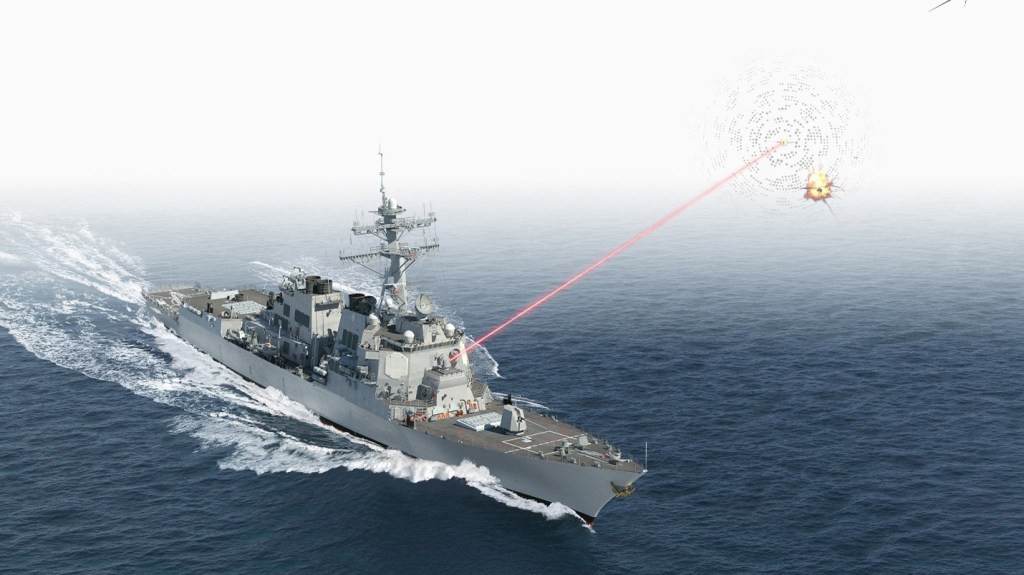
HELIOS, which also carries the designation Mk 5 Mod 0, is a 60-kilowatt-class laser directed energy weapon designed to be powerful enough to destroy or at least damage certain targets, such as drones or small boats. As its name indicates, it has a secondary function as a ‘dazzler’ to blind optical sensors and seekers, which could also be damaged or destroyed in the process. In the past, Lockheed Martin has talked about potentially scaling HELIOS’ power rating up to 150 kilowatts.
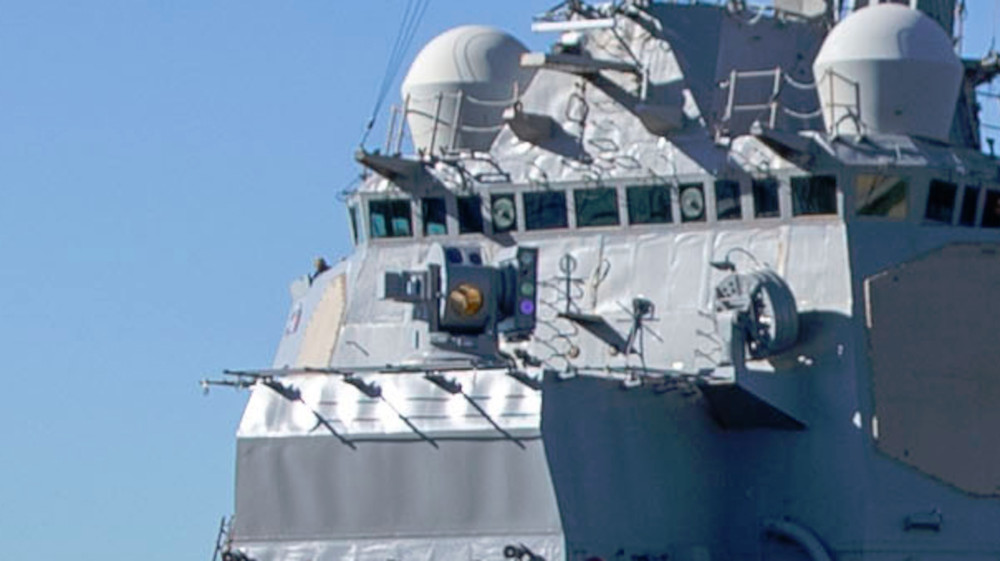
HELIOS has been integrated on Preble since 2022, and is currently the only Navy ship equipped with the system. Several other Arleigh Burke class destroyers have received lower-powered Optical Dazzling Interdictor (ODIN) laser systems. The Navy has installed more experimental high-energy laser directed energy weapons on other ships in the past.

Preble successfully downed at least one drone using HELIOS in a previous test in 2024. That milestone was disclosed in an annual report from the Pentagon’s Office of the Director of Operational Test and Evaluation (DOT&E) released in January 2025.
A multi-target scenario is a logical evolution in the demonstration of HELIOS’ capabilities. The Navy’s experiences during operations in and around the Red Sea in the past few years have underscored the challenges defenders face at sea and on land when responding to large volume drone attacks. Uncrewed aerial systems layered in with other threats like anti-ship ballistic and cruise missiles present even more complexities. The potential for traditional air defense capabilities to be overwhelmed is real. The level of complexity will only increase as artificial intelligence and machine learning-driven capabilities, including automated targeting and fully networked swarming, keep proliferating globally.
Laser directed energy weapons like HELIOS offer functionally unlimited magazine depth, as long as there is sufficient power and cooling capacity. As Lockheed Martin’s Taiclet noted last week, lasers also offer a way to conserve traditional surface-to-air missiles for use against targets that they might be better optimized against. That is particularly valuable for ships operating in areas where opportunities for rearming may be extremely limited and/or force them to leave their assigned station for an extended period of time.
This all presents cost benefits, too. As an example, the latest versions of the RIM-116 Rolling Airframe Missile (RAM), used for point defense on many Navy ships, each cost around $1 million.

Many warships across the Navy are also equipped with Mk 15 Phalanx Close-In Weapon Systems armed with six-barreled 20mm M61 Vulcan rotary cannons, but the ammunition for those weapons is not unlimited, either. Each Phalanx has enough ammunition to fire for a total of around 30 seconds, at most, at the lower of two rate-of-fire settings, before needing to be reloaded. Many ships across the Navy also have a mixture of other guns, including 5-inch or 57mm main guns, as well as 25mm or 30mm automatic cannons, all of which can also be used against close-in threats.

There are still significant questions about the demonstration last fall, including how rapidly the USS Preble was able to shift HELIOS from one target to another and how long it took each one to be effectively neutralized. The proximity of the drones to the ship and what kinds of profiles they were flying are also unknown.
A single laser can only engage one target at once. As the beam gets further away from the source, its power also drops, just as a result of it having to propagate through the atmosphere. This can be further compounded by the weather and other environmental factors like smoke and dust. More power is then needed to produce suitable effects at appreciable distances. Adaptive optics are used to help overcome atmospheric distortion to a degree. Altogether, laser directed energy weapons generally remain relatively short-range systems.
In addition, laser directed energy weapons, especially sensitive optics, present inherent reliability challenges for use in real-world military operations. Shipboard use adds rough sea states and saltwater exposure to the equation. There is also the matter of needing to keep everything properly cooled, which creates additional power generation and other demands.
Despite the hurdles, the U.S. Navy, as well as other navies globally, have continued to pursue laser directed energy weapons, as well as high-power microwaves, because of the capabilities they promise to offer in the face of an ever-expanding drone and missile threat ecosystem. HELIOS and ODIN both feature prominently in the design of the Navy’s future Trump class “battleships.” There has been talk already about the potential for expanding that directed energy arsenal to include lasers with megawatt-class power ratings.
“You know, we have continuous electron beam, free electron lasers today that can scale to megawatt-plus, gigawatt-plus [power ratings],” Navy Adm. Daryl Caudle, Chief of Naval Operations, told TWZ and other outlets at the Surface Navy Association’s (SNA) annual symposium last month. “I’m telling you that I don’t think a one-megawatt laser is beyond what should be on that battery [on the Trump class].”
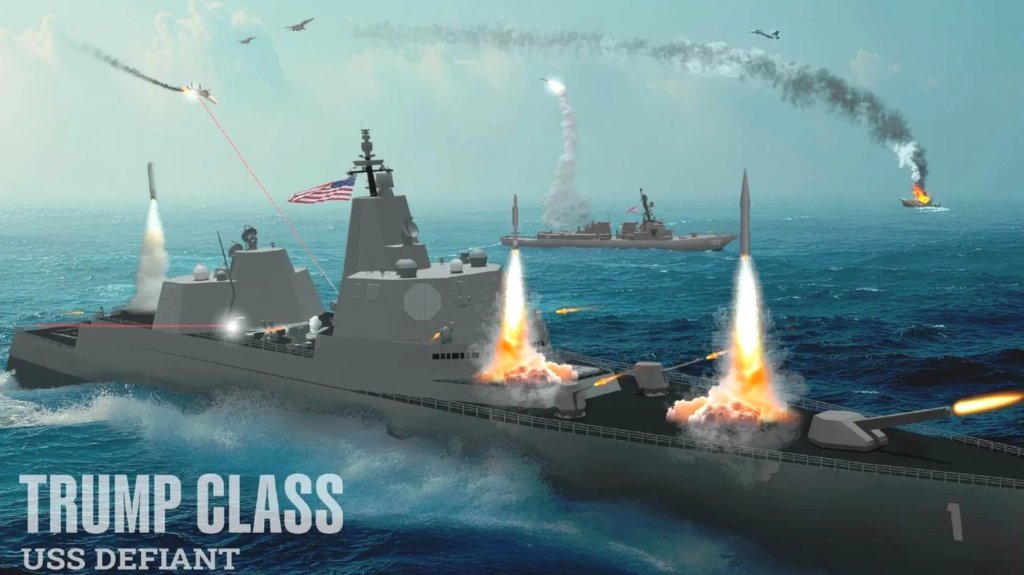
Beyond the Trump class, “this is my goal, if it’s in line of sight of a ship, that the first solution that we’re using is directed energy,” Caudle also said. “Point defense needs to shift to directed energy. It has an infinite magazine.”
“What that does for me is it improves my loadout optimization, so that my loadout, my payload volume is optimized for offensive weapons,” the Navy’s top officer added. Furthermore, “as you increase power, the actual ability to actually engage and keep power on target, and the effectiveness of a laser just goes up.”
Challenges to the Navy’s directed energy future clearly still remain. In speaking last month, Caudle was optimistic for the future, but he has been open about difficulties in the past. At the SNA symposium in 2025, the admiral, then head of U.S. Fleet Forces Command, said he was “embarrassed” at the state of his service’s directed energy weapon developments.
“I am not content with the pace of directed energy weapons,” Vice Adm. McLane had also said back in 2024. “We must deliver on this promise that this technology gives us.”
This is reflective of broader difficulties that all branches have faced in the development and fielding of laser directed energy weapons, in particular, for use in the air and on the ground, as well as at sea, as you can read more about here.
What we do know is that the Navy continues to use the USS Preble to prove out the HELIOS system, including with the recently disclosed demonstration of its drone-zapping capabilities last fall.
Contact the author: joe@twz.com
Loading comments…
Comments couldn’t be loaded. Please refresh the page.