

The U.S. Navy’s top officer wants directed energy weapons to become the go-to choice for the crews of American warships when faced with close-in threats. He also said that more powerful megawatt-class lasers should not be seen as “beyond” the capabilities that could be found on the future Trump class warships. The Navy has been a leader within the U.S. military in fielding laser weapons and is actively pursuing systems that employ high-power microwaves, but there continue to be significant hurdles to these efforts.
Chief of Naval Operations Adm. Daryl Caudle talked with TWZ and other outlets about his service’s directed energy weapon plans at a roundtable at the Surface Navy Association’s (SNA) annual symposium earlier today. Caudle has long been an outspoken proponent of directed energy capabilities.

“My thesis research at [the] Naval Post Graduate School was on directed energy and nuclear weapons,” Caudle said. “This is my goal, if it’s in line of sight of a ship, that the first solution that we’re using is directed energy.”
In particular, “point defense needs to shift to directed energy,” the admiral added. “It has an infinite magazine.”
When it comes to point defense for its ships, the Navy currently relies heavily on Mk 15 Phalanx Close-In Weapon Systems armed with six-barrel 20mm M61 Vulcan rotary cannons and launchers for RIM-116 Rolling Airframe Missiles (RAM). Each Phalanx has enough ammunition to fire for a total of around 30 seconds, at most at the lower of two rate-of-fire settings, before needing to be reloaded. RAM launchers available today can hold either 11 or 21 missiles at a time, and the latest versions of those missiles cost around $1 million each. Many ships across the Navy also have 5-inch or 57mm main guns, and/or 30mm automatic cannons, which can also be used against close-in threats.


Recent Navy experience during operations in and around the Red Sea has underscored the value of magazine depth and concerns about expenditure rates of traditional munitions.
“What that does for me is it improves my loadout optimization, so that my loadout, my payload volume is optimized for offensive weapons,” Caudle said of adding new directed energy weapons, and lasers in particular. Furthermore, “as you increase power, the actual ability to actually engage and keep power on target, and the effectiveness of a laser just goes up.”
To date, the plurality of the Navy’s available shipboard directed energy weapon capabilities are split between two systems: the Optical Dazzling Interdictor (ODIN) and the High-Energy Laser with Integrated Optical Dazzler and Surveillance (HELIOS). ODIN and HELIOS systems are currently installed on a number of Arleigh Burke class destroyers.
HELIOS is a 60-kilowatt class design, which is powerful enough to destroy or at least damage certain targets, such as drones or small boats. Its beam can also be used as a ‘dazzler’ to blind optical sensors and seekers. Those same optics could be damaged or destroyed in the process, as well. Manufacturer Lockheed Martin has talked in the past about the possibility of scaling HELIOS’ power up to 150 kilowatts.
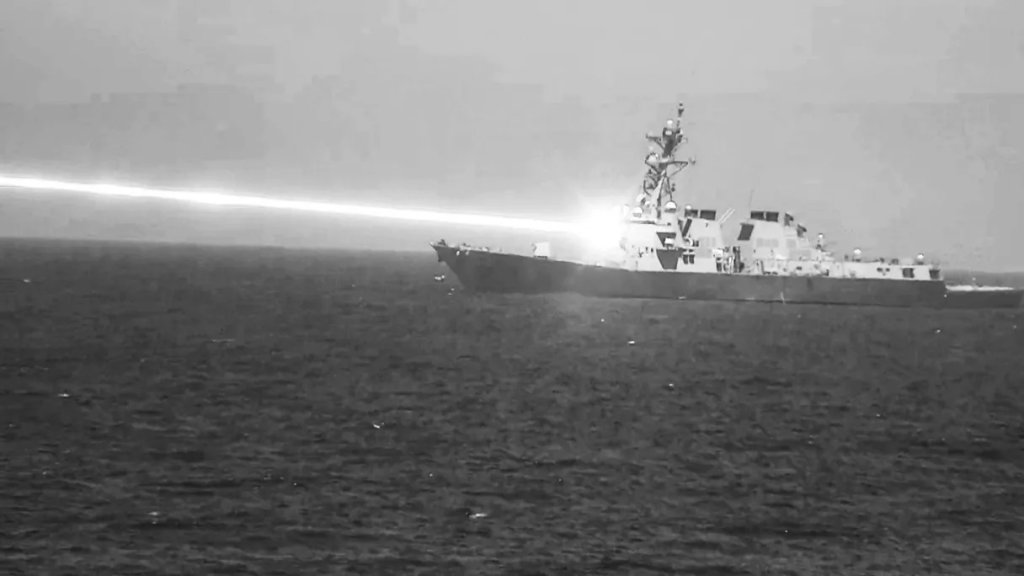
The exact power-rating for ODIN is unclear, but it is understood to be lower than that of HELIOS. ODIN can only be employed as a ‘dazzler,’ though the system also has a secondary surveillance capability.

The Navy has tested more experimental laser directed energy weapons on other warships in the past. The most recent known example of this was the integration of a 150-kilowatt design called the Laser Weapon System Demonstrator (LWSD) Mk 2 Mod 0 onto the San Antonio class amphibious warfare ship USS Portland in 2019. The LWSD Mk 2 Mod 0 has since been removed from that ship. The Navy just released a picture yesterday showing it at the Naval Surface Warfare Center, Port Hueneme Division’s (NSWC PHD) Directed Energy Systems Integration Laboratory (DESIL) at Naval Base Ventura County at Point Mugu in California.


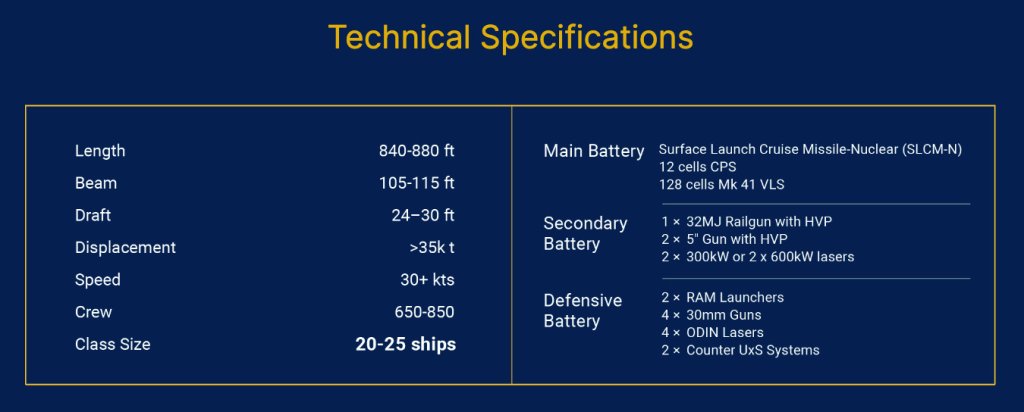
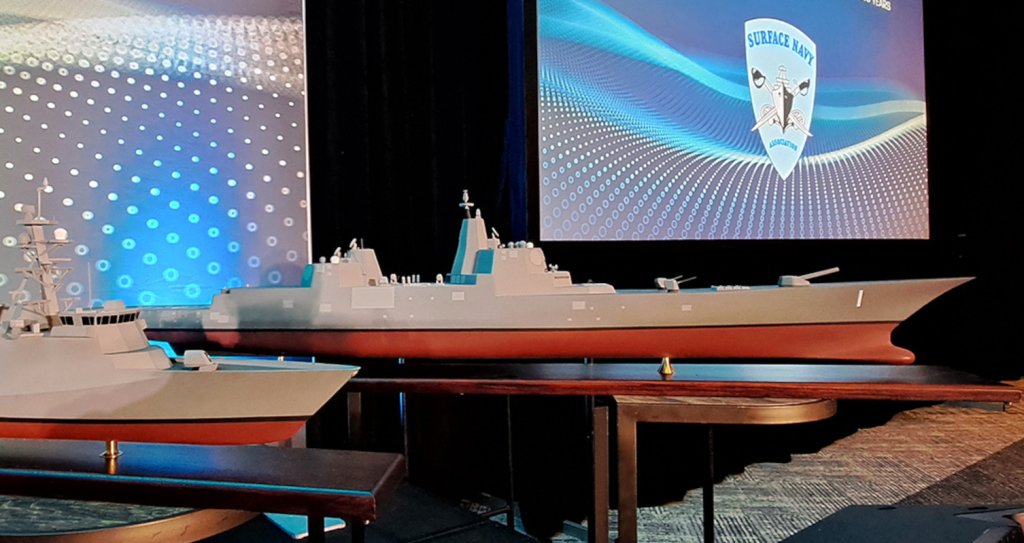
Higher-powered laser directed energy weapons in the 300 to 600 kilowatt classes are also in the Navy’s publicly stated plans, with a focus on improving shipboard defense against incoming cruise missiles. The service has said that each one of the future Trump class large surface combatants could be armed with two 300-kilowatt lasers, as well as a pair of 600-kilowatt types, along with four ODINs. It’s also worth noting here that the Navy has not ruled out using nuclear propulsion on these ships, which could help meet power generation requirements. You can read more about what is known about the design of those ships here.
“You know, we have continuous electron beam, free electron lasers today that can scale to megawatt-plus, gigawatt-plus” power-ratings, Caudle noted today. “I’m telling you that I don’t think a one-megawatt laser is beyond what should be on that battery [on the Trump class].”
A megawatt is 1,000 kilowatts, meaning a weapon in that category would be exponentially more powerful than HELIOS. A gigawatt is 1,000 megawatts. Megawatt-class laser weapon developments have historically focused in large part on the ballistic missile defense mission set.
“We were heavy into this with the Strategic Defense Initiative,” Caudle said, referring to the abortive Cold War-era missile defense program, also nicknamed “Star Wars,” which began under President Ronald Reagan. “We were really into high powered lasers, and we just basically – there was no business case for people to be out there working [on it] … so I don’t think we devoted the actual industrial might and the brain power across academia and think tanks and other places that generate this type of outcome toward directed energy in an effective way, so that we have taken it seriously. So now’s the time.”

“We’ve got to have different lasers, I think, going forward on the battleship to make them effective,” the Navy’s top officer added. “Laser power is not the issue. It’s the form factor. It’s the engineering of the power to get the density of that in a shipboard design. That’s the challenge.”
Caudle did highlight other ongoing hurdles facing laser directed energy weapon developments at the roundtable today.
“The targeting is always a challenge when you’re in a high-moisture environment, because the optics are critical to lasers,” he noted. Lasers are sensitive to various environmental factors that can break up a beam and reduce its effectiveness.
The beam’s power also drops as it gets further away from the source, just as a result of propagating through the atmosphere. More power is then required to generate effects at greater distances. Just ensuring the reliability of laser directed energy weapons with their sensitive optics is a challenge that is further magnified in a shipboard context by saltwater exposure and rough sea states. All of this, combined with the thermal cooling and power demands, have challenged the U.S. military’s ability to field directed energy weapons at greater scale at sea, as well as on land and in the air.
As Caudle highlighted today, the capabilities that laser weapon systems promise to offer are in high demand for ships amid ever-growing drone and missile threats. Advanced warships, particularly large ones like the Trump class, may be heavily protected, but are also high-value targets. As such, having added layers of defense with largely unconstrained magazine depth – as long as there is sufficient power and cooling in the case of direct energy weapons – would be advantageous.
“These things are based on renewable energy, so I can recharge the system … I don’t have to worry about payload [or] volume with directed energy,” Caudle, then commander of U.S. Fleet Forces Command, said at last year’s SNA conference. “All those things are appealing to a navy, [but] we just haven’t really matriculated that into a place … that’s ready for prime time.”
He added then that the Navy should have been “embarrassed” about the progress it had made by that point, or the lack thereof, in fielding directed energy capabilities.
As mentioned, the development of high-powered microwave directed energy weapons is another area where the Navy has been making major investments. The main focus of those projects is again on expanding shipboard defense against incoming cruise missiles, as well as drones. In line with Caudle’s comments today, the Navy has previously said its pursuit of microwave-based systems is directly tied to loadout optimization, though in terms of defensive rather than offensive capabilities. The service sees these directed energy weapons as critical to helping warships keep higher-end surface-to-air missiles in reserve for use against threats they might be better optimized for, especially anti-ship ballistic missiles. Of course, directed energy weapons, whether they are laser or microwave-based, could also allow for further remixing of missile loadouts and other changes that would give current and future ships more offensive magazine depth.
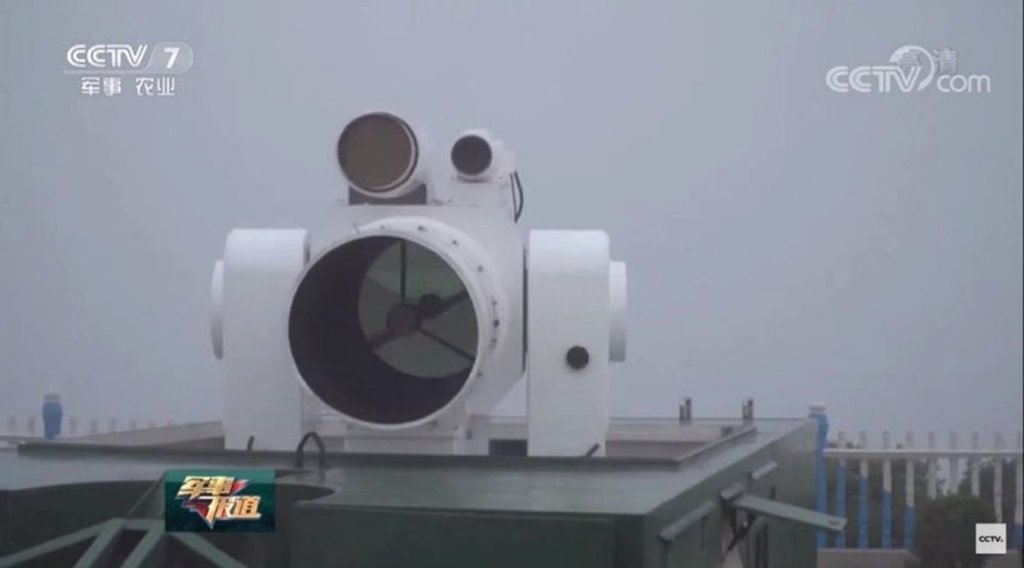
Other armed forces globally, including China’s People’s Liberation Army (PLA), are coming to similar conclusions, and are also actively pursuing directed energy weapon capabilities for shipboard use, as well as for land-based and aerial applications.
“I’ll take what I can get, and then, like anything else, we can evolve that,” the Chief of Naval Operations said today of ongoing work on directed energy weapons.
Whether a megawatt-class laser weapon is added to the arsenal of the future Trump class remains to be seen. The Navy’s top officer has issued a new and clear call to action to put directed energy capabilities front and center when it comes to defending ships against close-in threats like missiles and drones. At the same time, Navy officials have made similar pushes in the past, and there have been persistent challenges in turning that vision into a reality.
Contact the author: joe@twz.com
Loading comments…
Comments couldn’t be loaded. Please refresh the page.