
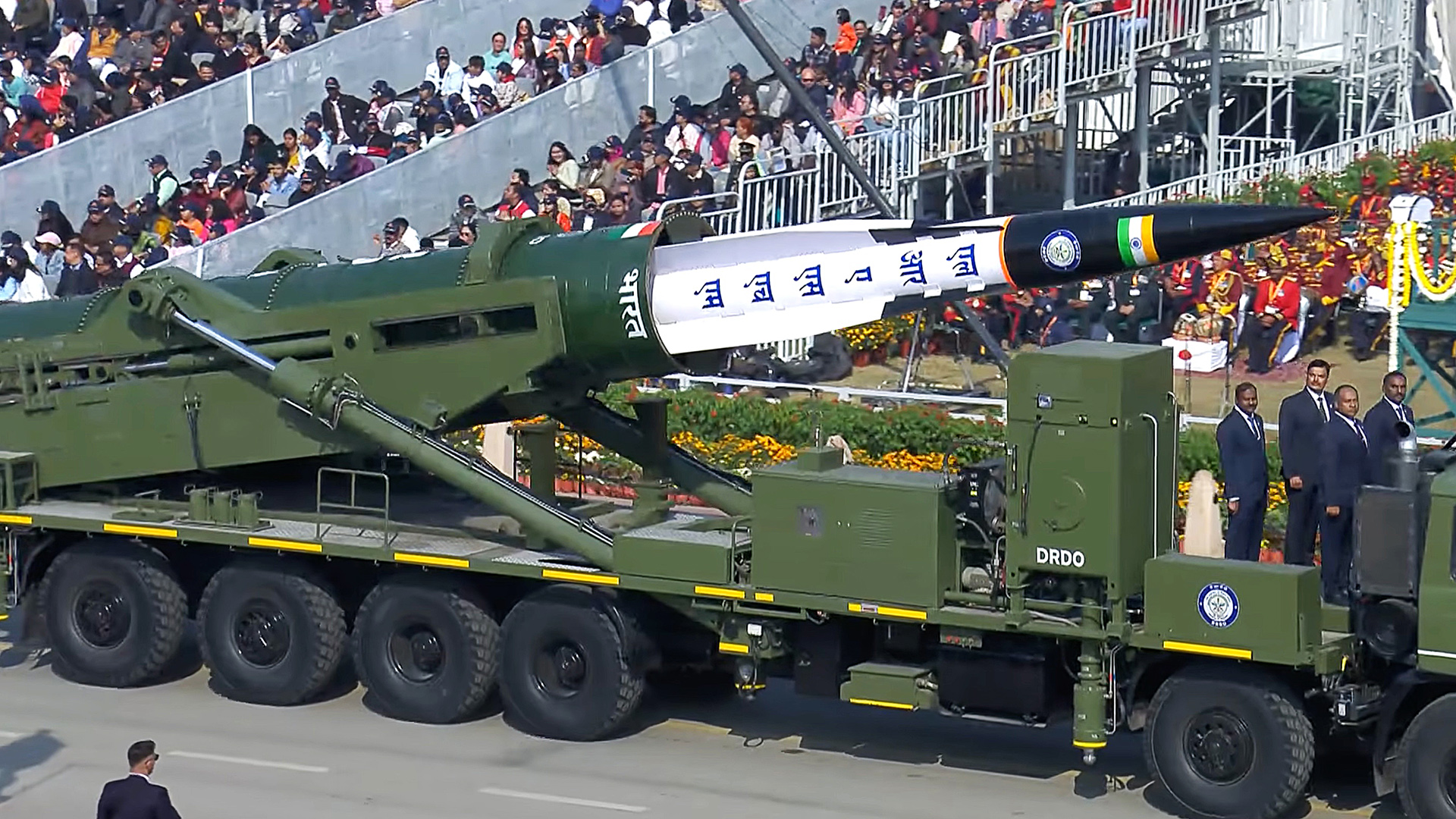
India publicly unveiled what it claims to be its first long-range hypersonic missile today during a display of military power at the country’s 77th Republic Day parade at Kartavya Path in New Delhi. A product of India’s Defense Research and Development Organization (DRDO), the Long-Range Anti-Ship Missile (LR-AShM) is seen as a way of helping keep pace with similar developments in Pakistan, as well as a means to directly counter regional rival China’s ever-growing naval surface fleet.
In New Delhi today, the LR-AShM was paraded on its mobile launcher, based on a 12×12 high-mobility wheeled truck chassis, on which it is intended to be fielded by coastal defense batteries operated by the Indian Navy. Each transporter-erector-launcher (TEL) carries a single missile round in a cylindrical container.

According to the Indian Ministry of Defense, the LR-AShM is designed to carry various payloads for ranges greater than 1,500 kilometers (930 miles).
Based on open-source data, the missile is thought to be around 46 feet long, with a diameter of around 4.6 feet, and a weight of less than 44,000 pounds.
The missile is powered by a two-stage solid propulsion rocket motor. It’s claimed that its final run-in to the target is made at low level, to better avoid ground- and ship-based radars, according to Indian military statements.
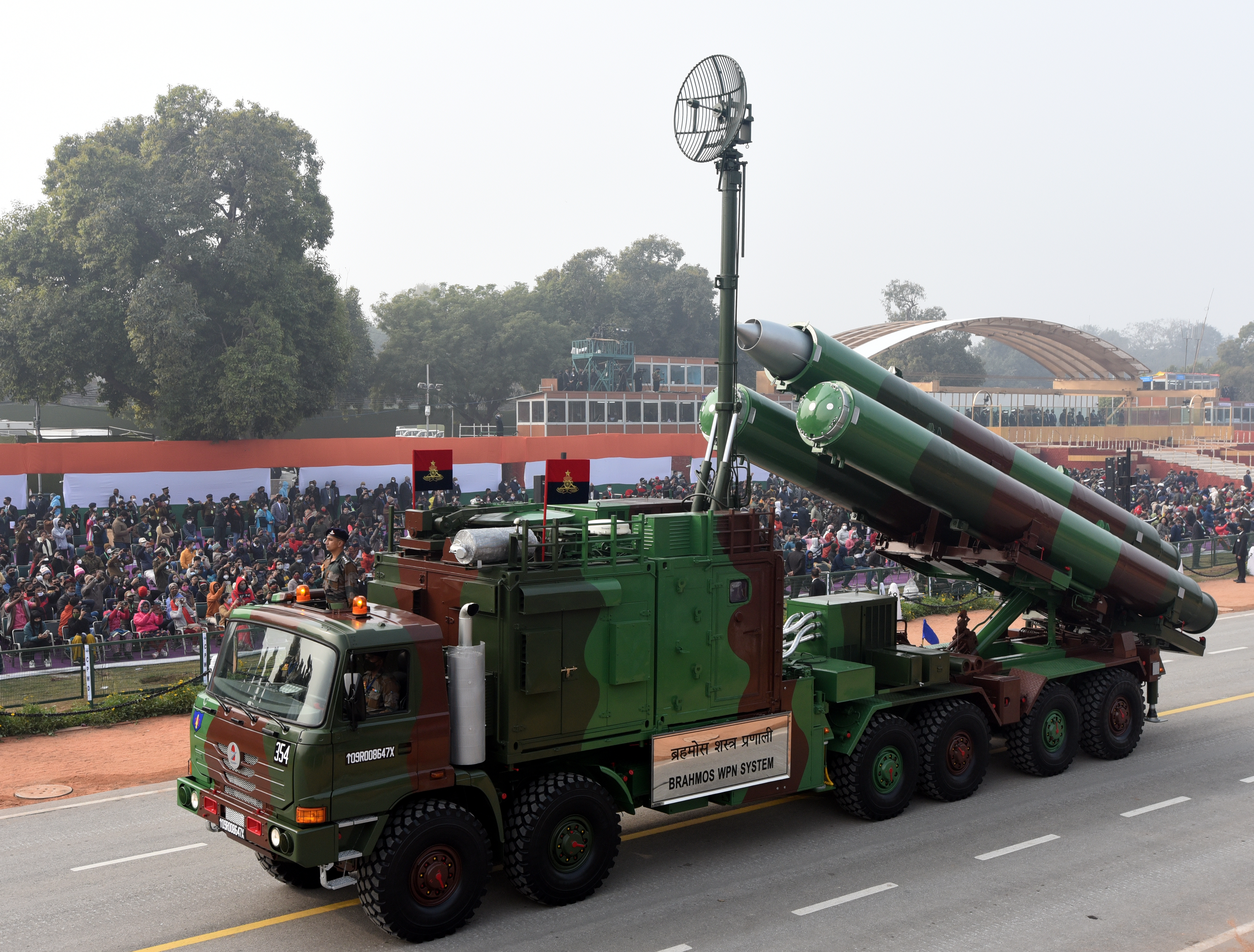
The nature of the guidance system is unclear, but the Indian Ministry of Defense states that it uses locally developed “high accuracy sensor packages” that allow it to hit static and moving targets. Unconfirmed reports suggest that the missile may be fitted with an active radar seeker for the terminal phase, based on technology used in the already-fielded BrahMos supersonic anti-ship missile.
Previously, the LR-AShM has been described as using an unpowered hypersonic glide vehicle (HGV), although there is now some doubt around the accuracy of this assertion.
An HGV works by being propelled to hypersonic speed by a rocket motor, after which it travels unpowered along a relatively shallow atmospheric flight path. HGVs are also designed to have a significant degree of maneuverability, allowing them to erratically change course and climb and descend along the way, something that fits the LR-AShM description. This, together with the HGV’s high speed, presents significant challenges for defenders when it comes to detecting and tracking it, as well as potentially attempting to intercept it or otherwise react to the incoming threat.
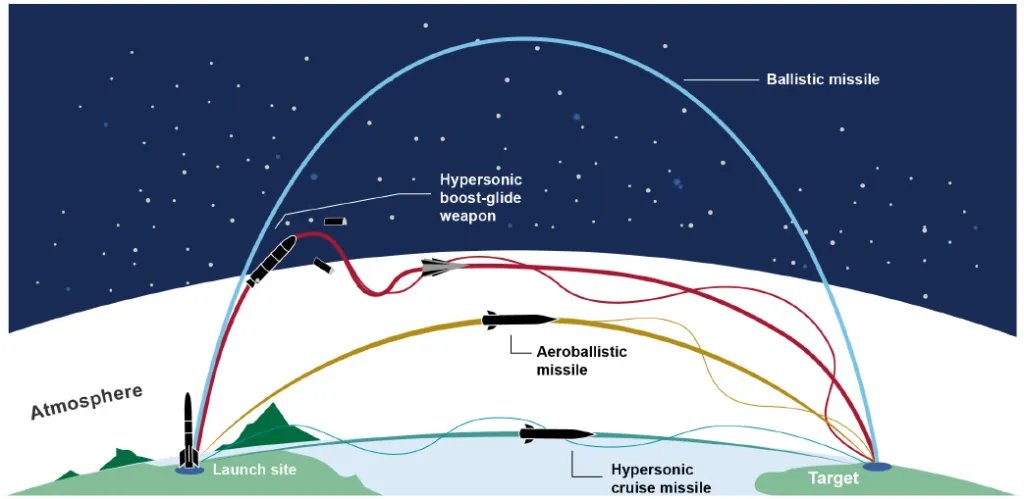
However, based on its appearance, the LR-AShM could be more of a quasi-ballistic missile, propelled to hypersonic speed by a relatively huge booster and then sustained further by its onboard rocket motor. The missile, as shown today and seen in a previous test, lacks the characteristic features of an HGV, including the wedge-shaped lifting body profile typically associated with a weapon of this kind. On the other hand, the large strakes/wings on the missile body do point to an enhanced glide capability.
This kind of missile flies on a quasi-ballistic (rather than a parabolic) trajectory, performing unpredictable, high-speed maneuvers that make it a more challenging target for missile defense systems. Such a “porpoising” or “skip-glide” trajectory involves the weapon abruptly pulling up at least once as it begins the terminal stage of its flight. This kind of maneuver is typically associated with the flight profile of an aero-ballistic missile.
According to the Indian military, the LR-AShM reaches a maximum velocity of Mach 10, while the average speed across the entirety of its flight is around Mach 5, said to be the result of the missile making multiple ‘skips.’ This description would also tally with the LR-AShM being a quasi-ballistic missile.
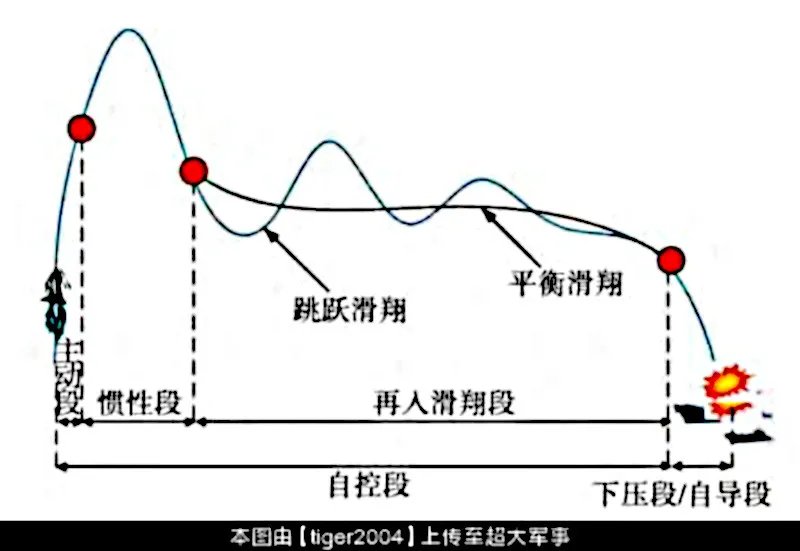
It could be that this weapon combined elements of both weapons categories, acting as a quasi ballistic missile, but possessing additional glide capabilities and enhance maneuverability, while not truly meeting the definition of the hypersonic boost-glide vehicle.
India announced a flight test of the LR-AShM in November 2024. The missile was launched from Dr. APJ Abdul Kalam Island, Odisha, on India’s eastern coast.
“The missile was tracked by various range systems, deployed in multiple domains,” the Indian Ministry of Defense said at the time. “The flight data obtained from down-range ship stations confirmed successful terminal maneuvers and impact with a high degree of accuracy.”
The November 2024 test may have been the second for the LR-AShM.
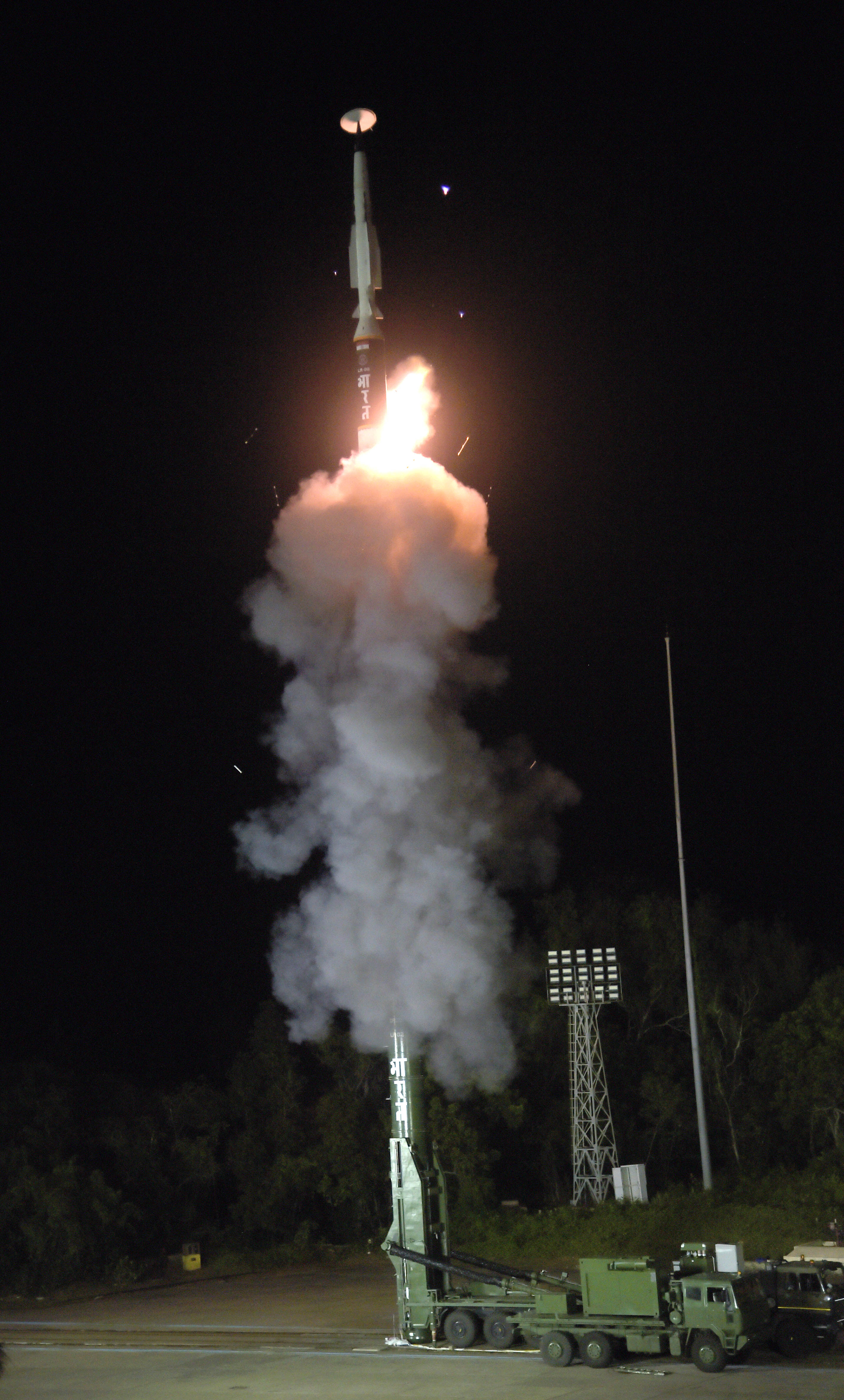
A photo of that test released by the Indian government’s Press Information Bureau showed the missile and the canister marked with ‘LR-02.’ An earlier missile test, in 2023, also involved some kind of long-range anti-ship weapon, possibly also the LR-AShM (which would have been ‘LR-01’).
The current status of the LR-AShM is unknown, with media reports after its November 2024 test noting that “further trials and refinements will be required before the missile is ready for production and deployment.”
The missile was displayed today alongside other high-profile DRDO projects, including the Arjun main battle tank, Nag anti-tank guided missile, and the BrahMos supersonic anti-ship missile, which was developed in collaboration with Russia.
Also significant in terms of its missile capabilities, New Delhi today also published official imagery showing Indian Air Force assets armed with previously unseen weapons.
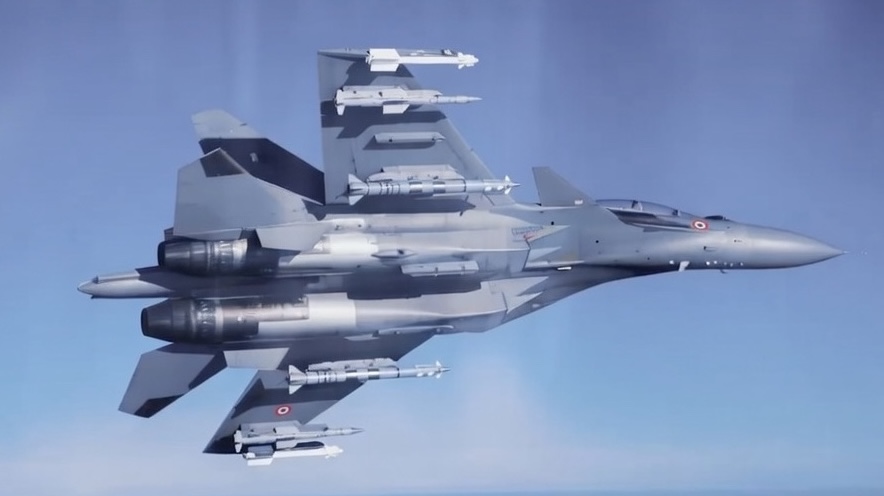
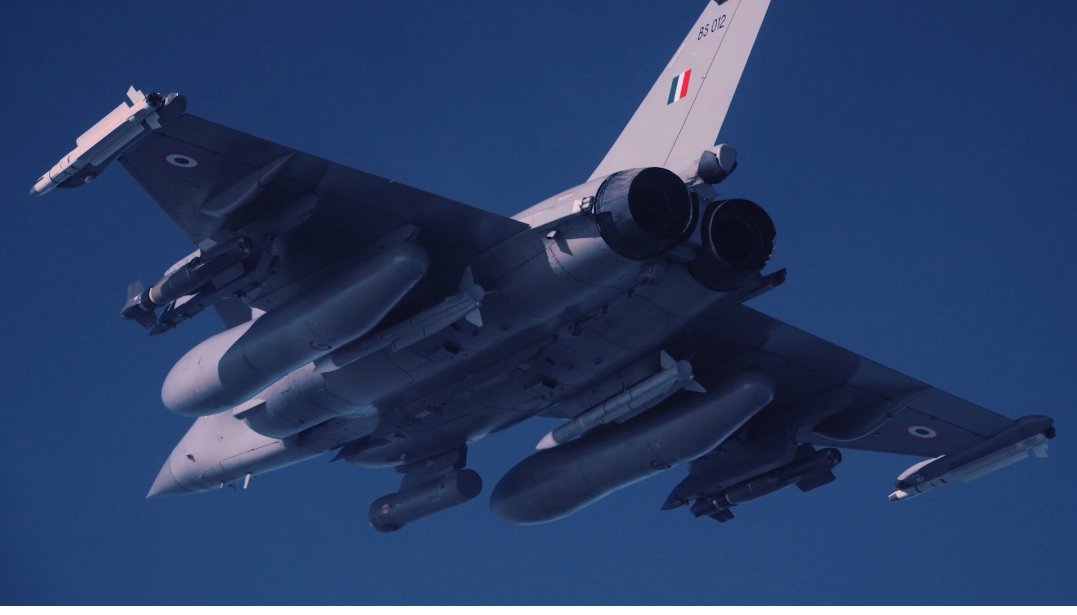
These included a Su-30MKI Flanker armed with locally developed Astra air-to-air missiles and Israeli-supplied Rampage high-speed strike weapons (previously only seen on Indian Navy MiG-29K Fulcrums). A Dassault Rafale was also shown, apparently for the first time, armed with the European-made Meteor beyond-visual-range air-to-air missile. You can read about the air-to-air missiles available to India here.
Returning to the LR-AShM, its appearance today demonstrates that India has likely joined — or is close to joining — an elite club that is equipped with long-range hypersonic missiles. In the past, Indian Minister of Defense Rajnath Singh described the successful testing of this same missile as a “historic achievement.”
India’s efforts in this regard parallel those of other countries, with China and Russia still very much in the lead.
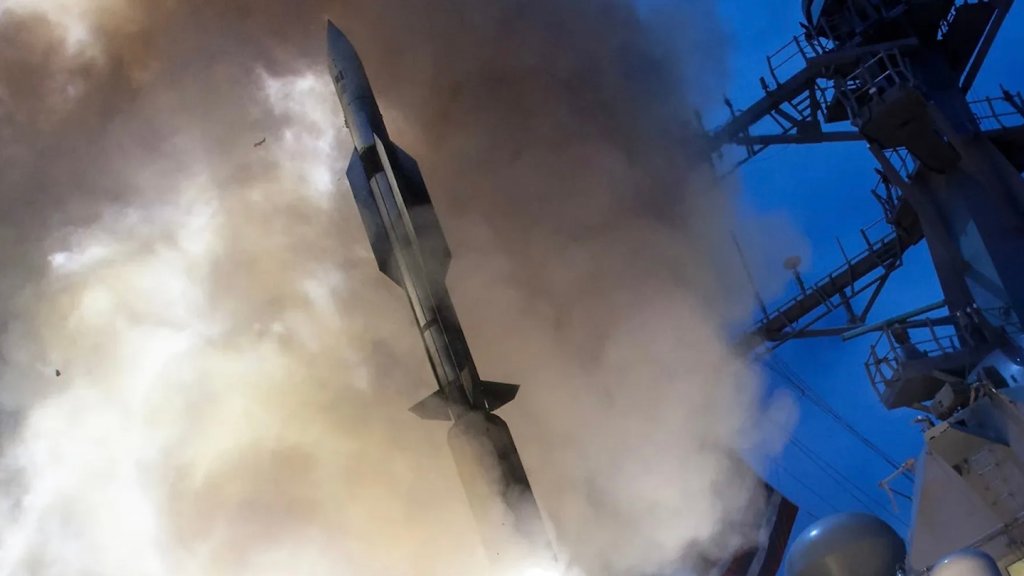
Looking to the future, India is reportedly looking at developing a version of the LR-AShM to arm surface combatants, which would match developments in China and Russia, both of which have already fielded (or claim to have fielded, in the case of Russia) ship-launched hypersonic missiles. The U.S. Navy does have access to the SM-6, which can be used in an anti-ship role and which has hypersonic or near-hypersonic capability; however, it was developed as an air-defense weapon. In the near future, the U.S. Navy will add the Intermediate-Range Conventional Prompt Strike (IRCPS) hypersonic missile to its inventory, starting with the stealth destroyer USS Zumwalt.
Meanwhile, Pakistan is working on an anti-ship ballistic missile, or ASBM, designated SMASH. A test flight of the locally developed missile was carried out last November. In contrast to the LR-AShM, SMASH is primarily intended for launch from Pakistani warships. SMASH reportedly has a range of approximately 220 miles and can be used to strike both maritime and land targets.

There has also been official talk that the LR-AShM could be adapted for Indian Air Force and Indian Army use, which would likely involve different payloads (potentially including nuclear) as well as launch options. This would also parallel the development path of the BrahMos, which was first fielded on a mobile ground launcher before being adopted for air-launch and surface-launch from warships.
In addition to presenting complications for defending forces, a hypersonic missile like the LR-AShM offers a way to close a kill chain faster, making it especially well-suited for use against time-sensitive targets.
In terms of specific target sets, the Indian Navy would be expected to use the ground-launched LR-AShM against high-value surface vessels, including aircraft carriers, amphibious assault ships, and cruisers, as part of an anti-access and area-denial (A2/AD) doctrine mirroring that deployed by China. The missile may well also have a secondary land-attack capability against fixed targets of known coordinates, too.

Traveling at such great speeds, the LR-AShM will be a notably powerful anti-ship weapon, since its warhead is combined with the effects of kinetic energy, which can punch through a vessel.
The LR-AShM offers considerable advantages over the BrahMos, not only in terms of its speed, but also its range. India is currently looking to increase the range of the BrahMos to around 560 miles, but the earlier versions of the missile were limited to striking targets at a distance of approximately 190 miles. On the other hand, much of this disadvantage is mitigated by the far more flexible launch options for the BrahMos, for example, being fired from a warship of a Su-30MKI fighter.
Overall, India’s expanding repertoire of homegrown missiles, now including a hypersonic one, is part of an effort to increase the range and effectiveness with which it can threaten hostile warships.
While we await confirmation about the status of the LR-AShM with the Indian Navy, there’s meanwhile no doubt that the country is working hard to develop long-range anti-shipping options at ranges exceeding that of the current BrahMos cruise missile. On the technological side, the public unveiling of the LR-AShM also signals India’s intent to strengthen its naval and strategic capabilities and its continued commitment to closing the gap with its major military rivals.
Contact the author: thomas@thewarzone.com
Loading comments…
Comments couldn’t be loaded. Please refresh the page.