
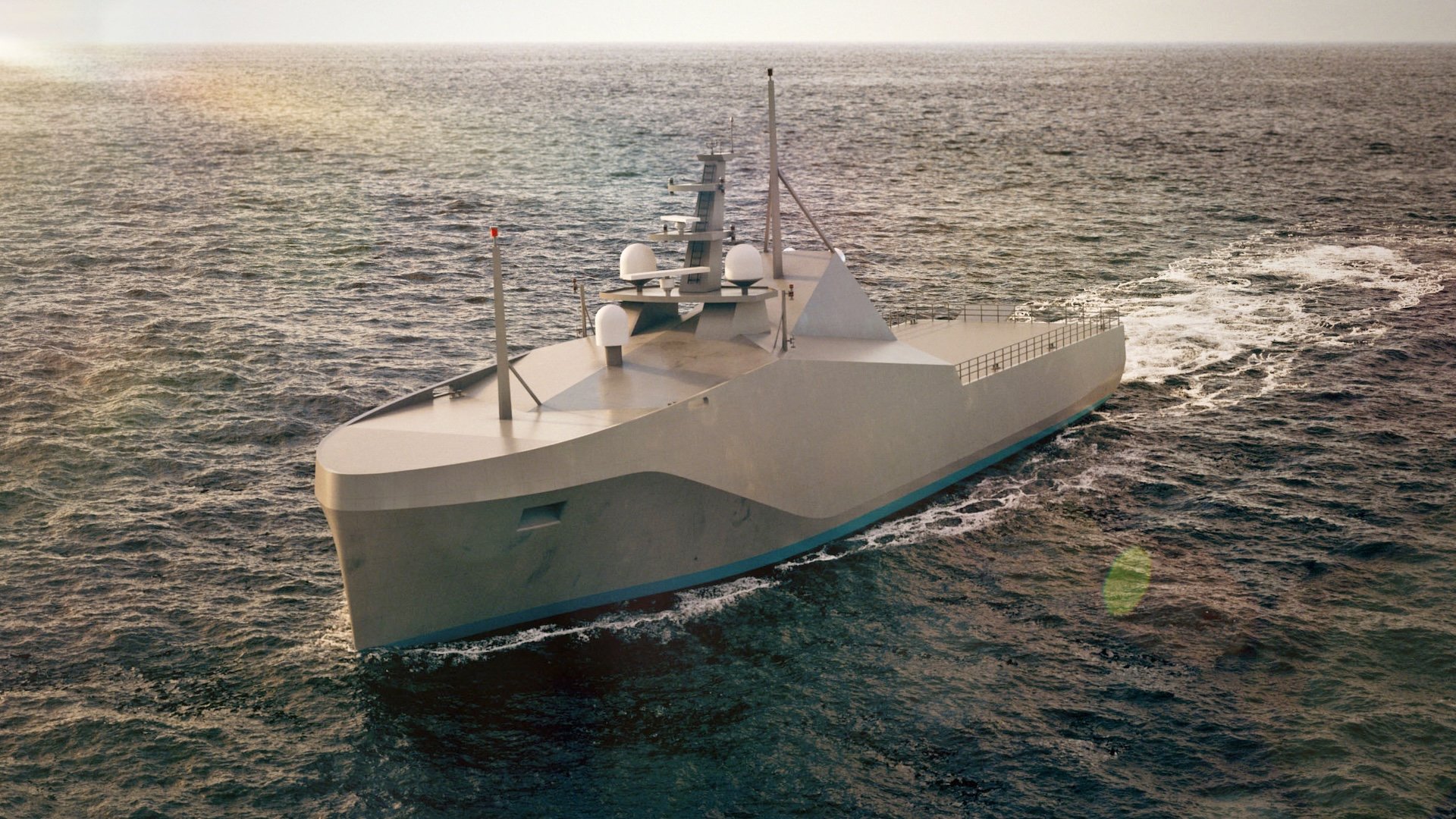
Kongsberg Maritime has unveiled a new fully uncrewed surface vessel (USV) design, which is based on a hardy fishing vessel, intended to meet the Royal Navy’s emerging Type 92 requirement. It calls for autonomous platforms to persistently hunt Russian submarines in the increasingly contested waters of the North Atlantic and Arctic.
Dubbed the Arctic Hunter USV, the vessel combines a proven commercial ship design with Kongsberg Maritime’s remote-control and autonomous technologies. It is being developed around an anti-submarine warfare (ASW) mission, with a particular emphasis on providing persistent underwater surveillance in the High North.
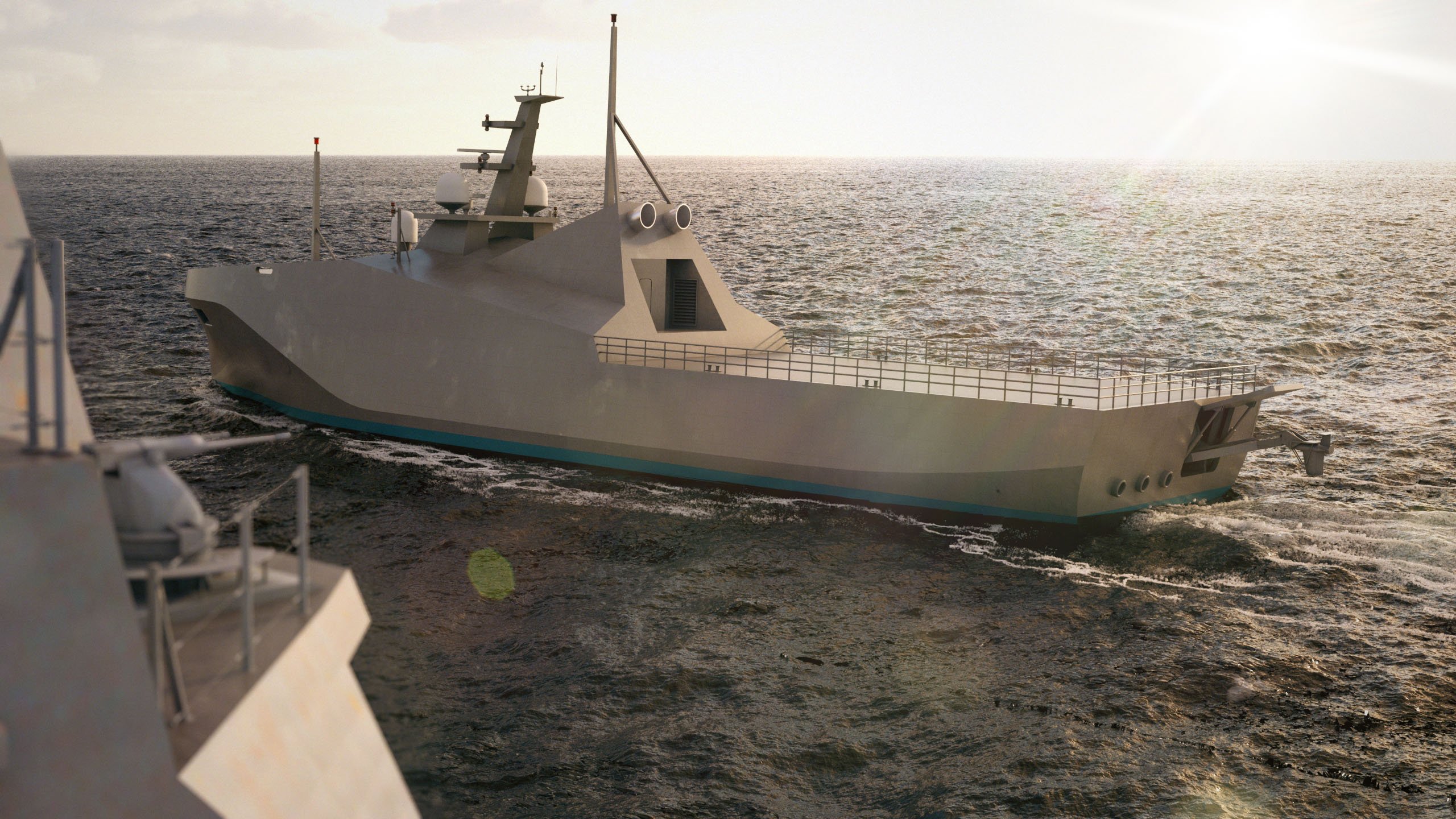
The announcement, made November 9, comes as the Royal Navy moves ahead with its broader Hybrid Navy concept, which will see uncrewed vessels and other autonomous systems operate alongside traditional crewed warships and aircraft. The Type 92 is one of four new uncrewed vessel types envisioned under this effort, which is intended to significantly expand the fleet’s overall sensing and weapons capacity.
Bruce Balchin of Kongsberg Maritime, which is headquartered in Norway, told TWZ that the Arctic Hunter concept emerged from the Royal Navy’s stated desire to address the submarine threat in the High North with capabilities that could be delivered quickly and in significant numbers, using commercial shipyards.
“We’ve been following the Royal Navy’s Hybrid Fleet and some of the statements that have been coming from the First Sea Lord,” Balchin explained. “The immediate threat is submarines in the High North. I need things at mass to be delivered at mass and at pace. I need commercial shipyards.”
Kongsberg’s response was to look at an existing commercial vessel design that could be adapted to tow a powerful submarine-hunting sonar. Rather than developing a new military ship, the company saw an opportunity to repurpose an Arctic fishing vessel, replacing its fishing equipment with the systems needed for ASW surveillance.
The resulting Arctic Hunter is based on an existing 184-foot hull design. Kongsberg plans to remove the wheelhouse and fish-processing factory, freeing up space for the military mission systems and equipment needed to operate the vessel remotely.
“Replace towing fish with towing sonar,” Balchin said, describing the basic concept. “It’s not a stretch to say we straight away got a vessel which is hardened to that environment, used to working at that sea state.”
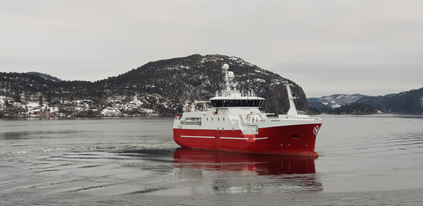
There are other advantages to starting with a fishing vessel, too. These ships are already designed to operate for extended periods in demanding Arctic conditions, with relatively straightforward maintenance requirements. They also have the machinery, power generation, and internal volume needed to support substantial mission equipment.
The platform is being designed around a relatively high-performance towed array, the Sonar 2087, developed by Thales Underwater Systems. The Type 92 is intended to provide a significant extension of the Royal Navy’s ASW sensing capabilities, and Kongsberg believes that requires a substantial towed array.
Sonar 2087 already equips Royal Navy Type 23 frigates and will be carried aboard its forthcoming Type 26 ASW frigates.
Another critical consideration is the vessel’s acoustic signature. A sonar platform needs to be quiet enough that its own machinery and propellers do not interfere with its ability to detect submarines.
“You can have the best sonar in the world, but if you’ve got a very noisy ship, it drowns out everything else you’re trying to find,” Balchin said. “You need a very quiet platform to maximize the performance of your sonar.”
Kongsberg has considerable experience in this area, having designed propellers for the Royal Navy’s Type 23 and Type 26 frigates. The company has applied some of that expertise to the Arctic Hunter, optimizing its hull and propeller design to reduce underwater radiated noise (URN).

The fishing vessel design already offered a relatively quiet platform, partly because of the requirements of its original mission. Kongsberg says it is further improving that performance for the ASW role.
The Arctic Hunter also draws on technology from another Kongsberg project called Reach Remote, an existing uncrewed offshore vessel that operates in the North Atlantic, deploying remotely operated vehicles (ROVs) for survey work.

Rather than developing an entirely new autonomous control system, Kongsberg intends to transfer the proven remote-operation technology from Reach Remote into the Arctic Hunter platform.
“We’re taking a proven platform, proven flag-approved remote autonomy technology with a proven sonar, and then we’ve also added on another layer of military communications,” Balchin said.
Those communications will be designed to provide secure connectivity in the contested and degraded environments expected in the High North.
Kongsberg is designing the Arctic Hunter for up to 60 days at sea without human intervention aboard. The company’s existing Reach Remote vessels already operate for around 30 days at a time, providing a basis for extending that endurance.
The vessel is uncrewed by design, rather than being a conventional ship subsequently adapted to operate without a crew, and this has significant implications for its layout and cost.
“Putting anybody on it for any period of time massively complicates a ship and adds significant costs,” Balchin explained, pointing to the need for accommodation, a galley, water supplies, and other systems required to support a human crew.
Engineers may occasionally board the vessel for maintenance or servicing, but its normal operation will be controlled from shore.
The initial concept is deliberately focused on a relatively straightforward ASW sensing mission. Balchin described this as a “minimum viable capability,” intended to get additional submarine-hunting sensors into the High North as quickly as possible.
Initially, the Arctic Hunter vessels could operate as an uncrewed flotilla, collecting underwater surveillance data and transmitting it to military decision-makers in the United Kingdom. This would provide the Royal Navy with additional sensing capacity without requiring the vessels to operate directly alongside crewed warships from the outset.
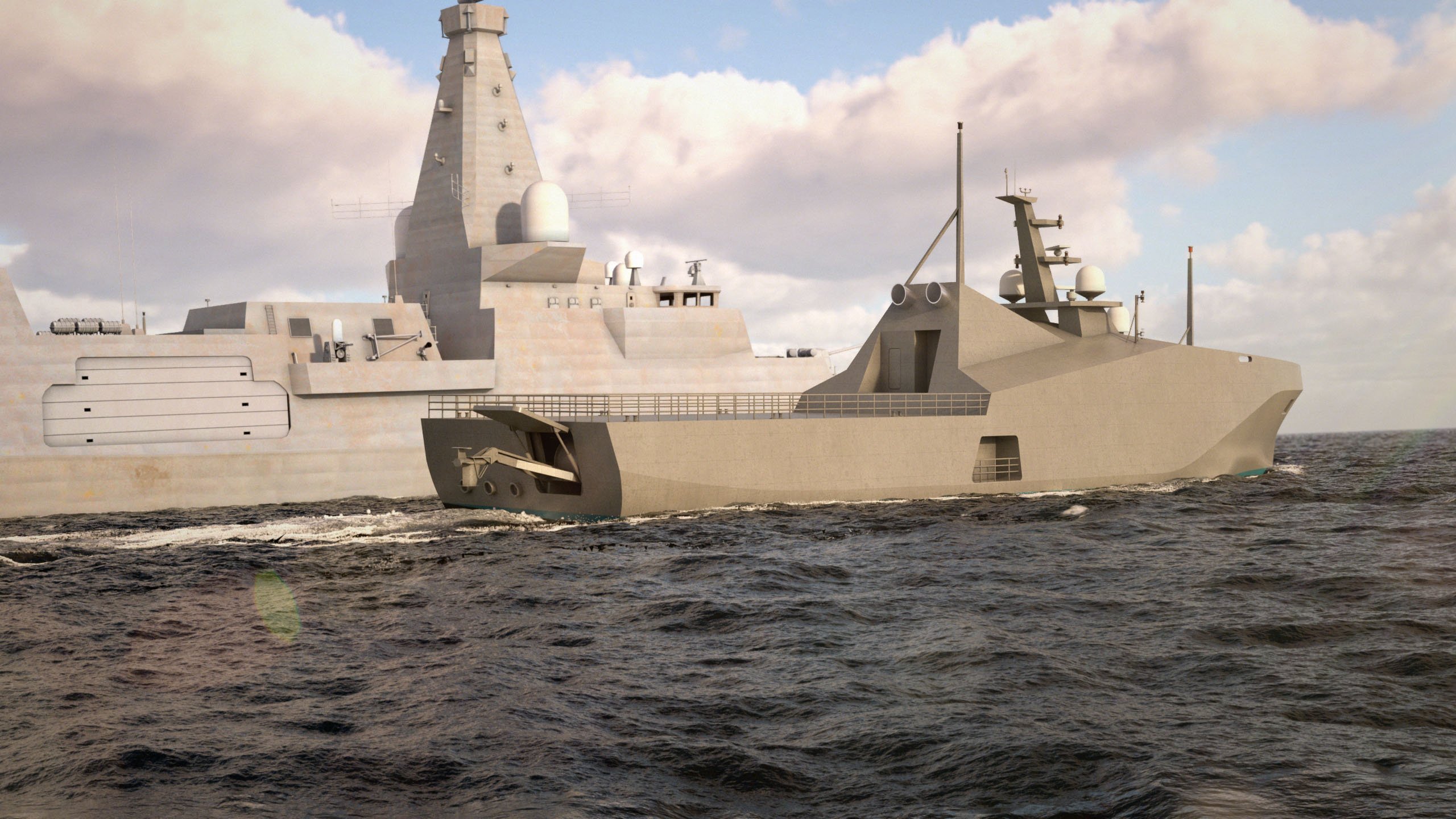
Over time, however, Kongsberg sees the vessels working more closely with the Type 26 frigates as those warships enter service.
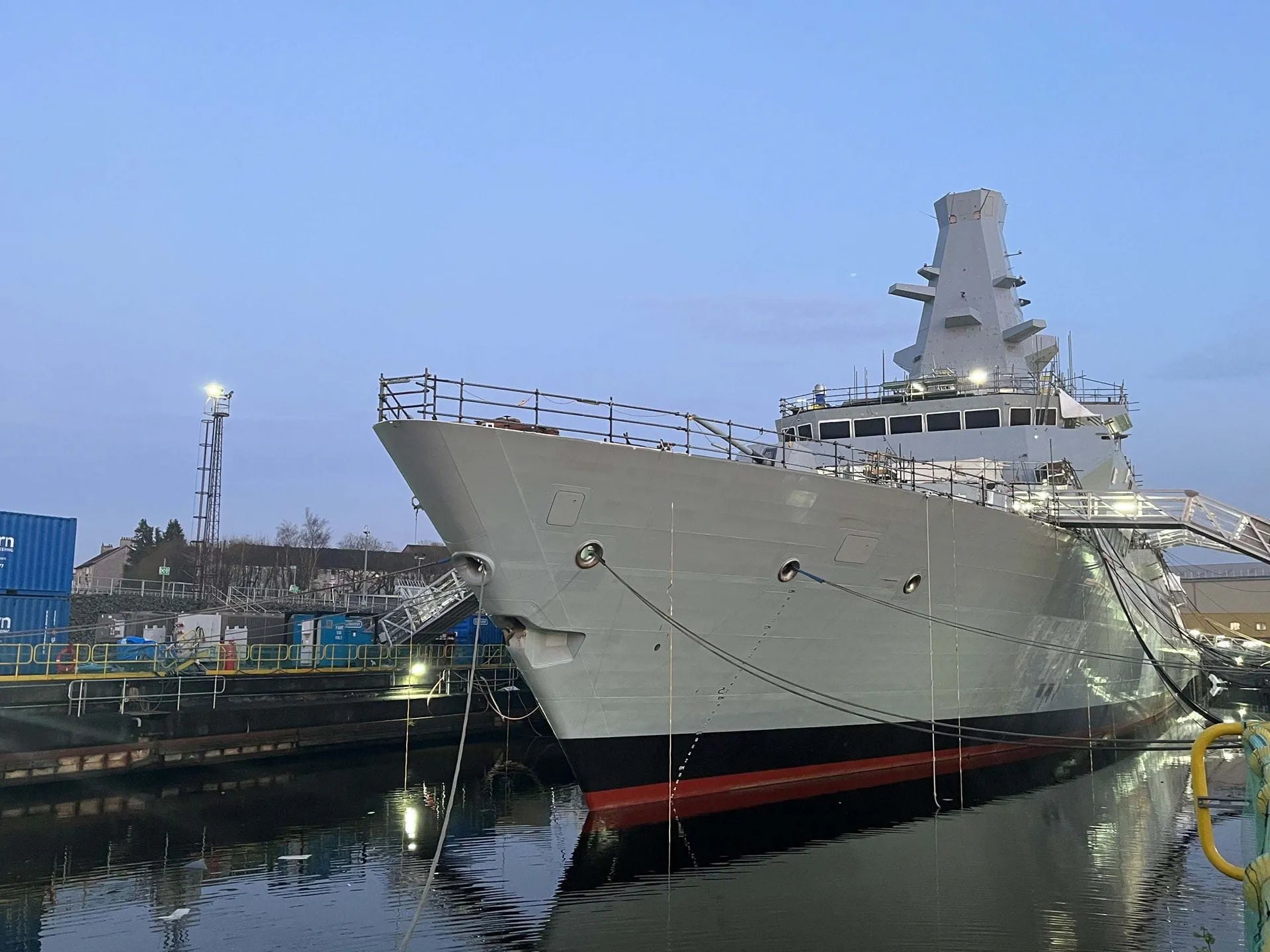
“Type 26 at the core, and these acting as autonomous wingmen,” is how Balchin described the longer-term concept.
This would give the Royal Navy considerable flexibility in how it deploys the vessels, allowing them to operate independently or as part of a wider ASW formation. It could also help address gaps in the existing frigate fleet by providing additional sensing assets that do not require a crewed warship to remain continuously on station.
Although the Arctic Hunter is being developed primarily as a sensor platform, its design has considerable room for additional capabilities. Balchin highlighted the vessel’s installed power, payload capacity, and unused internal volume as factors that could allow it to accommodate other mission systems.
“We have resisted the temptation to go on flights of fancy at this time around what else it could do, and instead stick to that very simple: we want to get a program of record in quickly,” he said.
The vessel’s potential flexibility could nevertheless be attractive to other navies. Balchin emphasized that the underlying platform is not inherently tied to British systems. For the U.K. Type 92 requirement, it would carry sovereign British sonar and secure military communications, but other customers could select their own equipment.
“If America said, ‘I want to tow a different sonar, and I’d like to have an American communication system in there,’ that’s very easy as well,” he said. It’s worth noting that a version of the Sonar 2087, known as CAPTAS-4, had been planned for the U.S. Navy’s now-canceled Constellation class frigate. The FF(X) that has superseded it currently lacks any built-in sonar array, fixed or towed, and other anti-submarine warfare capabilities.

Kongsberg believes its underlying platform could therefore provide a common commercial foundation for different national requirements, with the military payload adapted to suit each customer.
For the British program, the company is working with its established shipbuilding partner Balaena Maritime, with construction planned at the latter’s Birkenhead yard.
A commercial approach to construction is central to the Arctic Hunter proposition. Fishing vessels operating in Arctic waters typically spend around six weeks at sea before returning to port to unload their catch, refuel, and undergo servicing. They then head back out again, with relatively straightforward shore-based support.
Kongsberg believes the same model can be applied to the uncrewed ASW vessels. Existing commercial shipyard infrastructure, including dry docks and slipways, could support routine maintenance, with additional facilities required for sonar and military communications servicing.
There would also be a remote operations center in the High North to control the vessels themselves. However, the more important decisions about where the flotilla should operate and how its missions should be managed would remain in the United Kingdom.
The Arctic Hunter is also being presented as a potential export product. Balchin said Kongsberg’s separation from the wider Kongsberg Group earlier this year had given the maritime business greater freedom to work with different defense companies and national partners.
For the Royal Navy, the Type 92 is part of a much broader effort to reshape how the service operates at sea. Under the Hybrid Navy concept, four new types of uncrewed vessels will take on different roles, ranging from providing additional missile capacity to extending the fleet’s ability to detect and engage threats underwater and in the air.
The move toward a fleet built around autonomous vessels represents a new venture for the Royal Navy. However, the service is already beginning to establish the operational structures needed to make that transition.
Last week, it formally commissioned its 1st Autonomous Squadron at Portsmouth, a unit of around 180 personnel that will operate uncrewed surface vessels on frontline missions. Initially equipped with Kraken and Rattler craft, the squadron is intended to develop the skills, tactics and experience needed to bring increasingly sophisticated autonomous systems into the fleet. The Type 92 and other larger uncrewed vessels would represent a significant expansion of that effort, moving beyond smaller boats toward persistent, ocean-going capabilities.
The Arctic Hunter announcement also highlights the growing emphasis on industrial cooperation between the United Kingdom and Norway in the maritime domain. The two countries have been working more closely on security in the North Atlantic and High North, including through the Lunna House agreement, which includes an ambition for both nations to lead NATO’s adoption of autonomous systems in the region.
The proposed Type 92 program also comes amid mounting concern over Russian submarine activity in the North Atlantic, where Moscow’s undersea forces remain a significant threat to NATO’s maritime communications, reinforcement routes, and naval forces. Persistent uncrewed sensors could help address the challenge of maintaining surveillance over such a large area, particularly as crewed ASW platforms face competing operational demands.
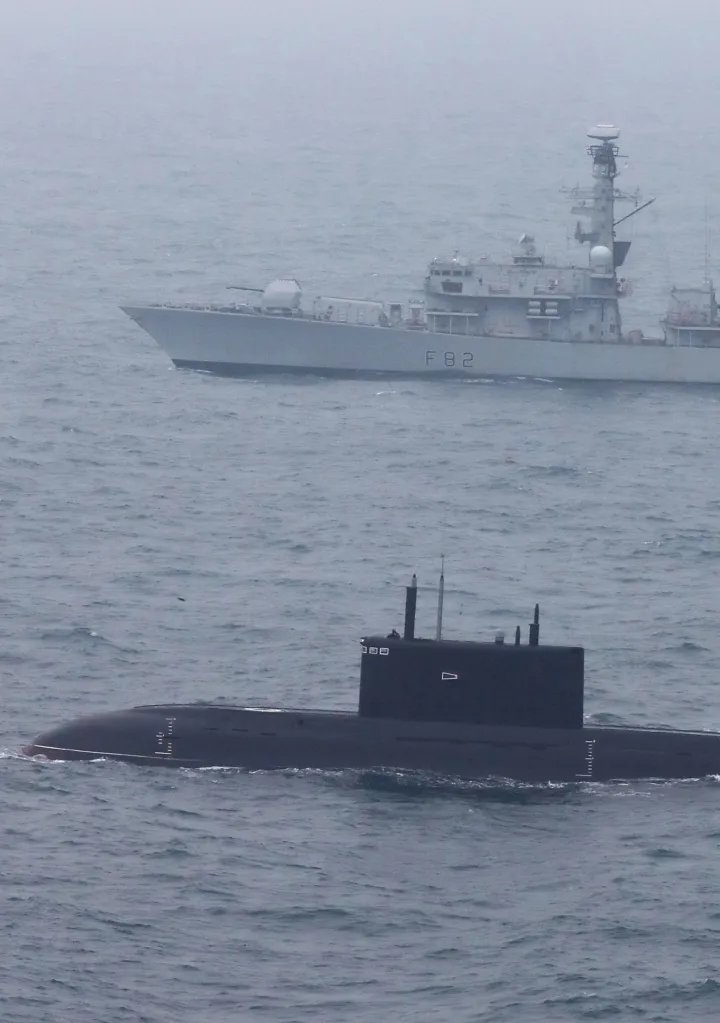
Russian submarine activity in the North Atlantic has been a growing worry for NATO for years, with the challenge involving not just the number of deployments but the increasingly capable boats involved. As TWZ has reported, Russian submarines are operating for longer periods and carrying more lethal weapons, while newer designs such as the Yasen class are quieter and harder to detect. In April of this year, the United Kingdom and Norway disclosed a month-long operation with Norway and other allies to track a Russian Akula class attack submarine and two small, special-missions submarines operating near critical undersea infrastructure in the North Atlantic. The episode underscored the demands placed on crewed ships and patrol aircraft to maintain persistent surveillance across the region.

For now, the Arctic Hunter represents an industrially focused proposal for a major element of the U.K.’s emerging Hybrid Navy concept. Its combination of commercial shipbuilding, autonomous vessel technology, and sovereign British ASW systems is intended to offer a relatively rapid route to expanding the Royal Navy’s underwater surveillance capacity.
More broadly, the Type 92 points toward a future fleet in which crewed warships are increasingly supported by uncrewed platforms that distribute weapons, sensors and other capabilities across a wider operating area. While embracing so much unproven technology and conceots comes with risks, the Royal Navy is betting that a combination of autonomous systems and traditional warships can deliver greater firepower, persistence, and operational reach.
Contact the author: thomas@thewarzone.com
Loading comments…
Comments couldn’t be loaded. Please refresh the page.