
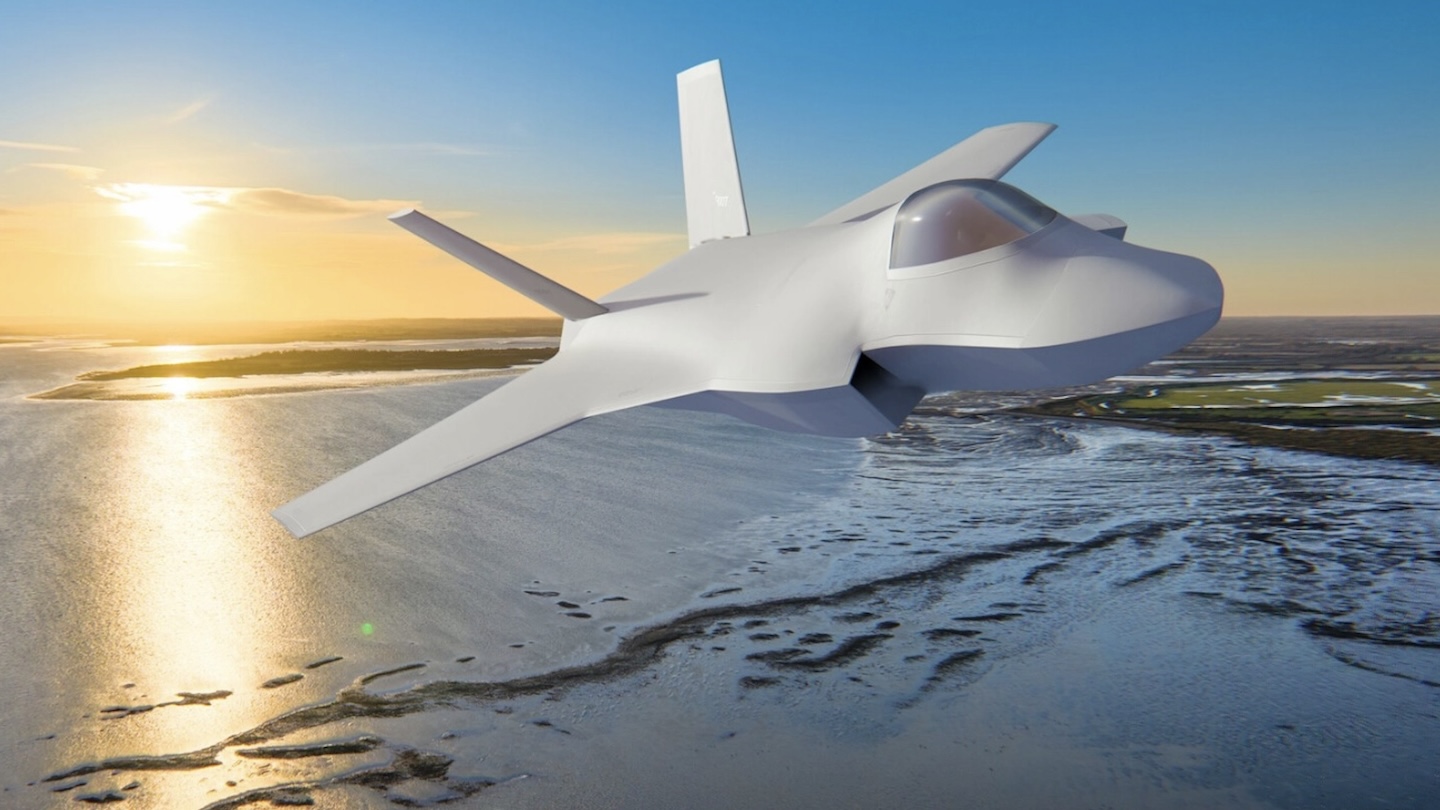
A first rendering has been released showing the new fighter demonstrator being built in the United Kingdom as part of the Tempest next-generation air combat program. The crewed flight test vehicle bears a notable resemblance to the Lockheed Martin F-35, apart from its lack of horizontal stabilizers and a number of smaller differences. Planned to take to the air in 2027, the Combat Air Flying Demonstrator will feed into the design of the Tempest, which is being developed as a stealthy fighter for the U.K.’s Royal Air Force, as well as for Italy and Japan, and is expected to be in service by 2035.
The digital rendering of the Combat Air Flying Demonstrator (previously referred to as the Flying Technology Demonstrator) was published by BAE Systems, which is building the aircraft at its facility in Warton, England. Overall, the design appears very similar to the F-35, including the outward-canted twin tailfins and diverterless supersonic inlets (DSI), which will feed a pair of Eurojet EJ200 turbofans. Unlike the F-35, and in line with Tempest renderings, there are no horizontal stabilizers.
Having twin engines means the fuselage is broader overall than the single-engine F-35, and it’s also notably flattened across its upper surfaces. The rear fuselage terminates in a notable boxy section, which may help conceal the engine nozzles, though this detail is unclear. Perhaps the most surprising feature is the wing, which is a cropped-delta type, with a prominent leading-edge root extension (LERX). The LERX was absent from recent renderings of the Tempest, which featured a larger wing. This used a different modified delta planform, which, as we noted in the past, recalled that of the proposed F-16U — the original Block 70 version of this aircraft as pitched to the United Arab Emirates.
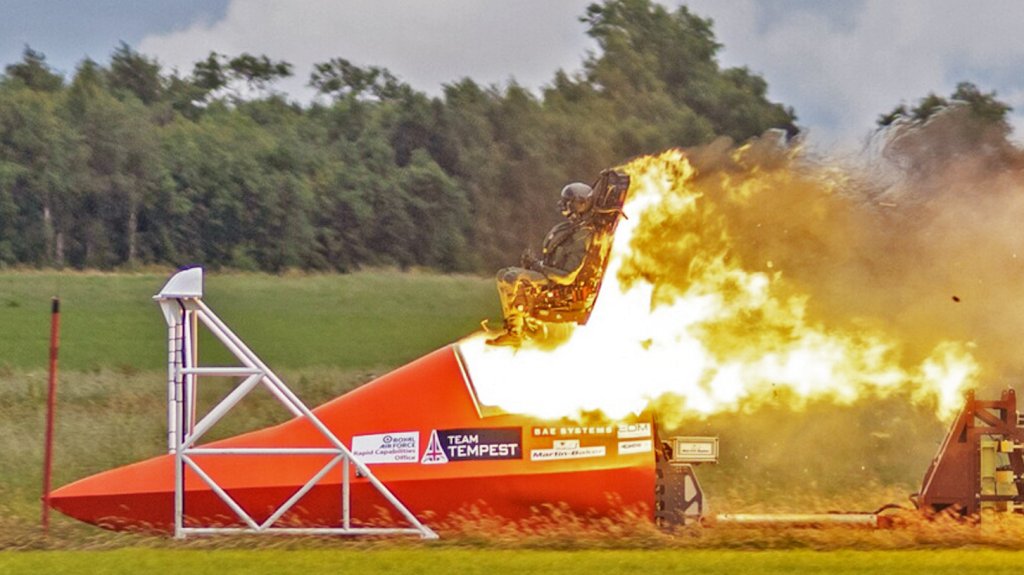
Otherwise, notable aspects of the Combat Air Flying Demonstrator include its broad nose, suggesting ample internal space for a large radar antenna, as well as a relatively small cockpit, which doesn’t appear to be optimized for pilot vision across the rear aspect. Not surprisingly, the forward fuselage appears similar to that which was used during trials of the aircraft’s Martin-Baker ejection seat.
“For the first time, people can see how this cutting-edge demonstrator aircraft will look when it takes to the skies,” said Tony Godbold, Future Combat Air Systems Delivery Director at BAE Systems, in a company statement. However, it should also be noted that the finished Combat Air Flying Demonstrator could still incorporate some changes compared with the rendering.
With an ambitious plan to have the Combat Air Flying Demonstrator flying by 2027, we shouldn’t have to wait too long to compare the real aircraft with the official rendering.
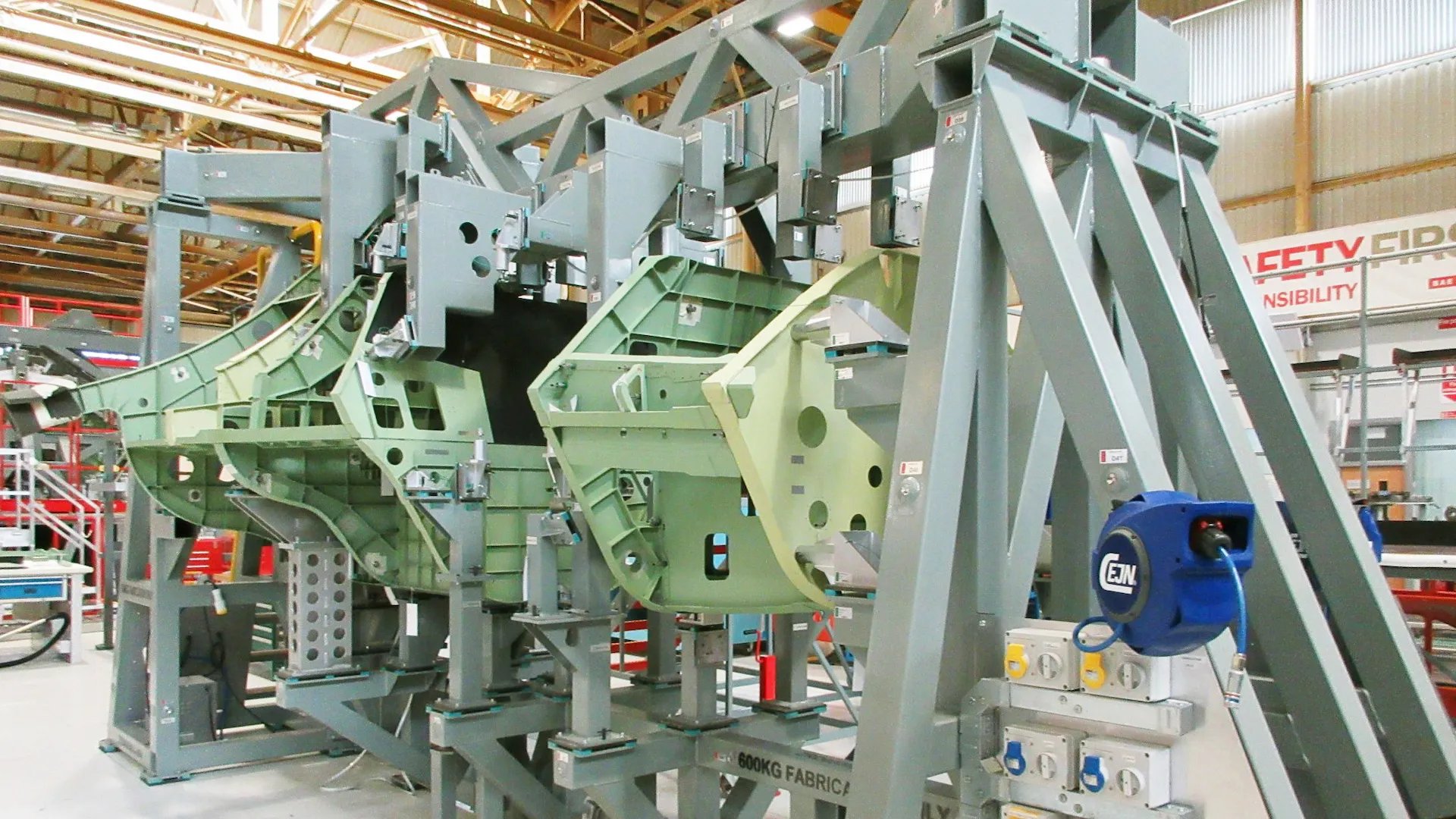
Last summer, BAE Systems revealed photos showing the forward fuselage section of the Combat Air Flying Demonstrator under construction. At this point, over 50 percent of the aircraft, by structural weight, was being built or had already been completed.
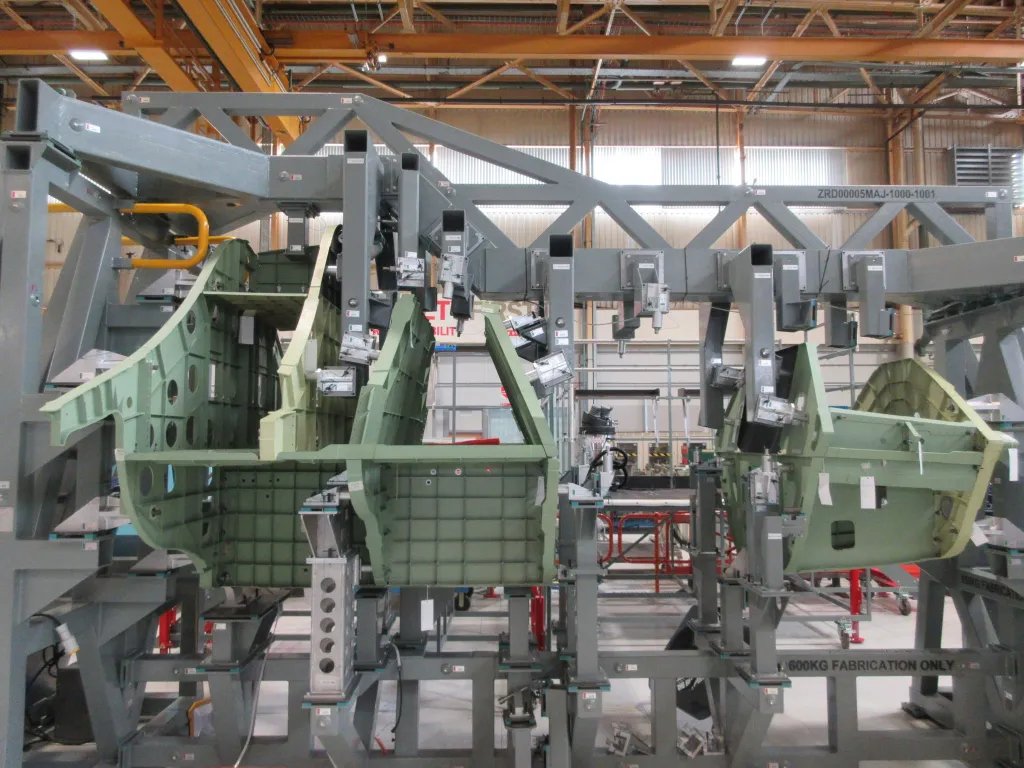
As of today, BAE Systems says that two-thirds of its structural weight is now in manufacturing, with the aircraft’s main structure, wings, and tailfins all taking shape at Warton. The work is making extensive use of robotic and digital manufacturing and assembly technologies, including 3D printing, cobotics, digital twins, model-based systems engineering, and virtual simulation.
Helping to develop new kinds of manufacturing processes is one important part of the Combat Air Flying Demonstrator’s contribution to the Tempest, for which it will test a wide range of new technologies, including “the integration of stealth-compatible features.”
Ahead of flight-testing with the Combat Air Flying Demonstrator, test pilots from BAE Systems, Rolls-Royce, and the Royal Air Force have been putting the design through its paces in a specially developed simulator. So far, they have flown more than 300 hours in the simulator. This has included testing the flight control systems during more complex flight maneuvers.
The United Kingdom has also developed a Flight Test Aircraft (FTA), nicknamed Excalibur, that will serve as a flying laboratory for the Tempest. Based on a Boeing 757 airliner, the test aircraft successfully completed its first phase of modification and flight testing late last year, as you can read about here.
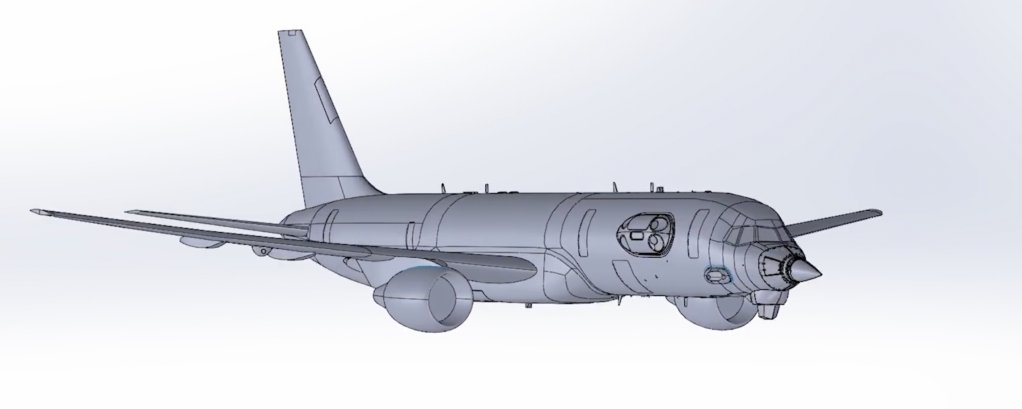
While we now have what is almost certainly a very good look at the Combat Air Flying Demonstrator, we still don’t know how close it will be in terms of size and configuration to the Tempest. However, with the demonstrator intended to prove, among others, the configuration and dynamics of the Tempest, there will surely be some commonality.
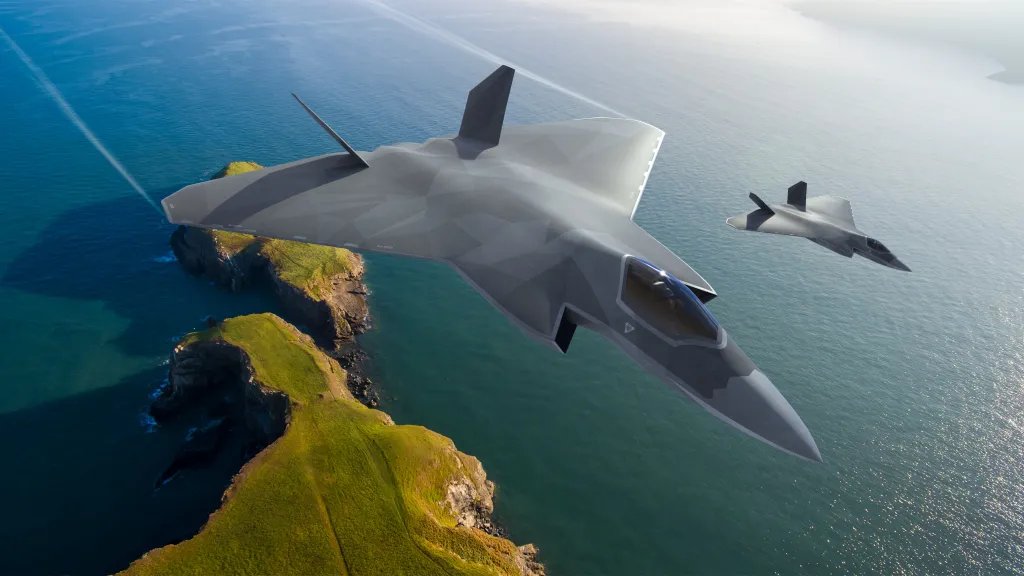
We do know that the Royal Air Force wants the Tempest to prioritize a large payload, roughly twice that of the F-35A. The service has also said it wants “really extreme range” for the new aircraft, with potentially enough internal fuel to fly across the Atlantic without refueling.
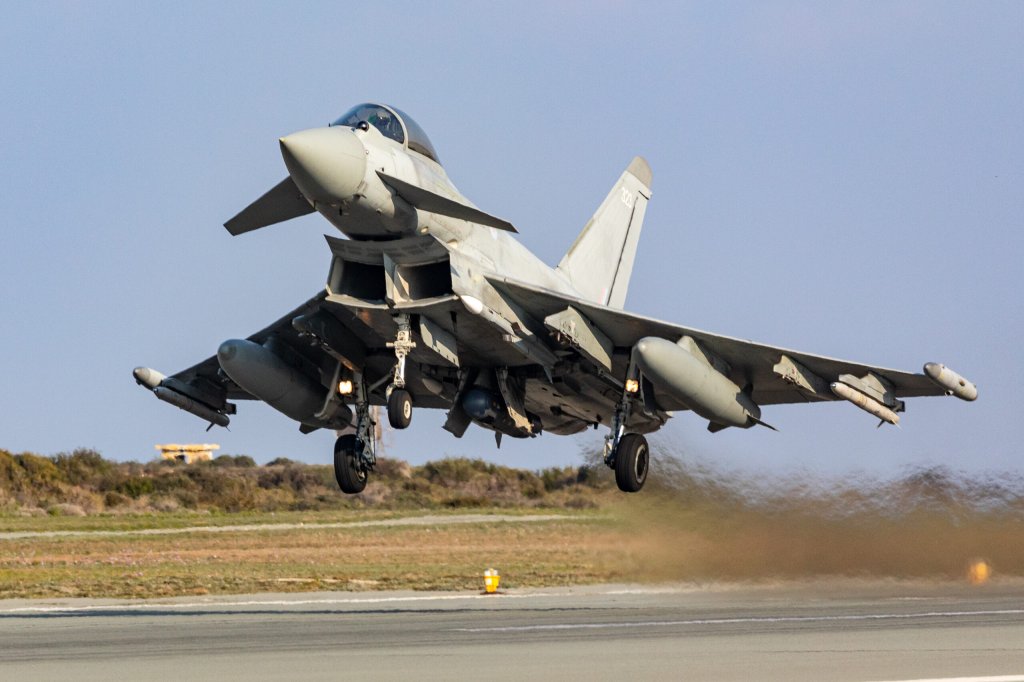
One major difference will be the powerplant, with the Combat Air Flying Demonstrator using the same EJ200 turbofans as the Eurofighter Typhoon. The production Tempest will feature an all-new powerplant that is now under development.
The Typhoon program might also provide a hint of the degree of commonality that will exist between the Combat Air Flying Demonstrator and the Tempest.
The United Kingdom flew the British Aerospace EAP fighter demonstrator in 1986 to help prove the concept for the Typhoon that followed it. It was powered by engines used in the earlier Panavia Tornado combat aircraft, but its basic configuration was broadly similar to that of the Typhoon.
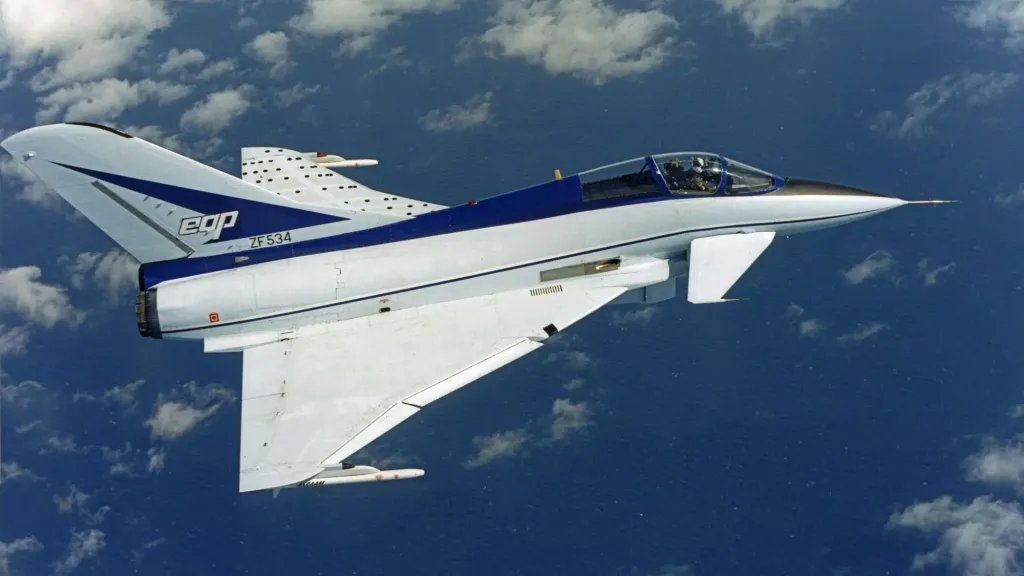
So far, like the EAP, the Combat Air Flying Demonstrator is being pursued as a U.K. program, although it remains possible that Italy and Japan could also become involved.
Between them, the United Kingdom, Italy, and Japan make up the Global Combat Air Program (GCAP), which seeks to field the Tempest aircraft, plus associated support and training, in each of these countries.
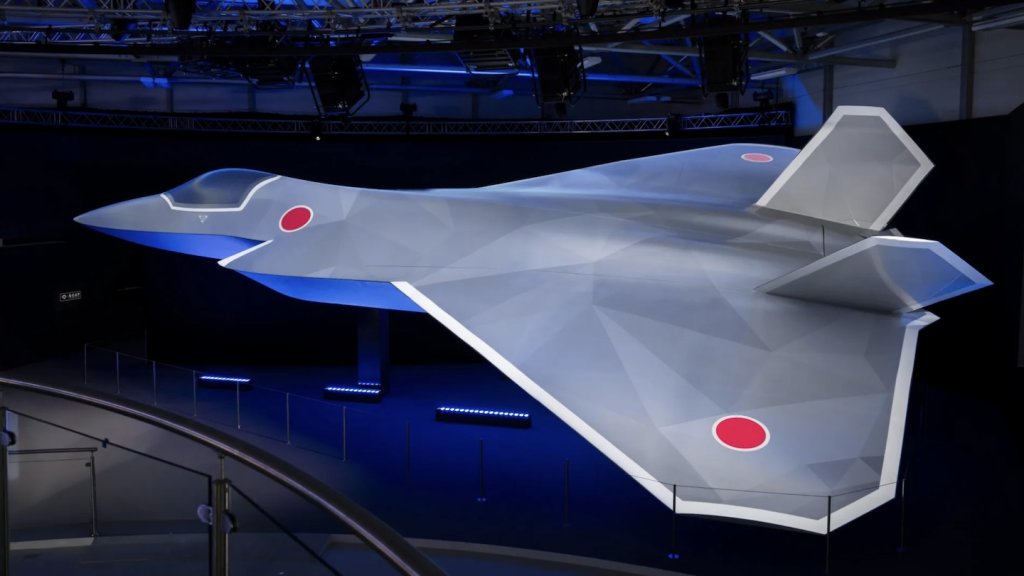
Within the United Kingdom specifically, the Tempest falls under the wider Future Combat Air System (FCAS) program, which will also include uncrewed platforms, next-generation weapons, networks, data sharing, and more.
For a long time now, the viability of the Tempest, in particular, has been questioned in some quarters in the United Kingdom.
As TWZ wrote back in July 2022, when the demonstrator was first announced:
“The capabilities promised by the Tempest look convincing, on paper, at least, although they may look less so once the aircraft is actually available for service. After all, the timeline as it stands looks to be exceedingly ambitious. If, as stated, a demonstrator starts flying within the next five years, that could leave as little as eight years between its first flight and the planned initial operating capability for the production-representative Tempest. Compare this with the Typhoon, for which 17 years passed between the demonstrator’s first flight and service entry.”
As we have previously reported, there have been concerns raised that the continued reassessment of U.K. defense spending priorities may affect the Tempest program.
Another potential pitfall for the Tempest is the U.K. government’s decision to buy conventional takeoff and landing (CTOL) F-35A stealth fighters to operate alongside the short takeoff and vertical landing (STOVL) F-35B models it already uses. The F-35A has been chosen due to a combination of lower costs than the F-35 and its ability to carry nuclear weapons.
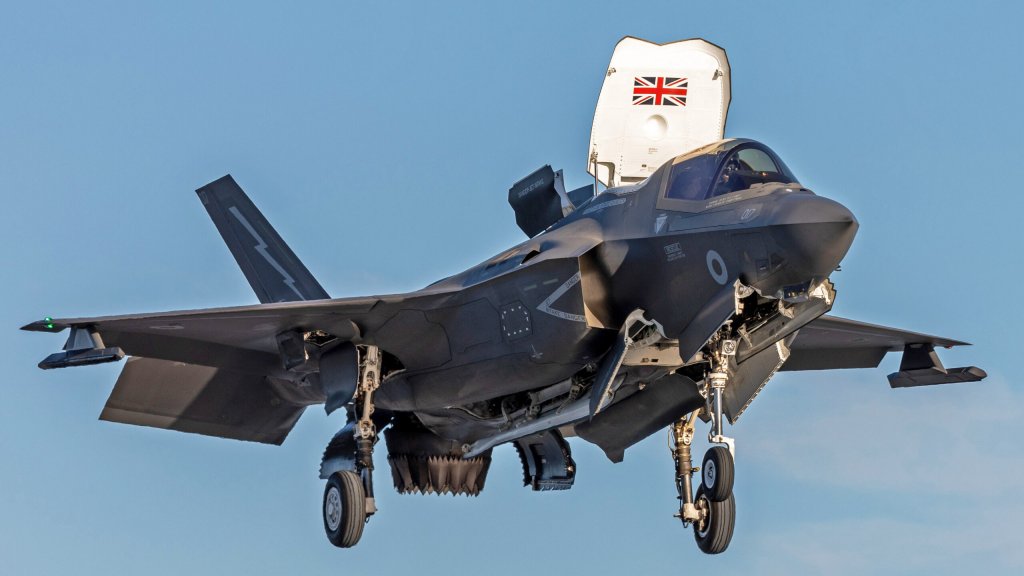
Should the F-35A prove itself, that could open up the possibility of a follow-on purchase, and larger numbers of the CTOL version would be a very obvious threat to the future of the Tempest. Beyond that, there remains the strong possibility that the Tempest could face a more direct challenge from advanced follow-on F-35 derivatives that might yet still emerge. Lockheed Martin, for example, has already discussed the potential for a “Ferrari” or “NASCAR upgrade” to the F-35’s core “chassis.” This could introduce a pilot-optional F-35, along with new stealth coatings and other modifications.
It remains to be seen to what degree the F-35A order — which is initially just for a token fleet of 12 aircraft — might affect the Tempest program. At the same time, there are other challenges, including competition for funds from other big-ticket military acquisitions, including but not limited to, the new Dreadnought class nuclear-powered ballistic missile submarines.
Ultimately, there is a lot at stake for the Combat Air Flying Demonstrator. If all goes to plan, it will provide valuable experience that will be fed into the Tempest program, reducing the risk for both the new-generation fighter and the broader programs that it falls under. But developing a new fighter from scratch is a big challenge, and long development times, high costs, and political factors could play against the Tempest regardless of what happens with the Combat Air Flying Demonstrator.
Contact the author: thomas@thewarzone.com
Loading comments…
Comments couldn’t be loaded. Please refresh the page.