
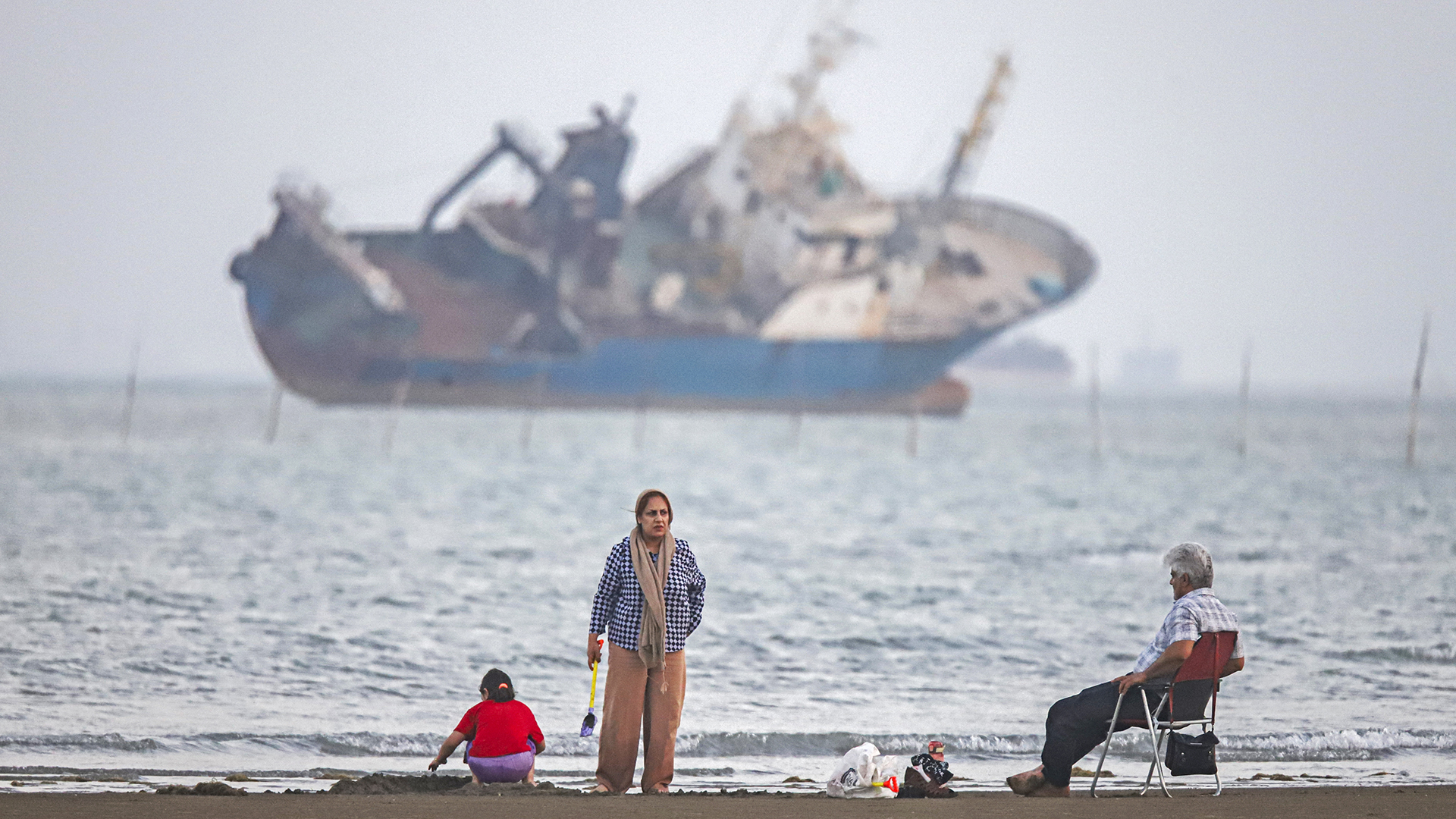
The pressure is mounting on the shaky ceasefire between the U.S. and Iran with an increasing pace of tit-for-tat strikes between the two foes and Iran’s suspension of peace talks after blaming Israel’s deepening advance into Lebanon. Exacerbating tensions, Tehran claimed it will “completely block” the Strait of Hormuz while threatening to close the Bab al-Mandeb Strait as well. Located at the mouth of the Red Sea, it is another critical regional chokepoint. The Strait of Hormuz has been largely closed to most traffic by Iran since not long after the launch of Epic Fury on Feb. 28.
All these actions are taking place against the backdrop of sputtering negotiations between the U.S. and Iran that have yet to achieve any tangible results.
“Given the continuation of the Zionist regime’s crimes in Lebanon and considering that Lebanon was among the preconditions for the ceasefire, and now this ceasefire has been violated on all fronts including Lebanon, the Iranian negotiation team will stop ‘dialogues and text exchanges through intermediaries,’” the IRGC-affiliated Tasnim news agency stated on Monday. The two sides had been talking through mediators in Pakistan and Qatar.
“Also, the resistance front and Iran have resolved to completely block the Strait of Hormuz and activate other fronts including the Bab al-Mandeb Strait, in order to punish the Zionists and their supporters,” the outlet added.
Iran has been allowing some ships to transit the Strait of Hormuz through what it calls a system of fees paid for environmental and other services. Meanwhile, U.S. Central Command (CENTCOM) has helped guide the passage of about 70 commercial vessels through the Strait of Hormuz, according to The New York Times. This involves communicating and coordinating with ships, not escorting them, CENTCOM told the publication. Most of these transits appear to be closer to Oman than Iran, the publication added.
There were no details provided by Iranian officials about how Iran would completely close the Strait of Hormuz or when such a move could begin.
Tasnim also did not offer specifics about Iran’s threat toward the Bab al-Mandeb Strait or what it could entail. However, the Houthi rebels of Yemen, an Iranian proxy group, waged a protracted 15-month campaign against shipping in that region starting in the fall of 2023. TWZ has previously highlighted concerns that the Houthis could resume these attacks on behalf of Iran in the current conflict. As we have noted, Houthi strikes in this area would add further global economic strain and place additional burden on U.S. forces.
With the Strait of Hormuz closed, Saudi Arabia is rerouting its oil exports through pipelines to the Red Sea. A disruption of that transit option could cause oil prices to rise much higher and more quickly than they already have, creating a cascading wave of financial impacts and shortages across the globe, and especially in Asia. Even if the Strait of Hormuz were opened today, it will still take months for the global economy to recover from the shock. Meanwhile, for Saudi Arabia, the simultaneous closure of both straits is a long-standing nightmare, a financial double-whammy.
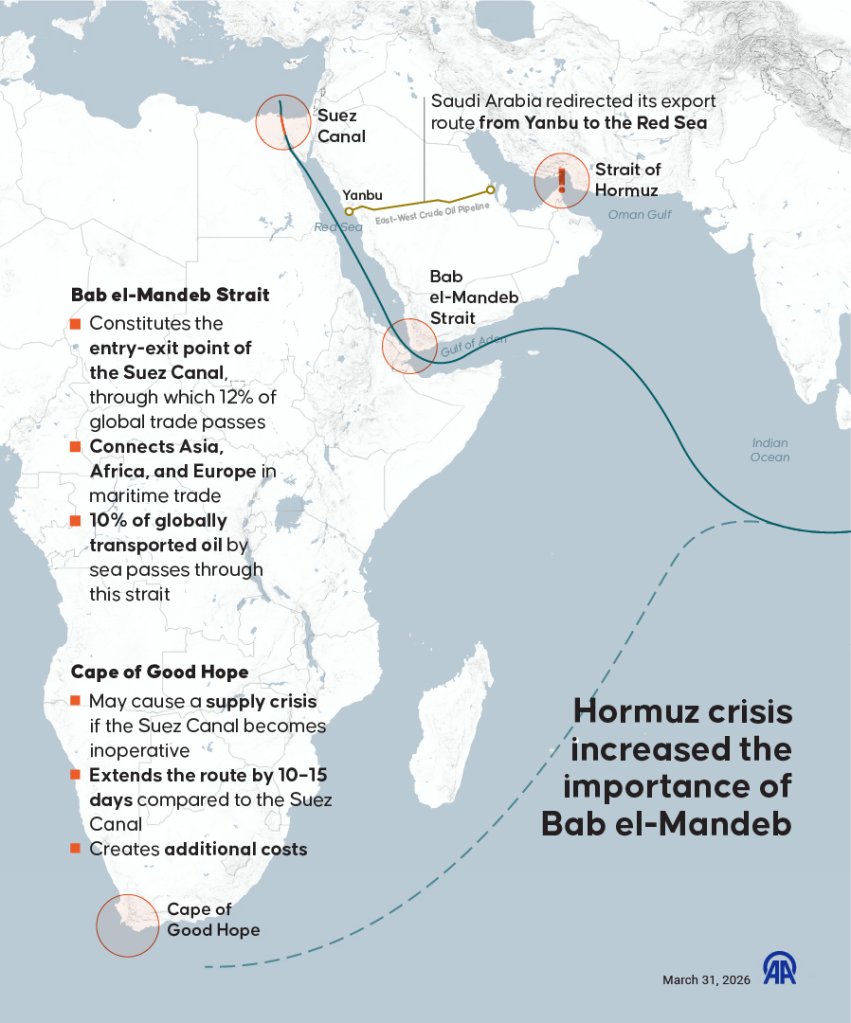
Just the recent news of the kinetic exchanges between the U.S. and Iran and Tehran’s decision to call off talks has sent the price of oil once again shooting upwards.
After dropping to a little more than $91 per barrel partly in the wake of President Donald Trump’s unfounded claim he was lifting the U.S. blockade on Iranian ports, the price as of 11:20 a.m. EDT was once again closing in on $100 per barrel, according to OilPrice.com. It reached a high this year of more than $114 a barrel in early May.

Defending against renewed Houthi attacks could require military assets at a time when the U.S. is already heavily committed to Operation Epic Fury and its aftermath that has seen a significant amount of equipment destroyed or damaged and munitions expended. During the previous Houthi Red Sea campaign, the U.S. and allies deployed numerous warships, including the Eisenhower and Truman Carrier Strike Groups (CGS) to both defend against Houthi attacks and strike targets in Yemen. These operations resulted in a large expenditure of air defense and strike munitions, with Houthi capabilities remaining degraded, but intact after it was all over.
You can see video from some of those encounters below.

Despite the widespread publicity over Tehran’s new positions, Trump told NBC News on Monday that he had not heard from Iranians that they were suspending talks. The president added that silence would be fine and he was willing to wait.
“I think we’ve been talking too much if you want to know the truth. I think going silent would be very good, and that could be for a long time,” the president proclaimed. “It doesn’t mean we’re going to go and start dropping bombs all over there. We’ll just go silent. We’ll keep the blockade.”
“I think I can wait as long as they want,” Trump continued. “They’re losing a fortune.”
Meanwhile, amid all this turbulence, the U.S.-Iran negotiations remain in limbo.
Early Monday morning, Trump took to social media to claim “Iran really wants to make a deal, and it will be a good one for the U.S.A. and those that are with us.”
Iranians have pushed back on the notion that they are eager for or close to making a deal. You can read more about the reported terms and scope of the talks in our previous reporting here.
As we mentioned earlier in this story, even before Iran reportedly called off talks, there was a heightened state of tension as the U.S. and Iran exchanged a new round of blows.
In a statement on X, U.S. Central Command said that at about 7:30 a.m. Tehran time on Monday, “U.S. forces successfully intercepted two Iranian ballistic missiles targeting American forces based in Kuwait. These missiles were immediately defeated and no American personnel were harmed.”
The command added that it “remains vigilant and will continue to protect our forces from Iranian aggression while supporting the ongoing ceasefire.”
Kuwait condemned the attack.
The Kuwaiti Foreign Ministry “affirms the State of Kuwait’s reservation of its full right to take whatever measures are necessary to preserve its security and defend its territories, holding Iran fully responsible for these heinous aggressions, in accordance with international law, the United Nations Charter, and the relevant Security Council resolutions,” it stated on X.
Iran, for its part, claimed it launched strikes on an unnamed U.S. base in response to U.S. attacks on Iranian targets on Saturday and Sunday.
In a post on X late Sunday, CENTCOM said it “conducted self-defense strikes on Iranian radar and command and control sites for drones in Goruk, Iran and Qeshm Island this weekend. The measured and deliberate strikes occurred on Saturday and Sunday in response to aggressive Iranian actions that included the shootdown of a U.S. MQ-1 drone that was operating over international waters. U.S. fighter aircraft swiftly responded by eliminating Iranian air defenses, a ground control station, and two one-way attack drones that posed clear threats to ships transiting regional waters.”
“No American service members were harmed,” the command stated. “CENTCOM will continue to protect U.S. assets and interests in response to unwarranted Iranian aggression during the ongoing ceasefire.”
UPDATE: 5:43 PM EDT –
Netanyahu says “he spoke this evening with President Trump and told him that if Hezbollah does not stop firing at our cities and citizens – Israel will strike terrorist targets in Beirut,” according to the Israeli prime minister’s office. “This position of ours remains unchanged. Concurrently, the IDF will continue to operate as planned in southern Lebanon.”
The conversation came after Trump claimed on Truth Social that: “I had a conversation with Bibi Netanyahu today, asking him not to go into a major raid of Beirut, Lebanon. He turned his Troops around. Thank you Bibi! I also had a conversation with Representatives of the Leaders of Hezbollah, and they agreed to stop shooting at Israel, and its soldiers. Likewise, Israel agreed to stop shooting at them. Let’s see how long that lasts — Hopefully it will be for ETERNITY.”
Meanwhile, Hezbollah continued firing on Israeli troops.
“Following the sirens that sounded a short while ago in the area of Metula, a launch was identified falling adjacent to IDF soldiers operating in southern Lebanon,” IDF stated on Telegram. “No injuries were reported.”
Other sirens heard in northern Israel, meanwhile, were determined to be false alarms, according to IDF.
UPDATES
As we noted earlier in our story, Iran is using the escalation of the Israeli-Hezbollah fight as a reason to walk away from peace talks, at least for now.
The move came after Israeli Prime Minister Benjamin Netanyahu on Monday ordered attacks on what he called “terror targets” in the Hezbollah stronghold of the Dahieh section of Beirut.
“Together with the Minister of Defense, I have instructed the IDF to strike terrorist targets in Beirut,” Netanyahu announced. “There will not be a situation in which Hezbollah attacks our cities and our citizens, and its terrorist headquarters in Beirut, in Dahiyeh, remains out of bounds.”
The Israeli leader added that “we are continuing to deepen our operational activity on the ground in southern Lebanon and are eliminating Hezbollah strongholds. Hezbollah is on the run. We are determined to restore security to the residents of the north, just as we did for the residents of the south.”
Netanyahu’s statement followed Israel proclaiming that it is operating north of the Litani River, a traditional demarcation line for Israeli incursions into Lebanon. Advancing north of the river marks a large escalation and the first time Israel has been that far from its border since withdrawing from southern Lebanon in 2000.
The IDF on Sunday announced it captured Beaufort Castle on Sunday. Overlooking the Beaufort Ridge on the Litani, the castle was once home to Crusaders, seized by them in 1139.
Netanyahu claimed the latest battle over the ancient structure was a victory for Israel.
“The capture of Beaufort is a dramatic stage and a dramatic change in the policy we are leading,” Netanyahu postulated. “We have broken the barrier of fear. We are taking the initiative. We are operating on all fronts – in Syria, in Gaza, in Lebanon. We have established security zones beyond our borders to protect our communities.”
An unspecified aircraft fired an AGM-114 Hellfire missile into the engine room of a Gambia-flagged merchant vessel trying to run the blockade, CENTCOM said in an X post on Sunday.
CENTCOM forces “observed M/V Lian Star transiting international waters toward an Iranian port on the Gulf of Oman and issued more than 20 warnings while informing the vessel it was in violation of the U.S. blockade” on May 29, the command stated. “A U.S. aircraft disabled the vessel by firing a Hellfire missile into the ship’s engine room after Lian Star’s crew failed to comply. The ship is no longer transiting to Iran.”
Since the blockade went into effect April 13, “U.S. forces have disabled five commercial vessels and redirected 116 to fully enforce the blockade as a ceasefire with Iran remains in effect,” CENTCOM added.
Other ships have been stopped from running the blockade by having bombs dropped down their smoke stacks, fighters firing 20mm cannon shells at their rudders and inert rounds from a destroyer’s five-inch gun blasting their engine rooms.
Further highlighting the ongoing danger to shipping in and around the Strait of Hormuz, a cargo vessel transiting the Gulf about 40 nautical miles southeast of Umm Qasr, Iraq, has been hit by an unknown projectile on its starboard side, causing a large explosion, the United Kingdom Maritime Trade Operations (UKMTO) reported on Monday.
UKMTO said it was unaware of any immediate environmental impact.
Since the launch of Epic Fury, UKMTO has received 53 reports of incidents affecting vessels operating in and around the Arabian Gulf, Strait of Hormuz (SOH), and Gulf of Oman. There have been 29 reported attacks, 22 reported suspicious activities and two reported hijackings.
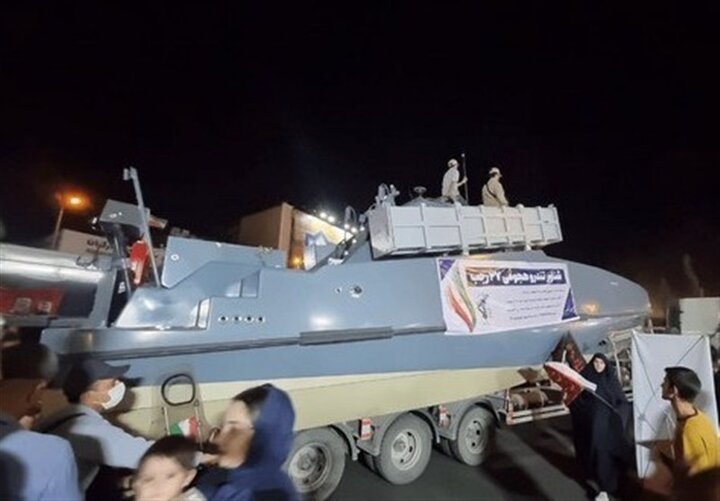
Iran claims it produced a new fast attack speedboat for the Islamic Revolutionary Guard Corps Navy (IRGCN). Dubbed the Rajab 27th, the semi-official Iranian Mehr News Agency described the vessel as a “fast attack watercraft featuring a trimaran hull design, which enhances stability and maneuverability in challenging maritime conditions.”
Mehr also said that the Rajab 27th is “capable of launching two sea-based cruise missiles with a range of 700 kilometers.”
The vessel, stated Mehr, is designed to conduct operations in sea states with wave heights of up to nearly 10 feet, the outlet added.
The unveiling of the new speedboat “highlights the continued development of the IRGC Navy’s fast-attack and missile-equipped maritime capabilities, which play a key role in Iran’s naval defense strategy and operations in southern waters,” Mehr posited.
TWZ cannot independently verify the Iranian claim, though it should be noted that the IRGC has invested heavily in its fleet of small boats for decades as TWZ has explored in the past. In addition to being armed with anti-ship cruise missiles, as well as artillery rockets and other weapons, they can also be used to lay naval mines. While the president claimed that 159 Iranian ships have been destroyed, the IRGC still has a large number of these small vessels.
The images below, taken during the unveiling ceremony, show glimpses of the Rajab 27th with what appear to be a missile container on either side of the boat.

Iran also claims it has restored gas production at three offshore platforms in the South Pars gas field, the head of the Pars Oil and Gas Company has told state media. As we previously reported, the facility was attacked by Israel in March.
Touraj Dehqani said on Sunday that the platforms had not been damaged in the attacks, Iran’s official IRNA news agency claimed.
“Dehqani said production from the three platforms was being routed to other processing plants in the region while repairs continued at damaged facilities,” Al Jazeera noted.
Contact the author: howard@twz.com
Loading comments…
Comments couldn’t be loaded. Please refresh the page.