
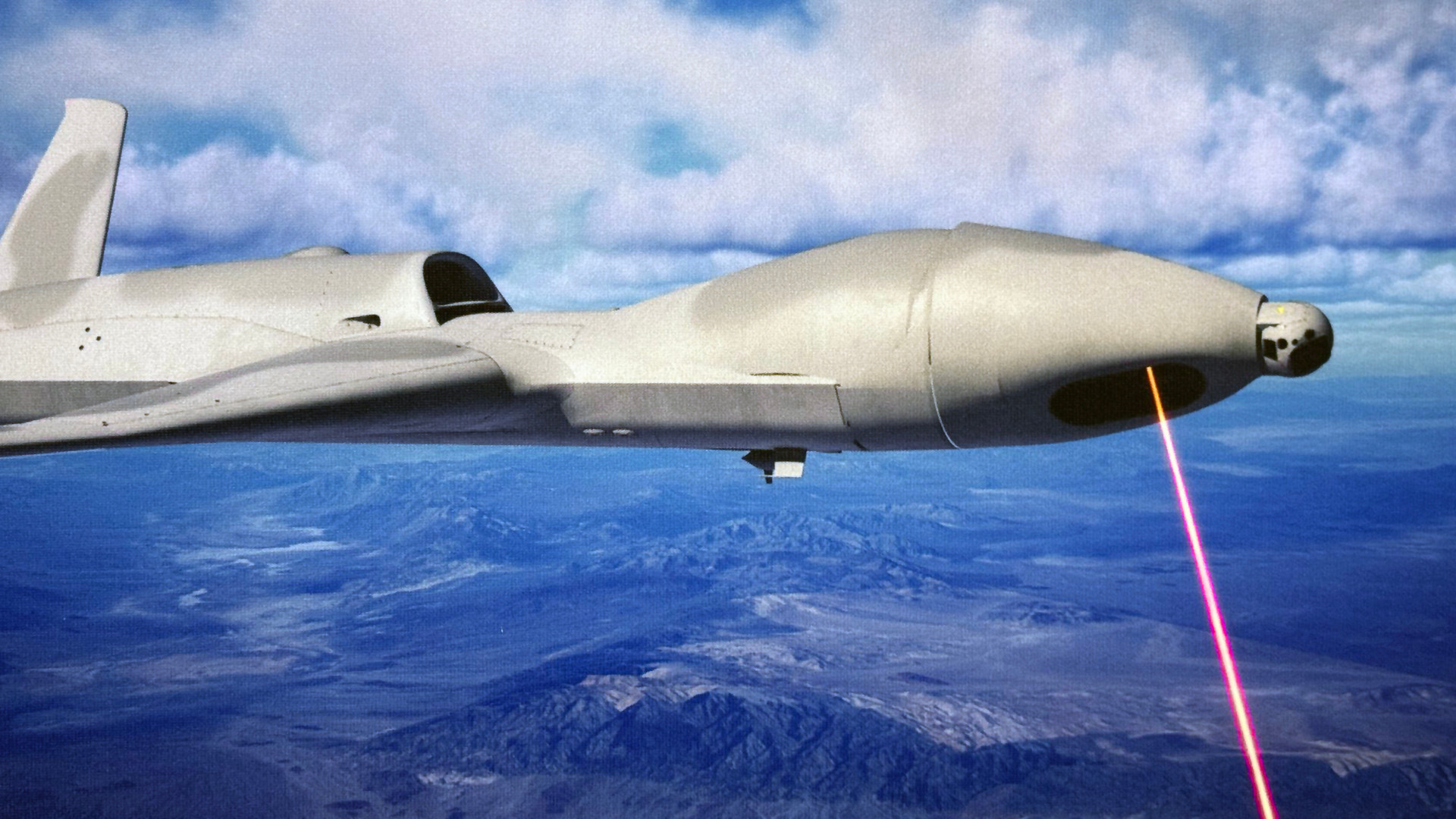
General Atomics recently showed what it says is a rendering of an MQ-20 Avenger drone armed with a laser directed energy weapon. The laser beam is depicted projecting through a fully rotating nose cone turret fitted in place of its normal nose section. The company says this is a purely conceptual design, but it reflects a broader exploration of potential laser armament for uncrewed aircraft across its portfolio, including members of the highly modular Gambit family – and that it could be closer to becoming an operational reality than one might expect.
The depiction of the laser-armed Avenger was seen in a brief video at General Atomics’ booth at the Association of the U.S. Army’s (AUSA) main annual convention last week. Naval News‘ Carter Johnston spotted the interesting clip and was kind enough to share a picture he grabbed of it, seen at the top of this story and in the social media post below. Though said to be a render, whether the imagery may have been composited, even in part, from real pictures is unclear.
In broad strokes, laser directed energy weapons mounted on aircraft, as well as ground-based platforms and ships, offer the promise of fast-as-light precision engagements against various types of targets in offensive and defensive contexts. There is also the benefit of largely unconstrained magazine depth, as long as there is sufficient power and cooling capacity. In addition, laser weapons are silent, and their beams are often not visible to the naked eye, which could help enable covert attacks, or otherwise contribute to chaos and confusion among enemy forces, depending on the exact engagement scenario. There are also limitations to laser weapons, especially due to power limitations and environmental factors, which you can read more about here.
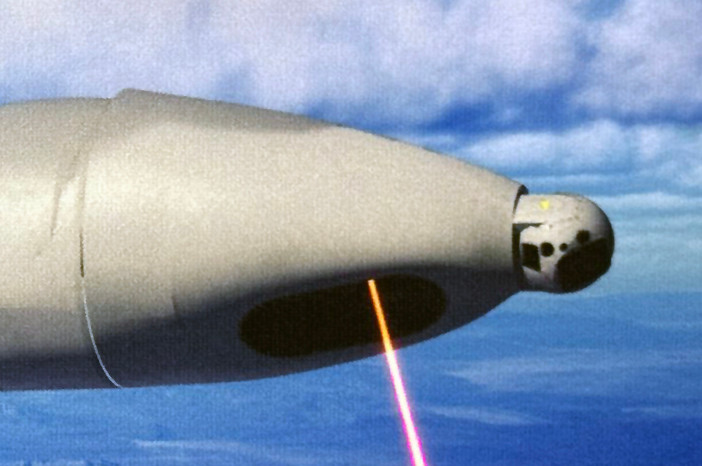
As noted, the rendering shows an Avenger with a completely new nose section, the core body of which rotates laterally and has an aperture through which the laser is projected. There is also a ‘ball’ type sensor turret, which are typically fitted with a combination of electro-optical and infrared cameras, as well as laser rangefinders and/or designators, at the very tip of the nose. Avengers have been seen over the years with similar sensor balls under their noses as a standard feature. Avenger is something of a curiosity itself, with the most significant operator to date understood to be the U.S. Central Intelligence Agency (CIA). Publicly, the drones, which have some low observable (stealthy) features, are mostly widely seen used as experimental testbeds.
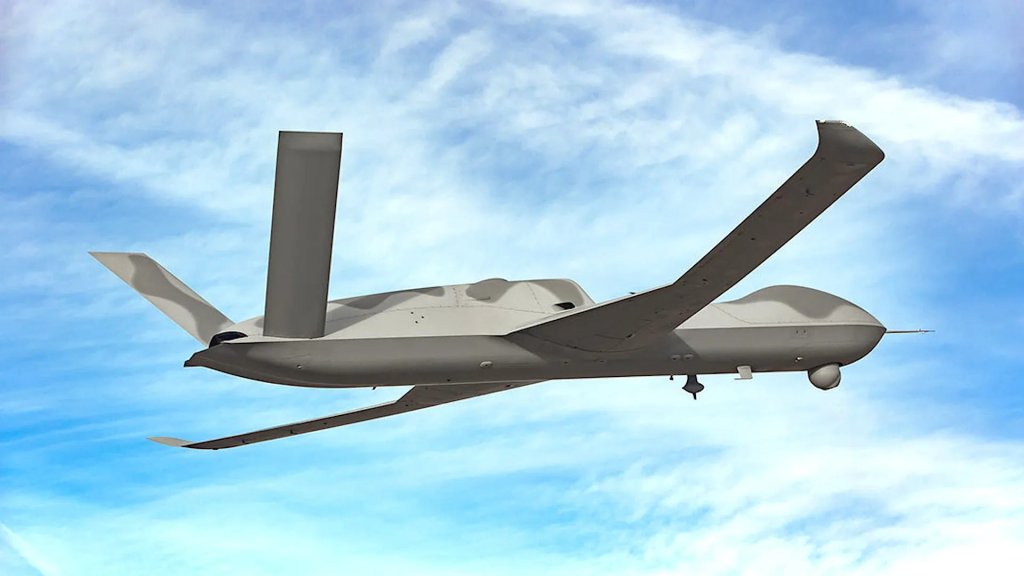
“What visitors saw at AUSA was a conceptual render and short animation of an MQ-20 Avenger with a high-energy laser (HEL) system. Both of those are existing General Atomics products, and a natural fit for us to use when describing the concept — instead of any specific government program or contract,” C. Mark Brinkley, a spokesperson for General Atomics, told TWZ when asked for more details. “The display was meant to simply convey that General Atomics continues to lead on research and development of both combat laser systems and uncrewed combat air vehicles (UCAVs). We are certainly exploring how those products could be combined to provide a variety of new opportunities for warfighters, including counter-UAS [counter-uncrewed aerial systems] and other uses.”
“I wouldn’t read too much into the actual visuals of the Avenger and laser depicted in that render,” he added. “A final version could take many forms — as a podded system on an MQ-9B or Gray Eagle STOL, for instance, or as an integrated weapon on our Gambit family of combat jets. The bottom line is that General Atomics continues to invest our own money into advancing UCAVs and lasers, both individually and as integrated systems. We remain excited about the future of that work.”

TWZ followed up on the prospect of one or more Gambit designs being equipped with an integrated laser directed energy weapon.
“I think that’s a real possibility, and on a future timeline that’s closer than many people might think,” Brinkley said in response. “I don’t want to get into TRL [technology readiness levels] or any of those specifics, but combining General Atomics’ established work in high-energy lasers with our advanced Gambit Series of uncrewed jets is certainly a future we can all imagine.”
General Atomics officially unveiled the Gambit family in 2022. The key element of Gambit is a common core ‘chassis,’ which includes landing gear, as well as key mission and flight control computer systems, which can then be paired with a wide array of different ‘body kits.’ The company’s experimental XQ-67A drone, originally developed for the Air Force’s once-secretive Off-Board Sensing Station (OBSS) program, helped prove out the concept. Work on the XQ-67A and Gambit have also been feeding into the YFQ-42A, which General Atomics is now developing under the first phase, or Increment 1, of the Air Force’s Collaborative Combat Aircraft (CCA) program.

It should be stressed that General Atomics has a long history of work on high-energy laser directed energy weapons conducted through its Electromagnetic Systems division (GA-EMS). Last week was also hardly the first time the company’s Aeronautical Systems, Inc. division (GA-ASI) has shown renderings of drones in its portfolio armed with laser weapons or otherwise talked about relevant work in this regard.
In the late 2010s, General Atomics notably openly discussed plans to test a variant or derivative of the High Energy Liquid Laser Area Defense System (HELLADS) on Avenger. HELLADS was a U.S. Defense Advanced Research Projects Agency (DARPA) effort with a stated focus on proving out a high-energy laser directed energy weapon system that could be used to swat down incoming artillery rockets and shells, and mortar rounds. Whether a HELLADS/Avenger demonstration ever occurred is unclear.

It is also worth noting that the U.S. Missile Defense Agency (MDA) had also hired Lockheed Martin in the late 2010s timeframe to demonstrate a laser directed energy weapon that a high-altitude, long-endurance drone could carry and use to shoot down enemy ballistic missiles during their vulnerable boost phase. By 2020, MDA had openly cooled to this idea, citing significant technical hurdles. Lockheed Martin had also been involved in HELLADS, among other U.S. military laser weapon programs. MDA did conduct tests in the late 2010s involving General Atomics MQ-9s with specialized sensor turrets installed at the front of their noses, which were intended to help spot and track ballistic missiles.

Just in April, General Atomics also showed a new concept for a podded directed energy laser weapon, which could be carried by its MQ-9 Reaper-series drones, and potentially other aircraft, at the Navy League’s Sea Air Space 2025 conference. At that time, the company heavily touted that pod’s potential value as a tool for knocking down incoming long-range one-way attack drones.
Other companies in the United States, including Raytheon, Northrop Grumman, and Boeing, have done work over the years on laser weapons, including for aerial applications, as well. Back in 2022, one of two stealthy Model 401 “Son of Ares” jets, built by Scaled Composites, a Northrop Grumman subsidiary, was spotted with a ventral pod with ‘shark with frickin’ laser beam’ artwork on the side, though its meaning, beyond a reference to a well-known scene from the 1997 Mike Myers spy comedy Austin Powers, was unclear.
It’s also worth noting here that the U.S. Air Force has, at least in the past, described directed energy weapons as a key element of the Next Generation Air Dominance (NGAD) initiative. Directed energy is an often overlooked aspect of NGAD, which encompasses a wide array of efforts, including the much higher profile F-47 sixth-generation fighter and the CCA drone program.

In general, technological developments in the past few decades have helped make solid-state lasers, in particular, viable weapons, as you can read more about in this past TWZ feature. Advances in the miniaturization of various components have further contributed to their feasibility. Armed forces around the world, including the U.S. military, as well as China’s People’s Liberation Army (PLA), have been working steadily to field various tiers of laser directed energy weapons, especially in ground-based and shipboard configurations.
However, the U.S. military has been open about the technical challenges it has continued to run up against in truly operationalizing many directed energy capabilities, especially in the aerial domain. In March 2024, the Air Force scrapped plans to flight test a laser directed energy weapon on an AC-130J Ghostrider gunship after years of delays. Just two months later, the service confirmed that its Self-protect High Energy Laser Demonstrator (SHiELD) program had concluded without achieving its stated goal of testing that system on a fighter, and that it had no plans to pursue that effort further.
While General Atomics says the recently emerged rendering of the laser-armed Avenger is currently just a concept, it does reflect real work the company has been doing for years already and underscores broader global trends. The company is clearly of the view that drones carrying lasers, including members of its Gambit family, are increasingly close on the horizon.
Contact the author: joe@twz.com
Loading comments…
Comments couldn’t be loaded. Please refresh the page.