
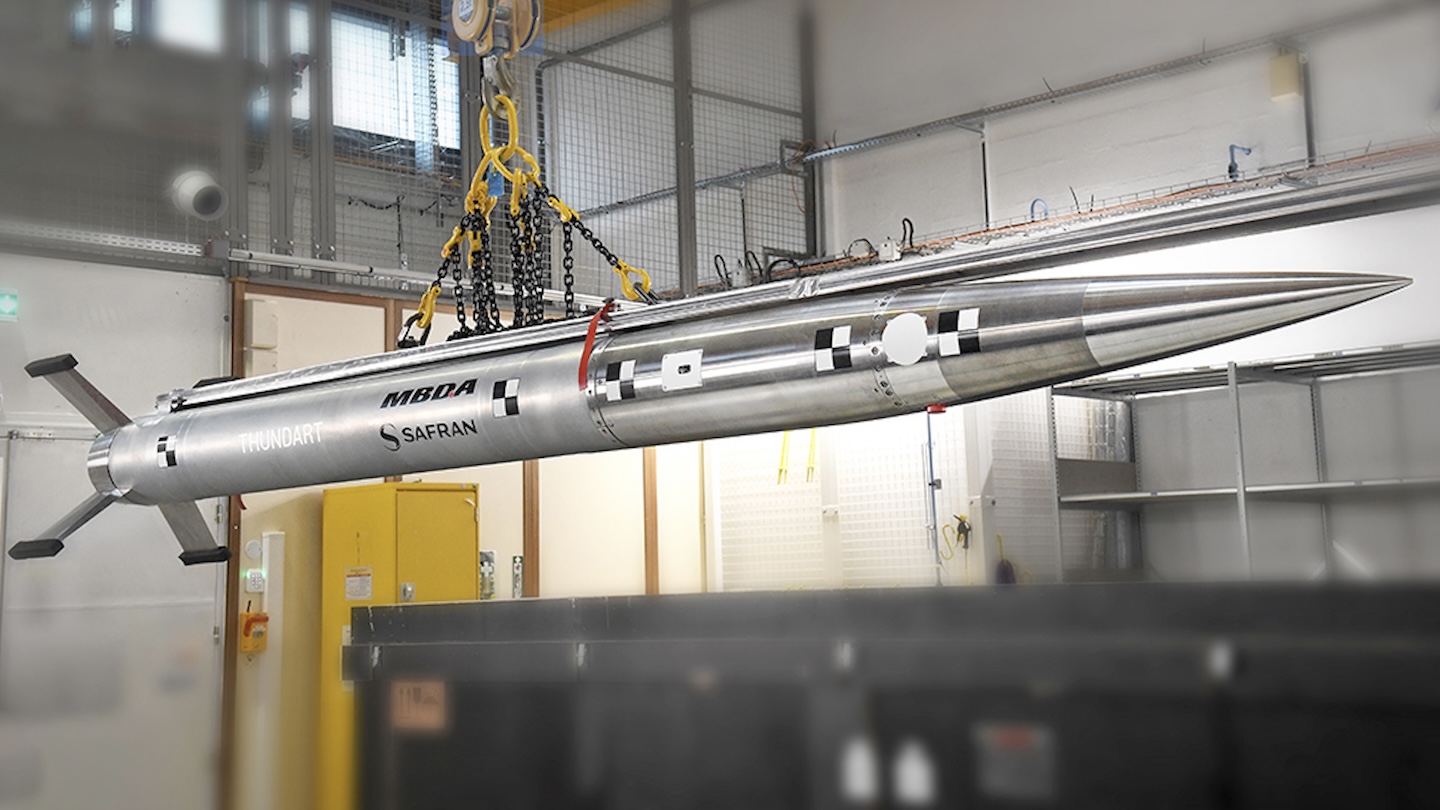
European missile house MBDA has, for the first time, shown an example of its Thundart surface-to-surface rocket, the result of a rapid development program as France looks to significantly expand the range of its land-based strike capabilities. Billed as a domestically produced alternative to the U.S.-made Army High Mobility Rocket System (HIMARS), Thundart reflects growing interest, especially in Europe, in long-range precision fires.
A first photo of the Thundart 227mm guided artillery rocket, in this case, a test round, was published on X by MBDA yesterday. December 4 is the feast day of Saint Barbara, recognized in France (and elsewhere) as the patron saint of artillery operators, among others.
The Thundart is a result of the Long-Range Land Strike (FLP-T) program, launched in 2023 by the French Defense Procurement Agency (DGA). With the aim of developing a tactical strike capability with a range of 93 miles (150 kilometers), the FLP-T program involves two industrial teams: MBDA and Safran, responsible for Thundart, and another combining Thales and the ArianeGroup. Few details are available about this rival effort.
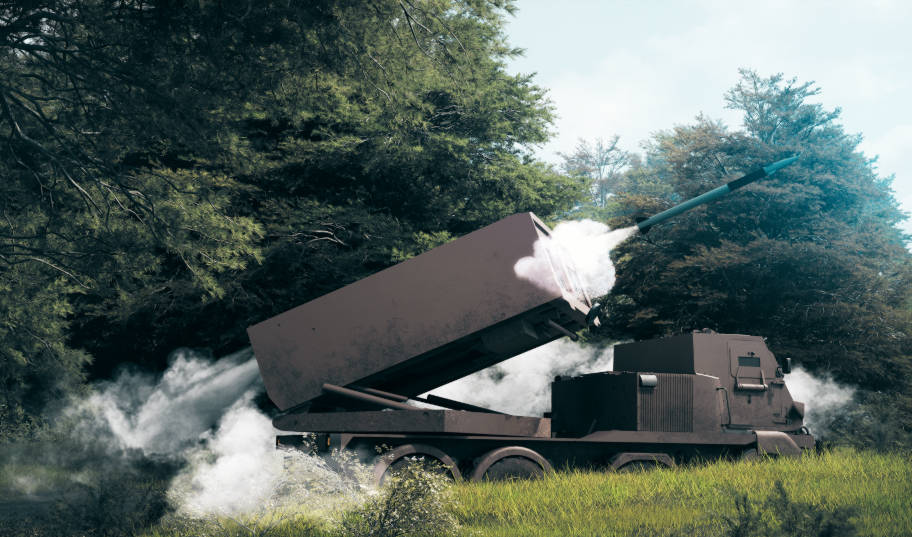
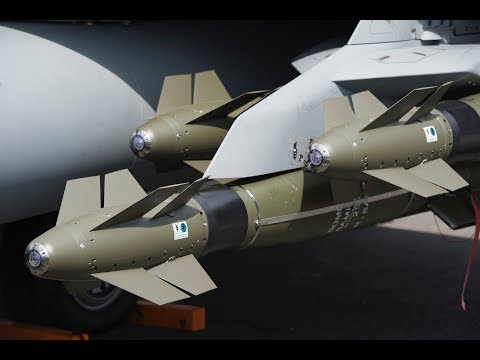
Work started on Thundart in late 2023, and it was first presented in mockup form at the Eurosatory defense show in June 2024. The guidance package is said to be very similar to what Safran produces for its AASM Hammer rocket-assisted bombs. All Hammer versions feature a GPS-assisted inertial navigation system (INS) guidance package that is designed to strike static targets. But there are also multi-mode guidance options that add either imaging infrared or semi-active laser homing modes. Multi-mode guidance allows the weapons to be used against moving targets and enhances overall accuracy, especially in GPS-denied environments.
Meanwhile, the fire-control system will be derived from that used in the French Army’s CAESAR self-propelled howitzer. Both the Hammer and CAESAR have been proven in combat in Ukraine.

FLP-T calls for technical solutions from each team that can be tested during demonstration firings by mid-2026, after which the French government will decide which solution to pursue, or whether it will instead purchase off-the-shelf equipment.
The notably ambitious timeline is based on the urgent need to replace the French Army’s current Lance-Roquettes Unitaire (LRU), a modified version of the M270 Multiple Launch Rocket System (MLRS). The M270 can fire 227mm artillery rockets, as well as ATACMS short-range ballistic missiles, but the French version only uses the rockets.

The longest-range artillery rockets currently available for the MLRS are GPS/INS guided and can hit targets out to around 43 miles (70 kilometers). The far larger ATACMS missiles can engage threats out to 186 miles (300 kilometers), depending on the variant.
The French Army’s nine LRU systems are due to be withdrawn in 2027.
According to Defense News, France’s defense spending plan from 2024 to 2030 has budgeted €600 million ($663 million) for the FLP-T program and aims to buy at least 13 systems by 2030 and 26 systems to equip a battalion by 2035.
The French Army chief of staff has deemed that the new long-range tactical strike capability is “essential,” and there is pressure from politicians and the military to acquire a domestically developed option.
There remains a question, however, as to whether a French-developed weapon, namely Thundart or its rival, can secure many other orders, at least within Europe.
Some countries remain committed to U.S.-made products.
The United Kingdom ordered more examples of the MLRS for the British Army. Meanwhile, it is also looking toward future requirements, including potentially a new battlefield ballistic missile, a class of weapon that it last fielded back in the Cold War.
Meanwhile, the HIMARS has been acquired by Estonia, Italy, Latvia, Lithuania, and Romania.
The Israeli-made PULS (Precise and Universal Launch System) multiple rocket launcher has been selected by Denmark, Germany, the Netherlands, and Spain. PULS has a range of up to 186 miles (300 kilometers), according to the manufacturer, Elbit Systems.

Germany is also pursuing a Europeanized version of PULS, in a collaboration between KNDS and Elbit, while Rheinmetall has teamed up with Lockheed Martin to develop the Global Mobile Artillery Rocket System (GMARS), a wheeled multiple rocket launcher similar to the MLRS.
Inroads have also been made in Europe by South Korea’s Hanwha Aerospace, which produces the Chunmoo, as purchased by Poland as part of a major defense-spending spree, in which South Korean products have figured prominently. The Polish version of the Chunmoo is the Homar-K, with a maximum range of approximately 180 miles (290 kilometers), according to the manufacturer. Poland also uses the U.S.-made HIMARS.
This leaves Norway and Sweden as the two main European nations that plan to acquire new rocket artillery systems, although it’s questionable whether the result of the FLP-T program would be ready in time to meet these Nordic requirements.
On the other hand, there is certainly a growing push within the European Union to “buy local,” rather than rely on the United States for its major arms requirements. This is a path that France has been following for a while, but the option of a fully European alternative to HIMARS could be very well timed, considering the changing political winds on the continent.
Thundart will also be independent of U.S. export restrictions. Specifically, it will not be covered by the U.S. government’s International Traffic in Arms Regulations (ITAR). An ‘ITAR-free’ guided rocket artillery system would be exportable to any country without any need for approval from the United States, which often creates additional hurdles for third-party countries.
There is also scope for further guided rocket artillery developments that could be pursued as a follow-on to the FLP-T program.
The French Ministry of Defense is also looking for a longer-range system, perhaps using hypersonic missiles, which could have a range of between 311 and 621 miles (500 and 1,000 kilometers). The DGA has requested that both consortia in the FLP-T program look into the cost and feasibility of such a system.
Separately from this, France is also involved in the European Long-Range Strike Approach (ELSA). This was launched by France, Germany, Italy, and Poland, and both Sweden and the United Kingdom subsequently joined.
The ELSA effort calls for the development of a new capability for “long-range strikes,” although the type of weapon being pursued is not mentioned.
Ultimately, it seems that ELSA will seek to provide a weapon with a range of between 621 and 1,243 miles (1,000 and 2,000 kilometers), which means there could be some overlap with the longer-range system that is being eyed as a follow-on to FLP-T.
ELSA calls for systems to be fielded between 2030 and 2035, and MBDA has already offered its Land Cruise Missile (LCM) system, a ground-based version of the company’s Naval Cruise Missile (NCM), as a short-term solution. You can read more about it here.
Returning to France, the war in Ukraine and the changing security situation in Europe underscore the need for land-based strike capabilities with a range considerably in excess of the roughly 43 miles (70 kilometers) achieved by the current MLRS.
As well as greater reach, the FLP-T program aims to give the French Army a system that offers increased firepower, enhanced saturation capability, and greater responsiveness, including against moving targets. Other key features will include high mobility, with an off-road-capable chassis, and a greater degree of autonomy in terms of infrastructure and support assets.
Another factor of growing importance, especially as regards precision standoff munitions, is the ability to procure weapons of this kind at relatively low cost and to scale up production, when required, to meet the demands of high-end contingencies. The planned unit cost of the system to be selected under the FLP-T program hasn’t been revealed. However, MBDA says that its factories in the Centre-Val de Loire region are already “geared up for the mass production of tactical ammunition in this format.”
Once again, the highly ambitious timeline for the FLP-T program means it remains questionable whether France will eventually opt for Thundart, the rival solution from Thales/ArianeGroup, or if it will go for a lower-risk off-the-shelf system. Regardless, the fact that France has such an urgent requirement for a weapon in this class further underscores the growing interest in land-based standoff strike capabilities, both in Europe and elsewhere.
Contact the author: thomas@thewarzone.com
Loading comments…
Comments couldn’t be loaded. Please refresh the page.