

A new cruise missile called Flamingo, which reportedly has a range of 1,864 miles (3,000 kilometers), has emerged in Ukraine and is said to have already been used to strike targets in Russia. A weapon with this range, something Ukraine has been teasing for some time now, would allow it to hold targets at risk well beyond the reach of other missiles known to be in its arsenal.
Associated Press photojournalist Efrem Lukatsky first revealed the existence of Flamingo in a post on Facebook yesterday. Along with an accompanying photo and the aforementioned range claim, he stated that the missile is in series production through a Ukrainian company called Fire Point.
Today, Ukrainian outlet Ukrainska Pravda released two videos of Flamingos being launched from rails mounted on two two-axle trailers. The missiles are shown climbing sharply right after launch. The clip seen immediately below is also said to show them being used in a real strike on Russia.


Ukrainska Pravda‘s report said that the missile’s warhead weighs around 2,535 pounds (1,150 kilograms), but does not cite any source for that information, as well.
Other details about Flamingo, including how it is guided to its target, are scant. At the time of writing, Ukrainian authorities do not appear to have confirmed any specifics about the missile. Ukrainian Defense Minister Denys Shmyhal said today that more information will be released “when the right moment comes.”
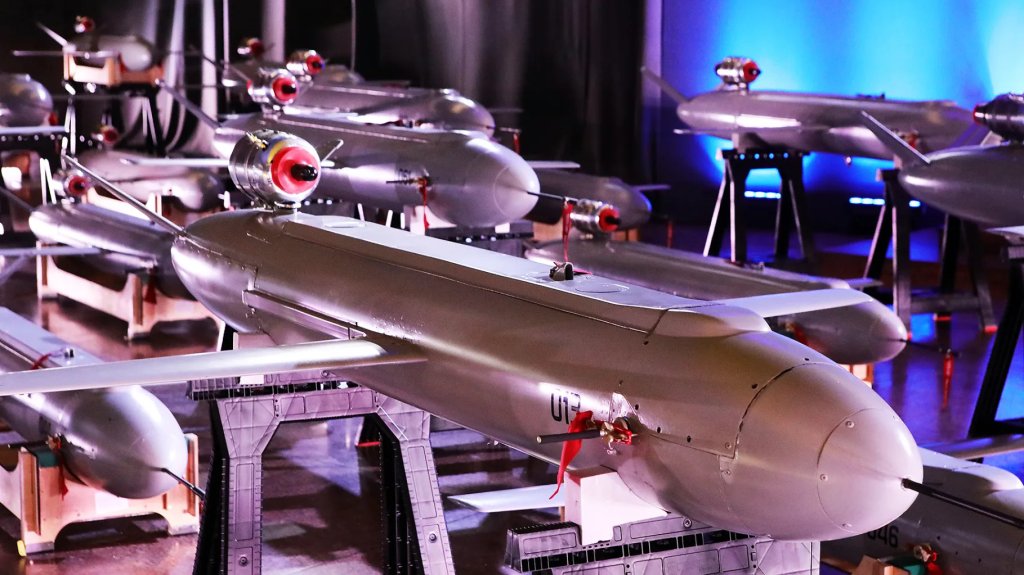
Intriguingly, the Flamingo is extremely similar, if not identical to a cruise missile design called the FP-5 previously exhibited by Milanion, a company based in the United Arab Emirates. This same firm has provided materiel to the Ukrainian armed forces in the past. Whether the “FP” in FP-5 stands for Fire Point is unknown.
Milanion says that the FP-5 also has a 1,864-mile/3,000-kilometer maximum range. A fact sheet on the company’s website, reproduced below, also lists a top speed of 590 miles per hour (950 kilometers per hour) and a cruising speed of 528-559 miles per hour (850–900 kilometers per hour).
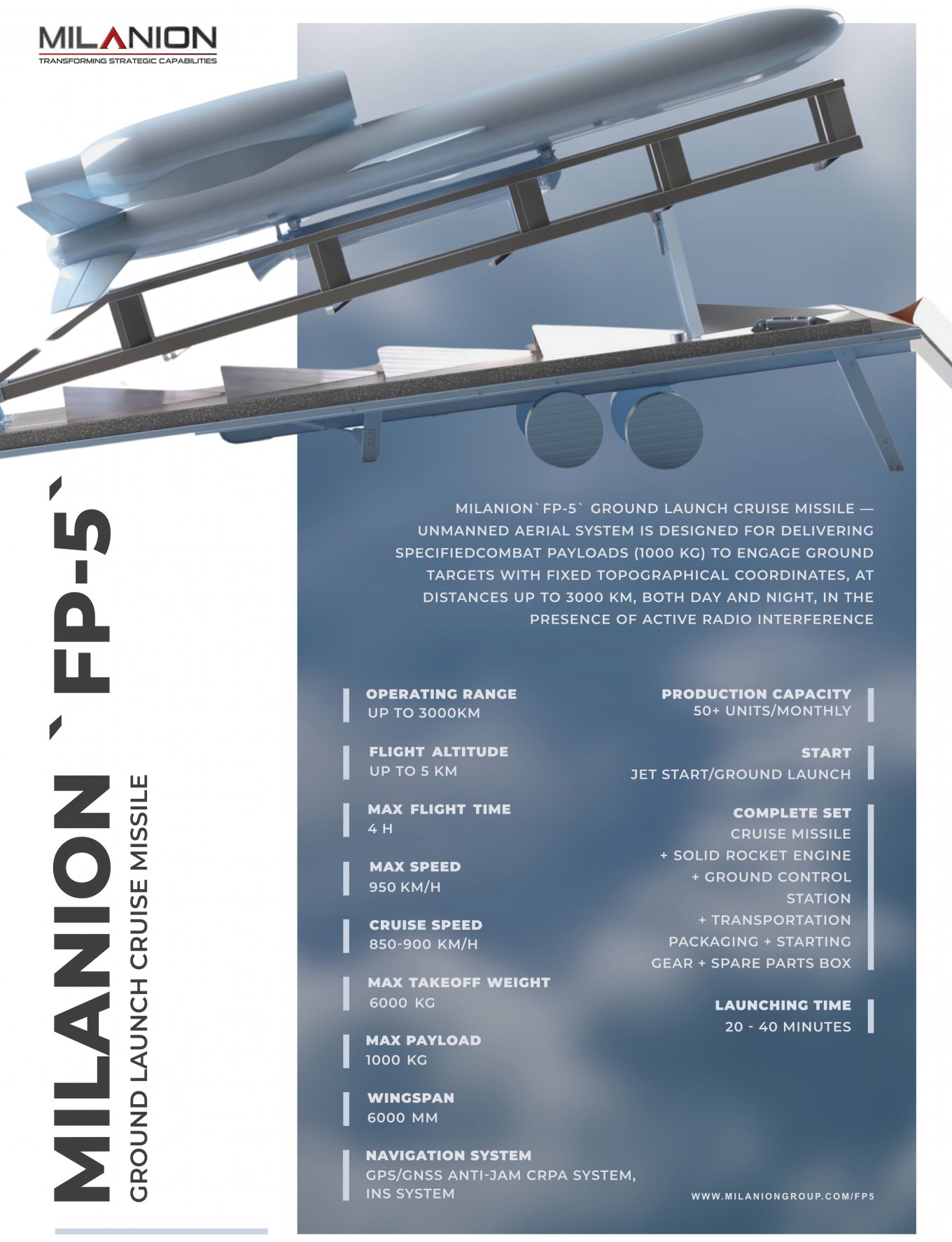
The FP-5 missile is notably large, with a wingspan of six meters (19.6 feet), a maximum takeoff weight of 13,228 pounds (6,000 kilograms), and a warhead weighing 2,205 pounds (1,000 kilograms), according to the fact sheet. It also includes a rendering of the missile prepared for launch on a two-axle trailer.
In terms of guidance, Milanion says the FP-5 uses a combination of methods, including various types of satellite navigation. The company says it is designed to be resistant to electronic warfare attacks. An underlying inertial navigation system is likely to be present.
It should be stressed that the exact relationship between the FP-5 and Flamingo is unknown, and that the performance specifications and other capabilities of the Ukrainian missile could differ in various ways.
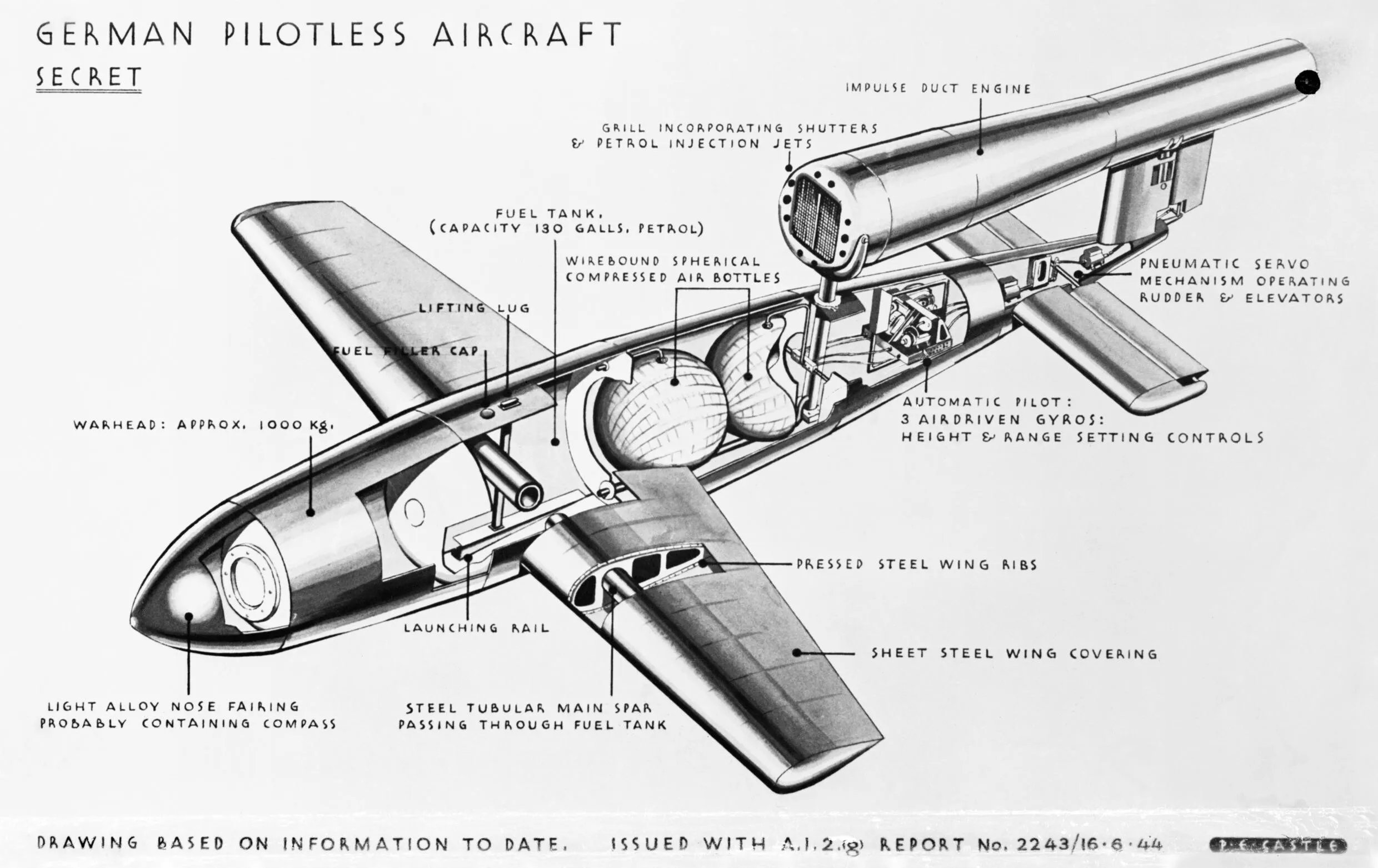
Broader comparisons have also been drawn between the Flamingo and Nazi Germany’s V-1 flying bomb, which was fired via fixed-rail launchers and was powered by a primitive pulse-jet propulsion system, although these are superficial at best.
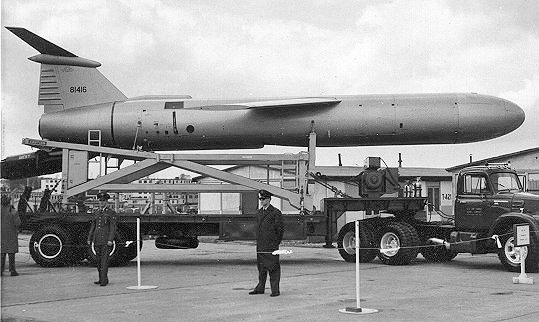
Observers have also drawn parallels between the Flamingo and the U.S. MGM-13 Mace, another ground-launched subsonic cruise missile that was inspired by the V-1 concept. Starting in 1959, the Mace was fielded by the U.S. Air Force across Western Europe, where they were aimed at Soviet targets. It had a range of around 1,400 miles and was similarly launched from a trailer, or alternatively from an underground bunker.
Ukraine has also previously turned Soviet-era Tu-141 and Tu-143 reconnaissance drones, which are similar in some broad strokes to the Flamingo’s basic design and are launched via rails on the ground, into long-range strike weapons.
![Ту-141 "Стриж" (ВР-2) Повітряних сил України [вересень 2021] thumbnail](https://i.ytimg.com/vi/A7mRdxPqT4c/hqdefault.jpg)
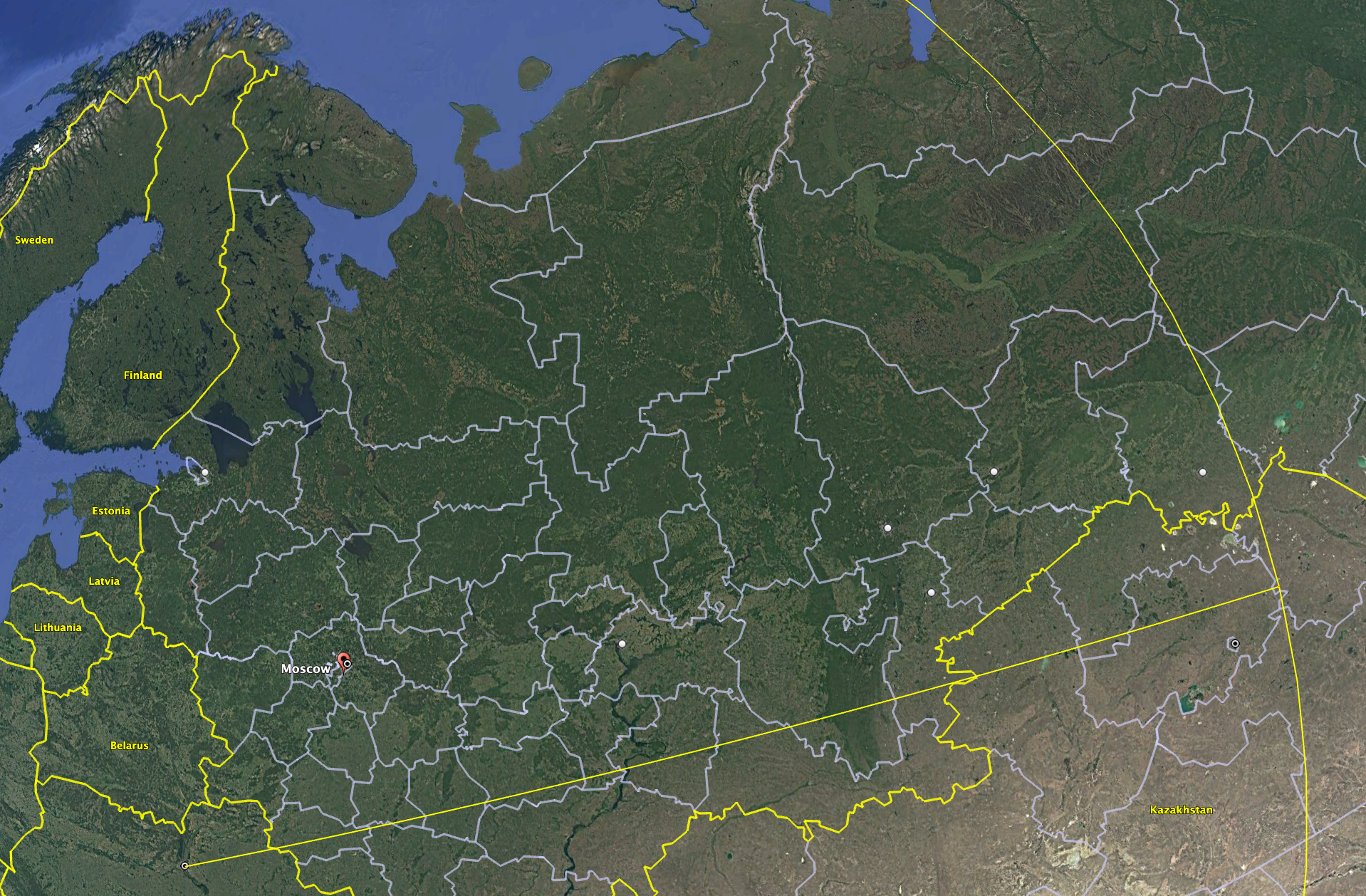
Regardless, a new cruise missile able to reach targets out to 1,864 miles/3,000-kilometers would put anywhere in central Russia under threat, including the capital Moscow and the country’s second largest city of St. Petersburg. The Flamingo could even reach as far as parts of Siberia.
The Flamingo is not the first Ukrainian foray into ground-launched cruise missiles. There is also a land-attack version of the Neptune anti-ship cruise missile, which Ukraine’s armed forces began using operationally in 2023. A Ukrainian defense official told TWZ in the past that the land-attack version of this subsonic missile could have a range of up to 225 miles. Ukraine has also received Storm Shadow and SCALP-EG air-launched cruise missiles from the United Kingdom and France, respectively, as well as Army Tactical Missile System (ATACMS) short-range ballistic missiles from the United States. However, none of them have similar ranges to what is claimed for Flamingo.
Ukraine has also unveiled a number of other designs that skirt the increasingly blurry line between long-range kamikaze drones and cruise missiles, including Palianytsia, Peklo, and Trembita. However, these all have much shorter ranges than the reach Flamingo is said to offer. This is on top of the country’s other long-range one-way-attack drone capabilities, which have already given it the reach to attack Moscow and other far-flung targets inside Russia.
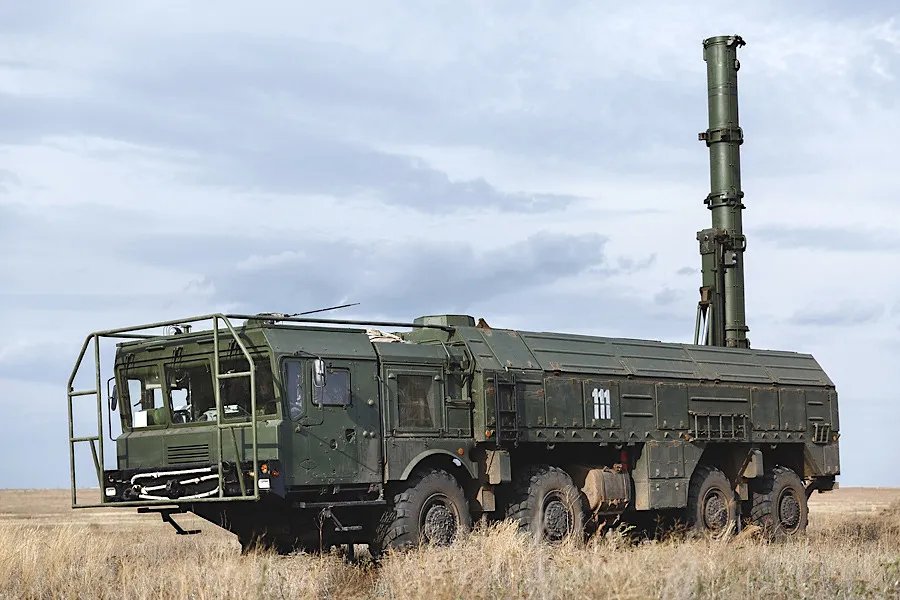
Ukraine has been working on developing new ballistic missiles, but the longest-range one of these, as far as is known, is the Hrim-2. According to reports, this missile has a range of 174 miles or possibly up to 310 miles, which puts it in the same kind of class as Russia’s Iskander-M, rather than a weapon with strategic reach.
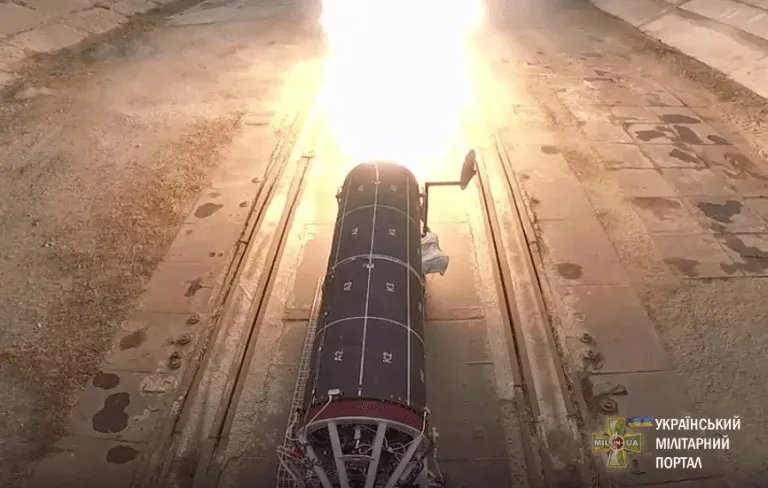
With a warhead weighing 2,535 pounds/1,150 kilograms, Flamingo would be far more destructive than any missile or one-way-attack drone available to Ukraine now, as well. This would give Ukrainian forces the ability to not only reach valuable targets much further away inside Russia, but also potentially inflict heavier damage on them.
Flamingo’s conventional jet-powered cruise missile design also offers speed and other benefits for penetrating deeper into Russia, especially compared to the converted light aircraft and similar types of drones it has often employed for very-long-range strikes.
With its claimed range, Flamingo would also notably offer Ukraine a strike capability in line with Russia’s Kalibr. Russian forces have heavily employed Kalibr in the ongoing conflict. Launched from ships or submarines, it is also subsonic and is thought to have a range of between 930 and 1,550 miles, carrying a high-explosive warhead weighing 990 pounds.
Footage of a (presumed Kalibr) cruise missile strike on Ivano-Frankivsk Air Base in western Ukraine in 2022:
Russia has also used ground-launched land-attack cruise missiles in the conflict, notably fired from the Iskander system, which is better known for firing short-range ballistic missiles. The 9M728 cruise missile that the Iskander can also fire has a range that keeps it within the 500-km (310-mile) limit of the now-defunct 1987 Intermediate-Range Nuclear Forces (INF) Treaty, according to official Russian accounts.
Perhaps just as importantly for Ukraine as the missile’s purported prodigious range is its possible optimization for mass production, with a correspondingly low price point, which are among the touted benefits of the FP-5. Large numbers of Flamingo missiles launched in barrages would be a serious problem for Russian air defenses, which already struggle with less capable long-range weapons Ukraine has been lobbing at them. Combinations of drones and cruise missiles would really put the pressure on Russia, even though, with its subsonic speed and what looks like zero attempts at signature control, the Flamingo is far from immune to interception. Adding decoys to the mix would further complicate matters for Russia’s air defenders.
In addition, since it has not been donated by Western allies, Ukraine would have more freedom to use the Flamingo against any targets that it wishes within Russia. These might include the strategic bomber bases and other airfields that Ukraine has already struck using different methods, as well as energy infrastructure and key logistics hubs, which have meanwhile been bombarded by drones, generally carrying much less destructive warheads.
It is perhaps also no surprise that the existence of the Flamingo has been revealed at this point, after U.S. President Donald Trump’s meeting with his Russian counterpart, Vladimir Putin, in Alaska. The Facebook post from Associated Press photojournalist Lukatsky also came right before today’s talks with Ukrainian President Volodymyr Zelensky.

The appearance of the Flamingo underscores Ukraine’s ability to continue to field new and more destructive weapons, as well as threaten targets over much greater swathes of Russia. It’s also a reminder to the Kremlin that, should it choose to, and provided Flamingo production can be ramped up, Ukraine would also be able to launch missile barrages against Russian cities, in the same way that Moscow has done, to considerable destructive effect.
Whether the Flamingo will fulfill its obvious potential remains to be seen. As well as perfecting its technologies, much will depend on how many of these weapons the Ukrainian industry is able to churn out. At the very least, the appearance of this cruise missile reiterates Ukrainian ingenuity in fielding new and innovative weapons to counter the Russian invasion.
Contact the author: thomas@thewarzone.com
Loading comments…
Comments couldn’t be loaded. Please refresh the page.