
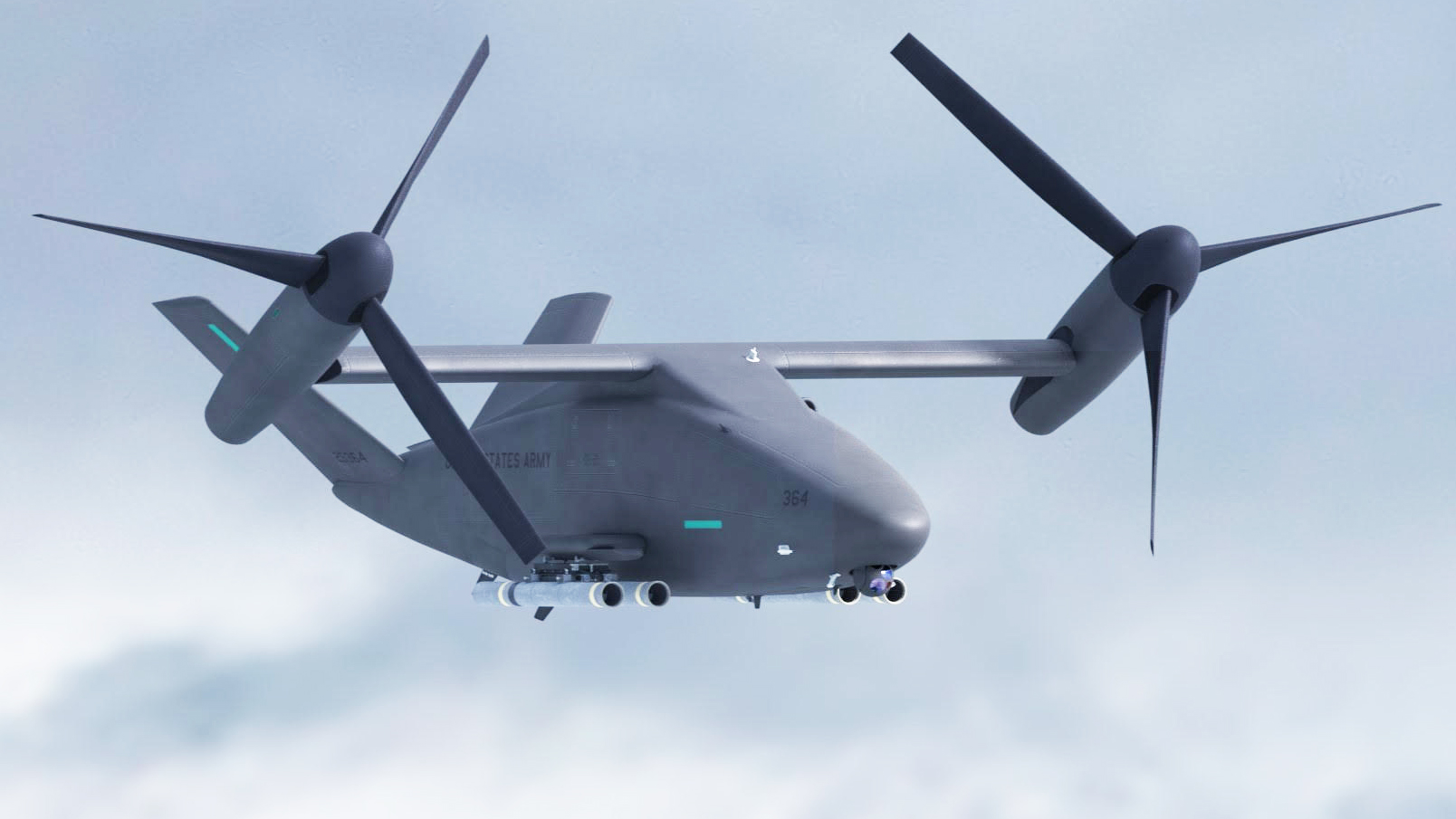
Boeing has announced plans for a family of new, tiltrotor drones that are intended to support existing crewed military helicopters, especially those of the U.S. Army, providing something like an equivalent to the U.S. Air Force’s Collaborative Combat Aircraft (CCA). Indeed, the company describes the drones as “collaborative rotorcraft” and expects them to serve alongside more conventional helicopters undertaking attack, logistics, and other types of missions.
Renderings were revealed today by Boeing at the Association of the United States Army (AUSA) tradeshow. At least two rotary-wing drones are currently projected, both based on a tiltrotor design, drawing upon the company’s experience with the proven V-22 Osprey. However, the modular concept means more mission versions of the drones will be possible.
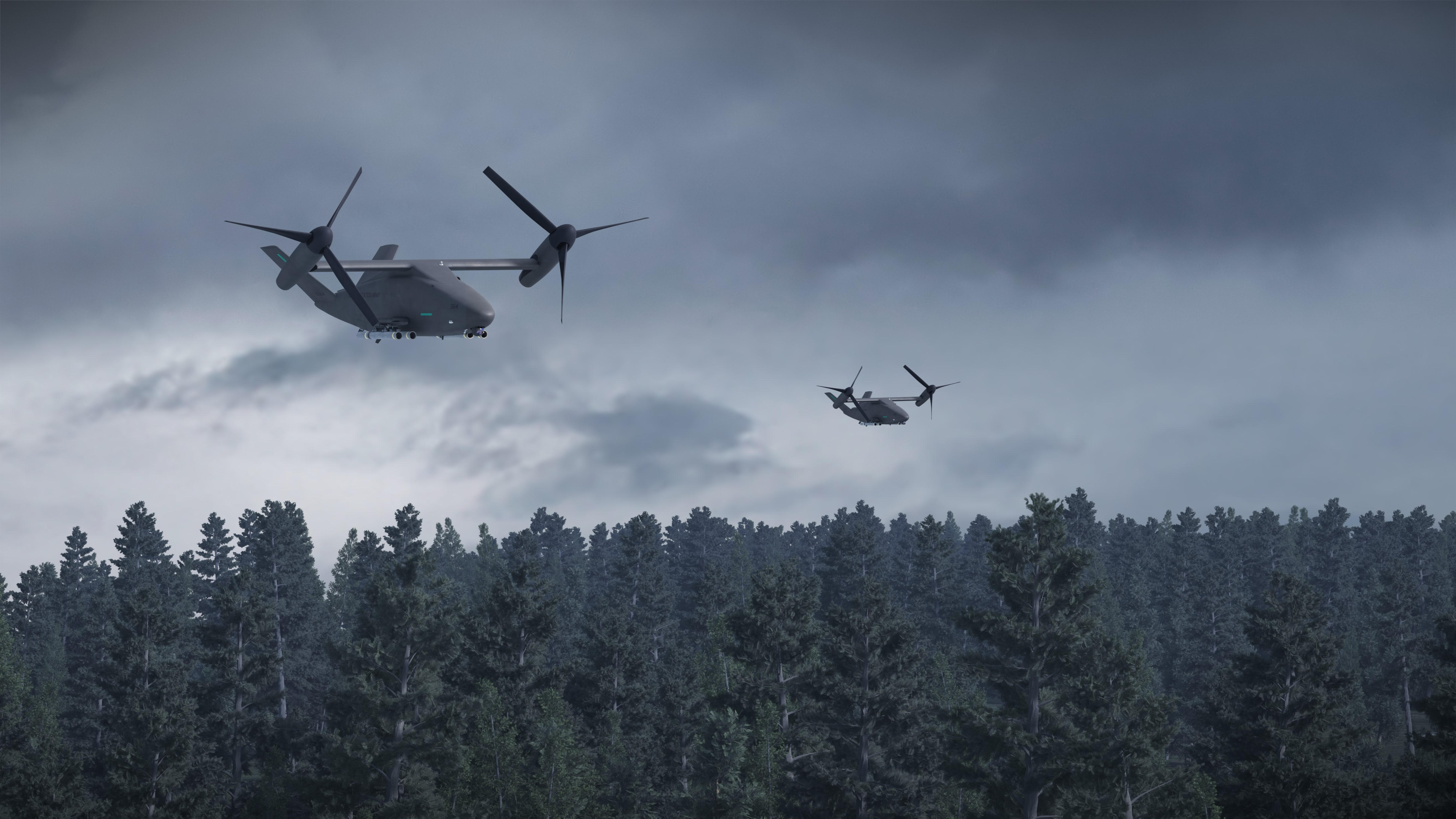
Boeing describes the drones as “completely uninhabited,” with no plans for them to be offered as optionally piloted platforms.
In each case, the drone has a high wing and a V-tail. Each will be powered by a single turboshaft engine driving a pair of prop-rotors. Boeing chose this “classic” powerplant option as it considered it the most mature technology, making it easier to get the drones into service rapidly. As part of its evolution, however, other propulsion systems might well be offered in the future, Boeing says, including hybrid electric/gas turbine.
Boeing has said that the drones will likely have a maximum gross weight in the region of 5,000 to 7000 pounds, including a payload in the range of 1,000 to 2,000 pounds, depending on range and specific mission load-out.
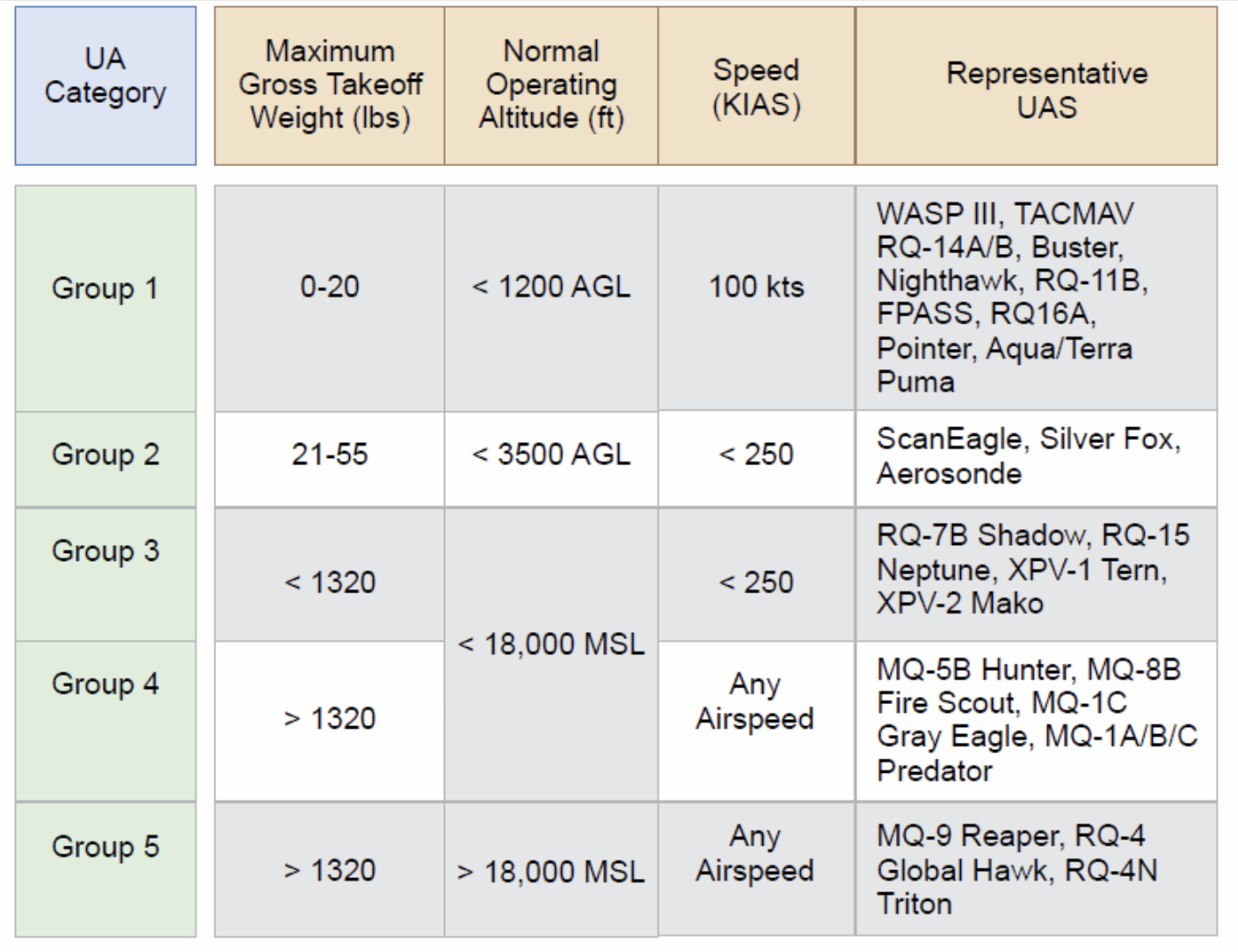
Speaking to journalists ahead of AUSA, Chris Speights, chief engineer for Boeing Defense’s Vertical Lift division, said the drones will have “relevant range [and] relevant payloads […] to truly be collaborative,” meaning they can keep up with a crewed helicopter’s mission profile. The drones will be in the Group 4 or 5 category. Of these, Group 4 encompasses drones weighing over 1,320 pounds, and operating at altitudes usually below 18,000 feet, while Group 5 covers the same weight category, but typically flying above 18,000 feet.
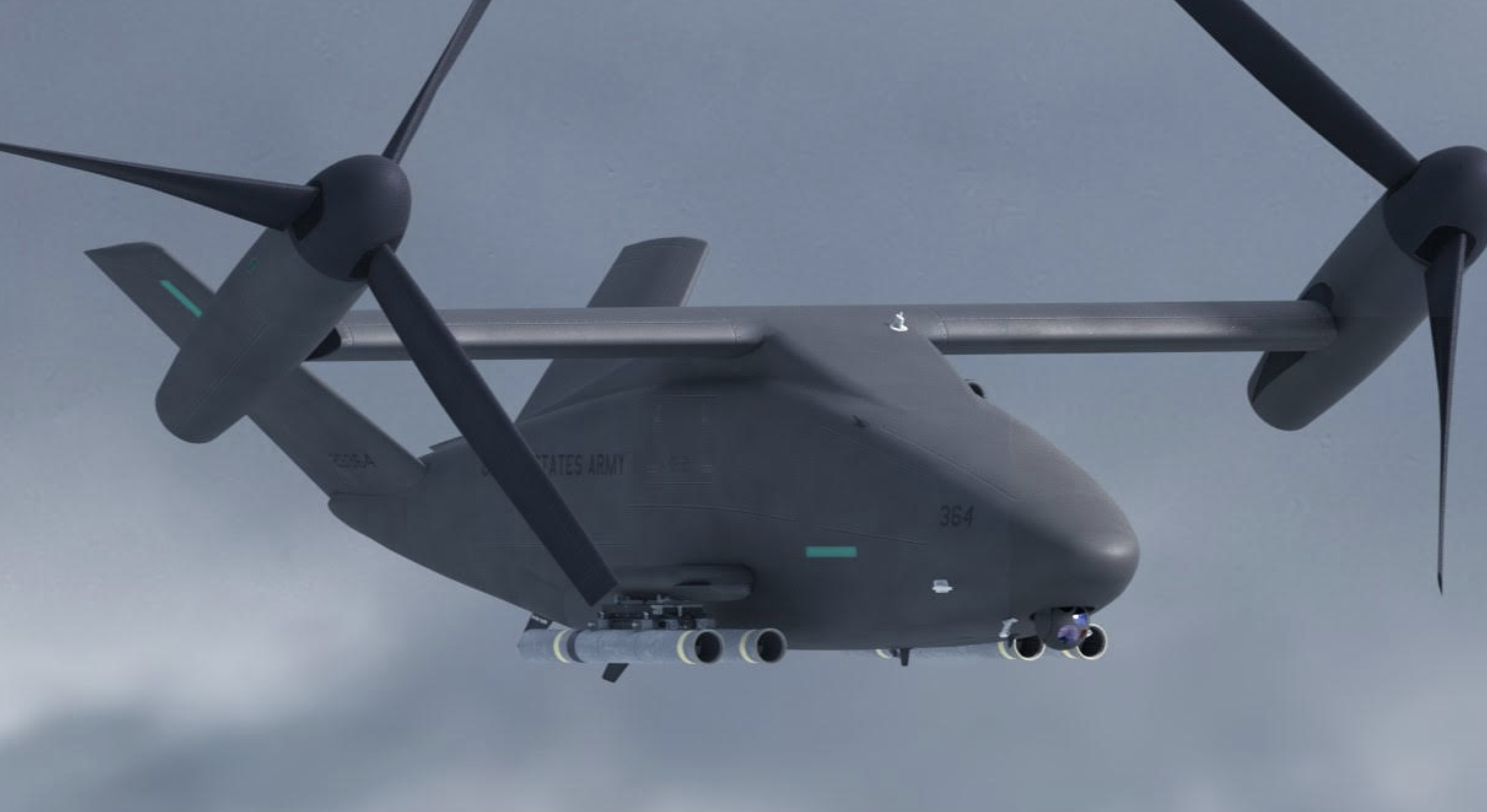
The first of the drones to be described in detail is the CxR, or Collaborative Transformational Rotorcraft. Speights explained: “The idea is that the CxR is a modular core that we can adapt for things like a loyal wingman, collaborative rotorcraft, that would partner with an aircraft like the Apache or even the Little Bird or whatever else you may have.”
The CxR would be able to carry various types of effectors and other payloads, including launched effects (LE), which are smaller drones capable of being configured to strike, reconnoiter, and jam targets far from their launch platform. LEs are increasingly seen as being critical to the future survival of combat helicopters, especially when operating in higher-threat areas.
One rendering shows the drone carrying a pair of tubes on stub wings on each side of the fuselage, likely signifying launched effects. Speights outlines Boeing’s vision of Apaches, collaborative rotorcraft, and launched effects all working together as “layers of capabilities that we can apply to different situations.”
Speights said the CxR’s tiltrotor configuration is ideal for missions such as reconnaissance, surveillance, and target acquisition, or RSTA, “where you need very good maneuverability, nap-of-the-earth [flying], hide behind hills, mountains and trees, and have the maneuverability to be able to perform that mission with the level of survivability that’s really needed to be successful.”
“That would enable it to fully support the types of attack, reconnaissance, and scout missions that the Apache performs,” Speights added. “It would be able to carry the payloads that are relevant for Apache-type missions.”
While the CxR is currently primarily being pitched as a drone that can operate collaboratively with the Apache, Boeing expects that it will have the relevant speed, range, and endurance to complement the Army’s forthcoming MV-75 tiltrotor assault transport as well. With this in mind, the company is targeting a speed in the range of 200 to 250 knots.
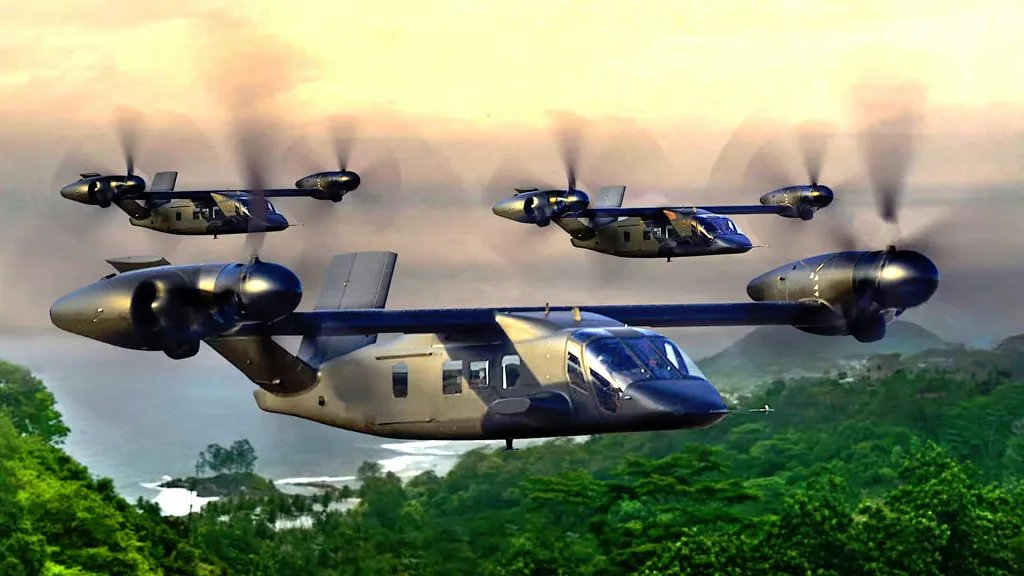
At the same time, the CxR will be designed to be expeditionary, so that it can be rapidly deployed aboard fixed-wing C-130 Hercules transports.
A logistics version of the new rotary-wing drone is also being proposed. This is the CLR (Collaborative Logistics Rotorcraft), which would be expected to augment the H-47 Chinook and other logistics platforms, especially in contested environments.
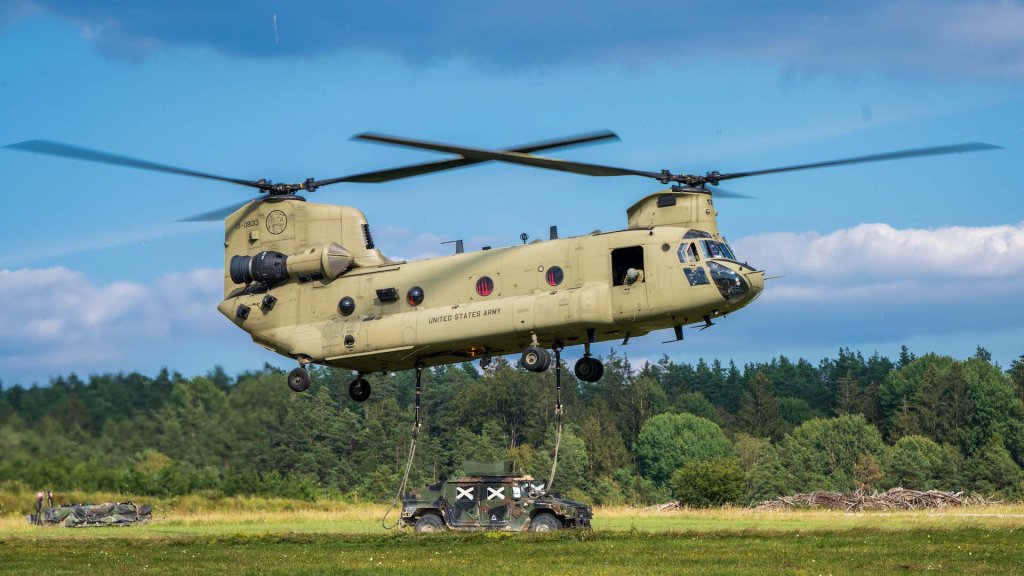
The logistics version of the drone would make use of the CxR’s common core, including the propulsion system, “but we would simply replace the modular fuselage portion with something that can support the payload that would complement heavy- and medium-lift needs,” Speights explained. “When we think about the speed capability, we believe that being able to rapidly deploy the cargo is what adds value in this case. So we’ll get distance, we’ll get range, and speed. In a contested logistic environment, that can make all the difference if you’re bringing critical munitions to the battle and not risking human life.”
Boeing sees the new drones very much in the context of a broader “family of systems” approach, meaning they can work together with a range of platforms used by the U.S. Army and other forces around the world.
In the case of the Apache, in particular, the attack helicopter’s ability to work with the planned collaborative rotorcraft will be aided considerably by the fact that being able to control drones is a core part of its existing capability set. The Manned-Unmanned Teaming-Extended (MUMT-X) initiative adds a new rotor mast extension and other hardware that allows Apache pilots to take direct control of the sensors and flight paths of multiple RQ-7B Shadow V2 and MQ-1C Gray Eagle drones, as well as the latter’s weapons. You can read more about the MUMT-X here.
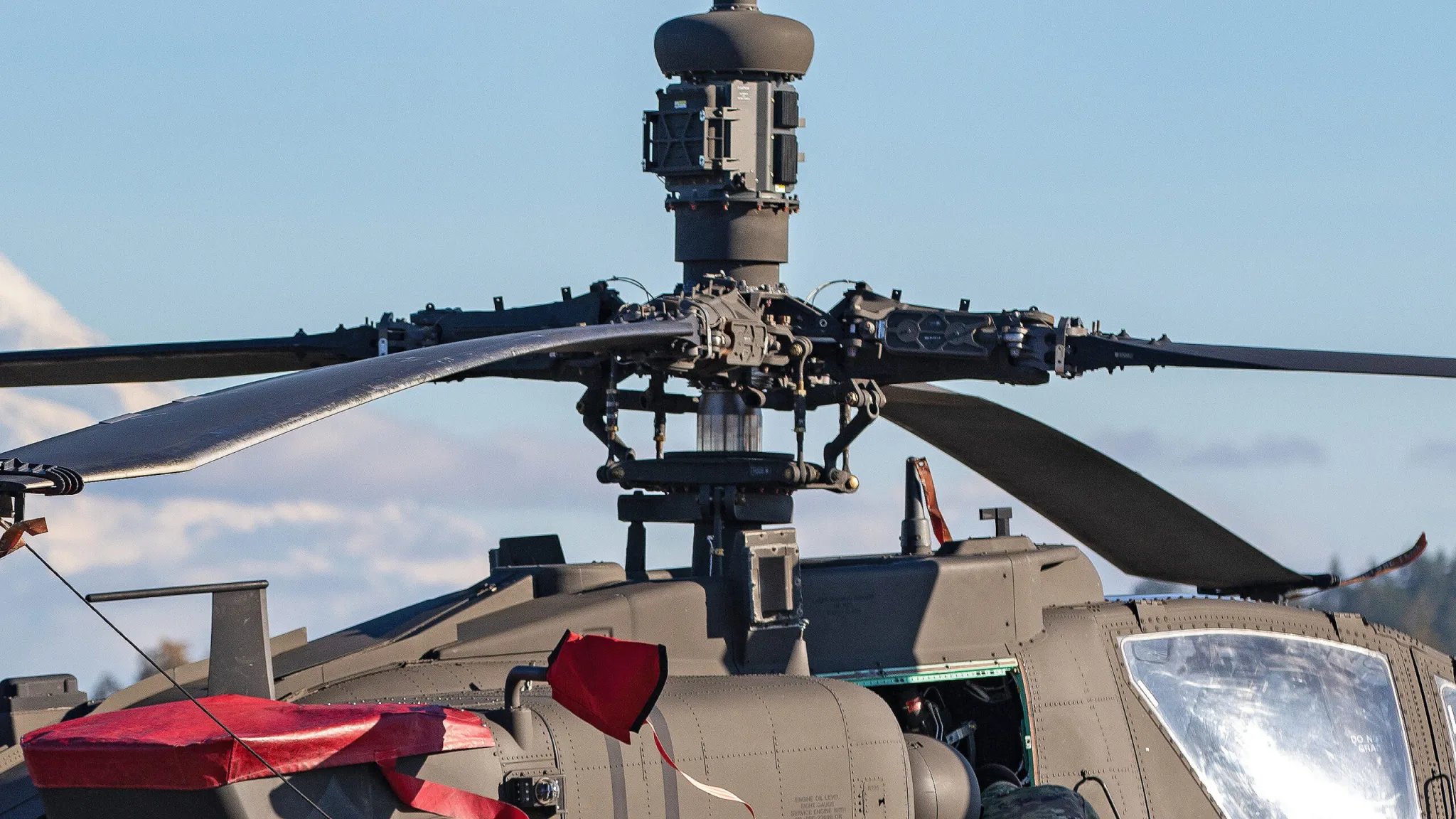
As it does now with MUMT-X, an AH-64E working with the CxR would mean the attack helicopter crews would be able to spot, evaluate, and kill targets from dozens of miles away, and do so even by controlling multiple drones at once. The system would presumably also facilitate the transfer of high-bandwidth live video feeds and other forms of data, from the collaborative rotorcraft to the Apaches and to other nodes elsewhere, supporting multiple data connections simultaneously.
The latest AH-64E v6.5 version also features a modular open system architecture (MOSA) approach.
Speights said that the MOSA interface “allows us to bring in either our own or third-party applications and integrate them rapidly within the Apache and work ‘under the glass’ so it will be seamless, as far as the pilot is concerned. From a safety and a design perspective, we’ve really been able to isolate that into an adjunct processor that does not have an impact on core vehicle management, flight control, critical mission systems.”
Using the latest AH-64E v6.5, Boeing has already demonstrated integration of launched-effect management, not just on a one-to-one basis, but also using swarms of launched effects.
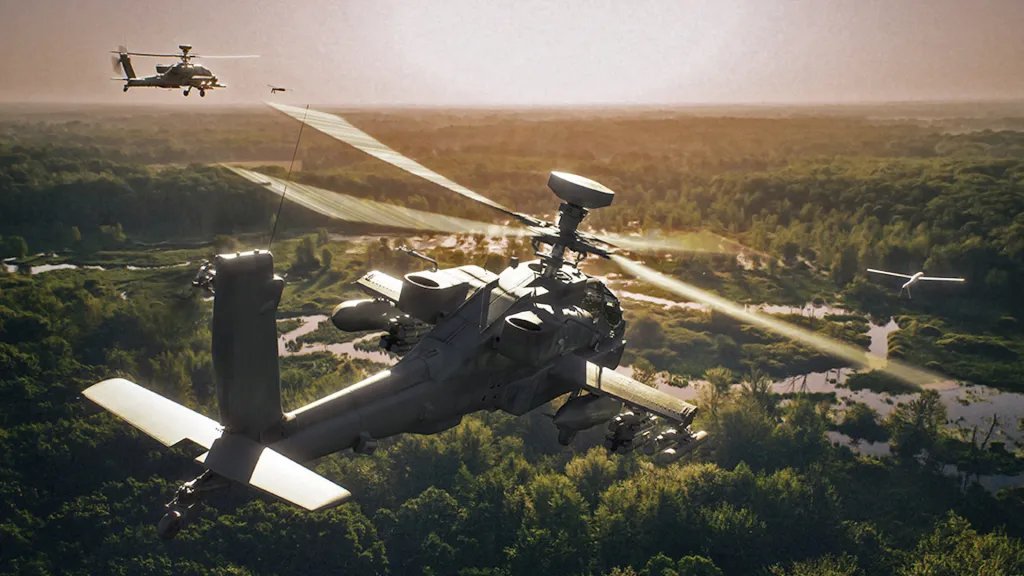
The same kind of approach is planned to be leveraged for the Apache’s collaborative rotorcraft ‘loyal wingman.’
At this point, the drones are still in the conceptual design phase.
In terms of U.S. Army involvement, Speights said that Boeing is currently “sharing the concepts with the customer so that we can get feedback and tailoring to make sure that we’re homing in on the right problem statements and the right needs” for the new collaborative rotorcraft.
Should the Army, or another customer, decide to move forward, Boeing would expect to rely heavily on its Phantom Works team to achieve a “very rapid development cycle,” although no precise timeline has been given so far.
Kathleen “KJ” Jolivette, vice president and general manager of Boeing Defense’s Vertical Lift division, said that the company wants “to be aligned with the Army as they want to rapidly field capabilities.” She also said that she expects the service to have a requirement for “many thousands” of collaborative rotorcraft, which means “the Army’s going to need more than one company building this type of capability.”
The Army’s need for collaborative rotorcraft may also become more urgent based on its ongoing rotary-fleet rationalization effort.
The service plans to shelve a reengining effort for its UH-60 Black Hawks and retire the MQ-1 Gray Eagle drone entirely. The CLR would provide a means of adding logistics capacity to support the UH-60s, while the CxR would appear to be a potential Gray Eagle successor in the RSTA role.
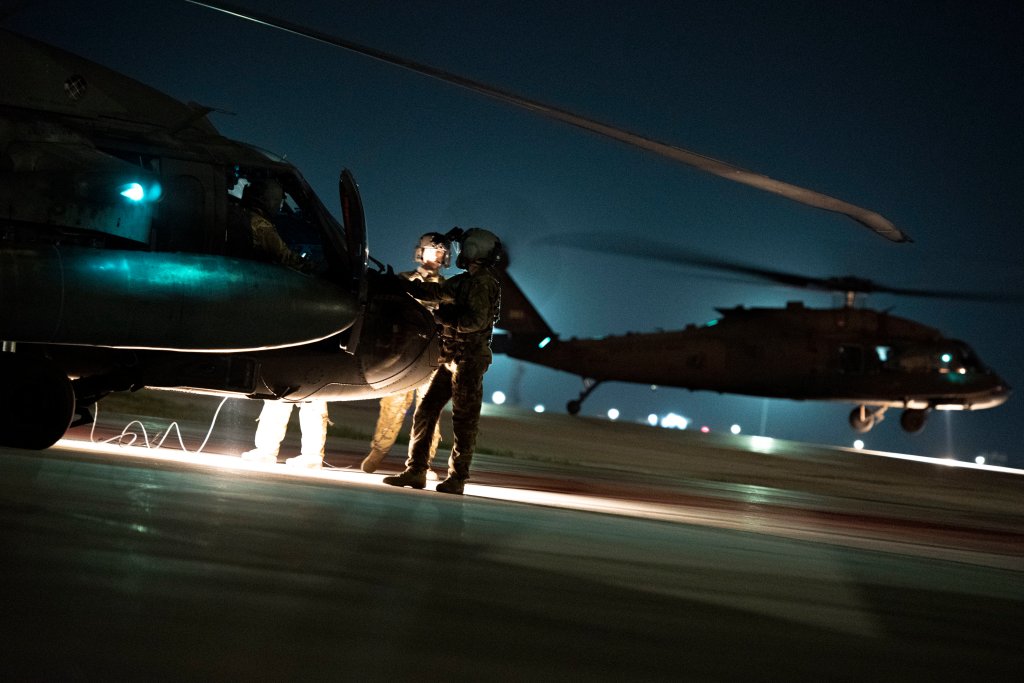
At the same time, the Army’s Apache fleet is being realigned, with all AH-64Ds planned for retirement. As part of this process, more capable AH-64Es are being shifted to the National Guard.
This means the Army’s active-duty AH-64E numbers will drop from 408 to 240 between fiscal 2025 and fiscal 2026. Here, again, the CxR, or similar collaborative rotorcraft, could provide a means of addressing the deficit.
Outside of the U.S. Army, Boeing still sees strong interest for the AH-64E, with deliveries to three new customers having begun this year alone: Australia, Morocco, and the Indian Army. Meanwhile, Poland is gearing up to become the largest international operator of the Apache, with 96 examples on order.
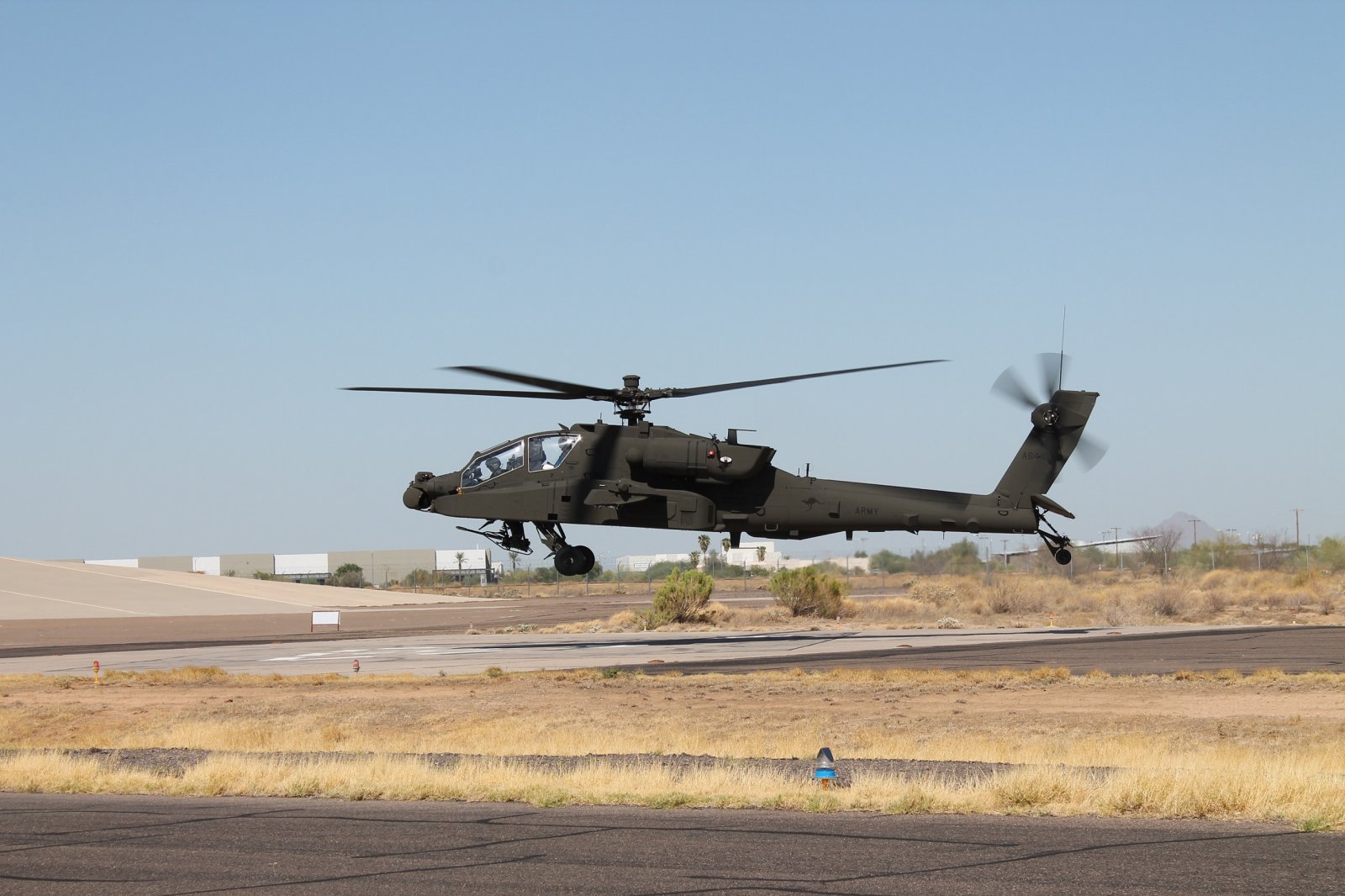
The “good, solid demand” that Boeing Defense’s Mark Ballew, senior director, business development and strategy, Vertical Lift, sees for the Apache on the international marketplace could, in the future, translate to demand for collaborative rotorcraft, too, as a cost-effective way of boosting capabilities, especially in more contested areas of operation.
More broadly, the collaborative rotorcraft concept could help answer some of the questions surrounding the survivability of crewed combat helicopters on future battlefields. Fueled by lessons from the ongoing war in Ukraine, there have been claims that the attack helicopter is irrelevant. While that is arguably overstated, it remains true that armies will need to more closely look at the return on investment for rotary attack, with survivability and employability under real scrutiny. A lower-cost collaborative rotorcraft could be one part of the solution to that emerging challenge. Meanwhile, other concerns around crewed attack helicopters focus on their questionable utility in a very long-range fight in the Pacific. Here, too, rapidly deployable collaborative rotorcraft could play an important role, especially when it comes to operations from remote locales with strictly limited infrastructure and support footprint.

Highly autonomous tactical rotary-wing wing drones are also becoming an area of fast-growing interest, reflected by Boeing’s pitching of the new Collaborative Logistics Rotorcraft. Already, entrants in this field include Sikorsky’s Nomad family, all using a common tail-sitting design powered by twin proprotors. Rather than being tiltrotors, these employ Sikorsky’s ‘rotor blown wing’ configuration, and the family includes increasingly large aircraft, all the way up to a size broadly equivalent to the Black Hawk. Then there is Bell’s V-247 Vigilant, a tiltrotor design that has been offered to the U.S. Navy for its Future Vertical Lift Maritime Strike (FVL-MS) development effort.

While Boeing sees crewed helicopters as being central to its rotary-wing offerings and to U.S. Army capabilities, long into the future, the company’s announcement of its collaborative rotorcraft today indicates that it increasingly sees these helicopters being supported, in a range of missions, by their own ‘loyal wingmen.’
Contact the author: thomas@thewarzone.com
Loading comments…
Comments couldn’t be loaded. Please refresh the page.