

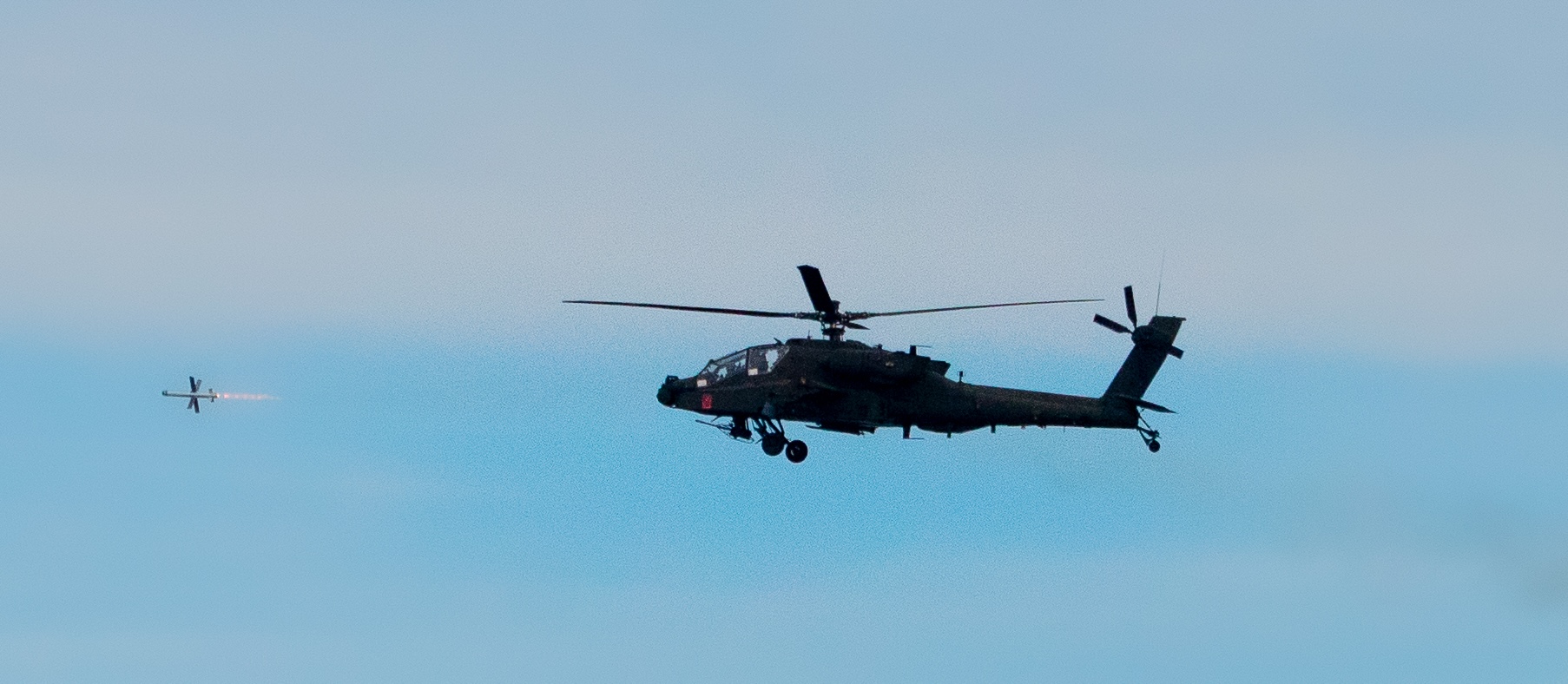
For the first time, U.S. Army AH-64E Apache Guardian attack helicopters have launched Spike NLOS missiles in the European theater. The Israeli-made missiles were used during a live-fire exercise in Poland, a country that has also ordered the AH-64E and which is being eyed as a future Spike NLOS customer.

The U.S. Army today released a video of the live-fire drills, which were conducted late last month at the Ustka range on Poland’s northern coast. The Apache Guardians involved in the trials were AH-64Ev6 variants from the U.S. Army’s 12th Combat Aviation Brigade. The results, including the man-in-the-loop imagery feed, were shown on a big display screen to a large gathering of attendees.
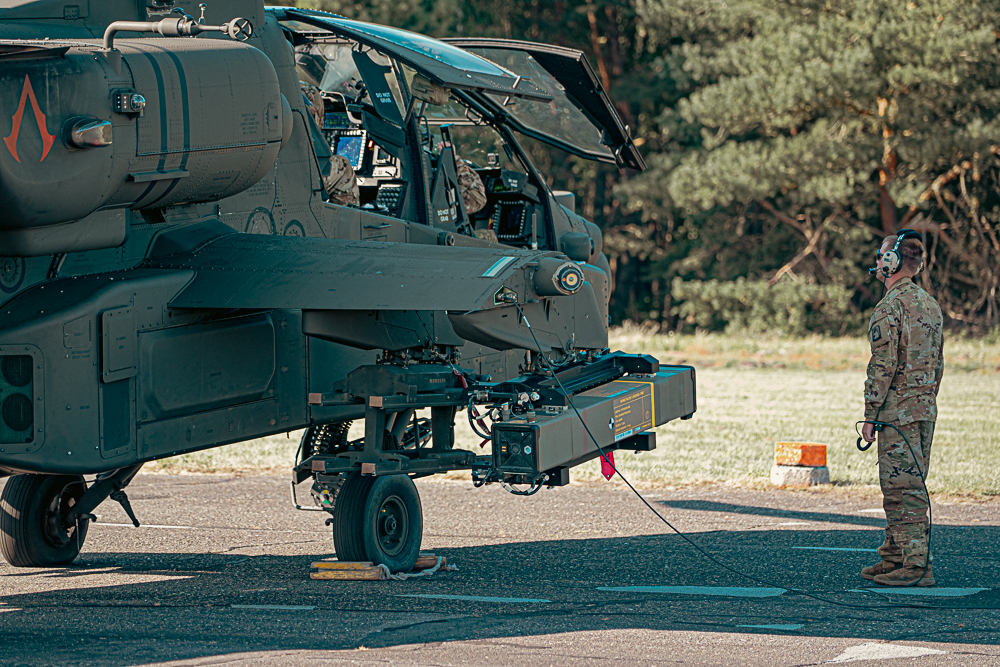
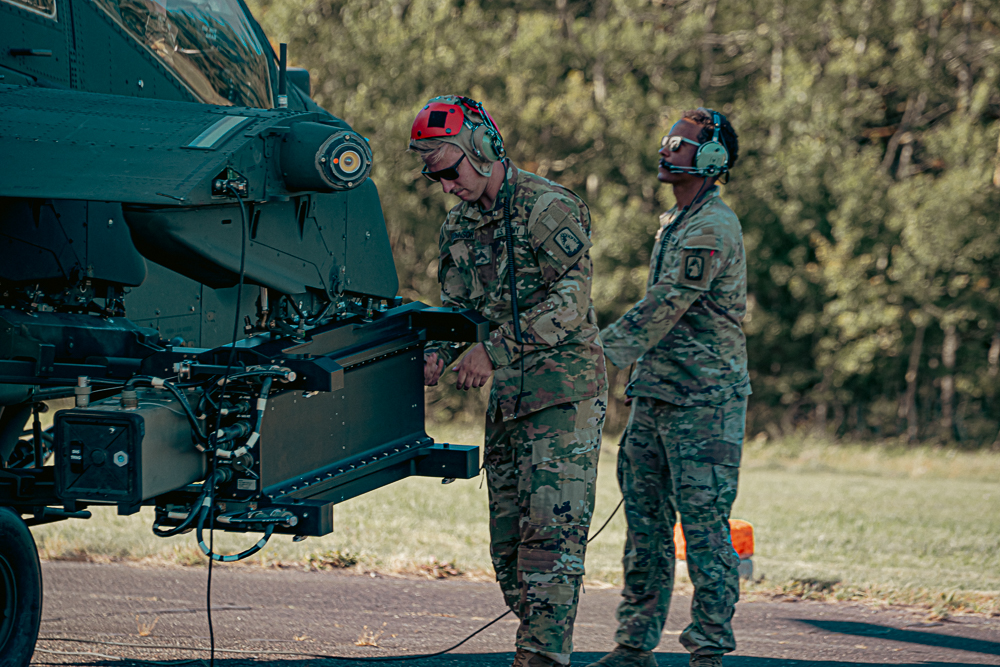
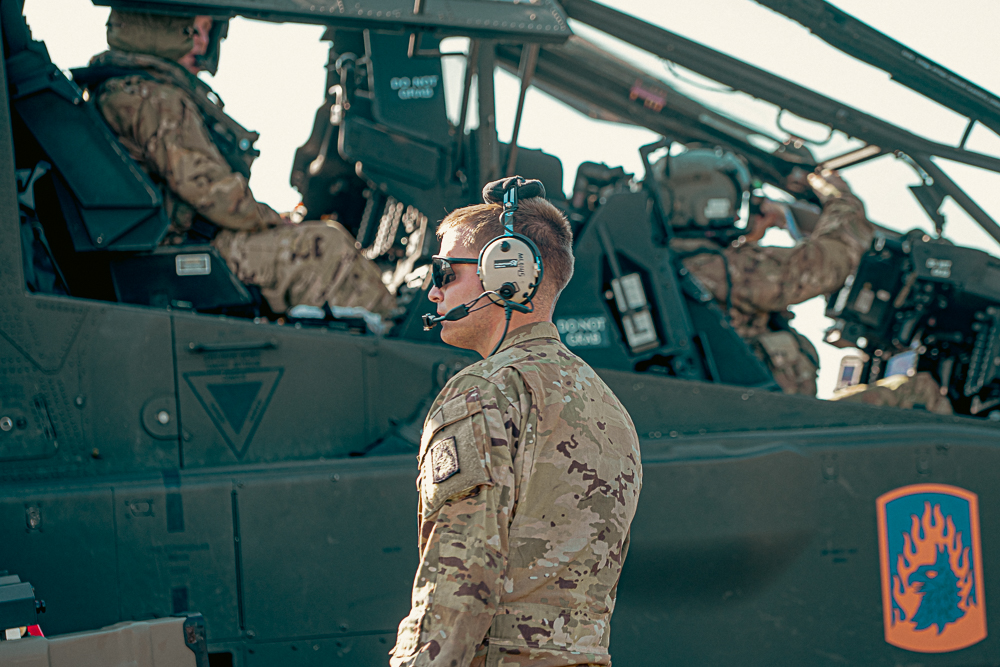
You can read more about the complete AH-64Ev6 here; suffice it to say that it’s one of, if not the most modern, configurations of the Apache. Compared to earlier AH-64Es, V6 types feature an expanded suite of sensors, as well as communications systems and datalinks, which improve their ability to spot and engage targets, especially during over-water operations, as well as detect and avoid threats.

During the campaign, two Spike NLOS (Non-Line Of Sight) missiles engaged sea-based targets at a range of up to 15.5 miles. The Army’s previous demonstration of the ability of an Apache to destroy a small boat with a Spike NLOS is something that TWZ was first to report.

Earlier this year, the Army released photos that showed Spike NLOS-armed Apaches assigned to the 12th Combat Aviation Brigade taking part in Exercise Allied Spirit ’25 in Germany, although on that occasion the weapons weren’t fired.

This makes the Polish live-fire campaign the first time the Army has launched Spike NLOS from any platform in Europe.
The Spike NLOS has also previously been noted in a combat theater, specifically in Iraq. TWZ reported earlier this year on what appears to be the first time Army AH-64s deployed to an active conflict zone with these weapons.

Compared to the AGM-114 Hellfires and AGM-179 Joint Air-to-Ground Missiles (JAGM) that also arm the Army’s Apaches, the Spike NLOS offers notably greater range and is highly flexible, able to attack targets on land and at sea with equal efficacy.
The original Spike missile dates back to the 1980s, when the Israel Defense Forces (IDF) introduced it. Characterized by its rectangular launch canister (Hellfire and JAGM rounds are mounted directly under the Apache’s stub wing), the Spike has been steadily improved since it was first fielded.
It can be fired from ground (including remotely operated) and aerial platforms and has also been adapted for shipborne use.

According to manufacturer Rafael, the latest Spike NLOS can strike targets up to 20 miles away. This provides a significant advantage over the Hellfire and JAGM, with the versions of these missiles used by Army Apaches having maximum ranges of less than 10 miles. In practice, targets are normally engaged much closer than that with these weapons. It should be noted, however, that Hellfires and JAGMs with ranges that are tripled and doubled, respectively, have also been tested.

Other notable capabilities of the Spike NLOS relate to its multi-mode guidance. This allows the crew to engage fixed targets by providing the missile with coordinates or to use the man-in-the-loop (MITL) control method. In the latter, an infrared camera in the nose of the missile provides the operator with a view of the target, meaning that manual adjustments can be made in the terminal phase.
In contrast, most Hellfires used by Army Apaches have laser guidance only, the exception being the AGM-114L Longbow Hellfire, with millimeter-wave radar guidance. The more modern JAGM has laser and millimeter-wave radar guidance.

The Spike NLOS is also able to loiter for a brief period while the operator looks for targets of opportunity. Another key feature of the Israeli missile is its ability to ‘pop up’ and hit targets behind cover.
As TWZ has previously explained:
“This gives Spike NLOS incredible accuracy, even against moving targets, and enables it to find its mark in bad weather or in parts of the battlefield obscured by smoke and dust, which could disrupt traditional laser or imaging seeker systems. As the weapon’s name implies, it also offers a way for the launch platform to engage targets beyond line of sight, while also remaining as hidden as possible, especially when coupled with targeting information from off-board platforms. It also offers the operator a greater ability to more significantly shift the weapon’s point of impact, even very late in flight, should circumstances on the ground change, such as the sudden appearance of innocent bystanders in the target area. The weapon can even be used to search for and kill targets of opportunity far from where the launch platform is located. Regardless, the missile offers the launch platform huge flexibility and a big boost in survivability.”
Like the Apaches previously seen toting Spike NLOS in Iraq, at last one of the 12th Combat Aviation Brigade examples deployed to Poland was fitted with the ‘bucket-style’ antenna for the Spike control datalink on its left stub wing. This has been a standard feature on Israeli Apaches that carry Spike for decades.

At least one of the Apaches in Poland was also outfitted with the Manned-Unmanned Teaming-Extended (MUMT-X) system, which is mounted on top of the rotor mast. MUMT-X provides communications and data-sharing capabilities, allowing Apache crews to control uncrewed aircraft like the MQ-1C Gray Eagle, as well as receive information from the drone’s sensors.
The Army’s fielding of Spike NLOS has been conducted fairly secretively, and it’s unclear exactly when the missile became operational on its AH-64s. At one point, the service said it planned for the milestone before the end of last year.

Looking further ahead, the U.S. Army continues to look at ways of ensuring its Apaches can strike objectives with precision and at long range, while increasing the overall flexibility of target engagement.
Beyond Spike NLOS, options could include air-launched loitering munitions, now more generally referred to as launched effects. A key driver for this requirement is ever more capable and longer-ranged air defense threats. Indeed, recent demonstrations of their vulnerability on modern battlefields have led some to question the continuing value of attack helicopters. This is a topic that TWZ has also looked at in the past.

In the meantime, however, Spike NLOS is an important capability for the U.S. Army and is one that may well find favor with other Apache operators.
It’s notable that the Polish Air Force Inspectorate was involved in the live-fire trials at Ustka and, moreover, that the U.S. Army’s own press release talks about the “potential future direction […] integration of Spike NLOS missiles onto Poland’s own AH-64E Apache fleet.”
Back in 2022, Poland announced plans to buy as many as 96 AH-64Es to replace its aging fleet of around 30 Cold War-era Mi-24 Hind gunships. This is set to make the Polish Land Forces the second-largest AH-64 operator worldwide, behind the U.S. Army. A first initial batch of leased AH-64D Apaches for Poland arrived in the country in June of this year, where they will be used for training.
The Apache order is also just one part of a broader multi-billion-dollar Polish military spending spree, spurred in part by the current conflict in Ukraine. It also includes 180 K2 tanks, among other items, from South Korea, as well as 250 M1A2 SEPv3 Abrams tanks from the United States.
The U.S. Army also pointed to the growing strategic importance of Poland, in particular its value when it comes to “further enhancing collective deterrence capabilities along NATO’s eastern flank.” With a resurgent Russian threat across its border and an extensive coastline on the highly strategic Baltic Sea, the specific capabilities offered by the Apache/Spike NLOS combination would be of particular interest to Poland, which also fields earlier versions of the missile in ground-based form.
Once Poland’s Apaches begin to arrive, that deterrence will be further strengthened, and it wouldn’t be a surprise to see Warsaw buy Spike NLOS missiles to arm these helicopters.
Contact the author: thomas@thewarzone.com
Loading comments…
Comments couldn’t be loaded. Please refresh the page.