
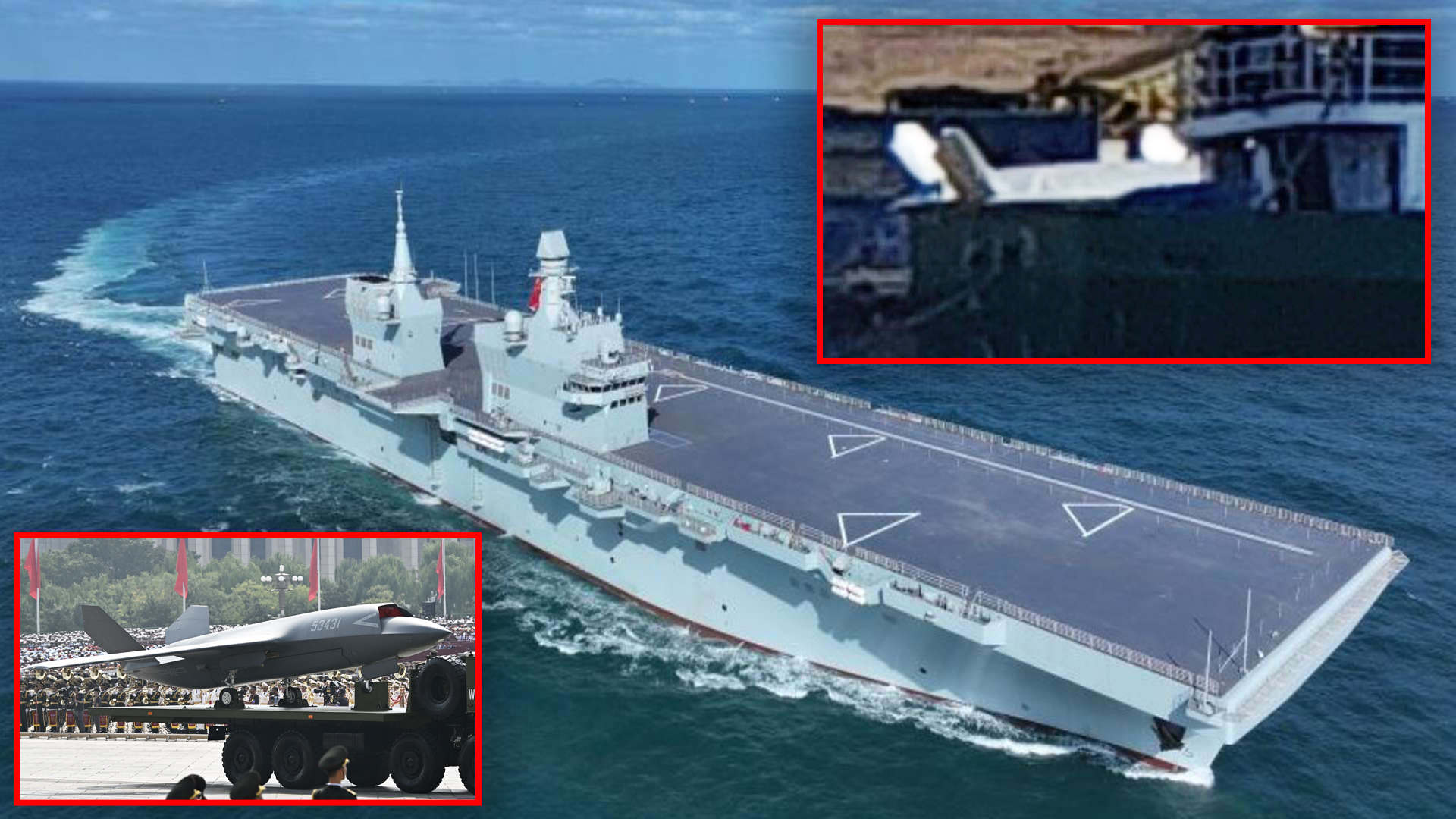
Imagery has emerged that shows, apparently for the first time, examples of China’s growing series of low-observable combat drones being prepared for naval trials, aboard one of the country’s aviation-capable warships. The location of the drones — at the Shanghai-based Hudong-Zhonghua shipyard — points to plans to put them aboard the super-sized Type 076 amphibious assault ship, the Sichuan, which was built there. At this stage, it’s not clear if these drones are the genuine articles or, more likely, mockups, but such plans would be in line with previous predictions that this vessel will be capable of supporting high-end aerial drone operations as well as traditional amphibious assaults.
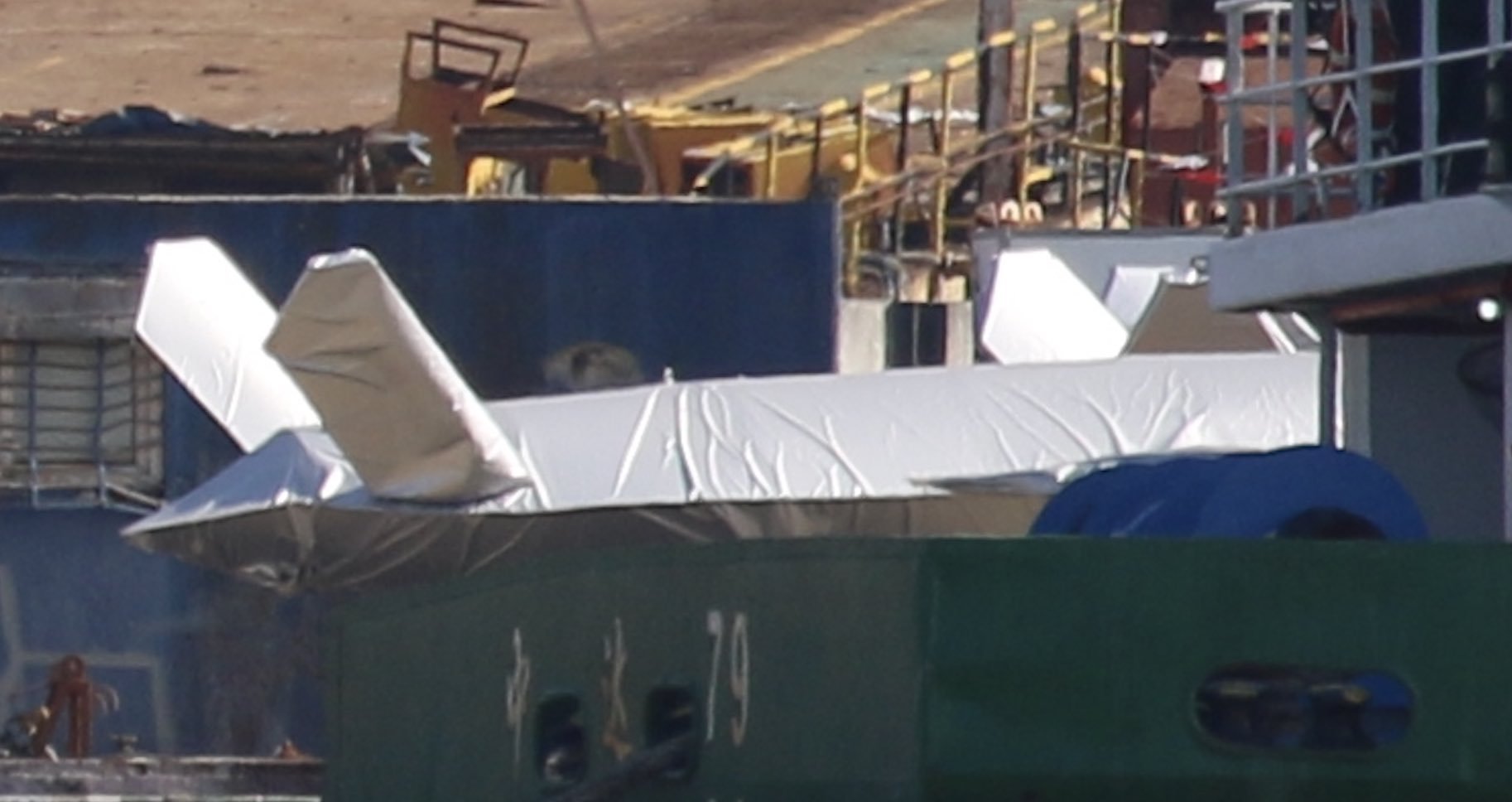
The imagery in question began to circulate recently online, with the initial view showing the rear portion of a drone, with another two just visible behind it. The characteristic twin, outward-canted, and cropped tailfins of these drones suggest that these are a navalized version of the design that has been informally dubbed Type C by Chinese aerospace observers. It is part of a collection of uncrewed aircraft that are considered to be broad Chinese equivalents of the U.S. Air Force’s Collaborative Combat Aircraft (CCA).
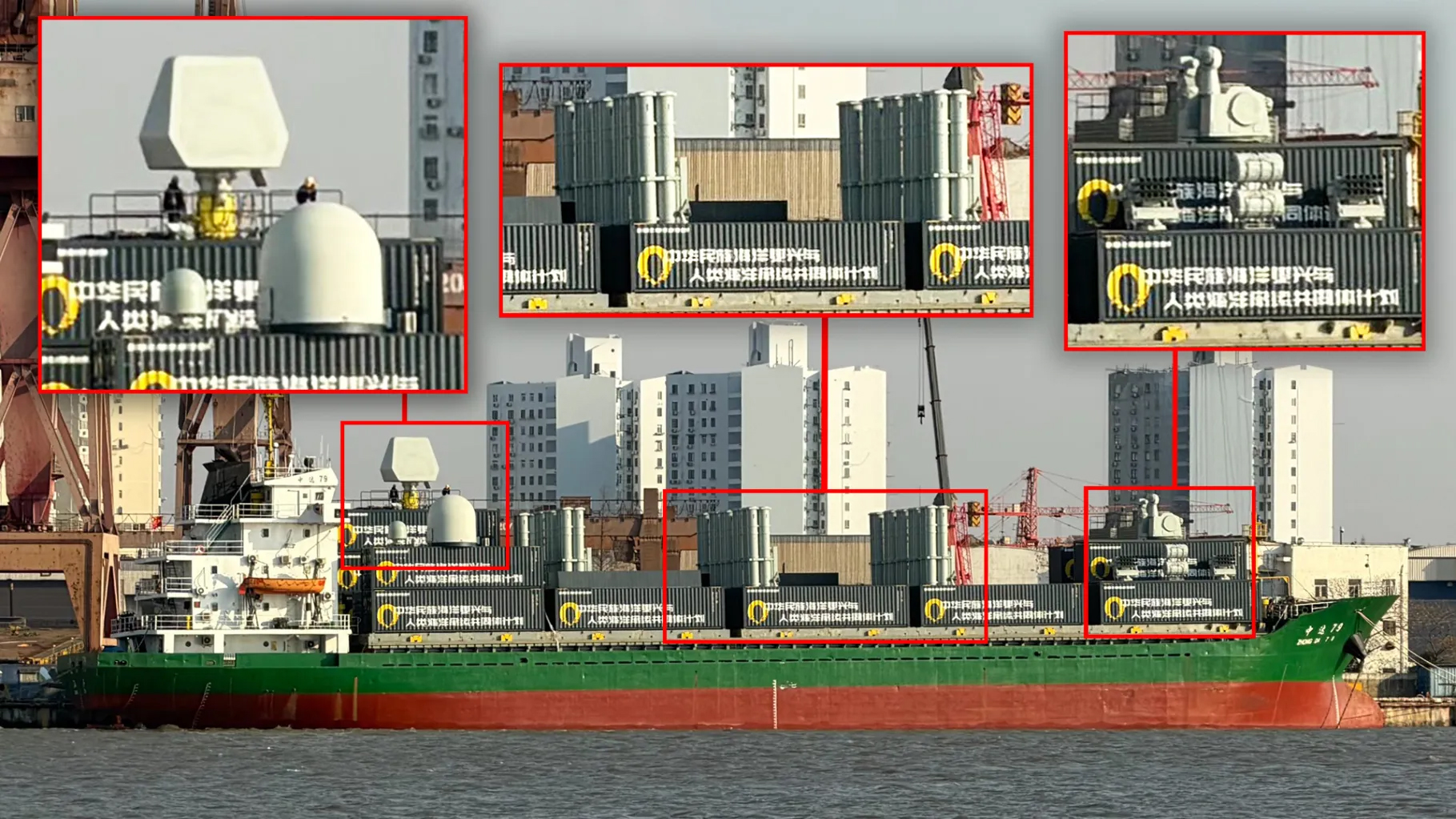
Interestingly, the vessel seen immediately in front of the drones is the medium-sized cargo ship that appeared last week, packed full of containerized vertical launchers, along with sensors and self-defense systems. You can read all about this development, and the growing possibility that China will weaponize more ships from its extensive commercial fleet, turning them into full-blown arsenal ships, here.
Subsequently, satellite imagery shows the same dockside drones viewed from above, this time revealing the presence of a total of six CCA-type drones, as well as one that looks more like one of the Wing Loong family of medium-altitude long-endurance (MALE) drones. The Sichuan is also seen in dry dock nearby.
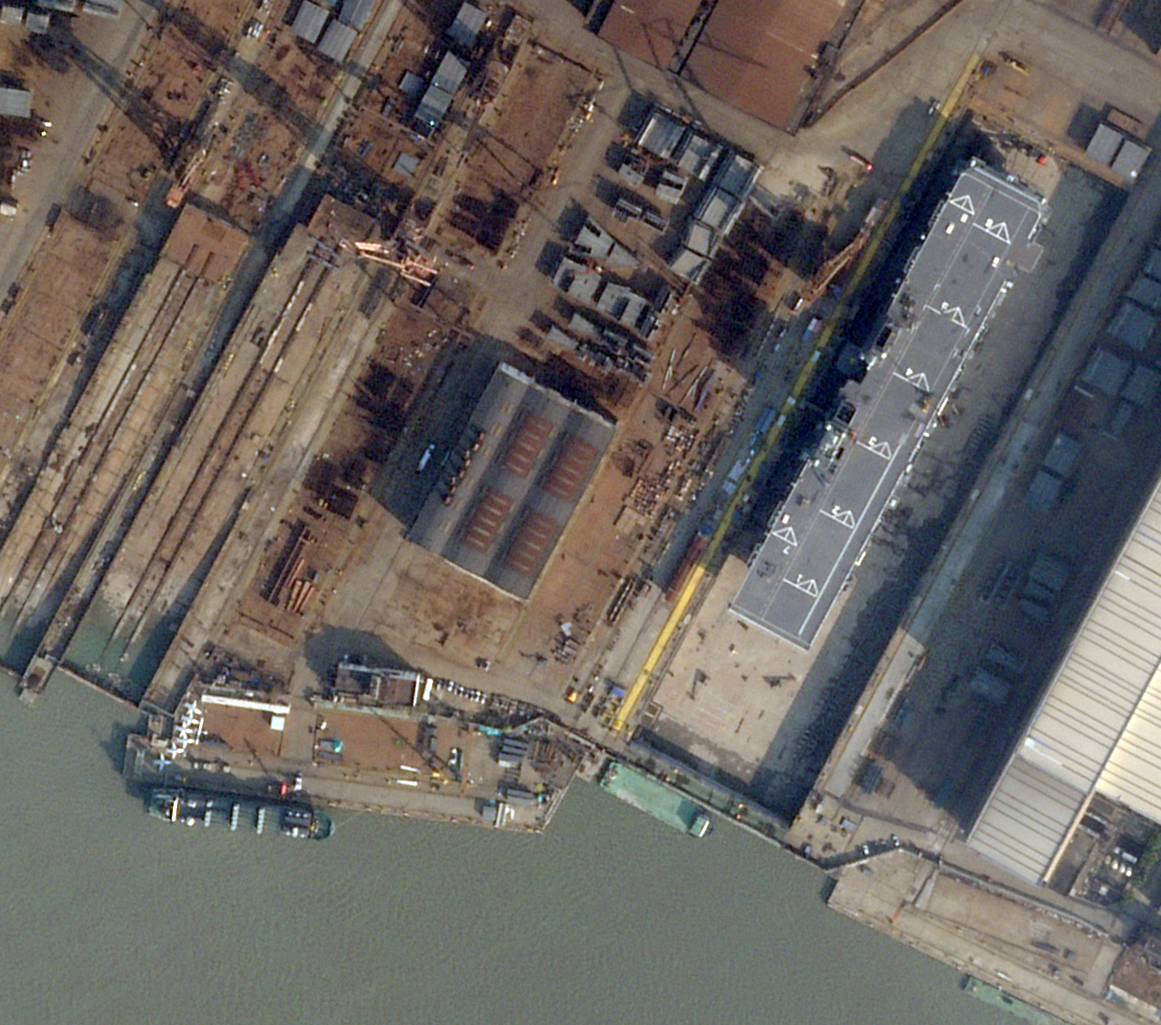
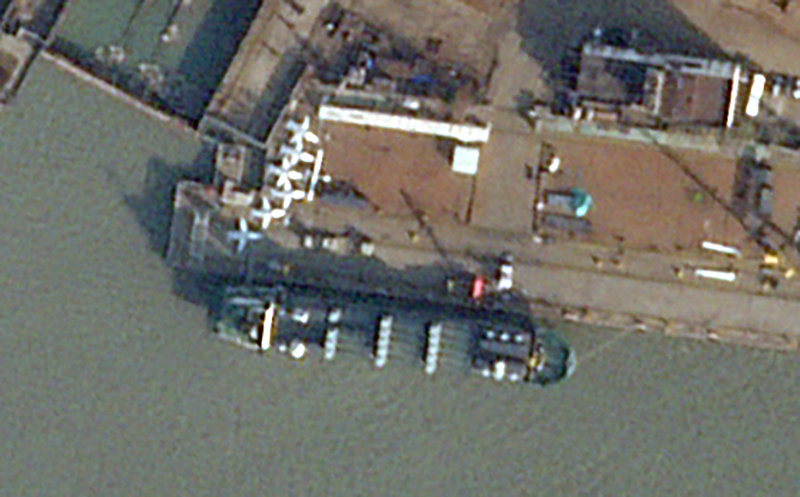
Developing a navalized version of the Wing Loong, or a version of another similar MALE drone, would have some parallels to efforts by General Atomics Aeronautical Systems (GA-ASI) to adapt its Gray Eagle STOL, or Short Takeoff and Landing variant, for carrier operations. The carrier capability of the Gray Eagle STOL was first demonstrated by the company-funded Mojave, which has been tested from various flattops.
Once again, it should be considered very possible, if not probable, that the drones in question are mockups, especially given their number. China makes considerable use of aircraft mockups, on land and at sea, to assist with the development and subsequent service introduction of aircraft carriers and assault ships.
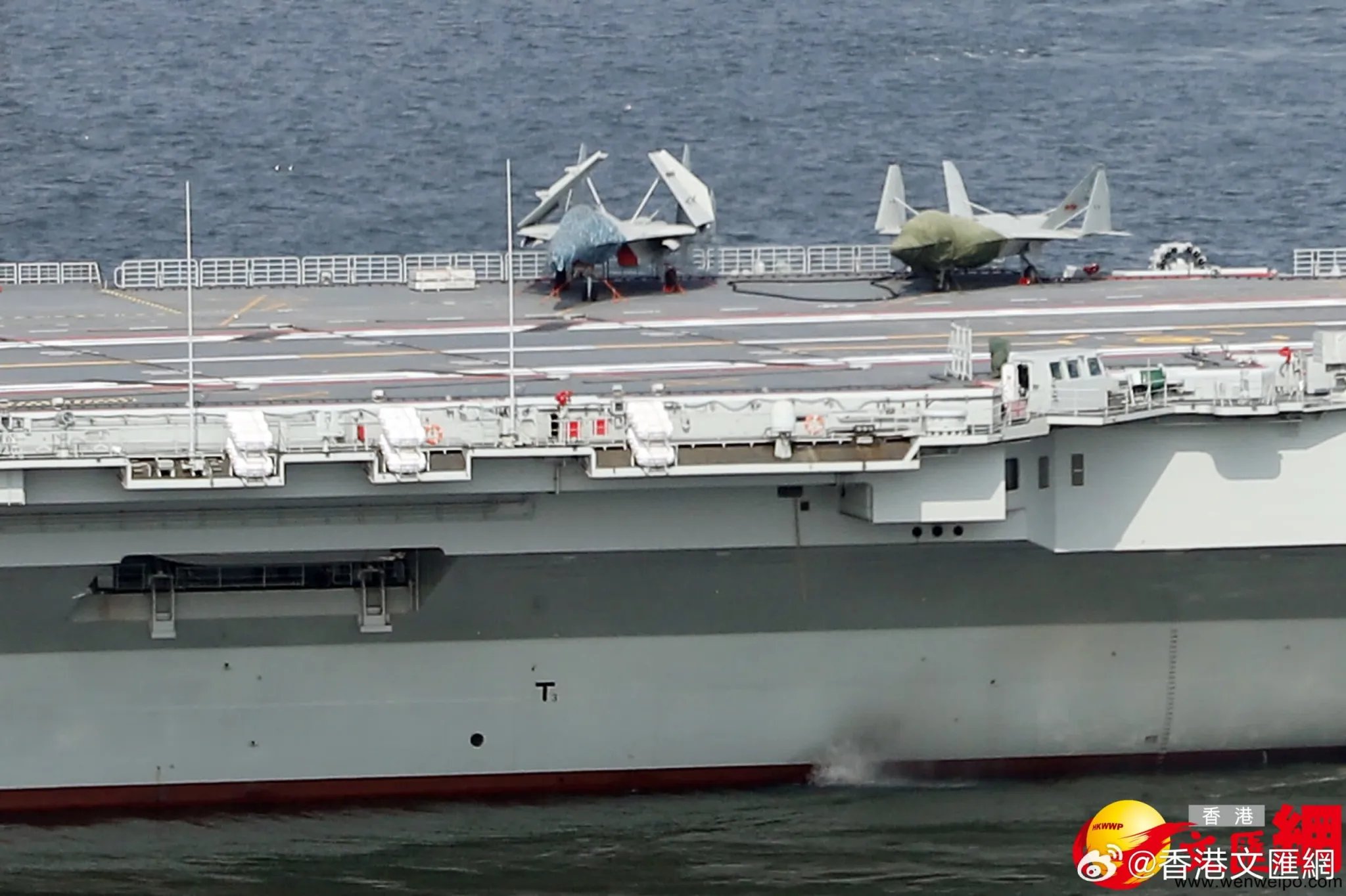
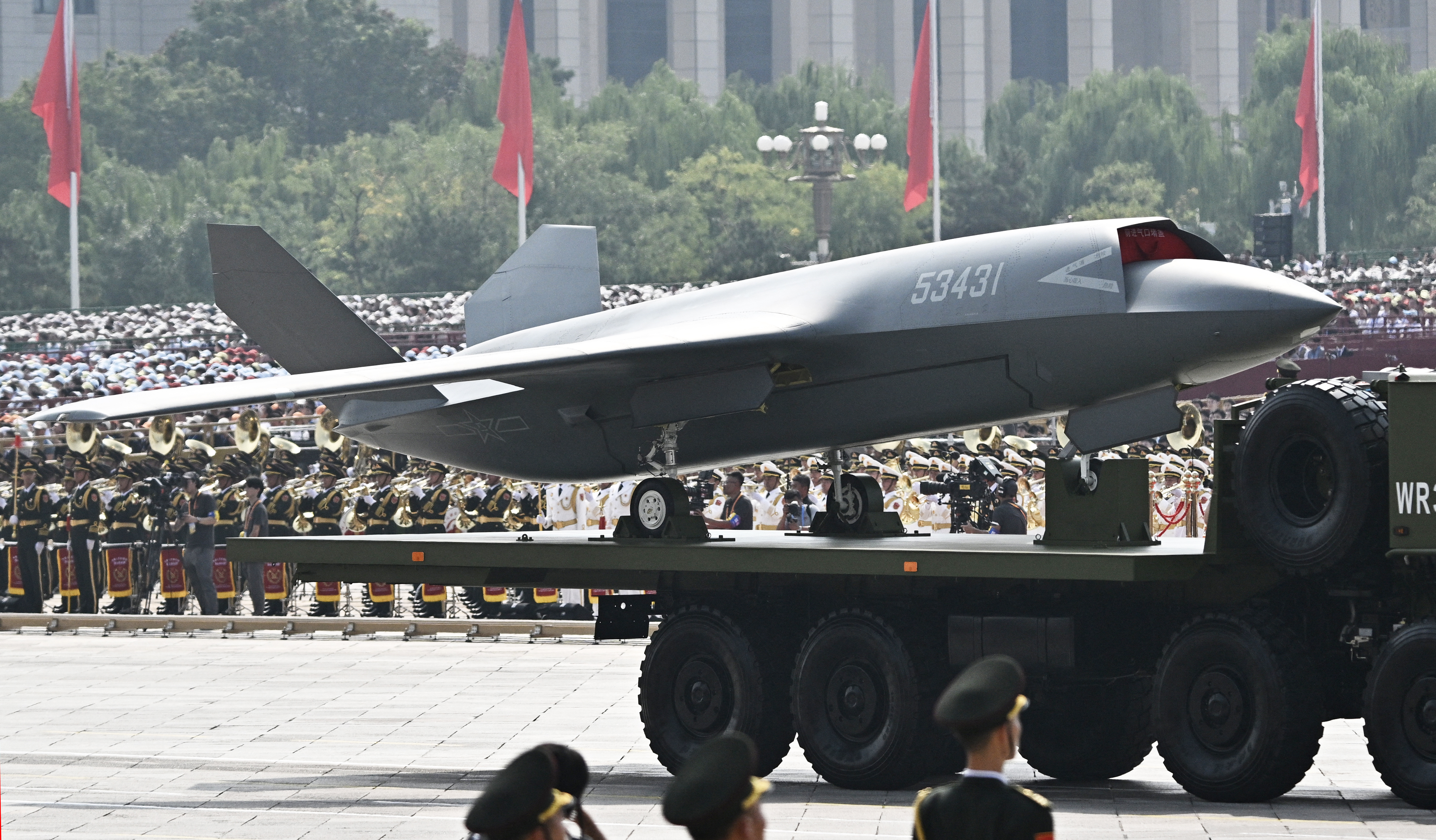
The so-called Type C is a subsonic CCA or “loyal wingman”-type drone. Its key features include a swept lambda wing planform, the aforementioned canted tail fins, an internal stores bay, and a single jet engine fed by a dorsal intake. Overall, in terms of configuration, it has some similarities with the U.S.-made XQ-58A Valkyrie, but it is much larger. According to unconfirmed reports, it is said to be optimized for air-to-ground missions, although intelligence, surveillance, and reconnaissance (ISR) and electronic warfare would also be likely roles. The Type C is one of at least four new CCA-type drones that were publicly unveiled at the parade celebrating 80 years since the defeat of Japan in World War II, held in Beijing on September 3, 2025.
Since the drones are seen dockside at Hudong-Zhonghua, it would make a good deal of sense for them to now be evaluated by the People’s Liberation Army Navy (PLAN) onboard the Sichuan, which is back in dry dock at the same location. As you can read about here, the first of the Type 076 assault ship left this port for its first sea trials last month.
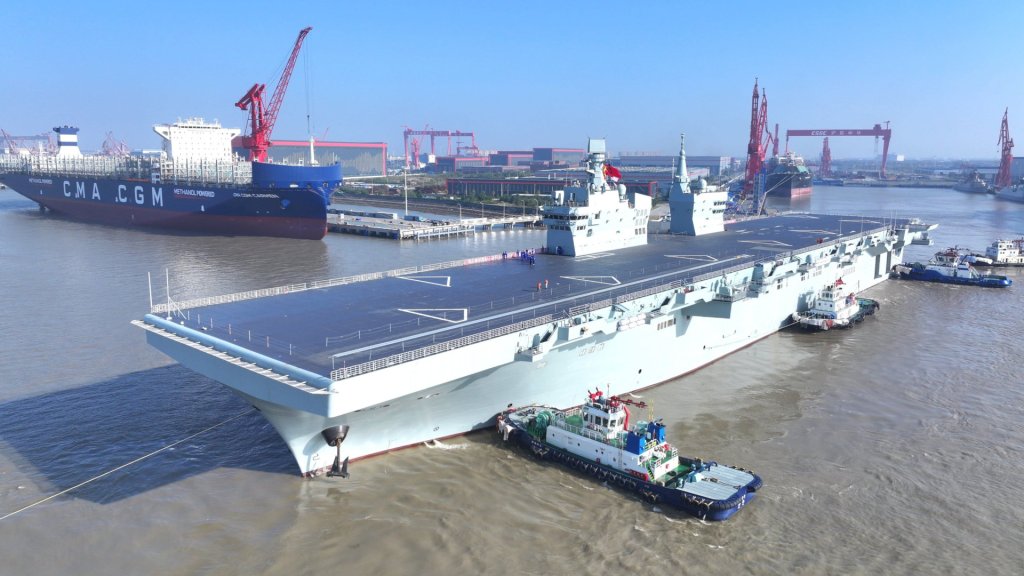
Thanks to its electromagnetically-powered catapult, the 44,000-ton Type 076 is unlike any other big deck amphibious warship in terms of the kind of air wing that it can accommodate, which is expected to be dominated by uncrewed types.
Previously, Type 076’s air wing was expected to include naval versions of the GJ-11 stealthy flying-wing uncrewed combat air vehicle (UCAV), sometimes known as the GJ-21. This theory was supported by apparent GJ-11 mockups that appeared at a test and/or training site right on Changxing Island in Shanghai, very close to where the Type 076 was being built. This may well still be the case, but it now looks like a navalized Type C drone, and perhaps also a navalized Wing Loong-type MALE drone will at least supplement it.
The navalized GJ-11 is expected to operate primarily from China’s true aircraft carriers, including the catapult-equipped Fujian, which was commissioned last month, in addition to the Type-076. This carrier is expected to be followed by six more by 2035, according to a Pentagon report, which would provide the PLAN with a total of nine. Recent imagery indicates that China is now progressing with work on its fourth flattop, which is expected to introduce nuclear propulsion.
Of course, it is possible that the drones seen at Hudong-Zhonghua are intended for trials aboard one of China’s three aircraft carriers, rather than the Sichuan, although, once again, the location makes more sense for the Type 076 — the PLAN’s two homegrown carriers were constructed at Dalian and at Jiangnan.
Returning to the Sichuan, in addition to drones, the warship will accommodate various helicopters, and very likely also a crewed tiltrotor aircraft, which is now in flight testing.
While we don’t yet know whether any drones have gone aboard the Sichuan, there have already been signs of preparations for flight trials. Shortly before the vessel left port for the first time, full markings had been painted on its flight deck, as part of its final fitting out.
Furthermore, as seen in the social media post below, evidence emerged at the end of October showing what looked to be a red-colored catapult test ‘truck’ on Sichuan’s deck. This, in turn, pointed to the start of testing of the ship’s lone catapult.
Again, as we have discussed before, as well as the catapult, the layout of the Type 076 design is heavily focused on sustained flight operations. These features include its unusually wide flight deck and the ship’s two islands. As such, fixed-wing drones can be launched by the catapult at the bow end and recovered via some form of arresting gear.
As TWZ previously wrote about the overall significance of the Sichuan:
“The potential value to the PLAN of having a fleet of very large deck amphibious assault ships that are highly capable of large-scale drone operations as well as traditional amphibious assaults is clear. These ships could be used to launch and recover UCAVs like the GJ-11 and other types of drones to perform a host of missions from maritime strike to intelligence, surveillance, and reconnaissance (ISR). They could be used to provide additional ‘mass’ in support of the operations of larger carrier strike groups and help to free the air wings of flattops like Fujian up for tasks they might be better suited for. In addition, they could provide a lower tier of naval aviation support that could be employed independently.”
…
“Simply having more naval aviation capacity overall would give the PLAN added flexibility for various operations closer to the mainland, including a potential military intervention against Taiwan or defending its expansive and largely unrecognized territorial claims in places like the South China Sea. Type 076s could also help project naval and air power further from China’s shores, something that has also been a driving factor behind the country’s broader carrier ambitions.”

It remains to be seen if the PLAN’s current ambitions include introducing the navalized Type C and Wing Loong-type as part of the regular air wing for the Type 076, or whether these drones or drone mockups are currently being used as part of an evaluation that may lead to a different type of uncrewed aircraft going aboard the warship. By the same token, we don’t yet know if China currently plans to acquire more Type 076s, or if this design is also initially intended more to prove out the concept of super-sized assault ships. Furthermore, there remains a more limited possibility that the drones are at Shanghai in relation to upcoming trials aboard an entirely different class of warship.
For now, however, the appearance of the drones, or drone mockups, dockside at Hudong-Zhonghua, underscores China’s broader goal of deploying a host of different uncrewed types aboard aviation-capable warships of various kinds.
Author’s note: The original version of this article suggested that at least one of the Type C drones was on the deck of the Type 076 vessel, rather than dockside. This has now been amended, with the article also including satellite imagery that was not previously available.
Contact the author: thomas@thewarzone.com
Loading comments…
Comments couldn’t be loaded. Please refresh the page.