
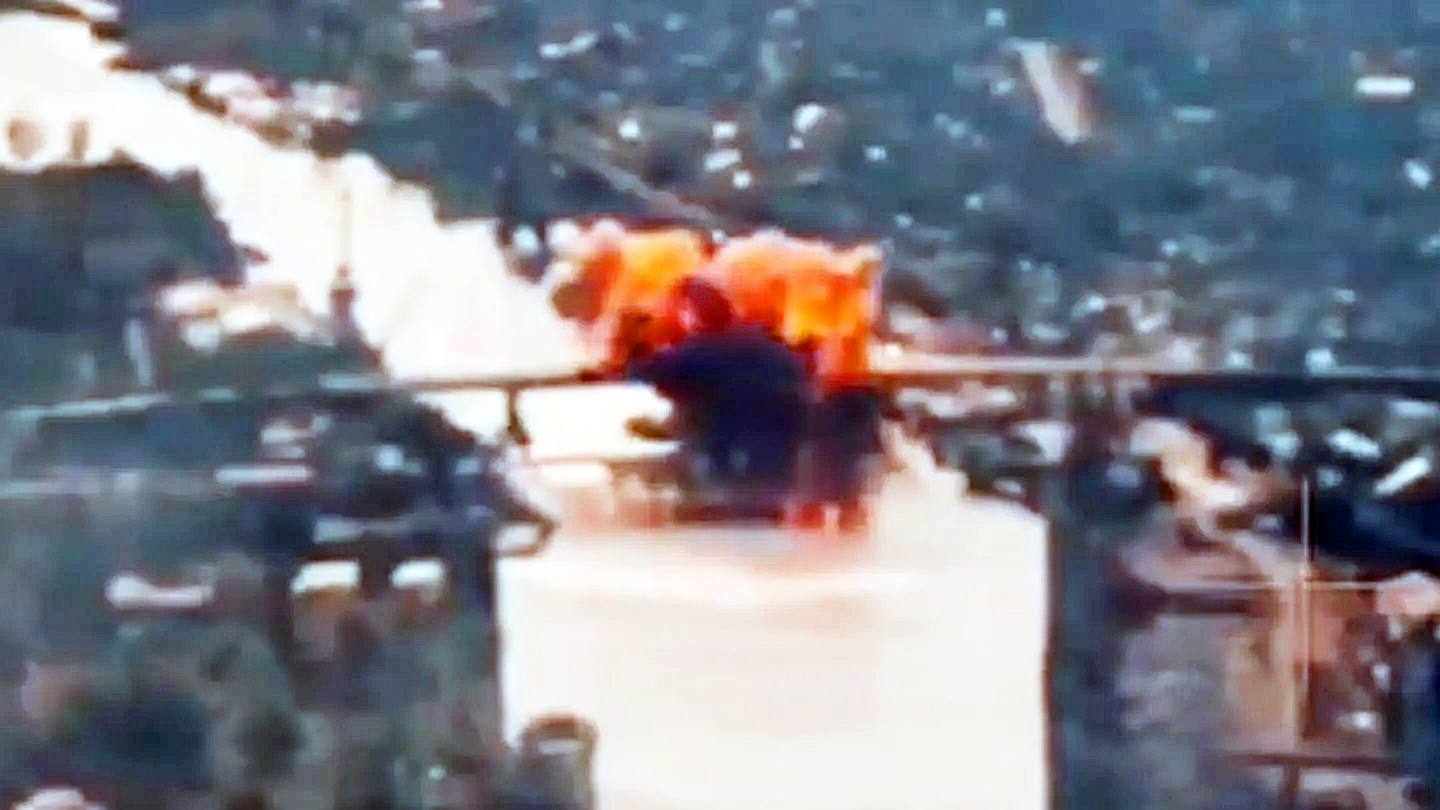
Despite a week of Russian attacks, a key bridge linking the city of Kherson to the island of Korabel remains standing. The repeated bombardment sparked concerns that Russia could launch an attack across the Dnipro River.
“The Korabel bridge is damaged but still passable,” Oleksandr Prokudin, Head of the Kherson Regional Military Administration, said in a message to The War Zone on Thursday. “However, traffic is difficult, making it problematic to deliver food, medicine, and other essential supplies. At this time, there are no plans to repair the bridge due to the complex security situation in the area.”
The following videos show several Russian aviation attempts to destroy the bridge.
Still, more than 1,000 residents have been evacuated from the island, Prokudin told us.
“Since Saturday, Russian forces have been launching daily airstrikes on the neighborhood,” he explained. “For example, just yesterday, the enemy dropped seven guided aerial bombs. Drone and artillery attacks have not ceased at all. Over the past six days, 1,009 people have been evacuated from the danger zone — including 56 children and 110 people with limited mobility. The evacuation from Ostriv continues.”
CNN recently suggested that Russians might attack across the Dnipro.
“The capture of Kherson city and region – seized in the opening days of the war and then freed by a swift Ukrainian counter-offensive in November 2022 – remains one of Russian President Vladimir Putin’s main goals for the conflict,” the network stated. The “renewed pressure to separate Korabel from the rest of the city has raised concerns Russian forces might seek to bombard and then land upon the flat terrain in the weeks ahead.”
However, the Ukrainian military dismisses that concern.
“The scenario that the enemy will now try to land in the Ostriv (Korabel) neighborhood is, from a military point of view, very doubtful at this time,” said Vladislav Voloshin, spokesman for the Southern Defense Forces. “This is because before approaching the Ostriv neighborhood, the enemy must overcome several waterways and pass several islands, which is quite difficult today. The Ukrainian defense forces are working on all assault and crossing groups that the enemy is trying to launch on our shore. It takes time for the enemy to swim from one shore to the other. And during this time, all of these enemy assault groups can be detected. Because we are not going to sit idly by and wait for the enemy to land on our shore and begin to capture areas of the city. To voice this scenario now is like talking about various scenarios of some unrealistic events that have not yet happened.”
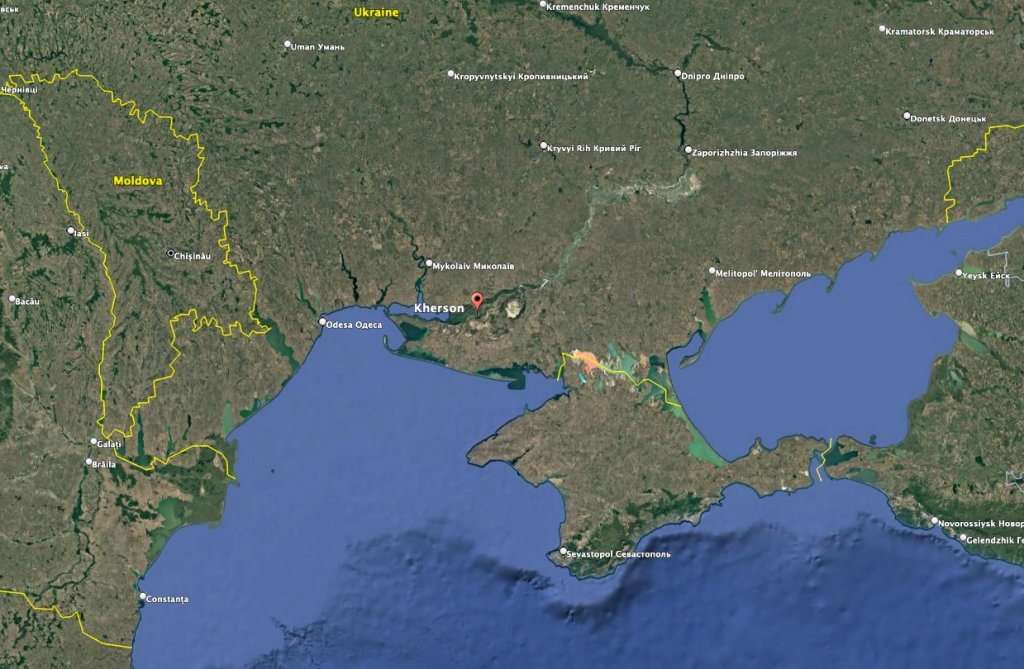
Voloshin’s analysis of the challenges facing any cross-river attack bears out what The War Zone suggested in January 2023. We wrote that troops and equipment trying to make the half-mile trek would essentially be sitting ducks.
Regardless of any attempted river crossing, Russian drone operators have deliberately hunted down hundreds of people in Kherson for more than a year, killing dozens and wounding at least 500.
Earlier this week, the Ukrainian Air Force struck back, destroyed a building used by Russians to carry out attacks on civilians living in the city of Kherson. The building was reportedly a sanitary-epidemiological station building used as a battalion-level command post.
Even without Russians physically crossing the river, they are making life in Kherson and especially the island, very difficult.
“Korabel is one of the most dangerous neighborhoods in Kherson, under constant Russian attack,” said Prokudin. “That’s why the evacuation from the area is taking place under extremely difficult conditions. The enemy continues to shell Korabel with artillery and attack it with drones — the evacuation of civilians does not stop the Russians.”
The Latest
U.S. President Donald Trump’s attempts to end the war remain in flux.
Russian President Vladimir Putin said Thursday he hopes to meet next week with Trump, possibly in the United Arab Emirates, according to The Associated Press. However, a White House official cast doubt on the summit occurring unless the Kremlin leader also agreed to a meeting with Ukrainian President Volodymyr Zelensky.
Putin’s announcement came on the eve of a White House deadline for Moscow to show progress toward ending the all-out war or suffer additional economic sanctions, the wire service added.
The U.S. was still expected to impose those sanctions Friday on Russia, according to a White House official, the AP stated.
“The same official said a U.S.-Russian summit would not happen if Putin does not agree to meet with Zelensky,” AP noted. “The official did not specify whether the condition was for Zelensky to be present at the possible U.S.-Russia summit or at a subsequent meeting.”
On the battlefield, the commander-in-chief of Ukraine’s Armed Forces said the fiercest fighting continues to take place in the Donetsk region of eastern Ukraine.
“It’s been a very busy month,” he stated on Facebook. “In the East, the Russian aggressor tried to step practically across the entire line of combat. Our troops bravely repelled attacks from an enemy who uses ‘thousands of cuts’ tactics, employing small assault groups for offensive actions.”
“The most difficult situation is in the Pokrovsky, Dobropilsky and Novopavlivsky directions,” he noted, adding that “we have success in liberating the territory of the Sumy region.”
Though Syrskyi said Ukraine has been repelling attacks, a former Zelensky spokesperson offered a much more dire take.
“Russian encirclement is nearly complete in several zones of the frontline in Ukraine,” Iulila Mendel stated on X. “Through months of grinding advances, Moscow is closing in on four key regions — Pokrovsk, Toretsk, Siversk, Kupiansk — home to over 250,000 people before the war… A breakthrough of just a few kilometers could cut off 1,000+ km² of territory, triggering a chain reaction of retreats. If nothing changes, Kharkiv could soon face a two-front assault, and Dnipro may follow.”
Meanwhile, the Russian Defense Ministry (MoD) claims it is inflicting heavy losses on Ukraine and driving deeper into its territory.
Here are some key takeaways from the latest Institute for the Study of War assessment.
- Kursk: Russian forces continued limited offensive operations in unspecified areas of Kursk Oblast on August 6 but did not advance.
- Sumy: Russian forces continued offensive operations in northern Sumy Oblast on August 6 but did not make confirmed advances.
- Kharkiv: Russian forces recently advanced in northern Kharkiv Oblast.
- Luhansk: Russian forces made marginal advances in the Kupiansk and Lyman direction but gained no ground toward Borova.
- Donetsk: Russian forces gained ground toward Siversk and Toretsk and Pokrovsk, while Ukraine advanced marginally in the Chasiv Yar area. Despite constant attacks on Novopavlivka and Velykomykhailivka, Russia made no confirmed advances toward those towns.
- Zaporizhzhia: Russian forces recently advanced in western Zaporizhzhia oblast, but gained no ground northeast of Hulyaipole near Zelene Pole and Temyrivka and east of Hulyaipole near Malynivk.
- Kherson: Russian forces continued offensive operations in the Kherson direction on August 4 and 5 but did not advance.
With its troops pressuring Pokrokovsk, the Russians are reportedly dropping leaflets urging local residents to reveal Ukrainian positions.
“Attention! Dear Citizens!” the leaflets read. “Russian troops are advancing and the liberation of your city is a matter of time. Mark the location of distributed Army known to you on the ground or fence.”
The leaflet goes on to ask for those locations to be revealed by having people use an X or an arrow to mark the spot.
Ukraine will have to continue its mobilization efforts to counter growing Russian troop numbers, Syrskyi warned. He claimed that while Russia lost more than 33,000 troops last month, they are adding nine thousand troops each month as well.
“Russian leadership aims to form ten new divisions by the end of the year,” Syrskyi stated on Facebook, adding that “two have already been created.”
“Therefore, we have no other choice but to continue mobilization measures, improve combat training, and strengthen the unmanned component of our troops,” he continued.
Not only is Russia building out new divisions, it is preparing the largest rearmament program since the collapse of the Soviet Union, according to Lt. Gen. Kyrylo Budanov, head of Ukraine’s Defense Intelligence Directorate (GUR). Budanov said Russia is planning to allocate approximately $1.1 trillion by 2036.
Speaking at the annual meeting of Ukraine’s ambassadors titled “Intelligence, Security, Diplomacy: A Common Strategy for Victory”, Budanov said that this military buildup is not merely a technical upgrade but a full-scale mobilization of Russia’s political system, economy, and society aimed at preparing for a potential large-scale war.
At least two people were killed and a dozen were injured in a Russian air strike on a recreation center in the Zaporizhzhia region on Wednesday, said Zelensky. It was one of several attacks on civilians across Ukraine, he added.
“There is zero military sense in this strike – just cruelty aimed at instilling fear,” Zelensky stated on X. “Also at night, there were vicious attacks on power grids in the Dnipro region, a drone-dropped munition targeting civilians in Kherson, and a strike on a gas facility in Novosilske, Odesa region. Hundreds of families were left without gas. This was a deliberate blow to our preparations for the heating season – absolutely cynical, like every Russian strike on our energy infrastructure. In the Kharkiv and Donetsk regions, the Russians targeted people’s private homes.”
Video emerged of the attack on the gas facility near the town of Orlivka in the Odesa region. It showed Romanian citizens watching from across the Danube River as the facility erupted in flames.
A large refinery was attacked by Ukrainian drones, military officials in Kyiv claimed.
“The damage to the Afipsky oil refinery in the Krasnodar region has been confirmed,” the Ukrainian Armed Forces General Staff stated on Telegram. “Its annual processing capacity is 6.25 million tons per year, which is 2.1% of the total oil refining volume of the Russian Federation. As a result of the UAV strike, a fire broke out at the technological unit for processing gas and gas condensate.”
Ukraine is also continuing to hammer Russian rail logistics.
Last night, Ukrainian drones hit a rail station in the town of Surovikino in Russia’s Volgograd region. Though videos show the attack sparked fires, the regional governor said the drones were downed and no facilities were damaged.
On Wednesday, the Tatsinskaya railway station in Russia’s Rostov Oblast was attacked for a second consecutive night. The Tatsinskyaya station is a key hub for Russian military supply transportation, according to the independent Russian ASTRA media outlet.
These are the latest in a string of attacks Ukraine has carried out against Russian trains, rail tracks and other infrastructure. As we previously reported, Moscow relies on rail to move most of its troops and equipment.
Ukraine has also been targeting occupied Crimea. In addition to striking radar systems and a ship, Ukrainian attack drones earlier this week hit a space object tracking radar near the city of Feodosia, according to the Ukrainian Militarnyi media outlet.
“The radar complex is used as one of the elements of Russia’s air defense and monitors the airspace, transmitting relevant information to the posts of anti-aircraft missile systems,” the outlet reported. “The four radar antennas are located 300 meters above sea level and are covered with radio-transparent spherical domes to protect them from wind and snow.”

Quick thinking by the Luftwaffe helped speed up the repair of a Patriot air defense system‘s radar unit, badly damaged in a Russian attack a few months ago.
It was brought back to Germany, where the industry determined that was a total loss, German Maj. Gen. Maik Keller, Deputy Commander of the NATO Security Assistance and Training for Ukraine, told the Frankfurter Allgemeine Zeitung (FAZ).
Since it would take a few years to replace it with a newly bought and built radar, experts from the Luftwaffe tried to repair it themselves and actually managed to accomplish it by spending 16 hours a day from Monday to Saturday, Keller explained to FAZ. In July, the radar unit was delivered back to Ukraine. Just last week, the first Russian target was intercepted by utilizing this very radar unit, the German general noted.
New video released by the Russian Espanola irregular military group shows its troops zipping toward the destroyed city of Chasiv Yar on motorcycles. The video shows the troops riding down a road, dodging explosives, before arriving at the city.
The Russians claimed they captured this town in Ukraine’s eastern Donetsk region last week after a 16-month battle. However, Ukraine’s military denies that. They say Ukrainian troops are still fighting in the city and that Russia “has no control” over it.
Partisans in Russia loyal to Ukraine released a video today showing what they claim was a sabotage attack on a Russian Mi-28 helicopter.
The Ukrainian People’s Resistance claims it infiltrated the 344th Center for Combat Use and Retraining of Army Aviation Flight Personnel, a key helicopter training base in the Tver region. The video, taken June 1, purports to show one of the group’s members walking up to the helicopter and placing what appear to be two explosive devices on it. While the video does not show what happened, it does cut to a shot of Russian Telegram channels wondering about an explosion and fire at the base.
The War Zone cannot independently verify this claim.
The remains of the Ukrainian equivalent of Russia’s Shahed drone were seen in a recent image emerging on social media. The picture shows that the drone had a hybrid warhead. Facing forward was a large shaped charge surrounded by a fragmentation jacket designed to disperse small metal shards at a high velocity. The rest of the casing is covered in shaped charges designed to strike in a 360-degree pattern.
Anti-drone drones are becoming an increasingly important weapon for both sides. As we previously wrote, Ukraine is scrambling to create interceptor drones to counter Russia’s rapidly improving Shahed kamikaze drones. Russia, too, is developing interceptors.
The Yolka is “a compact specialized kinetic interceptor,” which operates like a man-portable air defense system (MANPADS), according to the Russian Lost Armour Telegram Channel. “The target is destroyed by mechanical collision and destruction of the enemy UAV’s structure, which allows ‘Yolka’ to operate without a warhead (although optionally it is possible). Thanks to excellent speed and maneuverability characteristics, as well as an advanced target acquisition and tracking system with AI elements, the success rate of its use in the special military operation zone is extremely high.”
Videos below show them using the Yolka drone to hit Ukrainian drones.
Residents of Russia’s Belgorod region watched as a Ukrainian FPV drone blew up a military vehicle. The explosion caused a small fire and sent debris flying.
Back before the advent of FPV drones, soldiers could sometimes stop for short periods, hiding out in houses or other buildings with open doors and windows. However, thanks to the highly maneuverable, swift-flying FPV drones, those days are largely over. The following video offers an example of that, as Russian troops seeking shelter could not avoid being attacked.
In another example of how well a trained operator can use FPVs, Ukrainian troops managed to blow up a bridge in Russia’s Bryansk region by flying one around obstacles to detonate anti-tank mines set up under the span. The explosives were placed there by Russians in case they needed to blow up the bridge. You can see that unfold in the following video.
Ukrainian FPV drones destroyed several Russian weapons, including a Buk-M1 surface-to-air (SAM) system and several armored vehicles. The attack reportedly happened despite Russian electronic warfare defenses. In the video below, you can see a drone, operated by the 413th Separate Unmanned Systems Battalion, teeing up on the Buk that tried to hide out in a building. The attack, which also destroyed several other vehicles, was reportedly carried out despite Russian electronic warfare defenses.
The use of fiber optic cables to guide FPV drones has become so prevalent on both sides that fields once used for farming are now covered in the strands. You can see that in the following video, taken by a Ukrainian Mi-24 helicopter. The cables are impervious to jamming and other forms of electronic warfare. They also help mitigate terrain features that can impede radio signals linking the drones with the controller.
In an apparent effort to extend the range of its Mavic drones, Russia is using some of its Molniya reconnaissance drones as a mothership of sorts to carry them deeper into enemy territory. We have previously discussed the advantages of this. However, the mothership drones can be quite pricy, something else we have noted. Using the relatively inexpensive Molniya this way appears to be a cheaper option.
We have written frequently about Ukraine’s drone boat campaign against Russia, especially GUR’s development and use of its Magura line. Recently, navalist H I Sutton provided some background about how the Magura came to be.
And finally, a Russian soldier used his head, literally, to try to ward off a Ukrainian FPV drone.
The attempt did not work.
That’s it for now.
Contact the author: howard@thewarzone.com
Loading comments…
Comments couldn’t be loaded. Please refresh the page.