

During its ongoing fight against Russia, the First Corps Azov of the National Guard of Ukraine comes under constant drone attack. Usually, it’s from small, highly maneuverable first-person view (FPV) drones. Occasionally, however, Russia uses its Shahed long-range kamikaze drones against Azov’s frontline positions, Lt. Col. Arsen “Lemko” Dmytryk recently told us in an exclusive interview. Though infrequently deployed against Azov, Shaheds are hitting other Ukrainian units near the front. There is additional evidence that points to these drones increasingly being modified to support closer-range use against targets of opportunity, even moving ones, near the heart of the fighting. This could become a major issue as production of the weapons, which have become Russia’s primary long-range strike capability against static targets, is set to explode.
In March 2024, it became apparent that Russia installed cameras and cellular modems on a small number of Shaheds. That likely gave them aerial reconnaissance capability and the ability to send images back home, and possibly direct man-in-the-loop (MITL) control when connected opportunistically via Ukrainian wireless networks. Standard Shahed drones have no MITL control or autonomous targeting capabilities and can only strike static targets that are predetermined prior to launch.
As we previously reported, Russia is increasing the use of its main standoff weapon against dynamic targets like moving trains. This has been enabled by MITL control and/or autonomous targeting capabilities. MITL could be provided by leveraging cellular connectivity when available, a line-of-sight datalink when the target is in close enough proximity to the front lines and/or airborne relays are used, or even a micro beyond-line-of-sight (BLOS) satellite communications system, which is less likely.
Recently, Ukrainian electronic warfare specialist Serhiy Beskrestnov, known by his callsign “Serhiy Flesh,” noted that one of the Shaheds used in the train attack had an antenna on the tail and a camera in front.
“This is Shahed with online control who…attacked the railway,” Flesh noted on Facebook. “The operator walked on the target many times, trying to optimally strike. A large non-returnable FPV with a combat unit of 50 kilograms, controlled from the Russian Federation.”
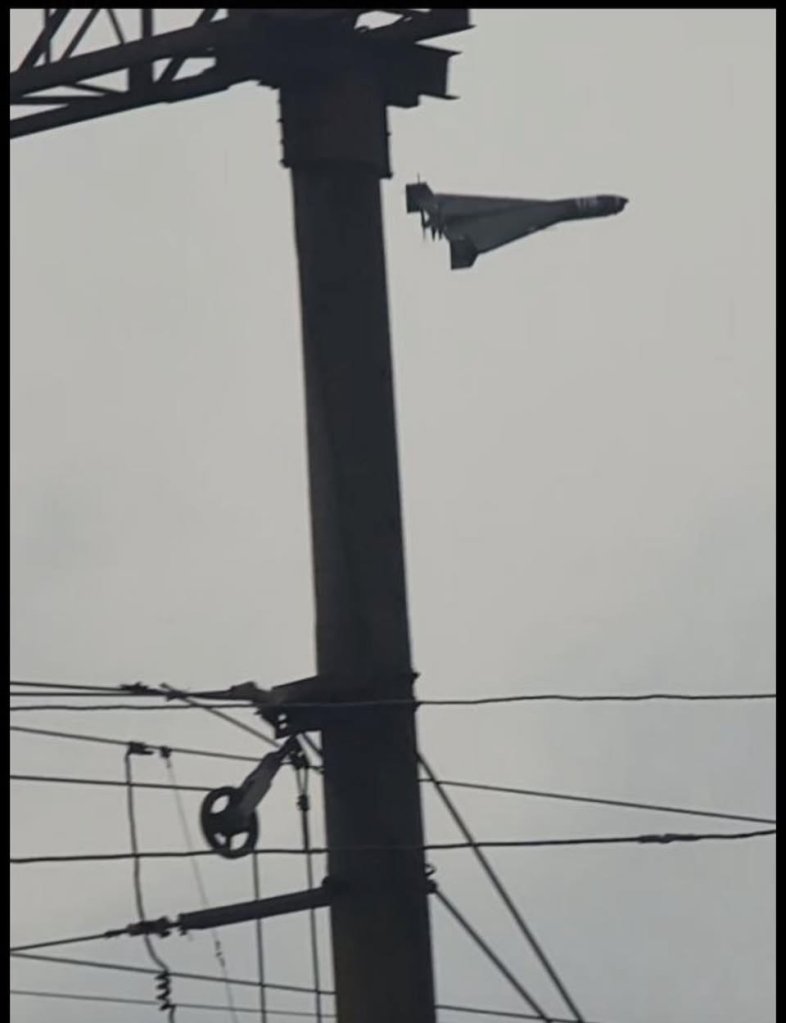
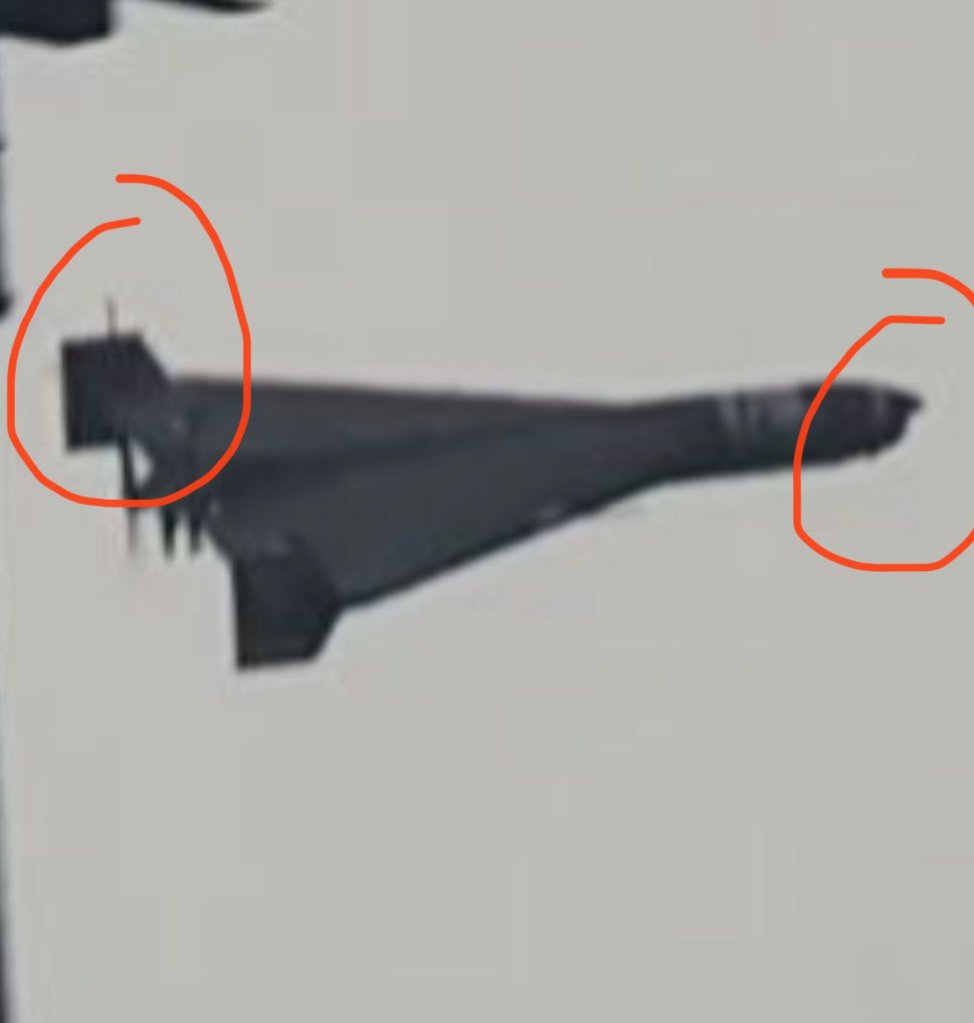
As we have highlighted in detail, for Russia, having Shaheds that can dynamically seek out targets, even moving ones, inside Ukrainian territory would be a tremendous advantage. It would open up scores of potential targets that Russian airpower, with its lack of robust long-range kill chains and no air superiority over Ukraine, cannot currently address.
Even being able to just hunt for and attack dynamic targets within a dozen or so miles from the front lines, using simple line-of-sight datalinks, would give Russia a weapon that can loiter for long periods and deliver a far heavier blow than current lower-end drone capabilities that also lack endurance. Shaheds pack around a 100lb warhead of increasing lethality, but if they are launched closer to the front and require far less fuel for these kind of strikes, that warhead size could potentially be increased, making it a very flexible and deadly weapon. It could be especially threatening to rear logistics chains, artillery emplacements, and air defenses.
Military analyst Rob Lee, Senior Fellow at the Foreign Policy Research Institute, also confirmed the use of Shaheds at or near the front, telling TWZ “I heard from the commander of an artillery brigade and a marine brigade that Russia was using Shaheds to target artillery.”
Why Russia may push Shaheds to attack near the front lines is likely more about logistics than technological capabilities. Russia is now building Shaheds at such a rate that they can use them for missions beyond their core deep strike against fixed targets repertoire. This includes expanded experimentation with new tactics and hardware configurations. We have already seen this with Shahed-136s being used even in more exotic new ways, like laying mines, which likely uses a similar MITL control, among other concepts.
Oleksandr Pertsovskyi, head of Ukraine’s rail system recently told Reuters the huge uptick in rail system attacks is the result of Russia’s “dramatic increase” in the amount of long-range drones its military-industrial complex is producing. As we have previously reported, Russia is moving to produce about 5,000 Shaheds per month.
“Previously, they simply did not have sufficient resources for a single combat drone, such as a Shahed, to hunt down a locomotive,” Pertsovskyi told the publication. “Now they can afford to use Shaheds to hit individual locomotives rather than strategic targets.”
If Russia sees sustained results from using Shaheds turned into MITL-controlled strikers, we will see much more of them adapted to this role in the future, and this could prove to be a major problem for Ukraine. This will only become more dire as AI gets more deeply infused in lower-end drones, especially long-range kamikaze drones like the Shahed-136. With such a capability, it would be able to search for targets of opportunity autonomously hundreds of miles deep into Ukrainian-controlled territory without anyone at the controls.
Contact the author: Howard@TWZ.com
Loading comments…
Comments couldn’t be loaded. Please refresh the page.