
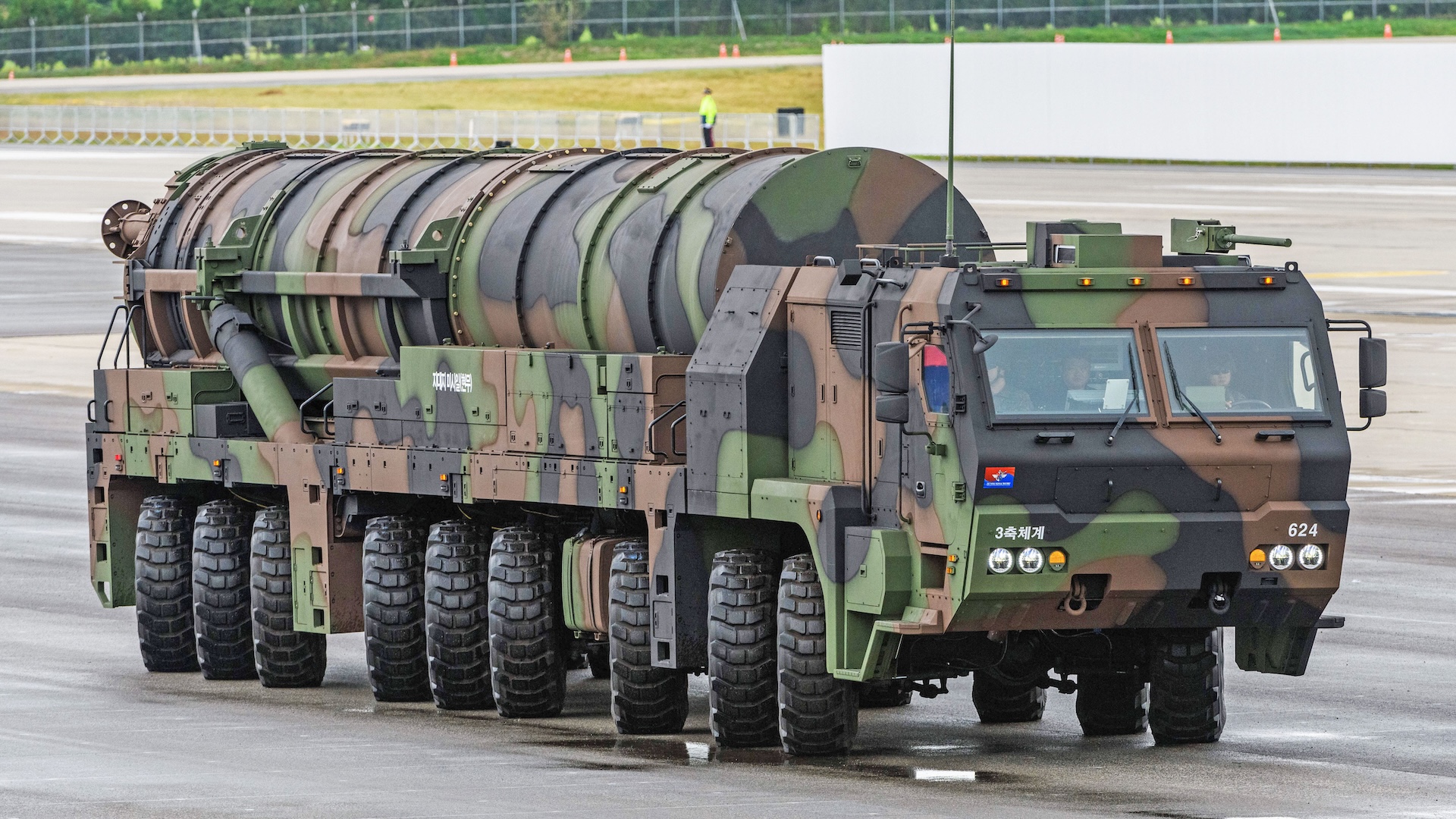
South Korea’s Hyunmoo-5 ballistic missile, the country’s largest to date, has now been operationally deployed, according to local reports. Overall, the missile remains mysterious, with no publicly confirmed test launches, although its size — closer to an intermediate-range ballistic missile (IRBM) — and its absolutely colossal penetrating warhead put it in a class of its own. It would likely play a key role in any kind of large-scale conflict with North Korea and, as such, is the latest in a line of bespoke weapons intended to counter growing threats from Pyongyang.
The weight penalty of its huge warhead makes the Hyunmoo-5 a short-range ballistic missile. In terms of applications, it has some parallels with the air-launched GBU-57/B Massive Ordnance Penetrator (MOP). While the Hyunmoo-5 warhead is around half the size, the MOP is dropped from a subsonic aircraft and does not have anywhere near the kinetic punch of this missile, which would be careening into the ground at near-hypersonic or well into hypersonic velocity, giving it a much larger punch and burrowing power before detonating.
A video prepared by Yonhap News TV to mark the deployment of the Hyunmoo-5 ballistic missile; note that the footage also includes other strike systems:

Anonymous military sources told The Korea Herald yesterday that the missile began to be fielded late last year. An official from the South Korean Ministry of Defense told the same publication that the military was “pushing ahead with the integration of the Hyunmoo-5,” with full operational deployment expected to be achieved before 2030.
It’s not clear how many of the missiles will be fielded. The Korea Herald describes deploying “several hundred high-power missiles.” However, these may also include other new types in addition to the Hyunmoo-5.
Overall, the Hyunmoo-5 remains secretive, with authorities ensuring that details of its precise role and capabilities remain ambiguous.
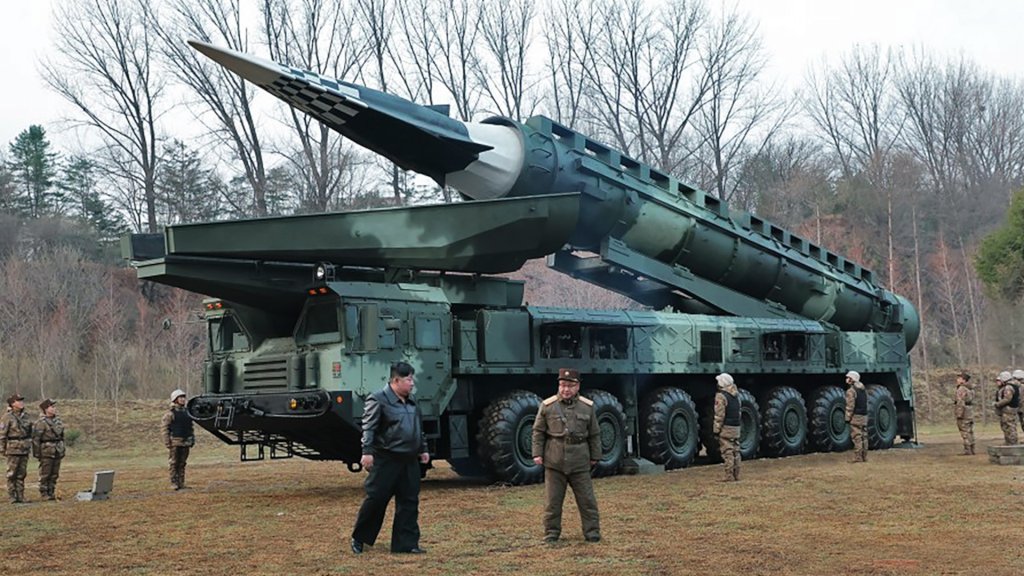
The Hyunmoo-5 was first publicly unveiled during Armed Forces Day celebrations in October 2024. The missile itself was not shown, but the nine-axle transporter-erector launcher (TEL) confirmed that this was South Korea’s largest ballistic missile yet.
At this point, however, the Hyunmoo-5 name was not revealed, with official statements instead referring to an “ultra-high-power ballistic missile.” Media reports, meanwhile, dubbed the weapon a “monster missile.”
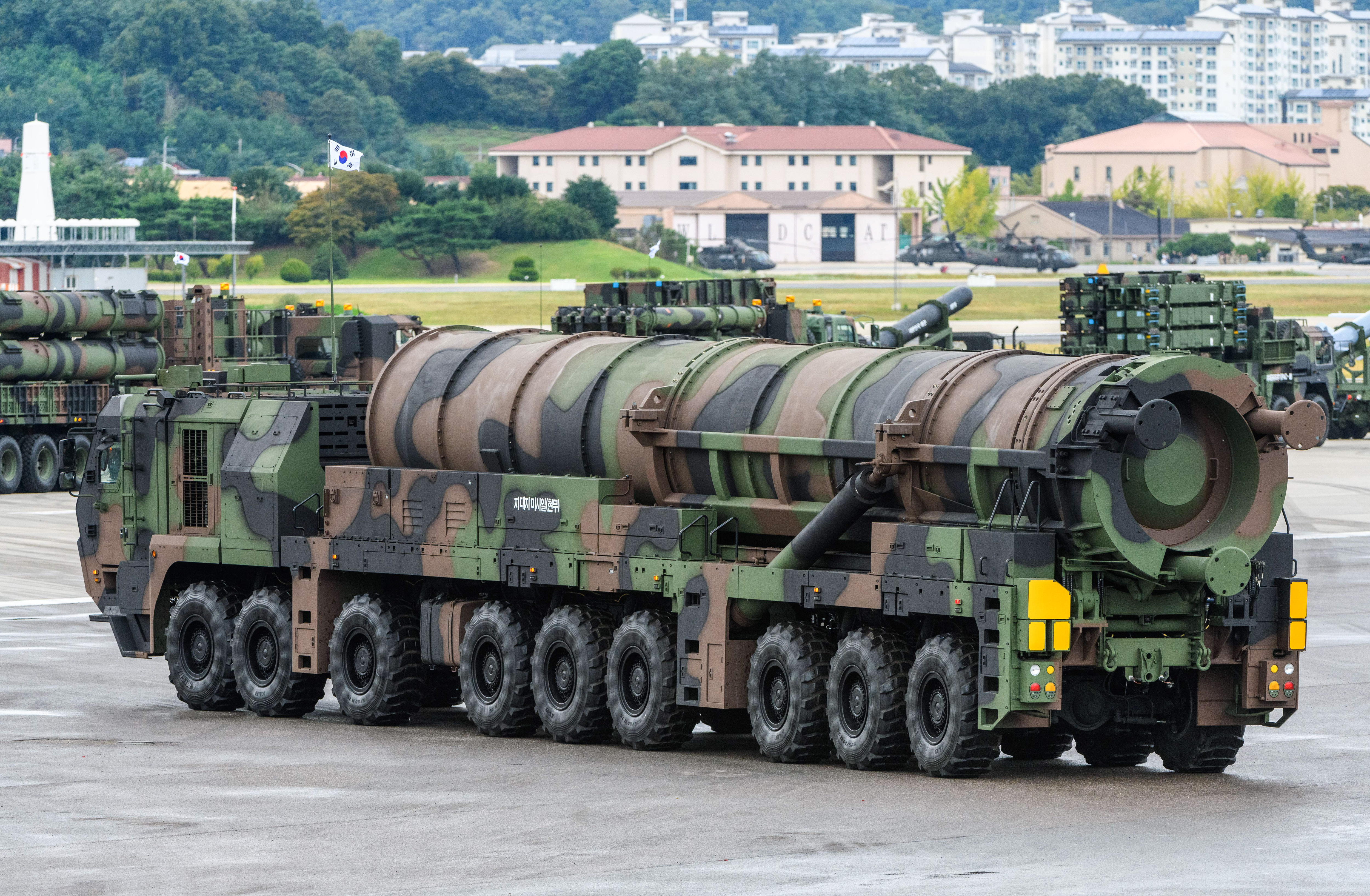
The Hyunmoo-5 designation was first confirmed by South Korean Minister of Defense Ahn Gyu-back in October last year, when he also announced plans for its mass production.
Development of the solid-fuel missile appears to have begun before October 2022, when its existence was disclosed in a National Defense Committee audit, which also stated that it had a total weight of around 35 tons and a warhead of more than 17,000 pounds.
The warhead weight alone makes the Hyunmoo-5 a unique weapon. Typically, conventionally armed ballistic missiles carry an explosive payload of less than 2,200 pounds. However, steadily more powerful warheads appear to be a feature of South Korean ballistic missiles, with the previous Hyunmoo-4 short-range ballistic missile (SRBM) reportedly carrying around 4,400 pounds of explosives.
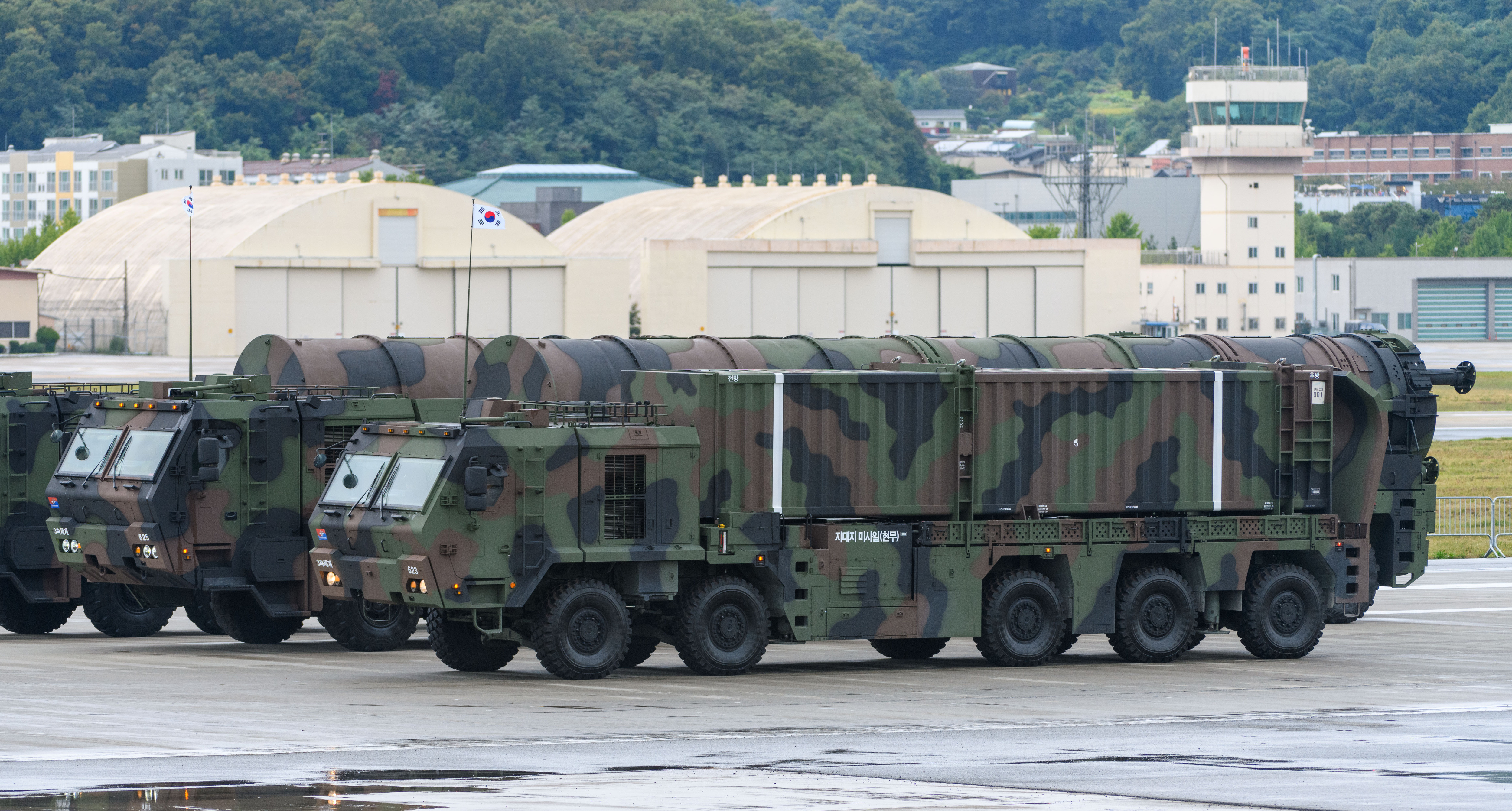
The “ultra-high-power” warhead of the Hyunmoo-5 points squarely to a weapon that’s designed to punch through North Korea’s most hardened targets, typically buried deep underground. These include regime facilities such as bunkers, as well as command and control nodes, and numerous storage facilities.
At the same time, it’s likely that the published warhead weight includes not only the explosive payload but also a dense metal penetrator casing to enhance its bunker-busting characteristics. Tandem charges are also likely, and possibly also decoys. Some accounts suggest that as much as 80 percent of the warhead, by total mass, consists of heavy metal, with explosive material making up the remaining 20 percent.
Meanwhile, the range of the Hyunmoo-5 has been much discussed.
According to most reports, the missile can hit targets at a distance of 600 kilometers (373 miles), which would be notably short for a weapon of this size. Its relatively enormous warhead imposes a significant range penalty. Substituting its big warhead for a smaller and lighter one could push the range further, but for its primary application — going after hardened North Korean facilities — it doesn’t need long range.
There are other reports suggesting that the Hyunmoo-5 can achieve IRBM performance — able to hit targets at a distance of more than 3,000 kilometers (1,864 miles) — if its warhead weight is reduced.
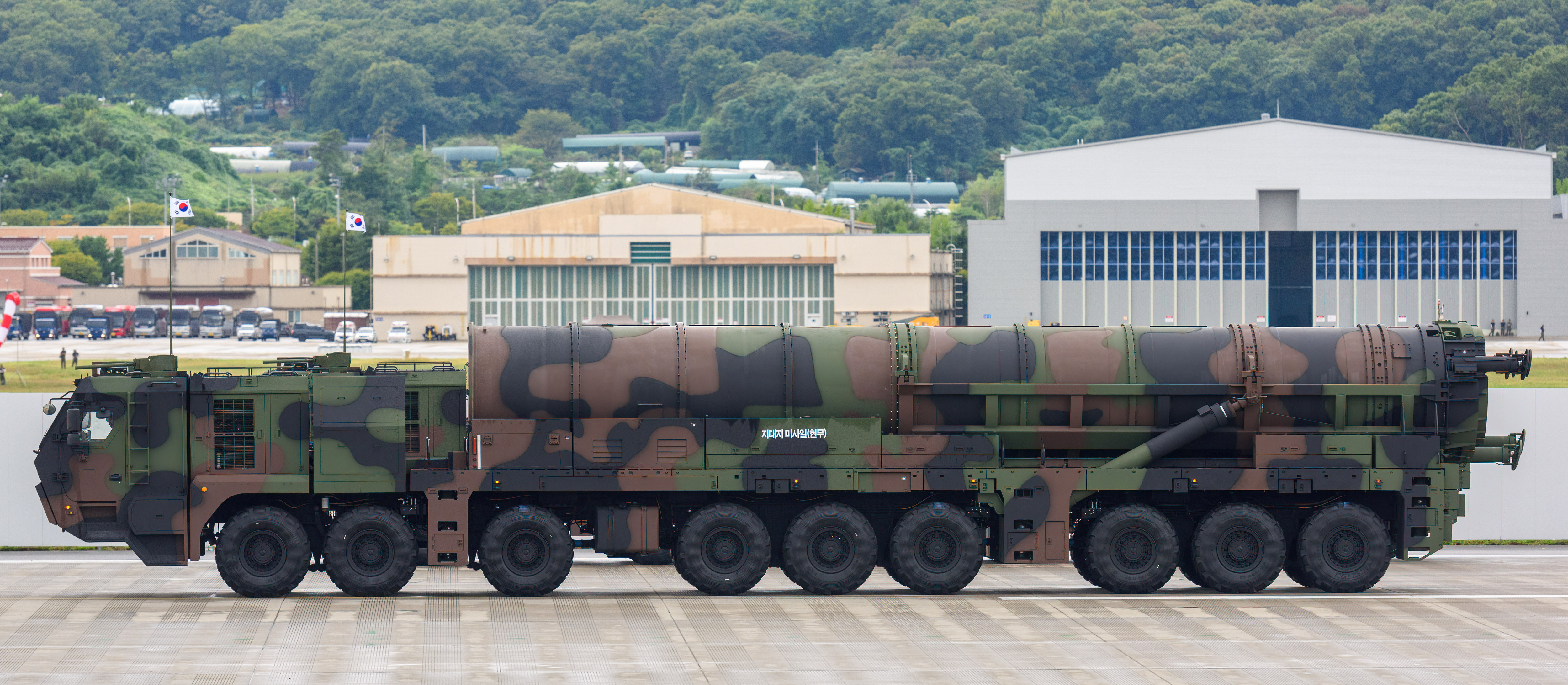
Clearly, the Hyunmoo-5 is able to go far beyond the limit of 180 kilometers (112 miles) that was imposed under the ballistic missiles treaty guidelines agreed between South Korea and the United States in 1979. Those same guidelines included a warhead limit of 500 kilograms (1,102 pounds).
The range restrictions were steadily relaxed, to 300 kilometers (186 miles) in 2001 and 800 kilometers (497 miles) in 2021 — putting all of North Korea potentially within range of South Korean ballistic missiles. Finally, the guidelines were scrapped entirely in June 2021, a reflection of the rapid pace of North Korea’s ballistic missile and nuclear weapons developments.
The Hyunmoo-4 and the Hyunmoo-5 both reflect South Korea’s push to produce longer-range-capable missiles now that these range (and warhead weight) restrictions have been removed.
Not surprisingly, the Hyunmoo-5 has been developed as a fundamental part of Seoul’s so-called “three-axis” operational plan, designed to dissuade or respond to a possible nuclear attack from North Korea.
Overseen by South Korea’s Strategic Command, the three-axis system has three components:
Kill Chain: This is intended to carry out a preemptive strike against Pyongyang’s nuclear and missile facilities to defend Seoul, if judged necessary.
Korea Air and Missile Defense: A network intended to destroy North Korean ballistic missiles targeting the South once they have been launched.
Korea Massive Punishment and Retaliation program, or KMPR: Also known as Overwhelming Response, this is an effort to develop ways to retaliate against North Korea, using overwhelming conventional strikes, should Pyongyang launch a first attack. North Korean leadership and strategic facilities would be key targets.
While the Hyunmoo-5 has been widely reported as a future pillar of the KMPR, its specific ability to penetrate deeply buried bunkers, such as those used by the North Korean leadership, the same functions mean that it can also fulfill elements of the ‘kill chain.’ In this way, it could be used as part of a pre-emptive strike, to try and knock out North Korea’s launch capability by targeting its hardened command-and-control facilities and missile storage areas.

When it comes to the Hyunmoo-5’s prodigious warhead weight, there have been some media reports that have attempted to compare its likely destructive effect with a tactical nuclear weapon. This is misleading, since the effects of these weapons are very different, especially in relation to their weight. It should also be recalled that even the most powerful conventional weapons aren’t necessarily always effective against the most hardened and deeply buried targets.
Regardless, South Korea has redoubled its efforts to develop powerful conventional strike capabilities to meet North Korea’s missile and nuclear weapons buildup. Seoul describes this activity as a vital “balance of terror” as it faces off against Pyongyang’s nuclear forces.
At the same time, there have been signs that South Korea is at least mulling the possibility of adding nuclear weapons to its own arsenal in the future, which would mean it stepped away from the Nuclear Non-Proliferation Treaty of which it is currently a signatory.
The Hyunmoo-5 would be one obvious candidate for a nuclear warhead. Such a payload would also be far lighter than its conventional cargo, potentially putting many more targets within its reach.
This brings us to Seoul’s increasing concerns around potential wider regional threats. On a public level, South Korean officials have repeatedly stressed that their growing arsenal of long-range strike capabilities is solely aimed at North Korea. In the background, however, it’s clear that the leadership in Seoul is looking at how to provide deterrence against threats further afield, including China and Russia.
Putting more targets within reach of the Hyunmoo-5, as well as increasing its survivability, could see the missile put to sea aboard South Korea’s future Joint Strike Ship, something that officials have suggested in the past. The Joint Strike Ship reflects the growing interest in ‘arsenal ships’ expressed by navies around the globe.
With the previous ballistic missiles treaty guidelines no longer limiting the range of these weapons, South Korea is in a position to develop longer-range ballistic missiles, if it so wishes.
We still don’t know exactly what kind of range the Hyunmoo-5 can achieve. However, its deployment underscores South Korea’s ability to field ballistic missiles that not only have the potential for far greater range than their predecessors but also, when employed against targets closer to the border, that offer a unique destructive capacity.
Contact the author: thomas@thewarzone.com
Loading comments…
Comments couldn’t be loaded. Please refresh the page.