
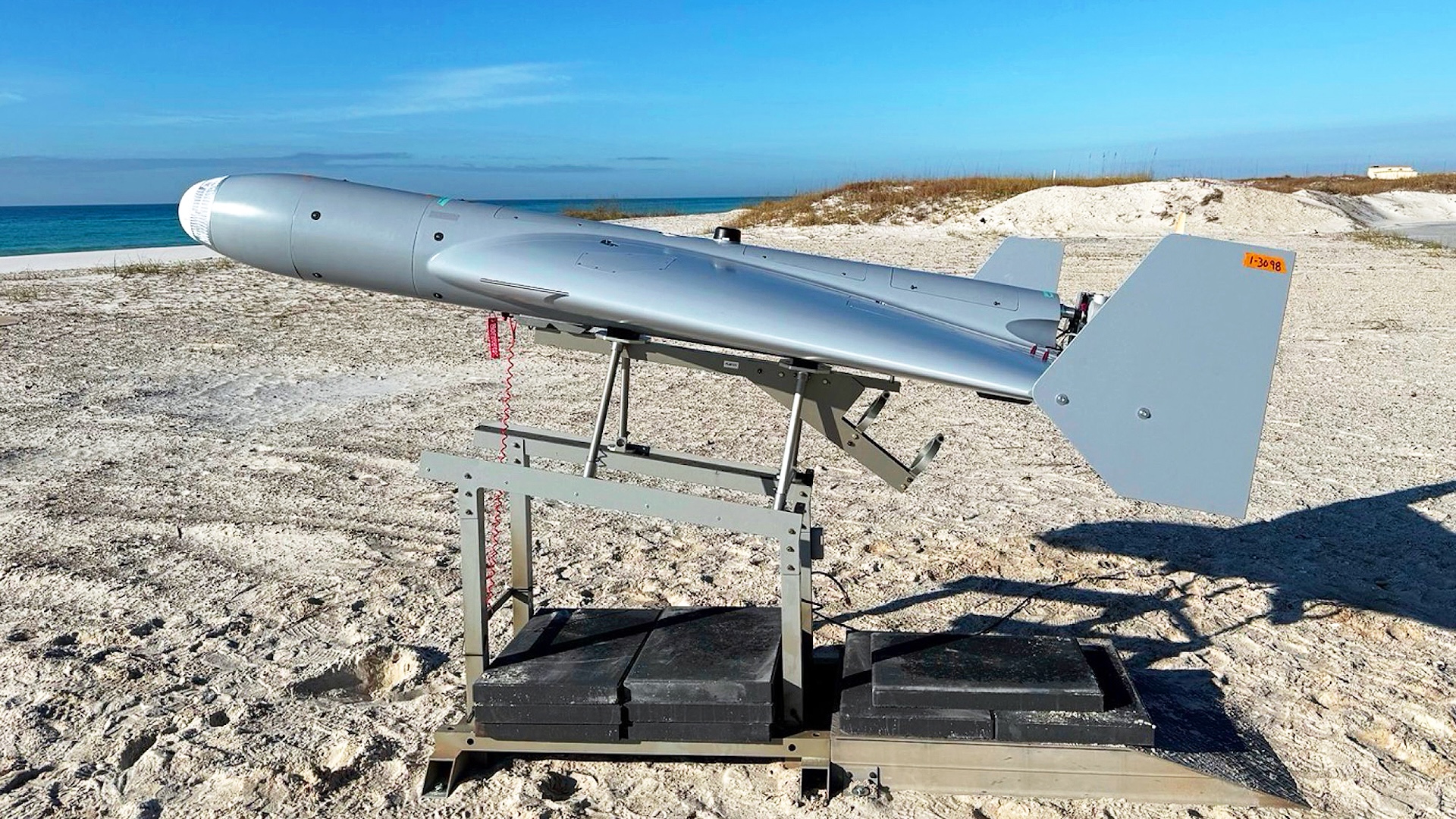
The U.S. military’s Low-Cost Uncrewed Combat Attack System, or LUCAS, the recently combat-proven long-range one-way attack drone designed for massed operations, will be equipped with Hivemind autonomy software from Shield AI. The company was selected for the integration effort by the Office of the Under Secretary of War for Research and Engineering (OUSW R&E) as part of an effort to bring AI-enabled swarming and autonomous teaming to LUCAS. The aim of incorporating swarming capabilities onto LUCAS, which is built by SpektreWorks, is something that officials told us about soon after the program broke cover.
The LUCAS program, developed by the Office of the Deputy Assistant Secretary of War for Prototyping and Experimentation under OUSW R&E, is intended to field ‘affordable mass’ by producing large numbers of relatively low-cost drones that can be deployed in coordinated waves to saturate enemy defenses and expand strike capabilities at scale. Each LUCAS drone costs around $35,000, which is a fraction of the price of available missiles with similar range.
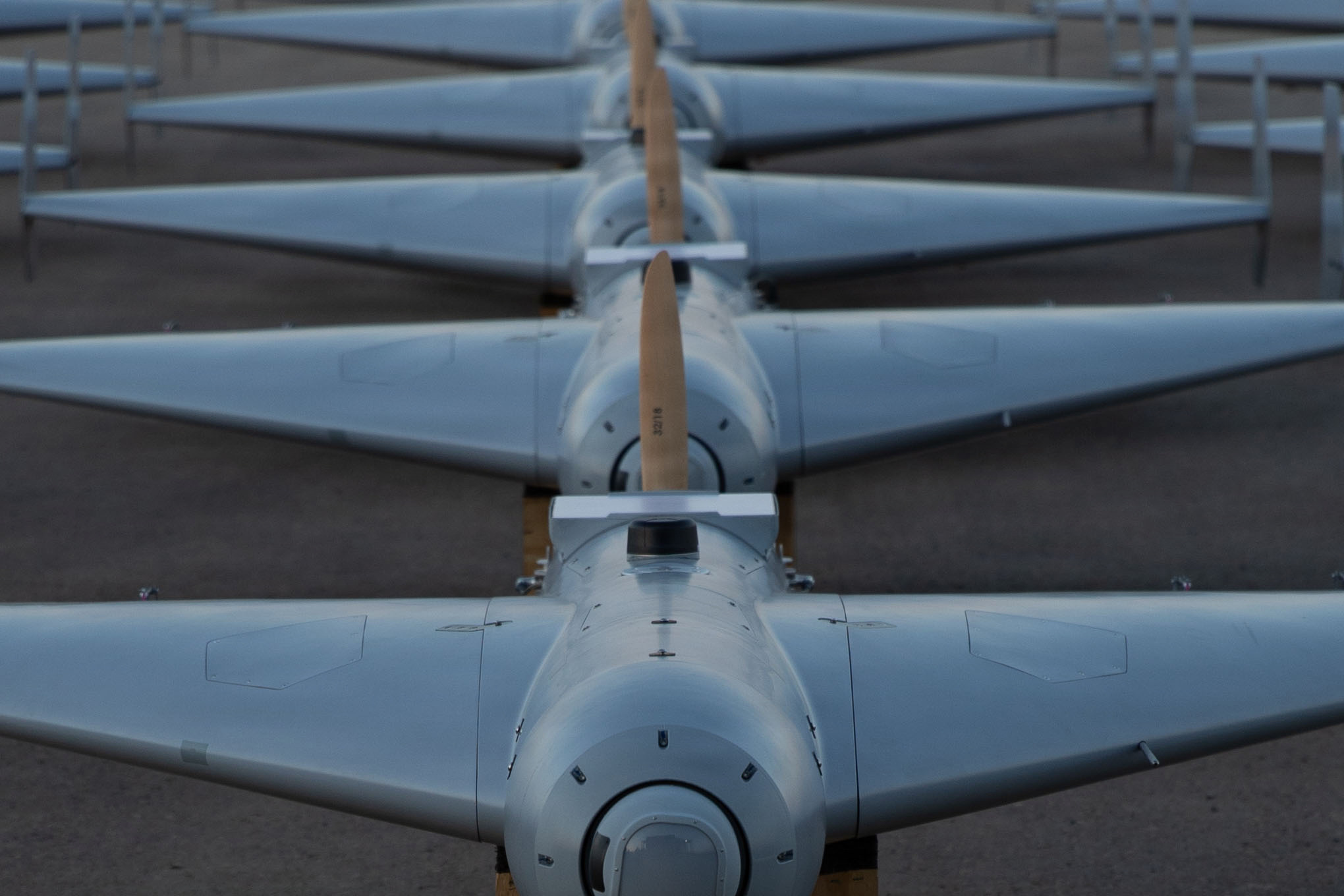
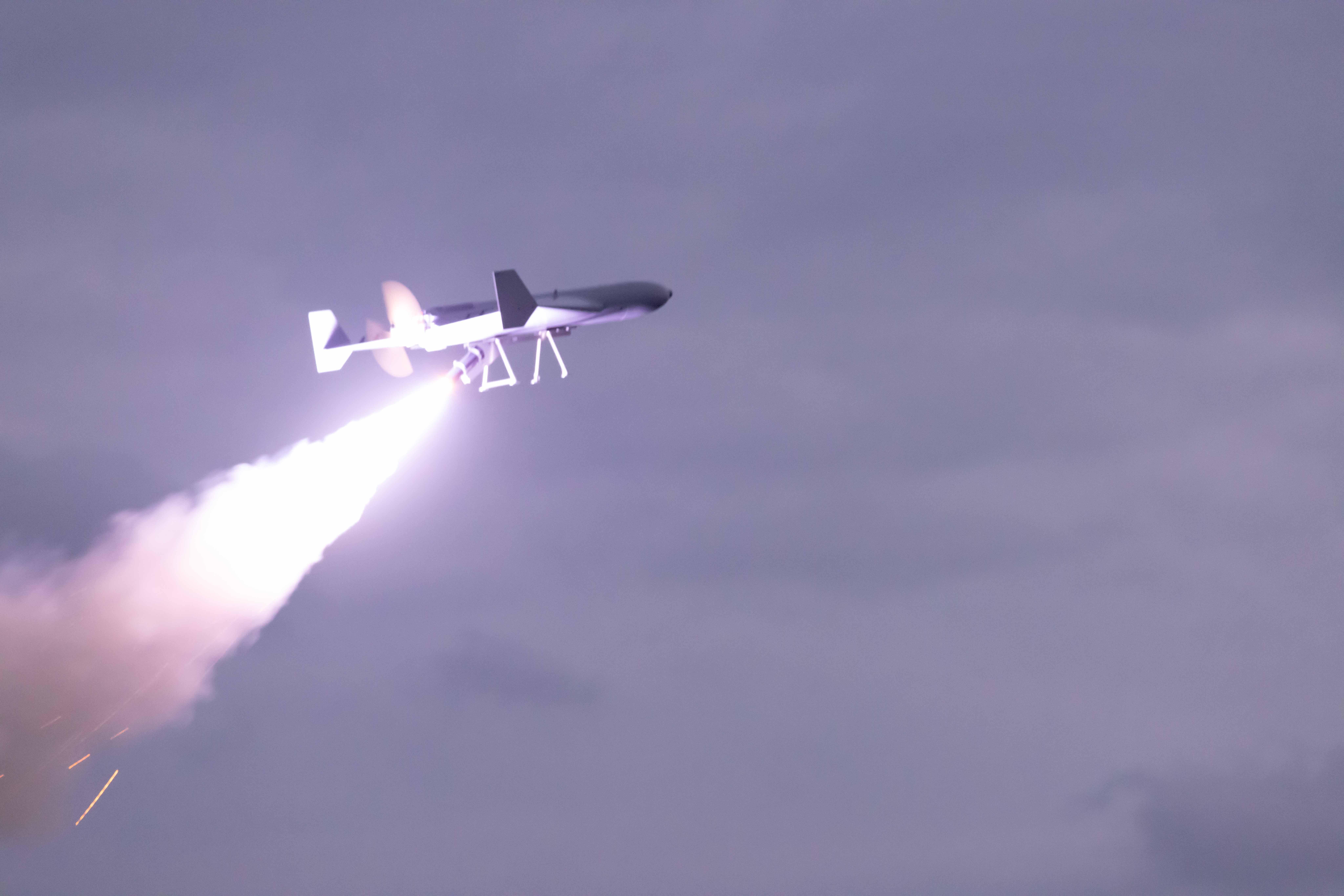
Based on the Iranian Shahed-136, LUCAS was used in combat for the first time when a large number of them were fired against Iranian targets in the opening salvos of Operation Epic Fury, the U.S. part of the joint U.S.-Israeli attack on Iran that began on February 28 of this year.
“LUCAS, indispensable,” U.S. Central Command boss Adm. Brad Cooper told TWZ when asked how effective the drones had been and how much they helped preserve magazine depth, given their comparatively low cost and faster and easier production.
Meanwhile, the original Shahed-136, as well as Russian Geran-series developments of it, have rapidly become a signature weapon of the war in Ukraine, acting as Moscow’s primary standoff strike munition. For years now, Shaheds have led Russia’s campaign of bombardment against Ukrainian infrastructure and cities. While the Shahed has a range in excess of 1,000 miles, LUCAS, in its current configuration, is a bit smaller, with a range of around half that distance. A version of the current airframe used for the LUCAS program also serves in a target surrogate role for training and testing.
Under the new effort, Hivemind will act as an AI “pilot” for LUCAS, allowing groups of drones to coordinate movements, maneuver collaboratively, and adapt to changing battlefield conditions in real time. The effort will culminate in an operational demonstration this fall in which a single operator will direct a swarm of LUCAS drones, but initial flight tests with the software installed will take place before then, Shield AI told TWZ.
Speaking to TWZ at the annual SOF Week conference yesterday, Shield AI’s Brandon Tseng explained that much of the work on inserting the Hivemind AI pilot into LUCAS has already been proven by the company’s experiences working with Ukraine.
“LUCAS is a reflection of about two years’ worth of work with OUSW R&E, and a reflection of a lot of the work that we’re doing in Ukraine with one-way attack drones,” Tseng explained. “For the past several months, we’ve been shipping hundreds of AI pilots for one-way attack drones into Ukraine. Those drones have increased the probability of a kill. They have reduced [the] kill chain timeline, they have reduced the cost per effect, instead of, one out of every 10 of these one-way attack drones hitting their target, now they’re 10 out of 10 in terms of what we’re seeing, and it’s really about taking a lot of that development that we’ve done over in Ukraine and bringing it to a program like LUCAS to again increase probability of kill, reduce cost per effect, and increase probabilities of success.”
In the Ukrainian context, Tseng confirmed that its AI agents are employed across a range of uncrewed platforms. At one end of the scale, these include one-way attack drones with a range of around 62 miles and an overall cost of $8,000, out of which the AI pilot costs around $1,000. At the other end of the scale are much larger and more expensive drones and missiles, including cruise missiles from the Switzerland-based Destinus company.
Returning to the U.S. military, the current effort began with Shield AI working on collaborative autonomy with OUSW R&E, something that began before the second Trump administration. That work was carried forward until the company was one of several down-selected to provide AI pilots for LUCAS.
The effort could represent a significant step toward fielding collaborative autonomy, a long-term goal of massed drone operations, with teams of autonomous systems operating together in dynamic and highly challenging combat environments. These could include ones where GPS is denied and communications are degraded, due to heavy employment of electronic warfare by the enemy.
“LUCAS is about delivering affordable mass, but mass without coordination is limited in value,” Tseng, who is the president and co-founder of Shield AI, said in a media release. “Hivemind is the AI pilot that makes that mass intelligent. It’s the autonomy layer that enables teams of drones to sense, decide, and act at scale. We’re proud to partner with OUSW R&E to put this capability in the hands of the warfighter at the speed of relevance.”
Hivemind is intended to streamline the operation of networked uncrewed systems by allowing a single operator to monitor and direct, as needed, multiple platforms simultaneously during complex, highly-coordinated missions. Using Hivemind, human operators retain authority over strike decisions, while the autonomy software handles navigation, coordination, and general mission execution. The operator can override and redirect the swarm’s operations and redefine its objectives at any time. Automating the swarm’s operations as much as a possible accelerates the timeline from target detection to engagement across a kill chain. The swarm should also be able to collectively act faster than an enemy can react, overwhelming and potentially breaking its decision cycle.
“It’s our policy that the moral decision behind the use of lethal force is always made by a human, and so ‘human in the loop’ is certainly part of the game for that decision-making process,” Tseng highlighted. “Once you make that decision, in the same way, once you decide to launch a cruise missile, then the AI is actually helping ensure that that decision gets fulfilled.”
For the time being, the U.S. military demands a human operator is ‘in or on the loop’ for kinetic or otherwise potentially deadly actions, as opposed to letting autonomous weapons choose what targets to attack on their own without any extra authorization. While less controversial morally, this can also be a tactical hindrance, slowing the swarm’s potential and adding complexity and vulnerabilities to its operations. The debate around this choice will only get more heated as adversaries bypass this elected restriction in order to get an upper hand in future combat scenarios.
As we pointed out in our initial reporting on LUCAS’s emergence, the fact that some of the LUCAS drones already include miniature SATCOM terminals is very noteworthy. After all, ‘human in the loop’ swarming would not be possible without this form of communications at the beyond line-of-sight ranges these drones fly. At the same time, an entire swarm can be controlled in this manner, even if just a handful are equipped with SATCOM terminals. While a swarm can be mesh networked within line-of-sight, it has to relay all the important information back to an operator. By using some of the drones as SATCOM relay nodes, the entire swarm can be controlled remotely from most places on the planet.
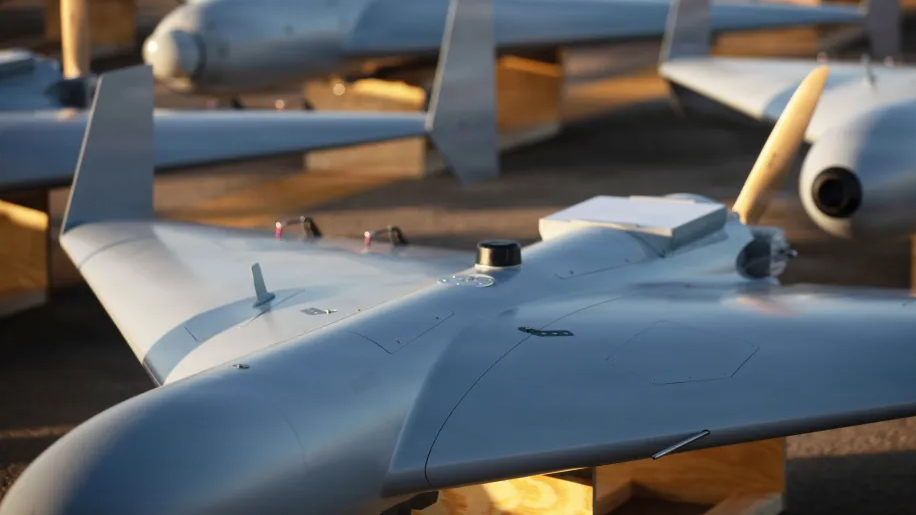
Regardless, the Hivemind AI pilot will allow appropriately equipped LUCAS drones to perceive their environment, make decisions, and act autonomously without continuous human input. Unlike conventional autopilots tied to fixed flight paths, Hivemind is designed to dynamically adjust mission plans, react to unforeseen conditions, avoid obstacles, and carry out complex tasks with minimal operator oversight.
In terms of how an AI pilot can assist LUCAS drones, including providing autonomous mission execution and swarming in GPS-denied, communications-denied environments, Tseng likened the technology to that which is behind self-driving cars.
“We’re using a lot of the same technical approaches that Tesla or Waymo are using; we use sensors on board these drones and weapon systems to perceive our environment. We got a GPU [graphics processing unit, a specialized electronic circuit designed for digital image processing] that thinks about what to do and is programmed to think about the different missions that it’s executing in said environment, and then we take action, maneuvering the drone or the weapon system in the environment.”
Already, Hivemind has been inserted in a variety of other platforms, including aboard Anduril’s YFQ-44A under the U.S. Air Force’s Collaborative Combat Aircraft (CCA) program, the U.S. Navy BQM-177 test aircraft, the Airbus UH-72B Lakota helicopter, and the Destinus Hornet platform. The company says it has integrated AI pilots for 28 different platforms to date.

Tseng said the company wants to start flight testing with Hivemind in July. “I hope they make it operational as quickly as possible,” he added.
The path to operational service should be made easier by previous experience from Ukraine, where it took only eight weeks to put an AI pilot into one of their one-way attack platforms.
However, the final decision on fielding AI-equipped LUCAS drones rests with the customer. “It’s up to the government, and I’m not going to disclose timelines on when the government thinks about fielding it,” Tseng said of the Hivemind-equipped LUCAS drone.
While LUCAS drones without AI pilots have already achieved impressive results in the recent conflict with Iran, according to the Pentagon, Shield AI is meanwhile confident that the capabilities of the platform will be significantly enhanced once they are flying with AI onboard. The results should include increasing the probability of kill, lowering the cost per effect, and increasing overall mission success.
“If you have cheap one-way attack drones, but it takes 10 or 20 of them to destroy a target, they’re no longer that cheap, right?” Tseng contended. “But if all of a sudden you have cheap one-way attack drones, and one out of one can kill it, and now you can kill 20 targets, that is a really low cost per effect, and that’s what the United States is after at the end of the day.”
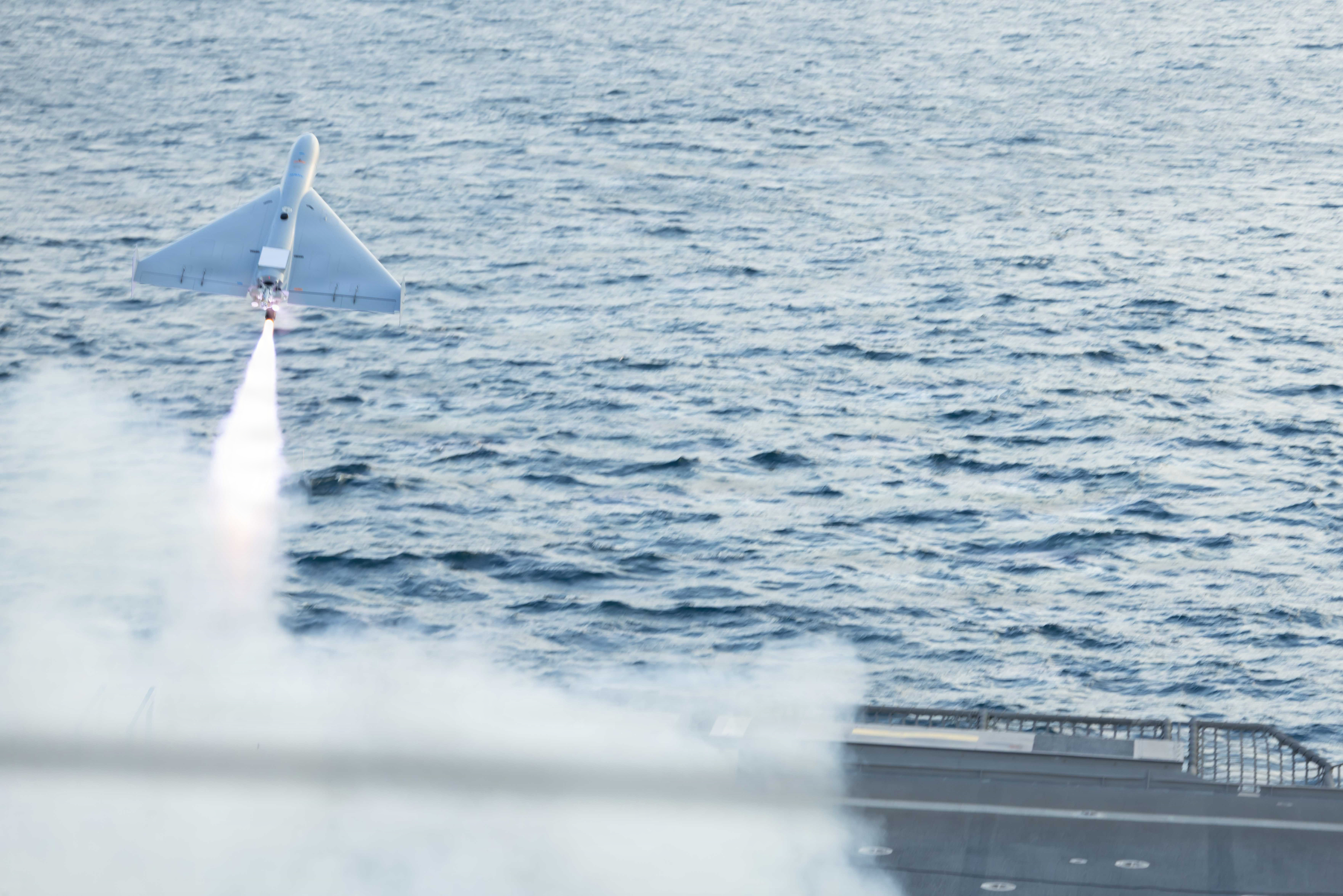
Putting an AI pilot in the LUCAS drone is a big deal for the program. If it works as planned, it should help realize the long-held ambition of coordinated swarms of drones, not just drones being deployed en masse.
Using the software, multiple LUCAS drones will be able to share tasks and maneuver cooperatively, making saturation attacks even more effective. As well as the drones dynamically rerouting, avoiding air defenses, and otherwise adapting to changing battlefield conditions, an AI pilot makes it easier for missions to continue despite hostile jamming or loss of datalink connectivity. Indeed, using AI, drone swarms can maintain near-perfect combat efficiency even if it loses members. Drones can be configured with all different payloads, with the swarm’s makeup tailored to each mission, and the AI system can maximize their collective effectiveness at all times.
With flight testing of Hivemind-equipped LUCAS drones expected to start in only a couple of months, we should begin to get a better look at the transformation of these kamikaze drones from expendable individual weapons into groups of networked weapons that collectively equate to much more than the sum of their parts.
Contact the author: thomas@thewarzone.com
Loading comments…
Comments couldn’t be loaded. Please refresh the page.