
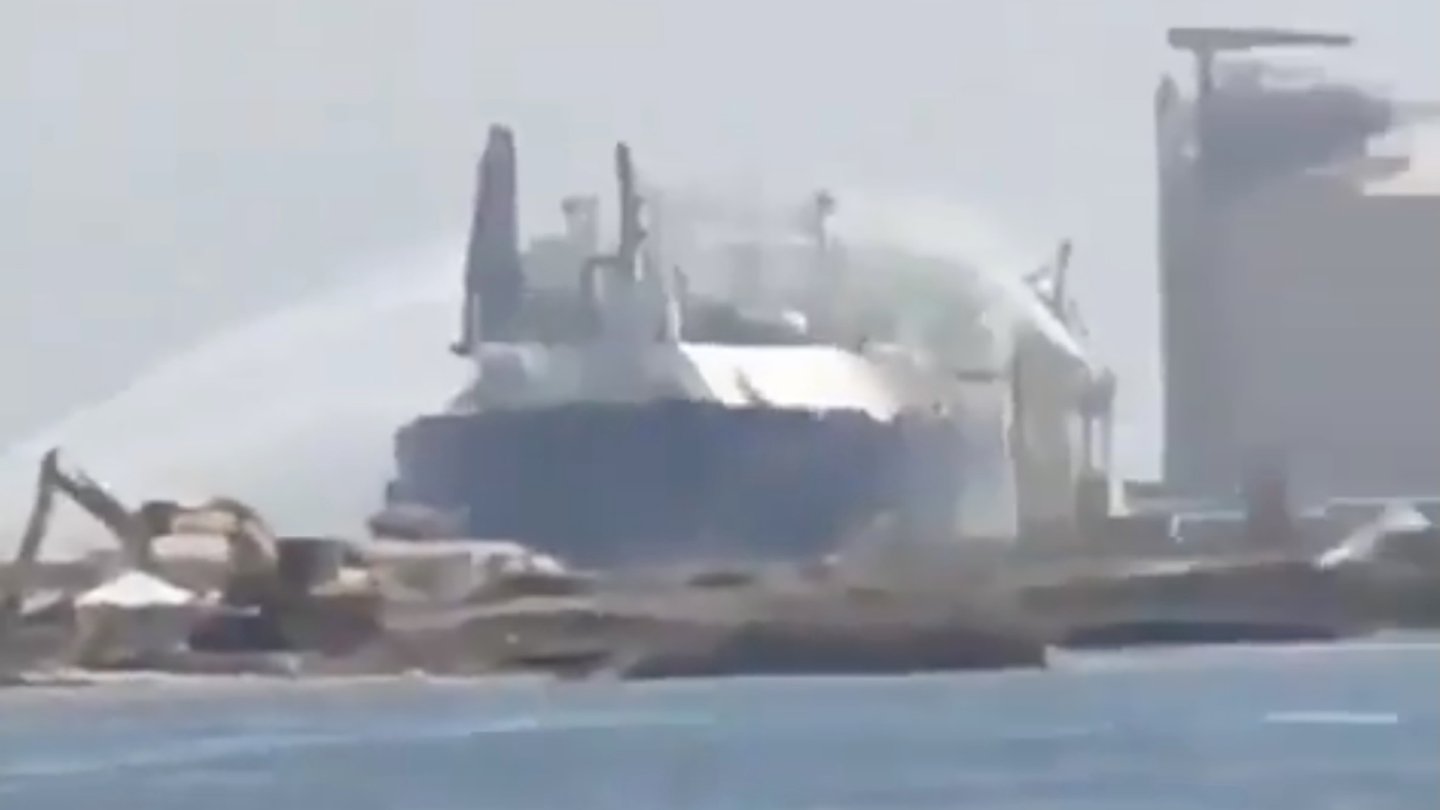
Egyptian officials have now confirmed that the port facility of Damietta was hit by a drone strike yesterday, the first public acknowledgment that the country has come under fire during this conflict. Though Cairo did not say who launched the attack, it raises the specter of another part of the region being brought into fighting that is largely centered on the flow of energy supplies.
The attack came as the Houthis began to consider imposing tolls on shipping through the Bab al-Mandeb Strait, where they have already established a blockade on Saudi shipping and attacked its vessels and energy infrastructure. Meanwhile, Iran continues to lob missiles and drones across the region as tit-for-tat strikes have resumed after a short pause.
“Following the successful containment of the fire, the relevant authorities conducted initial investigations into the incident, which indicated that a drone was responsible,” the Egyptian cabinet said in a statement on Thursday, according to state-funded Middle East News Agency. The cabinet added that “no party has claimed responsibility for the attack.”
“The competent authorities are continuing their investigations to determine the full circumstances surrounding the incident and to take the necessary measures to safeguard Egypt’s interests and national security,” the official government outlet added.
As we reported yesterday, the Ambrey maritime security firm said two vessels were struck by drones at Damietta. One of the ships was a U.S.-owned and operated, Marshall Islands-flagged liquefied natural gas (LNG) floating storage facility and the other was a Greek-owned and operated, Bermuda-flagged LNG tanker, Ambrey stated.
A maritime security specialist told us that the U.S.-owned and operated, Marshall Islands-flagged floating gas storage facility was the Energos Winter while the other ship was the Gaslog Salem.
While there has been no official claim or attribution, U.S. President Donald Trump hinted that it was an Iranian attack.
Asked during a press conference whether Iran was behind the drone attack on the Egyptian port, Trump said “it’s a little more of the same, but it’s going to be straightening out, it’s going to be straightening out. But in the meantime, we are going to be hitting them very hard, because it is our turn to hit ’em. They know it’s coming, they are asking us not to do it.”
The New York Times later reported that two Iranians, who asked not to be named to discuss security matters, “said the explosion was a drone attack designed to show that global shipping and energy supplies could be more deeply disrupted if Iran chose to escalate. The individuals did not say whether Iran or an Iran-allied militia in the region had launched the attack, or from where.”
The Iranians are not the only ones targeting energy facilities in the region. Several of their proxies have as well. It is part of a larger effort to impose cost on the U.S. and its allies.
The Saudis claim their oil infrastructure has been attacked by Iranian-backed militias in Iraq in addition to actions by the Houthis in Yemen. That in part prompted a joint U.S.-Saudi strike on militia targets across that country. It was the first publicly confirmed instance where U.S. and Saudi forces worked in concert.
The Iranian-backed Houthis, who, as we noted above, are striking Saudi oil infrastructure, on Thursday denied involvement in this incident.
“There is no truth to the rumors about Yemen targeting a ship in the port of Damietta in the Arab Republic of Egypt,” the group stated on Telegram. “The Yemeni position is clear, declared, and explicit, and it only targets the Saudi regime for its unjust blockade and ongoing aggression against the Yemeni people.”
U.S. Central Command, which oversees American military operations in the Middle East, deferred questions about the incident to Egypt.
Regardless of who attacked Damietta, expanding the conflict to Egypt’s Mediterranean ports marks a significant potential escalation. The region’s two main sea arteries for energy shipments are already being choked off. The Iranians have largely closed down the Strait of Hormuz and there is an ongoing U.S. blockade on Iranian ports. The Houthis, as previously noted, have halted Saudi transits through the BAM, which has had a cascading effect on other nations not wanting to risk attack.
As the Iranian threats to the Strait of Hormuz increased, the kingdom diverted millions of barrels of oil per day through pipelines to its Yanbu port on the Red Sea in an effort to minimize the energy shortages due to the hostilities in the Persian Gulf.
That workaround served its purpose until the Houthi blockade, at which point Saudi Arabia began boosting shipments through the Suez Canal. Exports via that route “rose 106% for the week of the embargo announcement to 1.06 million barrels per day, up from the week starting July 13, according to Kpler data,” The National News recently noted.
The port of Damietta, where yesterday’s attack took place, is 33 miles west of Port Said, which is at the northern entrance to the Suez Canal. Closure of the canal, or even a significant drop in traffic through it, would add to the pressures on the global economy already reeling from what is taking place in the Strait of Hormuz and the BAM.
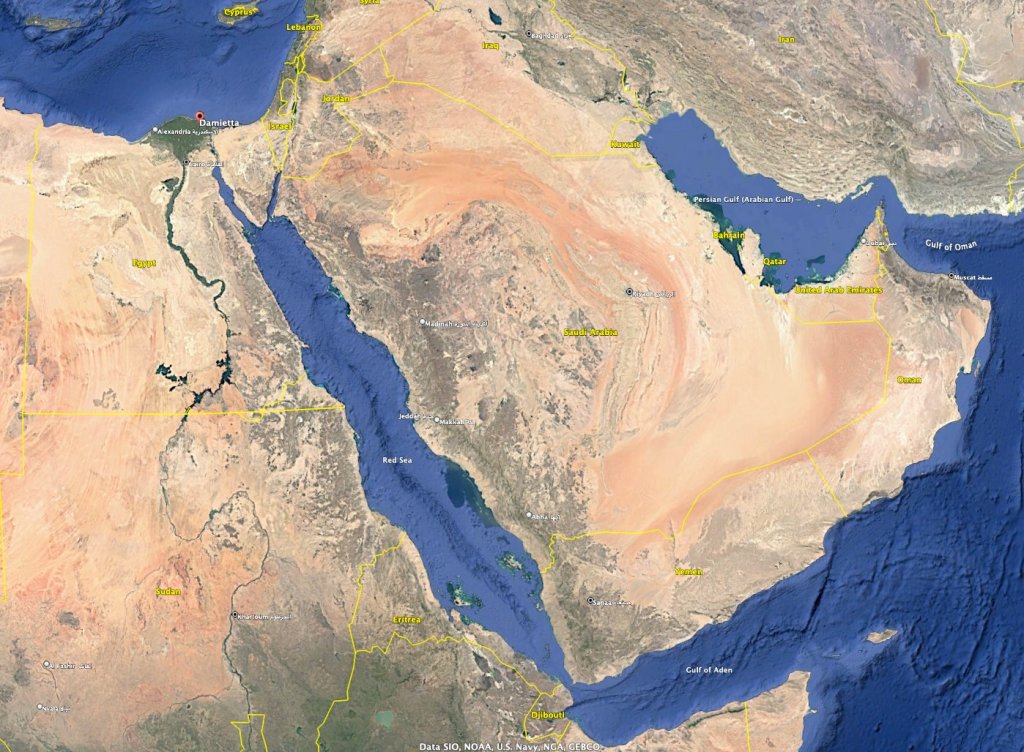
In a post on X, the Windward maritime intelligence firm called the attack on Damietta “a third front, separate from the Gulf and Red Sea.”
“The strike is assessed as separate from the Houthi Saudi-blockade campaign. Iranian state television had named Damietta as a retaliation target two days earlier, citing Ukraine’s strike on an Iranian vessel in the Caspian Sea, pointing toward an Iranian-directed operation rather than a Houthi one,” Windward explained in a related analysis.
Operation Aspides, the European-led task force created to provide security to shipping in the Red Sea region, told us it is monitoring reports that the Houthis are considering placing a toll on transits through the BAM, similar to what Iran has tried to impose in the Strait of Hormuz.
“At this moment, there has been no official statement from the Houthis confirming such a measure,” a spokesman told us Thursday morning. “We continue to monitor developments closely and are going to implement our mandate within our means and capabilities.”
On Thursday, Aspides posted an image of one of its member warships, the Italian frigate Bergamini, escorting merchant vessels in the Red Sea region.
Meanwhile, Iran is continuing to lash out across the region.
Kuwaiti officials said one person was killed in an Iranian barrage today.
“The sinful Iranian aggression targeted a building belonging to one of the Chinese companies in the north of the country, resulting in the death of one worker and causing serious material damage to the building,” the Kuwait Defense Ministry (MoD) stated on X. “The Armed Forces affirm that they will continue carrying out their tasks and duties with high efficiency, and taking all necessary measures to protect national sovereignty and preserve its security and stability, in coordination with the competent authorities, in a way that safeguards the safety of citizens and residents.”
The Jordanian military said it foiled an Iranian attempt to target the kingdom with five missiles. There were no casualties, officials said.
The Islamic Revolutionary Guard Corps (IRGC) claimed missiles made it through and that three F-35 Joint Strike Fighters were destroyed and three more damaged at Muwaffaq Salti Air Base (MSAB) in Jordan. The IRGC said it was in response to deaths caused by yesterday’s attacks by CENTCOM. However, the IRGC frequently fabricates claims or greatly exaggerates them and we cannot independently confirm this one.
As we have pointed out in the past, the base has been frequently targeted by Iranian missiles and drones. Three U.S. Army soldiers were killed in a strike there on July 17.
We reached out to CENTCOM for comment, which a short while later put out a statement on X denying the IRGC claim.
Regardless of the claims, the constant Iranian bombardment is beginning to stir unrest in Jordan, where public dissent is banned.
“Hundreds of Jordanian political, legal and other figures signed an open letter last week calling for the withdrawal of U.S. forces from Jordan,” The New York Times reported. “People who signed the letter said they were driven by a sense of national responsibility and concern that the troop presence endangered Jordanian sovereignty.”
“We maintain that their presence exposes Jordan to security, political, and economic risks that serve no national interest and increases the likelihood of our country being dragged into a regional conflict to which it is not a party,” the letter said.
As this conflict drags on, CENTCOM commander Adm. Brad Cooper, “has prepared an option for a punishing air campaign against Iran that could take up to two weeks,” The Wall Street Journal reported, citing people familiar with the matter.
“Now, as Trump moves to strike back after Iran’s surprise missile attack Tuesday, the president will decide how far to go,” the newspaper noted. “He could greenlight Cooper’s option of 10 to 14 days of intensive airstrikes intended to cripple Iran’s missile capability despite warnings that the U.S. is running low on air-defensive munitions. Or, he could opt for a more limited military strike in the hopes diplomacy could be pursued.”
Iran, working to rearm as the fighting continues, is expected to receive “a first shipment out of up to 400 Chinese-made shoulder-fired air-defense missile launchers,” Reuters reported, citing three sources familiar with the deal.
“The purchase, valued at $60-70 million, is one of Tehran’s largest-known efforts to strengthen its short-range air defenses since the outbreak of its war with the U.S. and Israel, which exposed gaps in Iran’s ability to protect military sites and strategic infrastructure,” the outlet noted.
That’s it for now. We’ll update this when there is more information to share.
UPDATE: 4:58 PM EDT –
Iranian Foreign Minister Abbas Araghchi addressed the drone strike on Damietta. In a post on X, he hinted at Israeli involvement but did not explicitly deny that Iran carried it out.
“Egypt is considered a friend and important partner in the region, and its security constitutes an utmost priority for us,” Araghchi stated. “We must all remain vigilant toward Israeli schemes and ‘false flag’ operations that aim to undermine regional peace. The threat is clear, shared, and fears Muslim solidarity.”
Contact the author: howard@twz.com
Loading comments…
Comments couldn’t be loaded. Please refresh the page.