
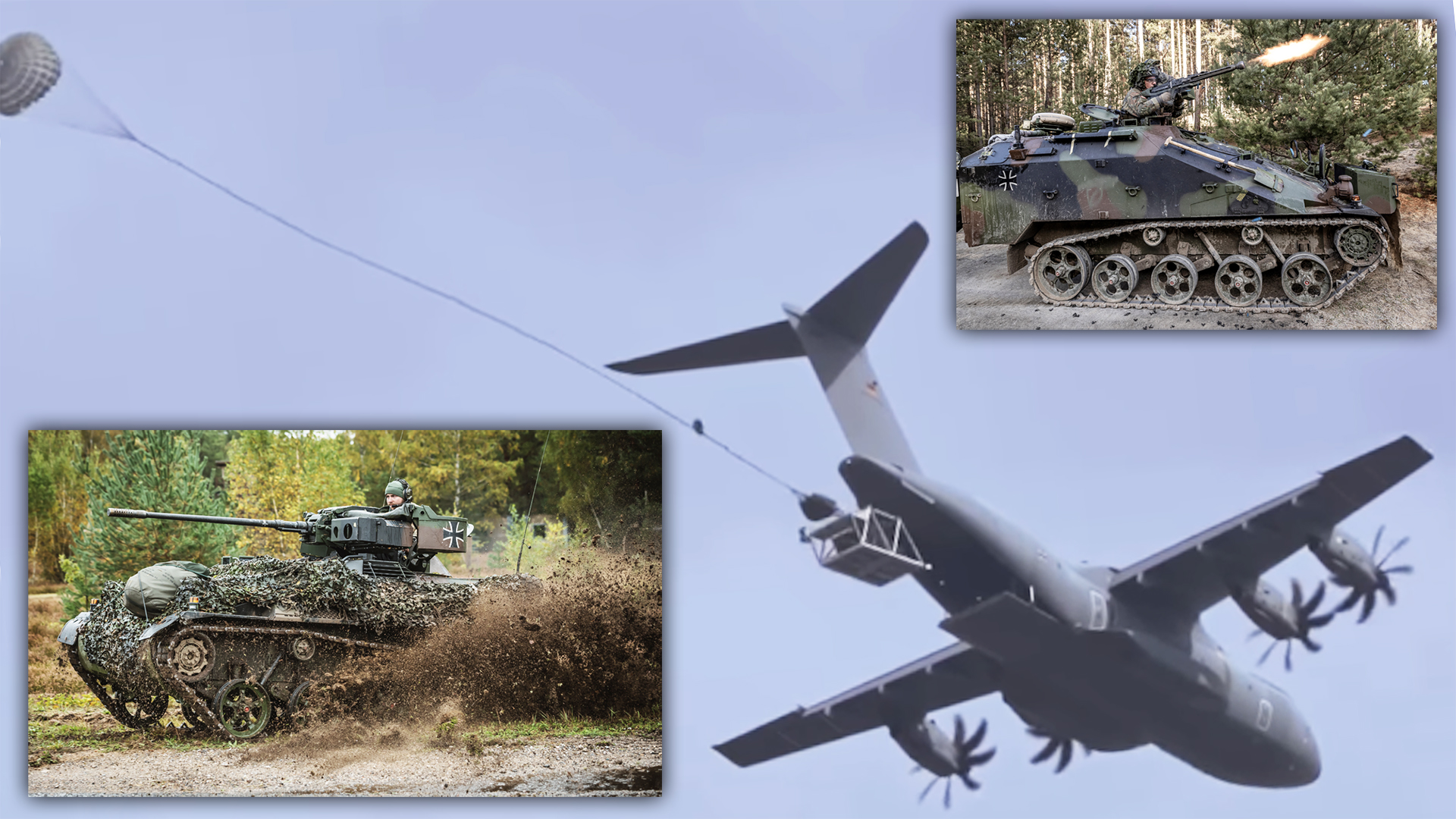
The German military has revealed details of tests in which its tiny Wiesel armored personnel carrier has been airdropped under parachutes from A400M transport aircraft. While the diminutive Wiesel (German for weasel) is already notably mobile, including fitting into a CH-53 helicopter, this appears to be the first time that it has been airdropped, marking an initial step toward a significant new capability for Germany’s airborne forces.
The German Army posted a video showing the airdrop trials, which involved, among others, the German Armed Forces’ Technical and Airworthiness Center for Aircraft (WTD 61) and the 1st Airborne Brigade (Luftlandebrigade 1).
The video shows the tracked Wiesel first being loaded into the hold of an A400M within its ‘cage,’ the ATAX parachute system from the British manufacturer IrvinGQ. The load is then rolled off the aircraft’s rear ramp and descends under three parachutes. Reusable shock-attenuating airbags under the cage provide a softer touchdown. Soldiers then drive the vehicle directly off the pallet, without any significant preparation.
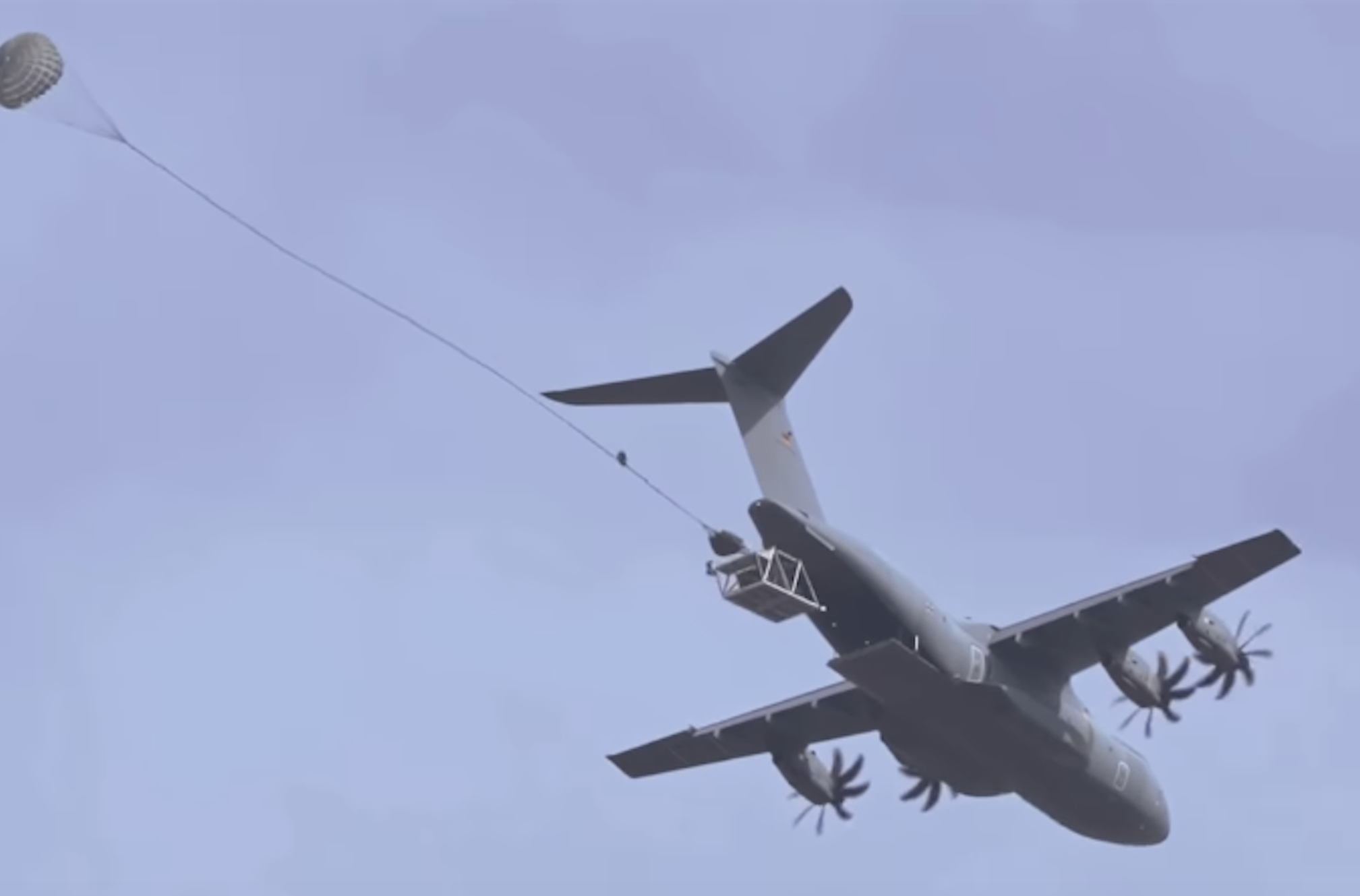
According to the German Army, the aim is to deliver the vehicle within 200 meters (650 feet) of the designated landing zone.
As for the Wiesel, which you can read about here, this vehicle already offers some unique capabilities.
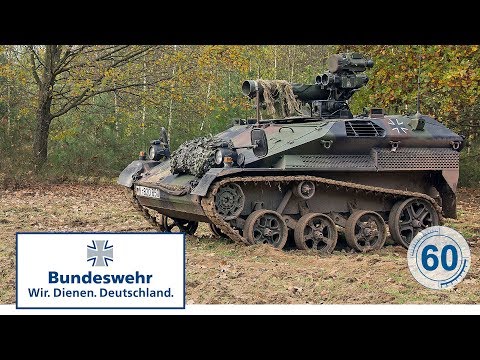
The German Army first began development of the vehicle in the 1970s to give added firepower to its airborne units. Initially led by Porsche, work on the project continued after the German Army abandoned its plans for the vehicle in 1975.
Ultimately, the German Army returned to the Wiesel and bought its first batch in 1985, becoming the only country to adopt the type. Rheinmetall took over series production and built more than 340 examples up until 1993. In 2001, Germany purchased around 180 lengthened Wiesel 2s.
In a drive toward simplicity, the Wiesel uses a standard four-cylinder diesel car engine from Volkswagen. The vehicle can reach a top speed of over 40 miles per hour and travel around 120 miles on one tank of gas, which is relatively impressive when you consider its diminutive size.
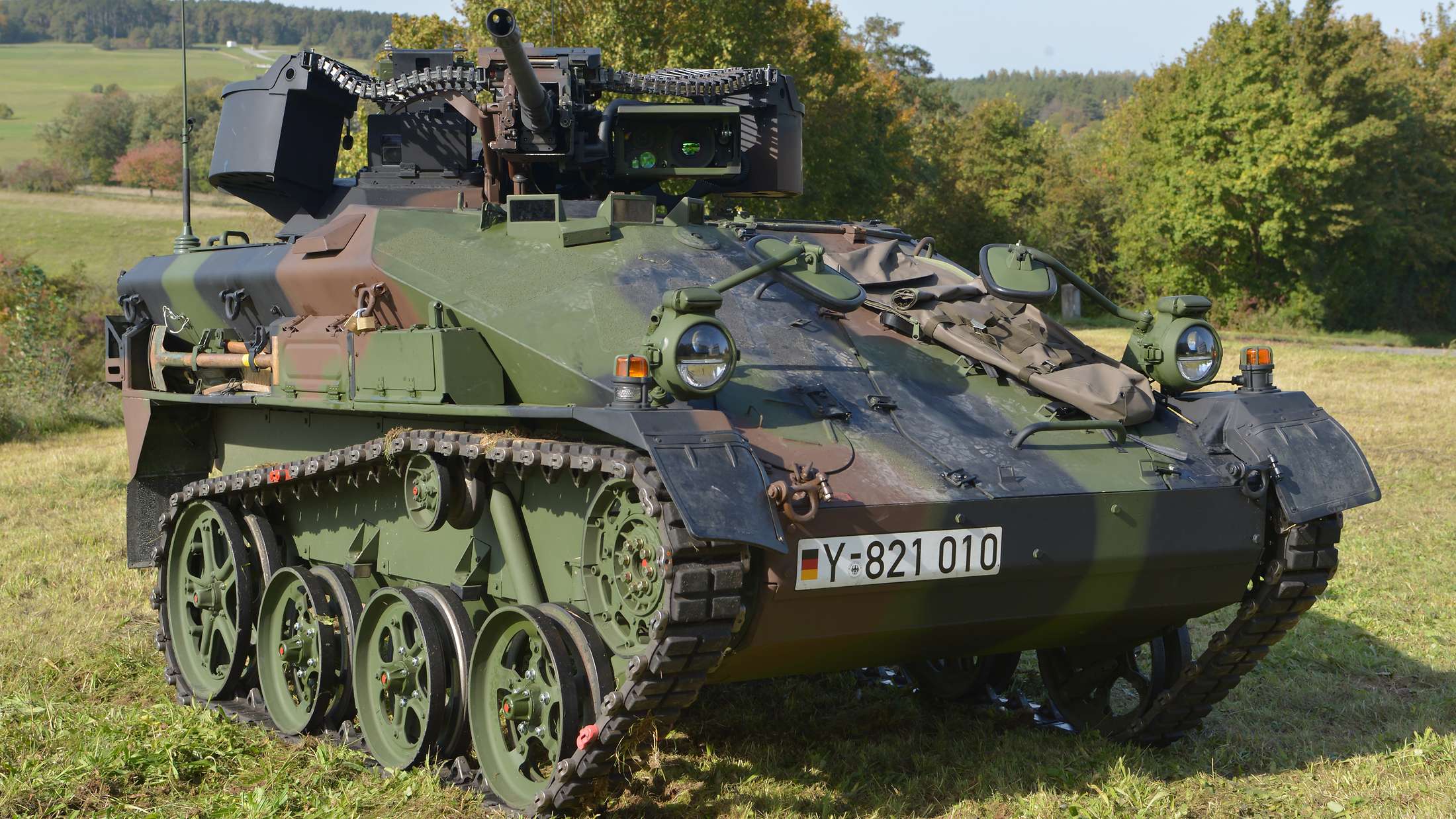
Perhaps the most remarkable feature of the Wiesel is its weight. There are more than a dozen variants in total, and the heaviest of them weighs less than five tons. For comparison, the latest examples of up-armored Humvees weigh around six tons.
The Wiesel’s modest size means two of the standard variants fit inside a CH-53 series helicopter and at least one into a CH-47. Heavy helicopters can carry more slung below their fuselages, too. An A400M typically carries four of the vehicles, but it’s unclear how many can be airdropped by a single A400M, after they have been rigged up.
Considering its capabilities, it is perhaps surprising that Germany has waited so long to test the airdropping of the Wiesel. In fact, until now, the modern German Army has had no means of airdropping vehicles into the theater of operations.
Instead, airborne operations have required paratroopers to first secure landing strips before vehicles can be delivered by tactical transport or heavy-lift helicopter. Until those vehicles arrive, the troops have only limited direct tactical fire support.
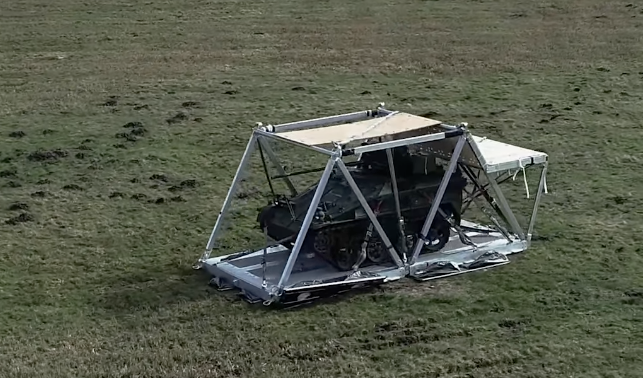
With the ability to airdrop the Wiesel, paratroopers and their combat vehicles can be delivered directly to their objective, without the need for any supporting infrastructure. While the Wiesel doesn’t offer the highest level of armor protection, it does at least shield its occupants against shrapnel, rifle, and light machine gun fire. On the other hand, since it was first fielded, it now faces the threat of battlefield drones and loitering munitions, although its small size and maneuverability could help mitigate that threat in some respects. Overall, like all armored vehicles, it would still be vulnerable.
Once on the ground, the Wiesel offers a significant amount of capability for its size. The most common version is a reconnaissance vehicle with a 20mm automatic cannon and a 7.62mm machine gun, more firepower than many American light armored vehicles. Another type packs a Spike anti-tank missile launcher, the Israeli weapon having replaced the earlier TOW anti-tank missile.
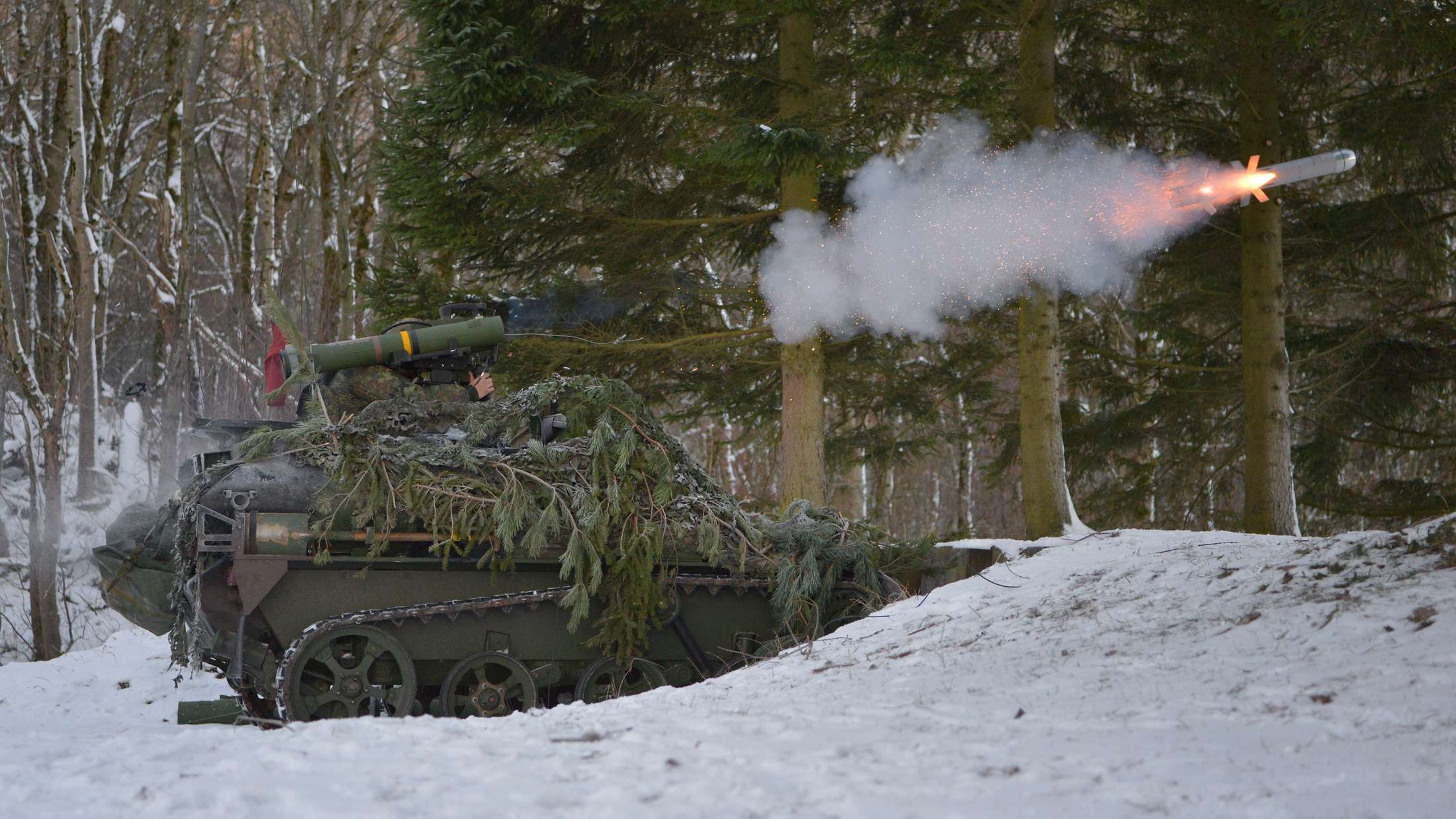
There is also the Leichtes Flugabwehr System, or Light Air Defense System, which includes a command post Wiesel 2 variant and another one of the vehicles with a small radar. This last component of the system is known as Ozelot, or ocelot, and features a launcher containing four FIM-92 Stinger heat-seeking surface-to-air missiles. This is a level of small, mobile, but still somewhat protected short-range air defense capability that few nations have.
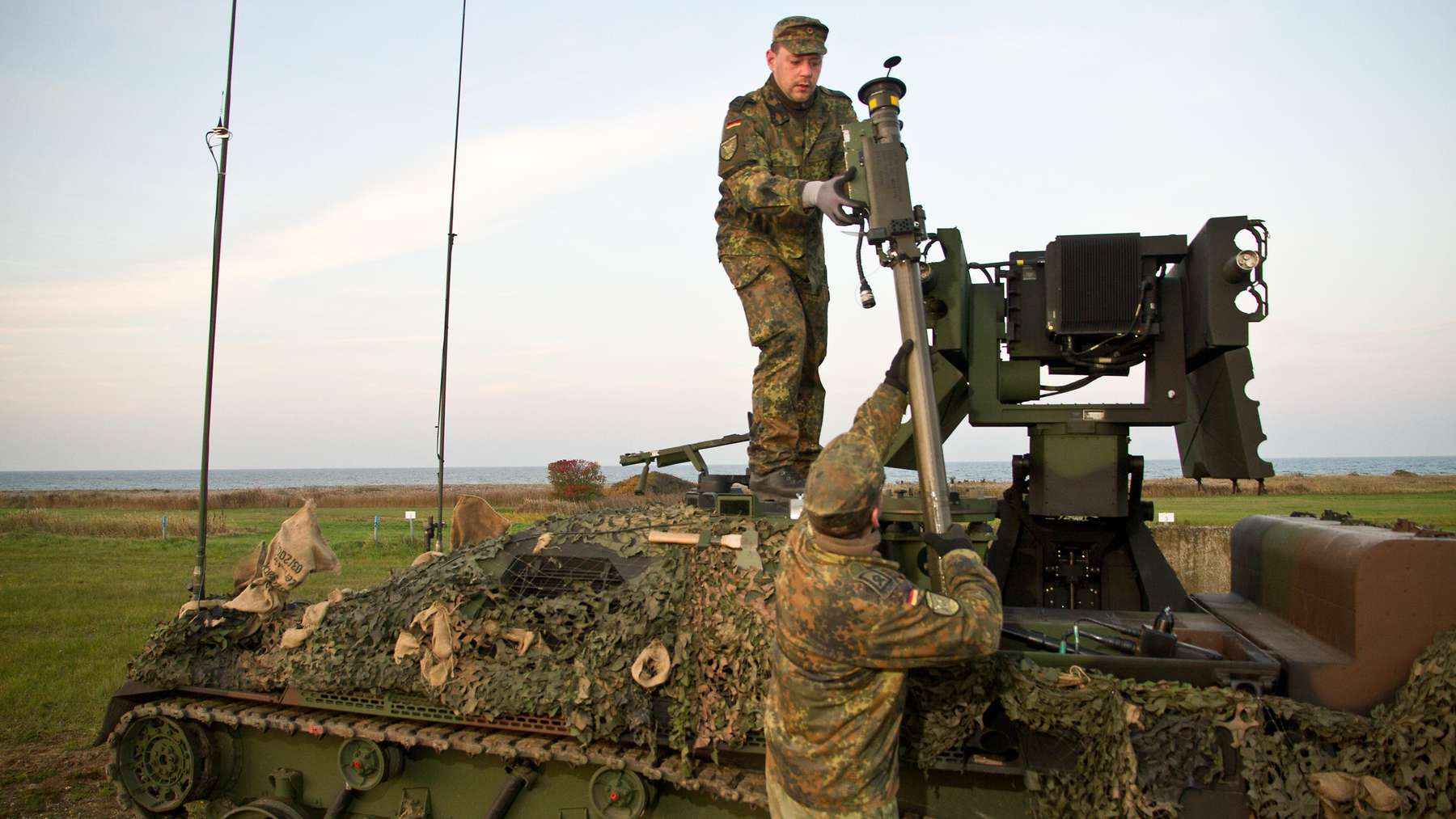
Other Wiesel ‘families’ include a mobile mortar section, including a vehicle with a computerized 120mm mortar. There are also different command post versions for unit headquarters, along with ambulances and engineering support types. In the past, there have also been studies for an uncrewed ground combat vehicle variant.
Once again, it’s not clear which of these versions might be cleared for airdropping, considering their different weights, dimensions, and the relative resilience of their equipment.
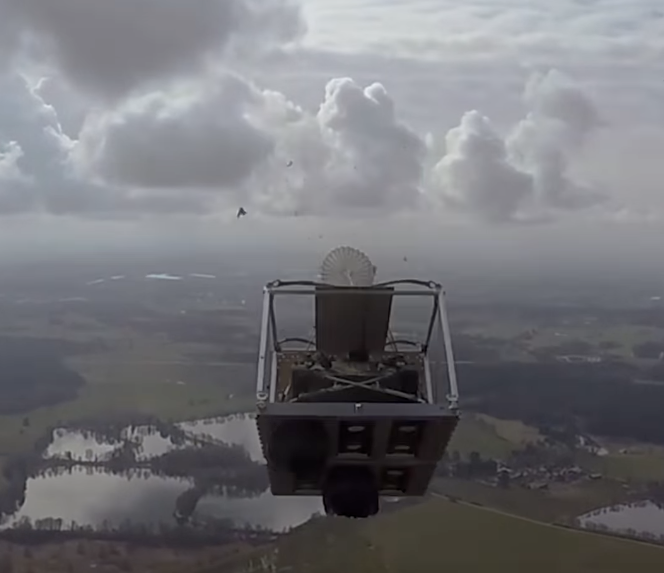
Should the trials prove successful, the ATAX parachute system would also allow the German Army to airdrop other vehicles. According to the German-language hartpunkt defense publication, these could include the airmobile Caracal, other light utility vehicles as used by both regular forces and special operations units, and uncrewed ground vehicles. Ultimately, airdropping with ATAX would also extend to the Wiesel’s designated successor, now being developed under the Luftbeweglicher Waffenträger, or Airmobile Weapon Carrier program.
These tests come as the German Armed Forces undergo their biggest transformation since the Cold War in response to Russia’s 2022 invasion of Ukraine. As well as increased defense spending, there is a broader attempt to move from a low-readiness, expeditionary force to a high-readiness, territorial military focused on operations on NATO’s eastern flank. With that in mind, these latest airdrop tests for the Wiesel could be the start of a significant new phase for the airborne troops and their capabilities.
Contact the author: thomas@thewarzone.com
Loading comments…
Comments couldn’t be loaded. Please refresh the page.