
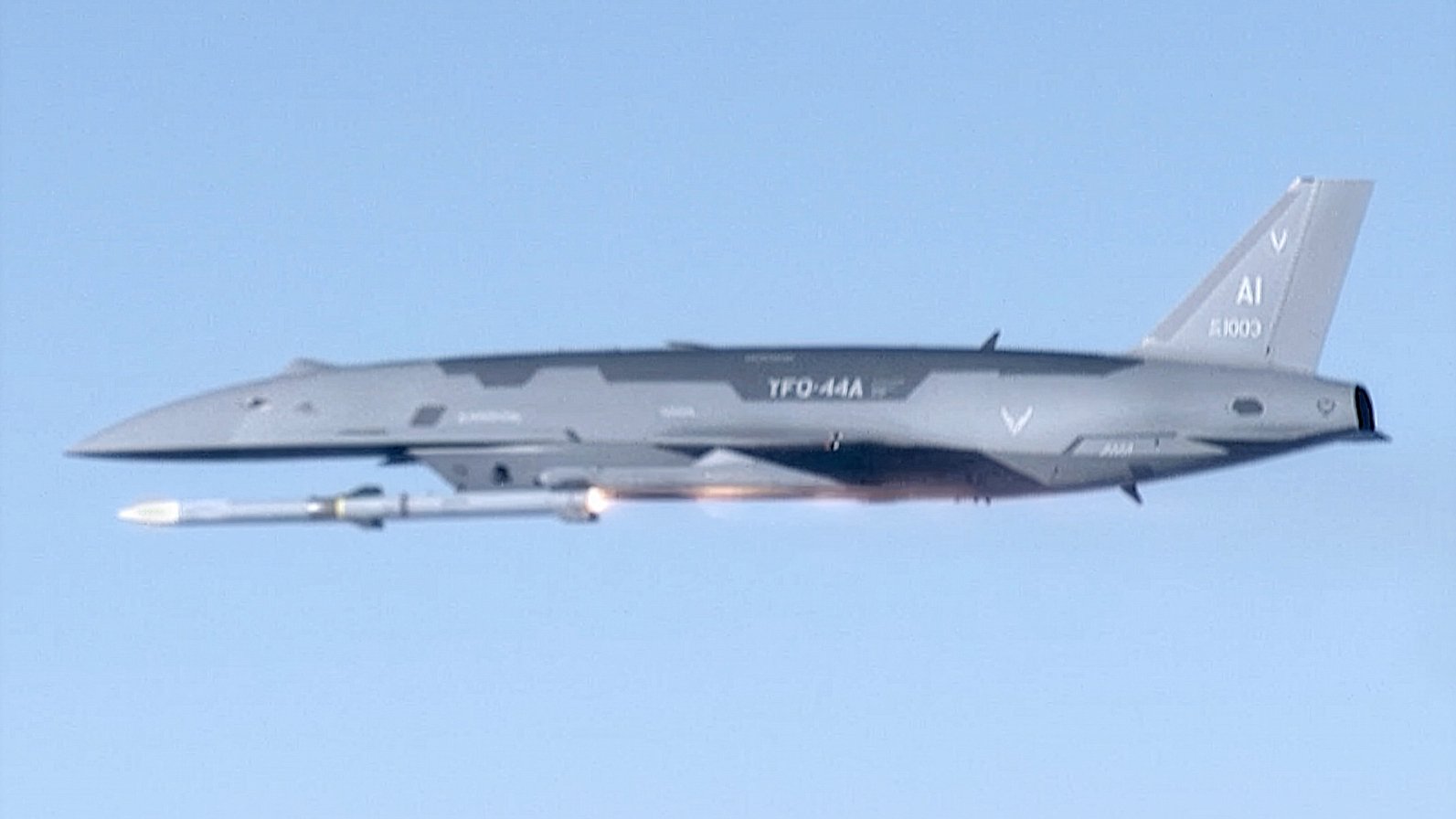
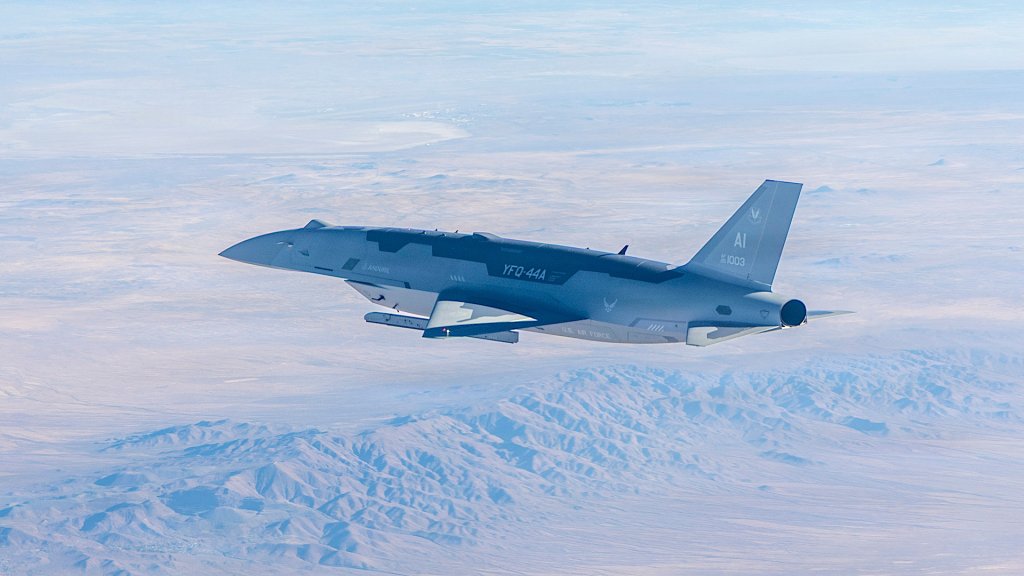
Anduril’s YFQ-44A Fury Collaborative Combat Aircraft (CCA) has live-fired a munition at a simulated target for the first time in a test conducted from Edwards Air Force Base in California. The launch of the AIM-120 Advanced Medium Range Air-to-Air Missile (AMRAAM) is also a first for any U.S. CCA-type drone. This is an important step forward in the development of Fury and for the U.S. Air Force’s CCA program.
The YFQ-44A is one of two drones in development as part of the first phase, or Increment 1, of the Air Force’s CCA program. The other is General Atomics’ YFQ-42A Dark Merlin. Last month, the service announced orders for production versions of both designs, which will form a mixed initial operational CCA fleet.
“The live-fire test was performed in coordination with the 412th Test Wing’s Air Dominance Combined Test Force, a team consisting of active-duty military, government civilians, and government contractors, who worked to refine and validate the models required for a safe live-fire execution,” according to a press release the Air Force put out today. “This latest milestone continues the rapid pace of developmental testing for safe and effective CCA operations.”
The Air Force’s release also says the AIM-120 missile was fired “in secluded airspace over the Mojave Desert” at what is described as a “digital target.” In its current configuration, the YFQ-44 carries stores externally on either of two hardpoints, one under each wing.
“We executed the first weapons shot from YFQ-44A, an important milestone in turning CCA into an operational capability,” Mark Shushnar, Anduril’s Vice President of Autonomous Airpower, also said in a statement. “This was more than a simple weapons release test – it demonstrated an end-to-end, beyond-line-of-sight strike against a simulated target. YFQ-44A took off from Edwards Air Force Base, our Lattice software ingested a target track, an operator tasked the aircraft to engage the target, and YFQ-44A fired an AIM-120 as instructed.”
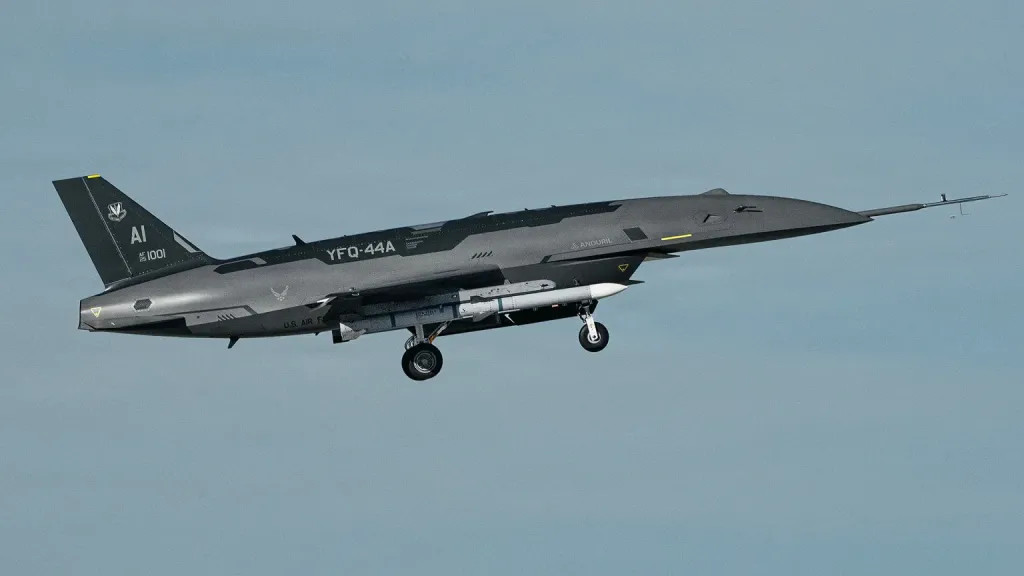
The Air Force had announced in February that the CCA program had entered the weapons integration and captive carry testing phase. A picture of a YFQ-44A carrying an inert AIM-120 was released at that time. To date, General Atomics YFQ-42A has not been seen carrying a munition, inert or live. The Air Force and General Atomics have said the YFQ-42A is on track to conduct a live-fire launch later this year, according to Breaking Defense.
“This [new live-fire] event is part of a deliberate, phased test progression that began with inert carriage evaluations earlier this year,” per the Air Force’s release today. “The initial inert weapons captive carry flights focused on collecting in-flight data to verify the aircraft’s handling. Subsequent evaluations validated the data link integration between the aircraft and the weapon system, ensuring operator commands were executed precisely by the platform in a simulated environment.”
“Moving from inert carriage earlier in the year to this weapon release demonstrates program maturity, allowing us to validate our digital integration models with actual data,” Air Force Gen. Dale White, Direct Reporting Portfolio Manager for Critical Major Weapon Systems, also said in a statement. “These tests provide operational validation that Collaborative Combat Aircraft can execute the weapon employment sequence autonomously within pilot-defined parameters, accelerating capability delivery to the warfighter.”
The Air Force is not the first to conduct a live-fire munitions launch from a CCA-type drone. In December 2025, a Turkish Kizilelma drone launched a pair of domestically-produced Gökdoğan air-to-air missiles. One of those missiles was fired at a physical target drone. You can read more about the test here.

Later in December 2025, the Royal Australian Air Force (RAAF), in cooperation with Boeing, test-fired an AMRAAM from an MQ-28 Ghost Bat drone, as you can read more about here. The missile successfully engaged an Australian-made Phoenix jet-powered target drone.

The U.S. Air Force has long said that air-to-air combat will be the main mission for its initial CCA fleet. The drones will also help increase the sensor reach of crewed fighters they’re teamed with. These drones, as well as other designs acquired through future iterative development cycles, could take on additional missions down the line. The Air Force sees CCAs, in general, as providing vital extra capacity, or ‘mass,’ during future operations, especially potential high-end fights against opponents such as China. By extension, they will also help reduce risk to crewed platforms and open up new tactical possibilities.
“This live-fire test is an important next step in the development of Collaborative Combat Aircraft,” Air Force Chief of Staff Gen. Ken Wilsbach said in a statement today. “We’re one step closer to delivering capabilities to the warfighter.”
With the Air Force aiming to begin fielding its first CCAs before the end of the decade, we can expect weapons and other testing to continue ramping up.
Contact the author: joe@twz.com
Loading comments…
Comments couldn’t be loaded. Please refresh the page.