
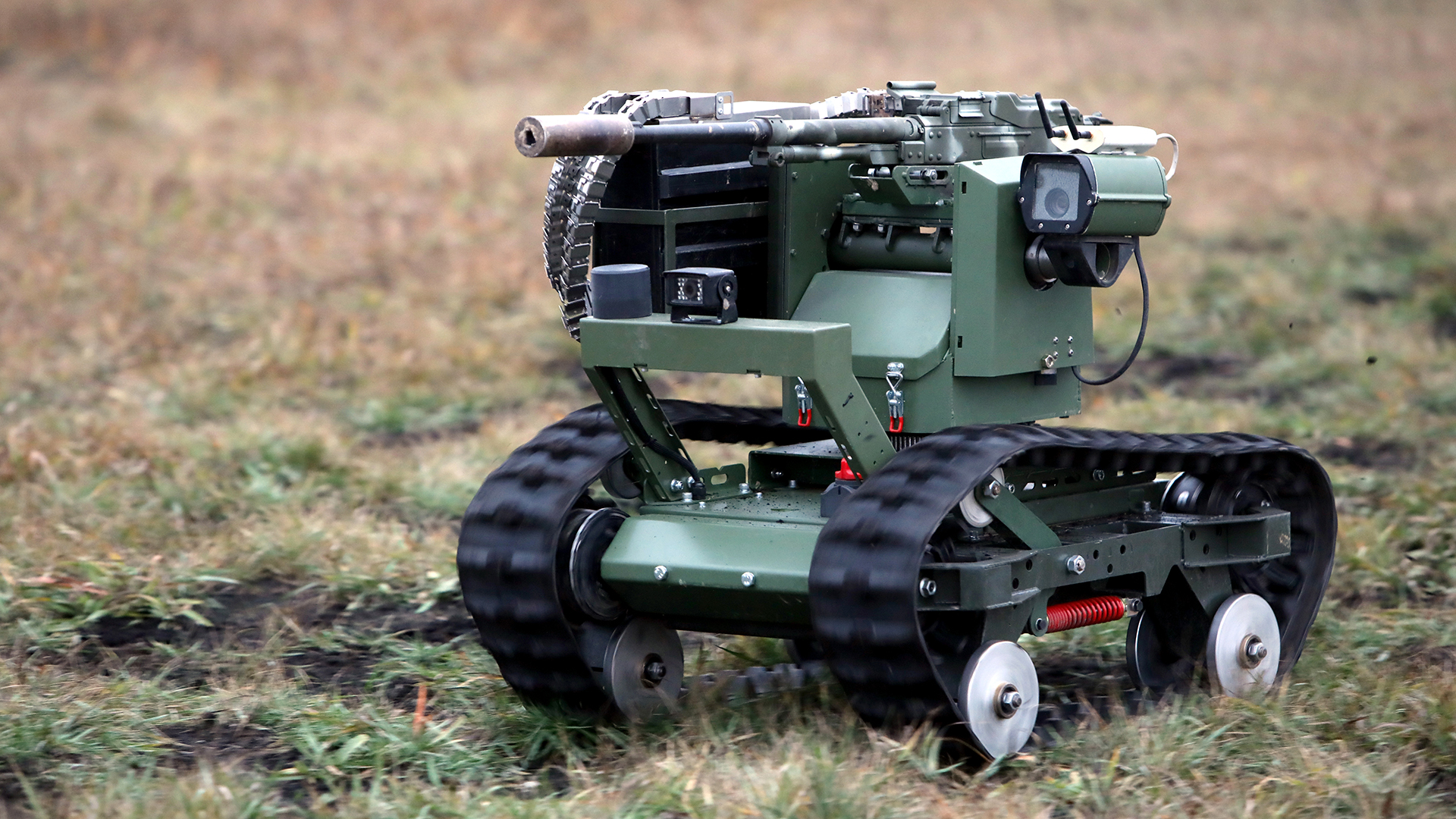
With ground maneuver a huge risk thanks to the ubiquity of deadly aerial drones, Ukraine is increasingly relying on uncrewed ground vehicles (UGVs) to move supplies, rescue the wounded, shoot down drones, lay mines and even fight battles. As a result, the head of the country’s defense technology incubator has been tasked with ensuring that there are enough of these systems to meet the voracious demand.
These efforts are being closely watched. Five years into an existential fight, Ukraine has become a global leader in ground drone technology. Kyiv is deploying these systems at a scale and pace that even the most advanced militaries can’t come close to keeping up with.
In an exclusive hour-long interview earlier this month, Brave1 CEO Andrii Hrytseniuk spoke with us about how Ukraine is set to produce tens of thousands of UGVs this year, how they are being used, and the importance of artificial intelligence in increasing the efficiency of these robots in combat.
This is the second of a two part interview. The first part focused on Ukraine’s interceptor drones, which you can read here.
Some of the questions and answers have been edited for clarity.

Q: President Zelensky set a goal of producing 50,000 unmanned ground vehicles this year. How is that going? And how can you hit that target?
A: We are moving according to the plan that was announced by President Zelensky. And this is a very ambitious goal, but we feel pretty confident that we will be able to execute this plan and this task and the armed forces will get many times more drones than in previous years.
Q: How do you reach that goal?
A: On the frontline, we use only Ukrainian drones, maybe just a few international ones, but about 99% of the drones that are used on the battlefield are fully manufactured here in Ukraine, and this is the high priority area for us for the last two years. There are 280 Ukrainian companies, private companies, that are producing UGVs. And in total, there are 550 different models of UGV. This is a big variety, starting from small to very big UGVs. And there are different types of categories of ground vehicles.

Q: What are some of those categories?
A: The first are those used for logistics. Their main purpose is to provide transportation in the gray zone, because it’s very dangerous on the last 10 to 15 kilometers from the front line, and there are a lot of drones used for transportation of goods, like construction materials, ammunition and provisions. It’s very risky for soldiers and our philosophy is that we should not risk our soldiers.
Everything that is possible to be done by drones has to be done by drones for transportation. In March, we performed 9,000 missions. In April, more than 10,000, so the implementation of logistics by drones is permanently increasing.
Q: What are the other categories of UGVs?
A: The second category are special UGVs that are used for evacuation of wounded soldiers.
You can see an example of one of those rescue missions in the following video.
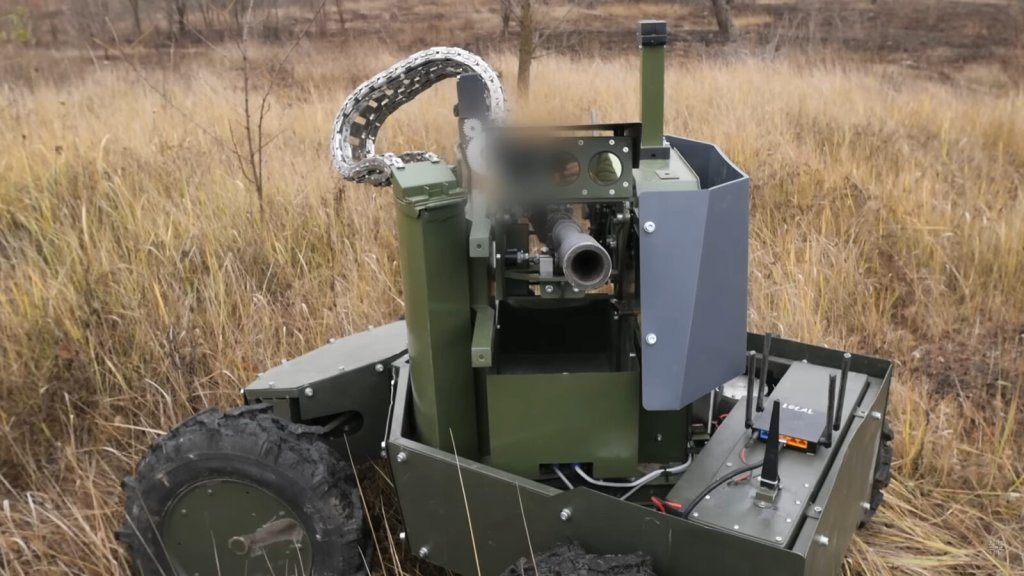
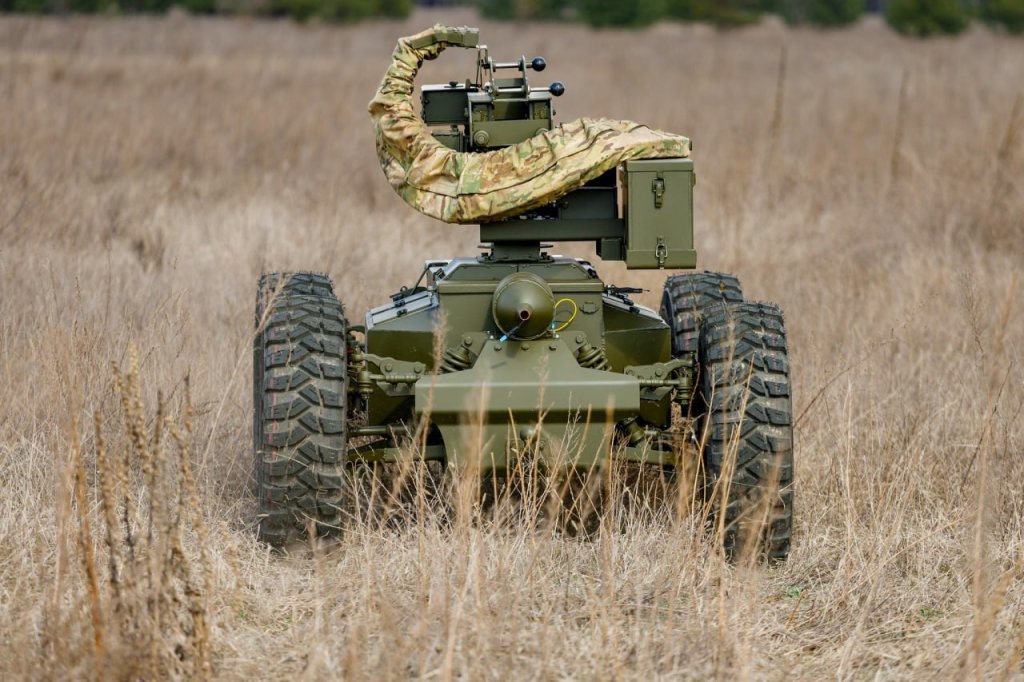
The third one is combat UGVs. And we have more than 10 different models of combat UGVs. They are used for attacking Russian soldiers and hitting Russian armored vehicles. Also they are used as anti-drone aerial defense systems. We use combat UGVs to hit Shaheds, to hit FPV drones, including those using fiber optics and even small Russian planes.
Q: How are these combat UGVs armed?
A: We have different combat UGVs using 5.45mm, 5.56mm, 7.62mm and 12.7mm guns. And we have a variety of different grenade launchers, like the Mk19 and others.
Q: Can you provide any details about what kinds of sensors these weapons use to engage drones?
A: I will not share the technical details, but I can tell you that combat UGVs without artificial intelligence do not work at appropriate effectiveness. All combat turrets that we are using have elements of artificial intelligence, and it allows them to be as effective as they are.
Q: How are the UGVs using AI to target drones?
A: First of all, this is machine vision. This is object recognition, identification, classification, tracking and providing recommendations for the operator on what to do.
Q: So basically, these systems acquire the target, determine how far away they are, at what altitude and speed and that they open fire on their own?
A: Yes. We are more advanced than Russia in combat turrets and combat UGVs, that’s why I would avoid sharing the technical details about how we are doing that.

Q: How common is the use of fiber optic cables to guide UGVs?
A: For UGVs, fiber optics is not used.
Q: Not at all?
A: There are some experiments, but the use cases for fiber optics on UGVs are very, very limited. Only a very small percentage of UGVs use fiber optics.
Q: Why?
A: UGVs typically have multiple missions. They go forward and go back, and when you’re using fiber optics, typically, this is a one-way mission.
Q: What can you tell me about how troops communicate with UGVs for combat missions?
A: Without the Delta command and control system, all these advanced technologies on the battlefield will not be working. The Delta command and control system, which is number one in the world, is absolutely crucial. And this is for all our drones, multi-domain operations, everything.

Q Can you provide any details about how that works?
A: No.
Contact the author: howard@twz.com
Loading comments…
Comments couldn’t be loaded. Please refresh the page.