
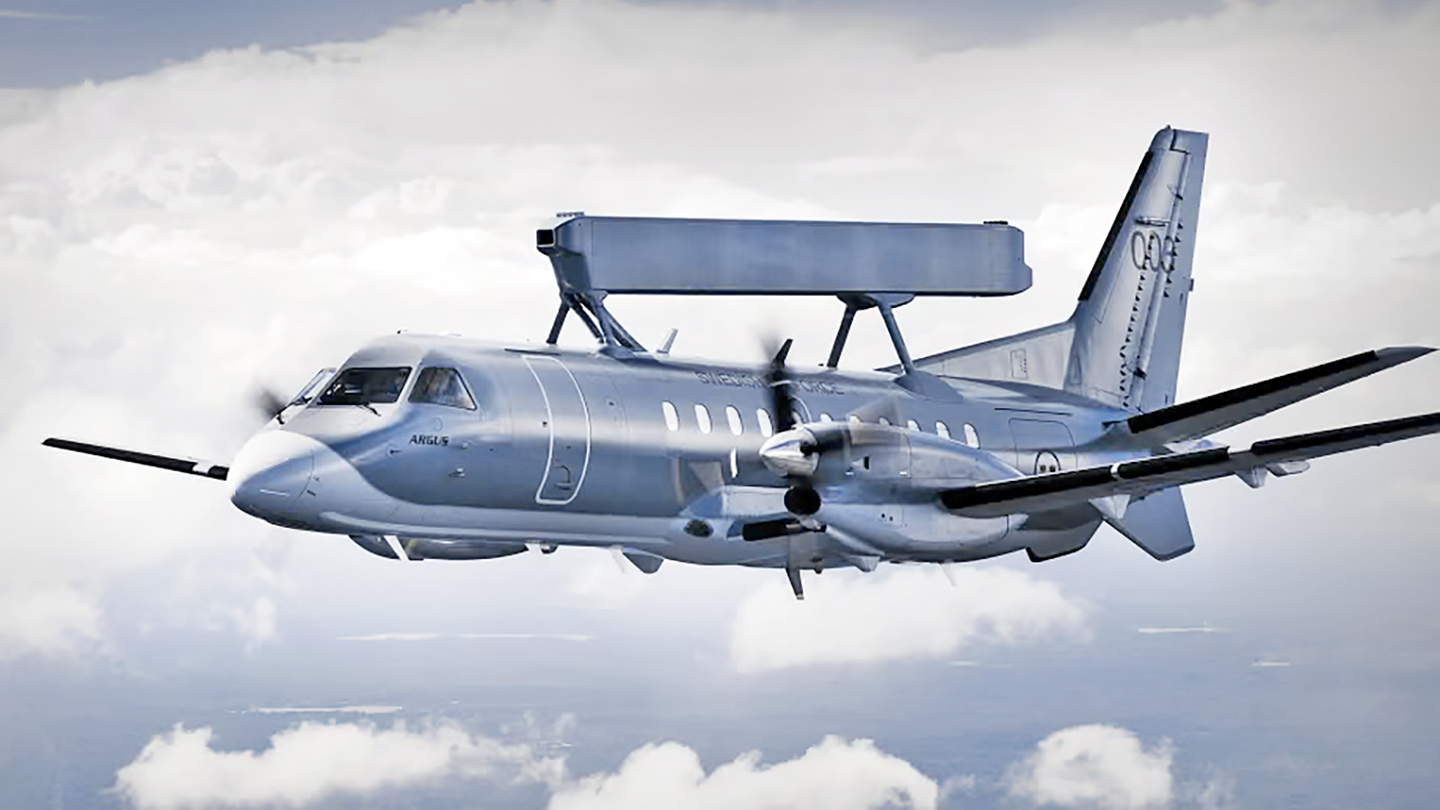
Footage has emerged that purportedly shows a Saab 340 airborne early warning and control (AEW&C) aircraft operating over Ukraine. If legitimate, this would be the first time that the radar plane has been seen in Ukrainian service, as far as we know, and would mark an important new capability for Ukraine, and one that we have discussed in depth in the past.
The video in question appears to have been first posted to a Russian Telegram account and clearly shows one of the aircraft, with its distinctive ‘balance beam’ radar fairing on the upper fuselage, in level flight during the daytime. The date and location of the video cannot be confirmed. It should also be noted that we cannot verify the footage itself, but there is nothing to immediately suggest it may have been doctored.
As mentioned, this appears to be the first time we have ever seen one of the Ukrainian Air Force’s two Saab 340 AEW&C planes, although there are suggestions that the type has been flying in Ukrainian skies for some time.
In April of last year, open-source flight-tracking platforms suggested that a possible Ukrainian radar plane was operating in the Lviv region, in western Ukraine, flying circuits and using the callsign WELCOME. Before that, an unidentified aircraft with the same callsign was observed operating in airspace near Poland and Hungary. If true, that suggests that the track over Lviv may have been a post-delivery acceptance or calibration flight. It’s also worth noting that transponders can be manipulated to provide false aircraft tracks, too.
Stockholm’s transfer of two Saab 340 AEW&C aircraft to Ukraine was announced in May 2024, as we reported at the time. The donation was part of the biggest Swedish military aid package for Ukraine up to that point, worth around $1.25 billion.
At the time, it was said that it would take around a year to train the aircrew and maintenance personnel, as well as prepare the ground facilities for the new aircraft.
The Saab 340 AEW&C aircraft is known in Swedish military service as the ASC 890 and alternatively as the S 100D Argus. The Swedish Air Force operated two of these aircraft, with both understood to have been provided to Kyiv. Another two ex-Swedish Saab 340 AEW&C aircraft are operated by Thailand, and another pair were sold to Poland, having previously been operated by the United Arab Emirates.

For Ukraine, the significance of the Saab 340 AEW&C is hard to overstate.
It brings an entirely new capability for the Ukrainian Air Force, which has never operated any type of AEW&C platform.
The core of the aircraft is its Saab Erieye active electronically scanned array (AESA) radar. Carried atop the fuselage, this can detect air and sea targets at ranges of up to around 280 miles, with the aircraft typically operating at an altitude of 20,000 feet. Reportedly, the AESA system can track up to 1,000 airborne and 500 surface targets simultaneously.
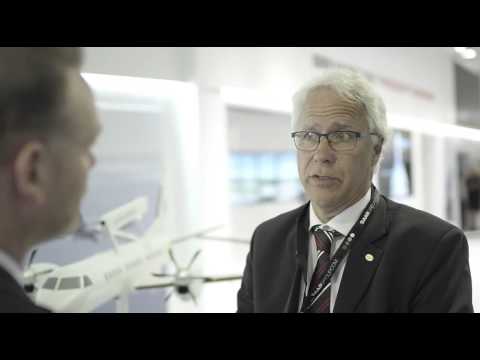
All this data is handled by a three mission crew: a mission control officer, a combat control operator, and a surveillance operator. It can also be downlinked to ground stations and to other aircraft, at least in theory, of which we will discuss more later.
Unlike a surface-based air defense radar, the Erieye provides a ‘lookdown’ capability. Without the line-of-sight limitations of terrain, the radar will be especially useful for detecting low-flying Russian drones and cruise missiles. These are otherwise notably tricky targets, due to the low altitudes at which they fly and their small radar signatures. With that in mind, the aircraft should provide Ukraine’s air defenses with a huge situational-awareness boost.
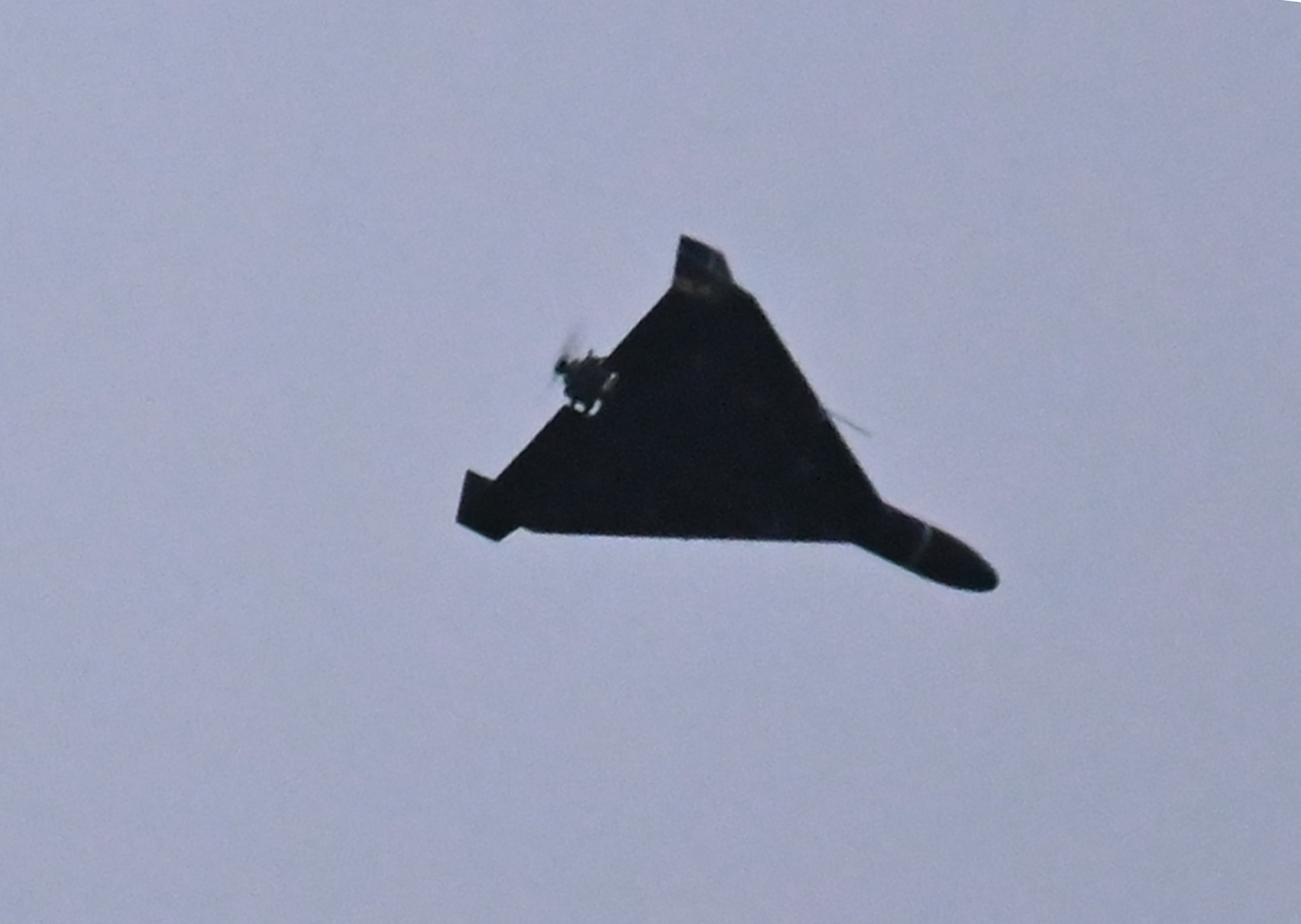
Within its layered air defense network, Ukraine relies heavily on crewed fighter jets (as well as other aircraft platforms) to intercept drones and cruise missiles. Adding the Saab 340 AEW&C to the equation, the radar plane should be able to work as a fighter controller, detecting targets, prioritizing them, and then assigning them to the fighters for interception. Equally, this data could be provided to other air defense assets.
Especially useful in this regard would be the NATO-standard Link 16 datalink communications system. This would, in theory, be compatible with Ukraine’s F-16 and Mirage 2000 fighters, as well as Western-supplied ground-based air defense systems.

However, in late 2024, it was reported that the F-16s donated to Ukraine have had Link 16 systems removed or disabled, due to U.S. worries that they could end up in Russian hands.
This would deprive those fighters of a real-time air defense ‘picture’ sourced from the Erieye radar, and, at this point, it’s unclear if the Link 16 connectivity is available to Ukraine.
As of March 2025, it was reported that the delivery of the radar planes was on track, and they would be able to operate effectively with Ukraine’s F-16s.
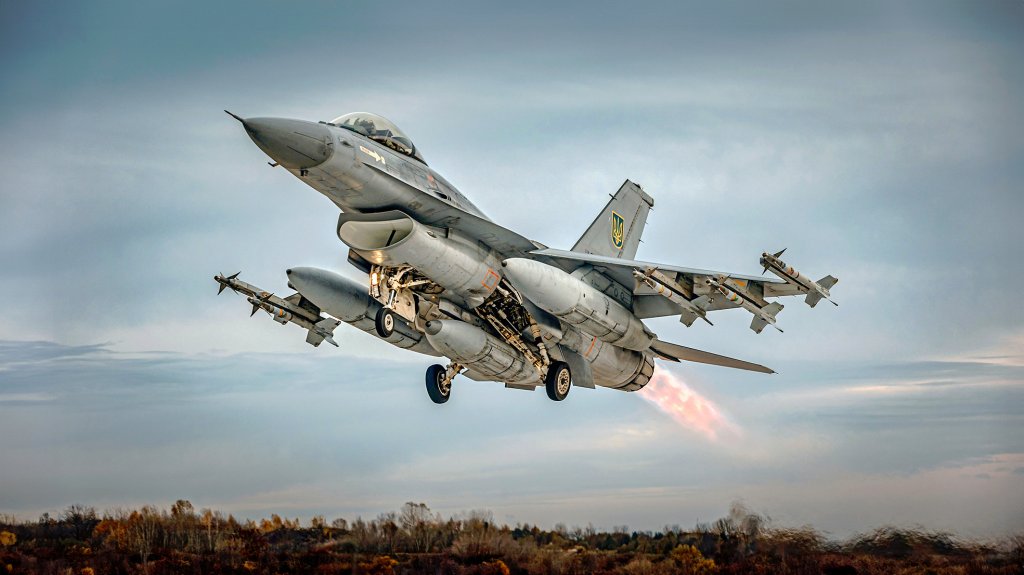
“The timing of ASC 890 deliveries is linked to when certain modifications to F-16 fighters will be ready. There is no delay in the transfer of airborne early warning aircraft to Ukraine,” the Lithuanian Delfi news agency reported. This sounds very much like a reference to enabling the Link 16 connectivity.
However, even without Link 16, the Saab 340 AEW&C is able to provide much-enhanced air and sea surveillance for Ukraine.
Later versions of the Erieye radar also have a synthetic aperture radar and ground moving target indication (SAR/GMTI) capability, although it’s not clear if Ukraine has received that either. While SAR provides detailed image-like mapping of the ground at standoff ranges, GMTI detects and tracks movements on the ground over time, which would allow monitoring of Russian troop movements.
Should Ukraine’s ambitious plans to buy Saab Gripen fighters in the future materialize, the combination of these jets and the Saab 340 AEW&C could make a tailor-made solution for air defense and other missions.
For all its capabilities, the Saab 340 AEW&C will also be a prime target for Russia.
Russia’s own A-50 Mainstay AEW&C aircraft have been repeatedly targeted by Ukraine, in recognition of their value as force multipliers.
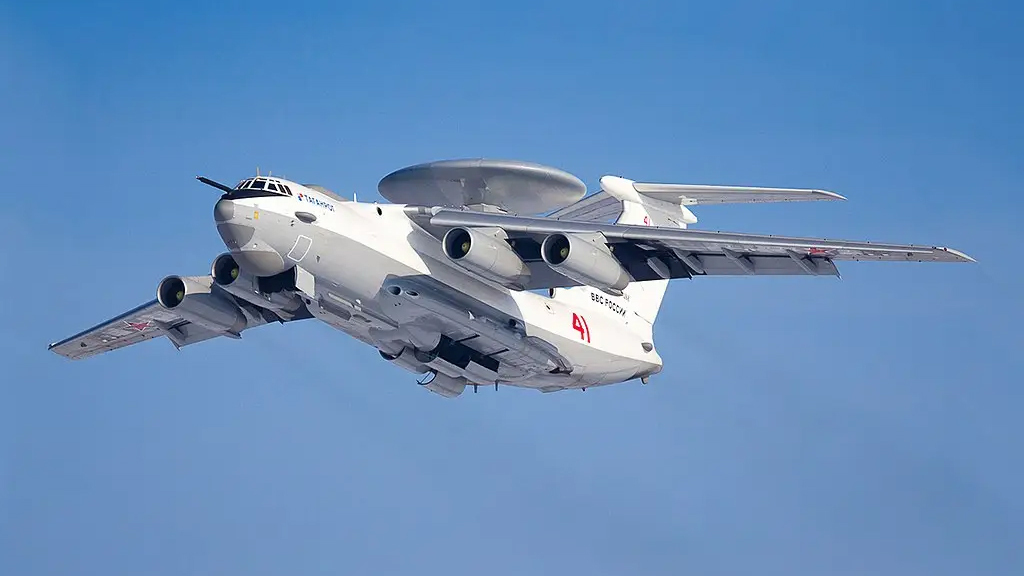
Russia was estimated to have nine A-50s in active service at the start of the full-scale invasion. Since then, there have been two combat losses, and another of these aircraft was damaged in a drone attack while on the ground at a base in Belarus, and its current status is unknown. More recently, the General Staff of the Ukrainian Armed Forces claimed an A-50 had been hit in a strike on a maintenance facility in the Novgorod region of Russia.
This reality almost certainly means Ukraine operates the Saab radar planes from the far west of the country, likely moving them between airfields to reduce their exposure to airstrikes. Similar tactics are also employed by Ukrainian F-16s. With a maximum of two aircraft, round-the-clock coverage is also impossible, so one aircraft may well be kept on permanent ground alert to respond to particularly intensive Russian drone and missile barrages.
It is likely for this reason, too, that we have not seen anything of the Ukrainian Saab 340 AEW&C aircraft since their delivery.
With time, we will hopefully learn more about what these secretive assets are bringing to Ukraine’s air defenses and what kind of effect they are having on countering the near-constant Russian drone and missile attacks.
Contact the author: thomas@thewarzone.com
Loading comments…
Comments couldn’t be loaded. Please refresh the page.