
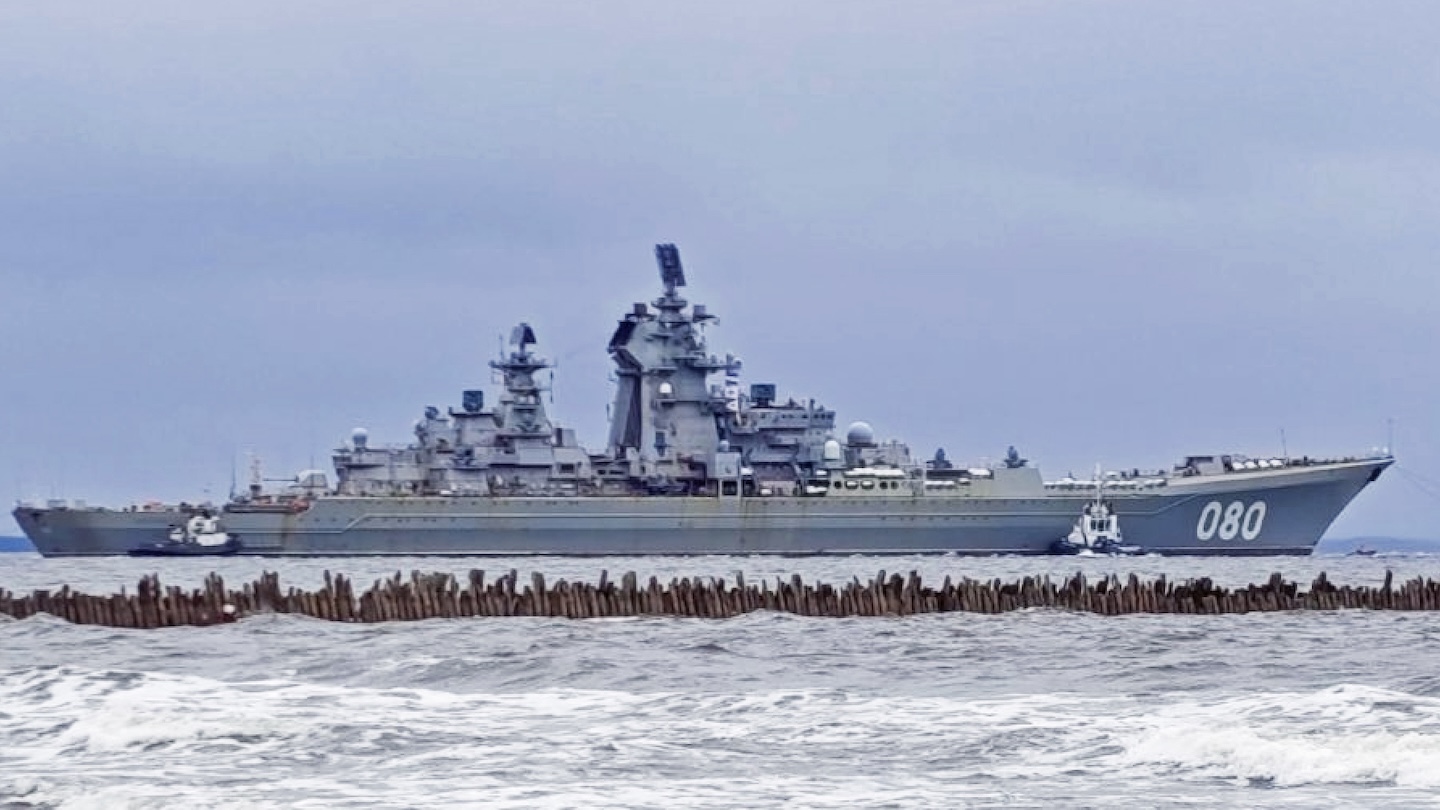
For the first time since 1997, the Russian Navy’s nuclear-powered battlecruiser Admiral Nakhimov is finally back in the water and moving under its own power, after years of repair work and modernization. The milestone comes after the 28,000-ton battlecruiser’s two nuclear reactors went back online earlier this year, and the warship is now expected to become the future flagship of the Russian fleet, superseding sister vessel the Pyotr Velikiy.
Videos showing the Admiral Nakhimov underway in the White Sea confirm reports from Russian state media that the warship has commenced factory sea trials. The photo at the top of this story shows the warship heading out to sea, pulled by a tug, and further imagery appears in the embedded tweets. According to the news agency TASS, citing an unnamed shipbuilding industry source, Andrei Kostin, the head of the United Shipbuilding Corporation (USC), informed President Vladimir Putin of the development yesterday.
In February, Russian reports stated that both the battlecruiser’s reactors were online again, with plans for the warship to commence trials in the summer, a timeline that has been achieved.
However, the path to this point has been far from easy, with the warship’s return to service being plagued by delays.
The Admiral Nakhimov was laid down in Leningrad in 1983 and was first launched in 1986, under its original name Kalinin. The warship is part of the class of warships known in Russia as the Project 1144.2 Orlan, which is codenamed Kirov class by NATO. In its current modernized form, the battlecruiser has the revised designation Project 1144.2M.
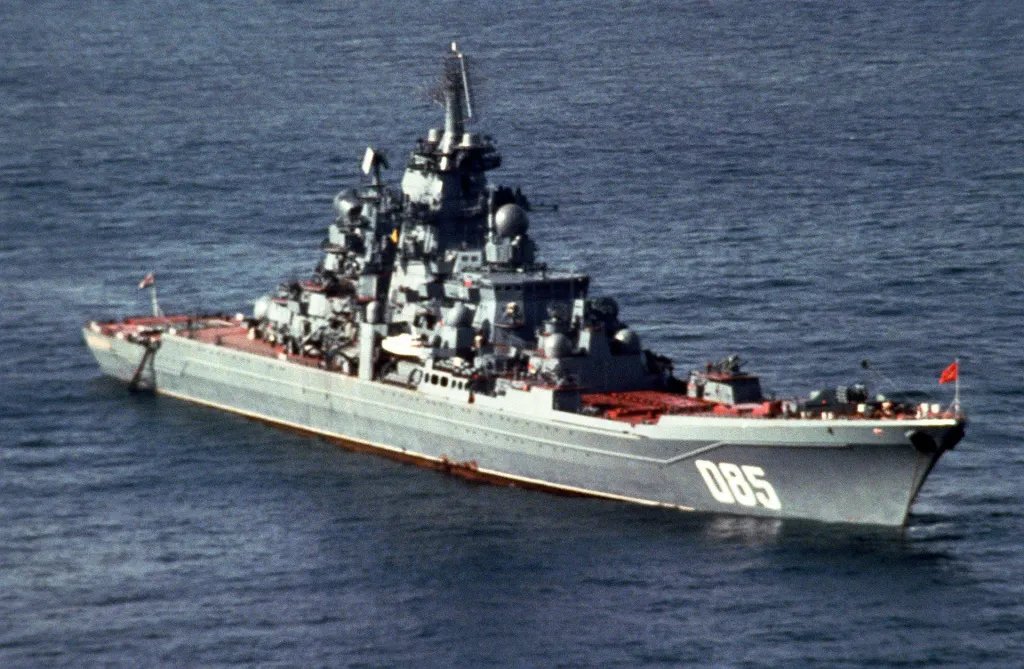
The battlecruiser joined the Northern Fleet in 1988 and received its current name, in honor of Russian Admiral Pavel Stepanovich Nakhimov, in 1992.
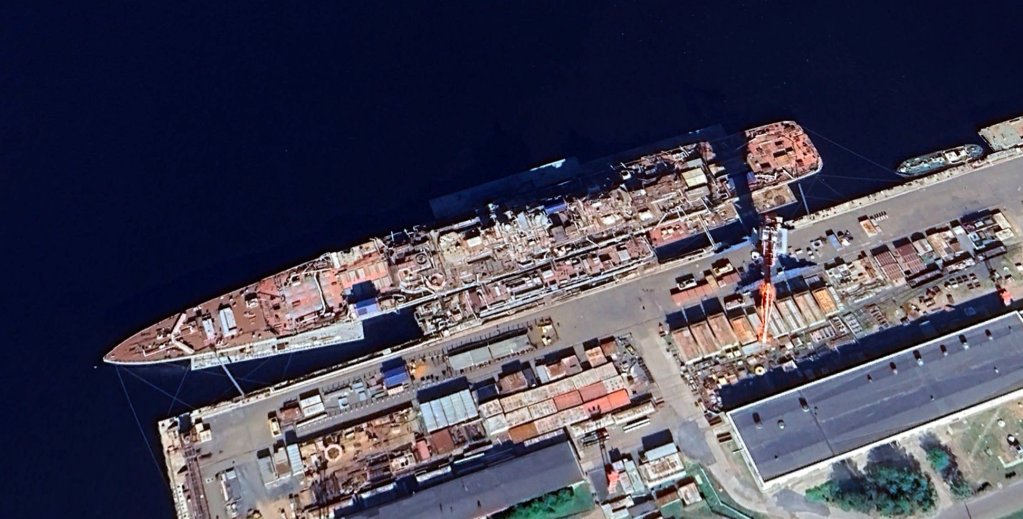
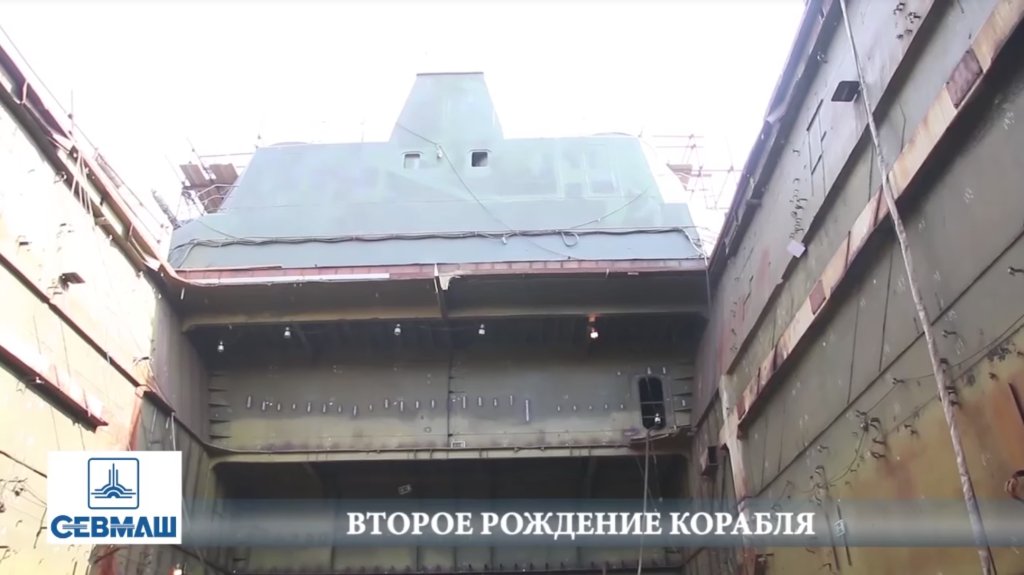
Still with the Northern Fleet, the Admiral Nakhimov was laid up in dry dock at the Sevmash shipyard in the port city of Severodvinsk on the White Sea since it last went to sea in 1997.
Work on the battlecruiser only really began in earnest in 2014. At one point, it was predicted that the project would be completed around 2018. But the date was repeatedly pushed to the right, first to 2019, and then to 2020. By 2017, TASS was reporting that work on the Admiral Nakhimov should be completed by 2021. In 2021, reports stated that the warship wouldn’t be back in service before 2023, while in 2022, the Sevmash shipyard stated that service re-entry had been pushed back to 2024.
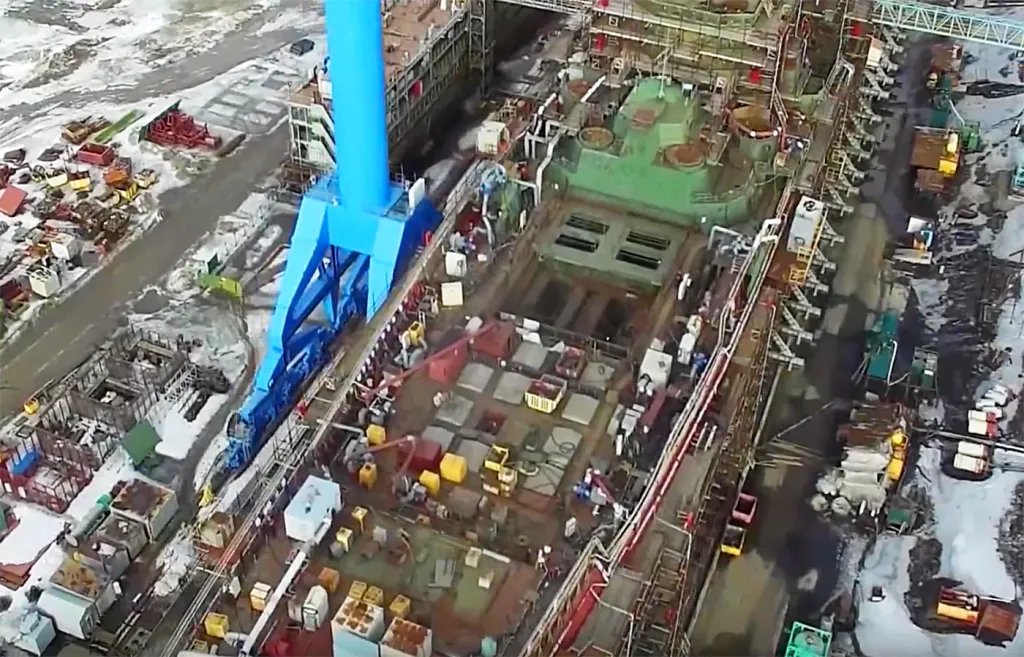
While the timeline has slipped dramatically, the refurbishment effort has now at least yielded more tangible results.
A question remains, however, about how ‘deep’ this modernization really is. Put another way, of the whole range of new weapons and sensors that were planned for the battlecruiser, how many of these have actually been installed, and with what degree of operational practicality?
At the core of the modernization was the plan to install no fewer than 174 vertical launch tubes, which would provide it with more than any other surface combatant or submarine in the world.
In comparison, China’s Type 55 ‘super destroyer’ has 112 vertical launch system cells. A Flight III Arleigh Burke class destroyer has 96 cells, while a Ticonderoga class cruiser has 122 cells. The U.S. Navy’s Zumwalt class stealth destroyers currently have 80 cells.
A video gives some idea as to how extensive the work on the Admiral Nakhimov has been (starts at 4:45):

Just as important is what the cells on the Admiral Nakhimov were planned to accommodate, with 78 of them assigned for various modern Russian cruise missiles, including the subsonic Kalibr, the supersonic Oniks, and the hypersonic Zircon.
While the Kalibr has already been extensively used in combat in Ukraine, fired from a variety of surface and sub-surface platforms, Russia has so far claimed that the more exotic Zircon has only been deployed on Admiral Gorshkov class frigates. At the same time, there is compelling evidence that the missile has at least been combat tested in Ukraine, perhaps from a ground launcher.
In the past, it was stated that the Kirov class would be the first operational launch platform for the hypersonic weapon, although delays with the work on the Admiral Nakhimov put an end to these ambitions.
The other 96 cells in the reworked Admiral Nakhimov were intended to be loaded with surface-to-air missiles associated with the S-300FM Fort system, derived from the land-based S-300 system. Missiles in this series were already part of the basic armament of the Kirov class. Other reports in the past have suggested that missiles from the land-based S-400 air defense system may be incorporated in the battlecruiser, which would enhance its anti-ballistic missile capability.
Other air defense armament would include eight Pantsir-M combined gun/missile systems for short-range interceptions, although, at this point, it appears that only six are fitted, three on each side of the vessel.
All of these weapons were to be supported by a comprehensive array of new sensors and command and control systems.
So far, however, we can only say for sure that the Admiral Nakhimov has received at least some new radar systems as well as a new main gun. The Soviet-era 130mm AK-130 dual-purpose gun has been replaced with a more modern AK-192M gun in the same caliber.
Of course, all of the aforementioned new weapons might also end up getting installed in the battlecruiser, but for now, we cannot be certain, and it’s unclear if the modernized warship really will return to the Northern Fleet in a basically ‘as new’ condition.
It should also be recalled that even less-invasive warship modernization programs can take a very long time.
For example, the U.K. Royal Navy’s Type 45 destroyer HMS Daring, the lead ship of its class, yesterday marked 3,000 days out of service, meaning that its current refit and regeneration effort has taken longer than its original construction. The destroyer is expected to rejoin the British fleet later this year.
As a nuclear-powered warship, the work on the Admiral Nakhimov was also more complicated from the outset.
The Kirov class is the last nuclear-powered surface combatant in service anywhere in the world, with the U.S. Navy retiring the last of its nuclear-powered cruisers in the 1990s, primarily on cost grounds.
At the same time, while the battlecruiser will be welcomed back into service, it’s widely expected that its return will see the decommissioning of the Pyotr Velikiy, also with the Northern Fleet.
A video shows the Pyotr Velikiy launching one of its 20 massive P-700 Granit (SS-N-19 Shipwreck) anti-ship cruise missiles stored in canted launch tubes in the bow:

Pyotr Velikiy underwent only a minor modernization and still relies primarily on Soviet-era weapons and sensors. At one time, it was planned that both battlecruisers would undergo the same in-depth rework. The status of those plans is now very much uncertain, with several reports indicating that the Russian Navy will retire the Pyotr Velikiy altogether.
Two earlier hulls, the Admiral Ushakov and the Admiral Lazarev, have been out of service for many years and have since been consigned to scrap.
The importance of returning to service another major surface combatant is also magnified by the likelihood that the Russian Navy aircraft carrier Admiral Kuznetsov will not now return to service, and with plans for a new class of ‘super-destroyer’ being shelved. As such, the modernized Admiral Nakhimov will likely be expected to form the centerpiece of future Russian flotillas.
After over a decade of work and many delays, the fact that Russia has finally returned its nuclear battlecruiser to sea is certainly a welcome development for the Russian Navy.
Contact the author: thomas@thewarzone.com
Loading comments…
Comments couldn’t be loaded. Please refresh the page.