
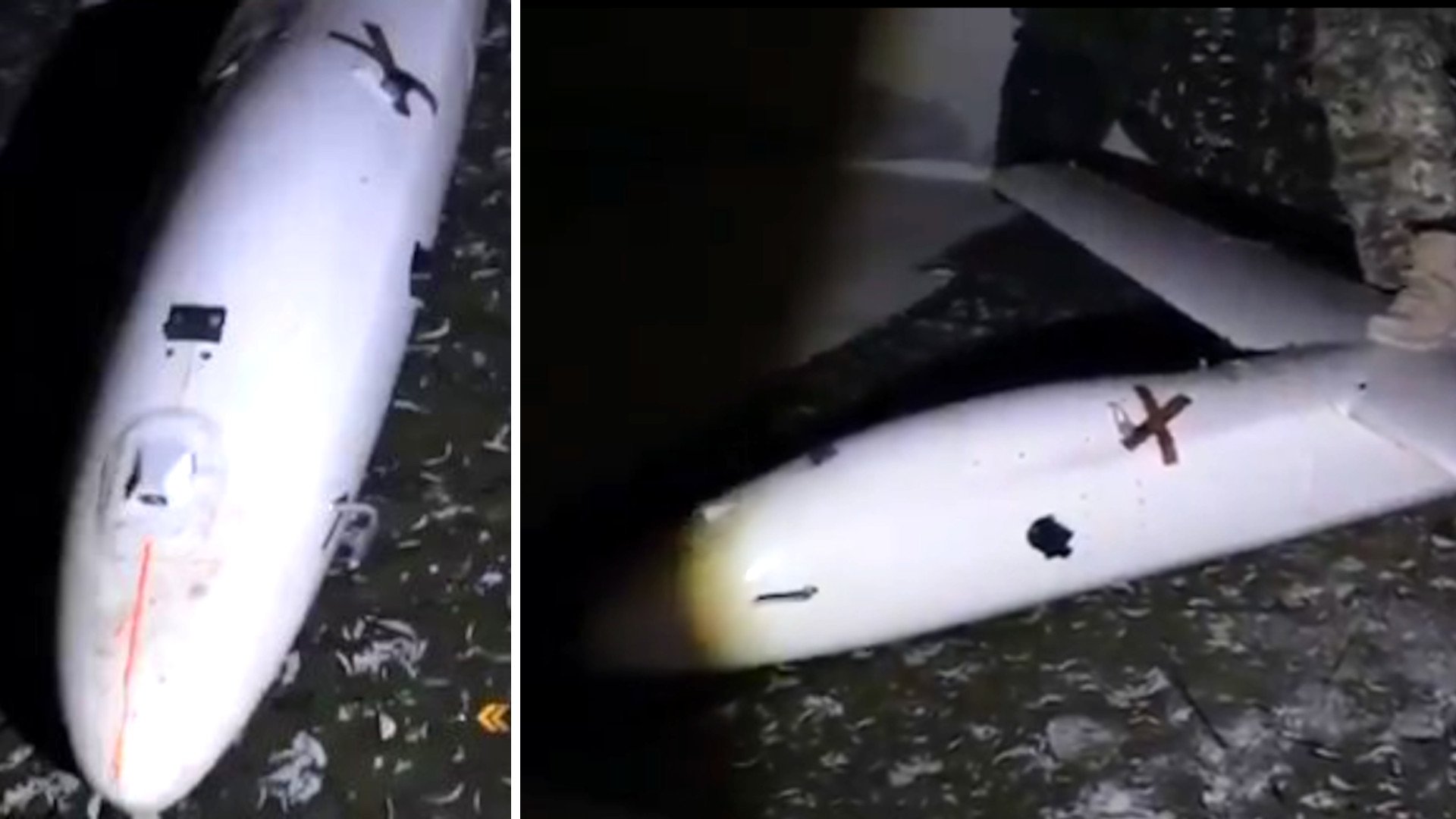
Iran claims to have brought down what looks to be a U.S.-made MQM-170C Outlaw G2 drone largely intact. A video shows it has a notable feature on top of its nose. In U.S. military use today, Outlaw-series drones are best known as an aerial target for use in training and testing.
The footage in question, and the accompanying claims, should be treated with caution given that the regime in Tehran and the country’s media outlets do routinely make exaggerated and unverified claims. That being said, so far, the footage looks to be credible. Furthermore, the U.S. military has pushed back on Iran’s version of events, but has not explicitly denied having lost one of these drones in the region recently.
For its part, Iran’s Islamic Revolutionary Guard Corps (IRGC) says it captured the MQM-170-series drone following what it described as an “offensive electronic warfare operation” somewhere to the “west of the Strait of Hormuz.” The IRGC also claims that the uncrewed aircraft was conducting reconnaissance on Iranian air defenses positioned along the country’s Persian Gulf coast. At the time of writing, no firm evidence has been provided to support either of these assertions. The IRGC has released the aforementioned video, seen below, which it says shows the drone being tracked via an infrared camera, as well as after its recovery.
“In the past weeks and months, the IRGC has repeatedly lied out of desperation, and today is no different,” U.S. Navy Capt. Tim Hawkins, spokesperson for U.S. Central Command, told TWZ when asked about the specific Iranian claims.
“We’re not going to waste our time. U.S. forces remain vigilant and laser-focused on our assigned missions,” Hawkins said in response to a follow-up question about whether CENTCOM could confirm or deny the loss of an MQM-170-series drone for any reason.
As an aside, Iran recovered an Anduril Dive-LD uncrewed underwater vehicle (UUV) largely intact last month in what the IRGC claimed had been a “complex intelligence and operational action.” U.S. authorities ultimately confirmed the loss of the advanced UUV, but said it was the result of a malfunction.
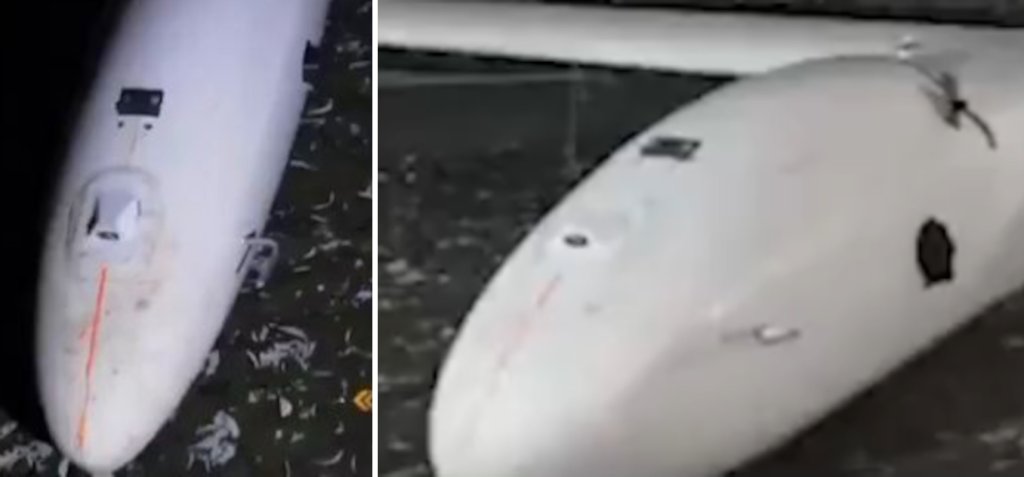
As mentioned, the drone seen in the IRGC video does look to be an MQM-170C, or at least a closely-related variant thereof. It has an interesting feature on top of its nose: a single forward-looking aperture. This is something that is commonly associated with staring-type optics, which drones often use to aid with navigation. There is a possibility that it could be a seeker, if the drone were to be configured as a one-way-attack munition, but this seems unlikely.
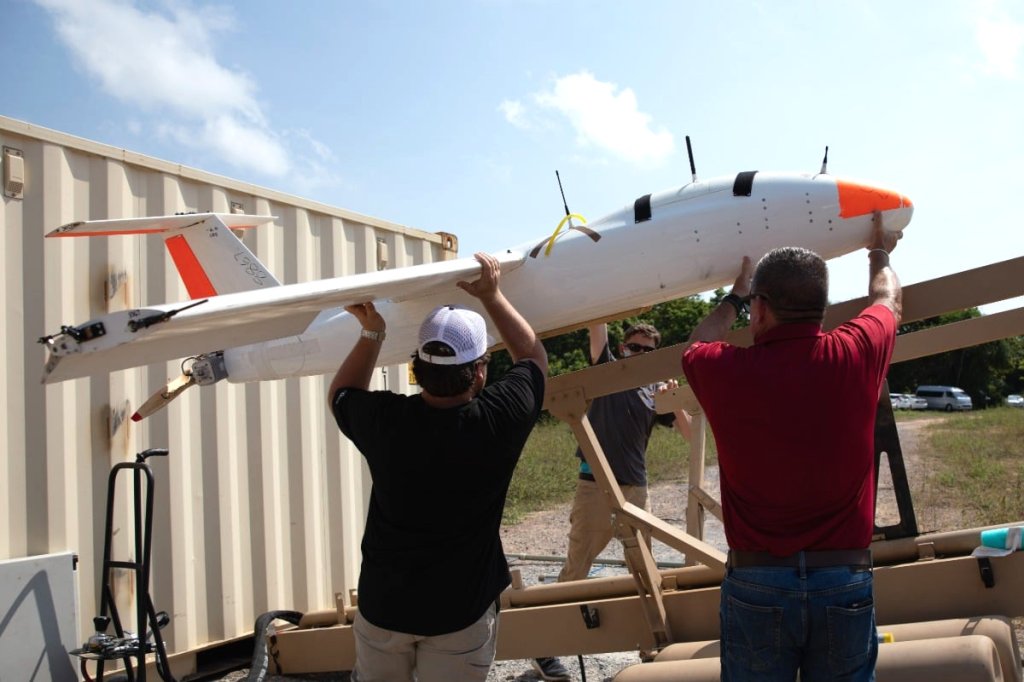
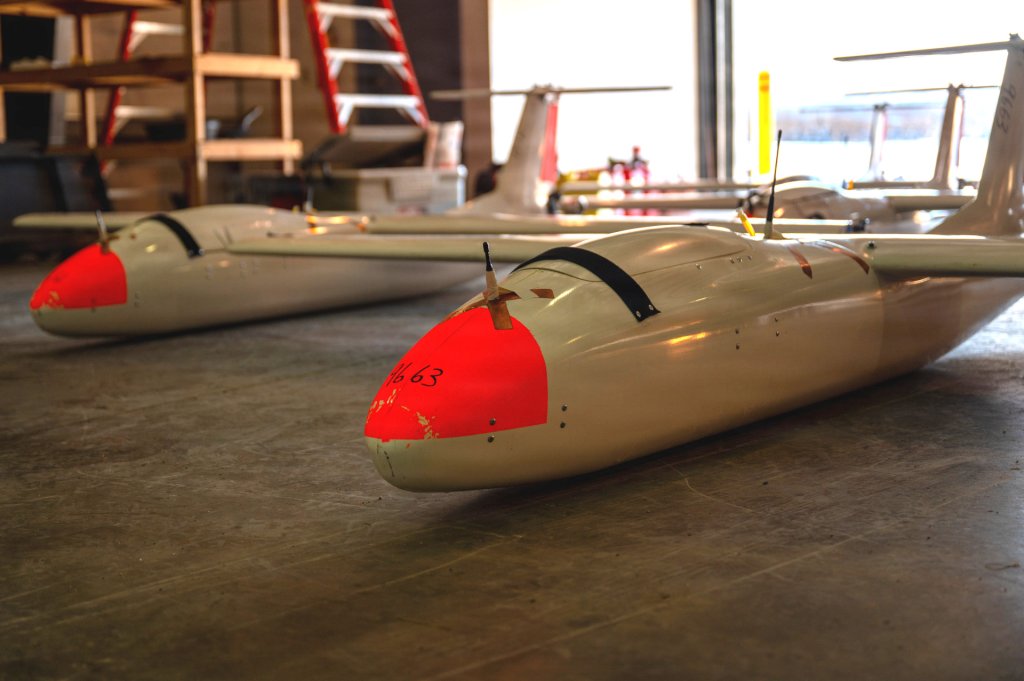
MQM-170C’s manufacturer, Griffon Aerospace, which refers to this design internally as the Outlaw Gen 2 (G2), does say on its website that it can be configured as “an inexpensive payload development platform offering great endurance, payload size, weight, and power.” The company’s website also says that the target configuration of the G2 has a gross weight of 150 pounds, but that this can grow to 225 pounds when used as a more general-purpose drone.
The drone, which is nearly 11 feet long and has a wingspan of 16 feet, otherwise has a stated maximum endurance of eight hours, top speed of 126 knots, and the ability to reach altitudes of more than 16,000 feet. The design is propelled by a 2-cylinder, 2-stroke combustion engine driving a single pusher propeller. The G2 gets into the air via a catapult-type launcher and can be recovered, either after a glide-in landing on suitable terrain or via parachute.
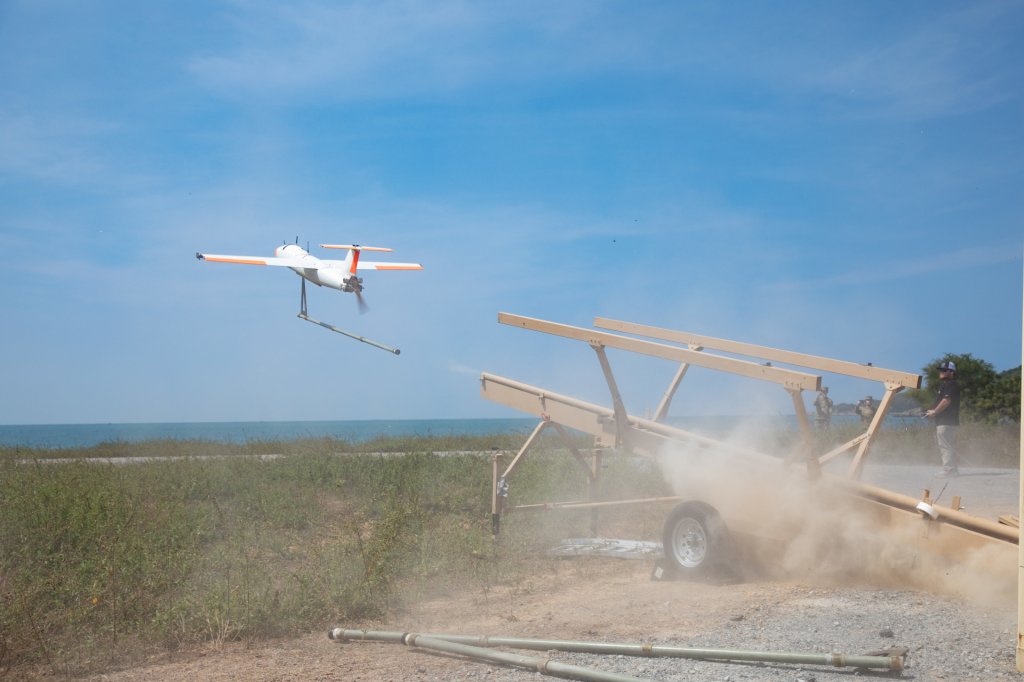
Griffon Aerospace also offers an ‘expanded’ G2E version with fixed tricycle landing gear as an “open and customizable platform for ISR [intelligence, surveillance, and reconnaissance] missions, subsystem testing, and R&D [research and development].” This version has a lower maximum takeoff weight and total endurance compared to the baseline G2, according to the company’s website. The IRGC video does not show any evidence of landing gear, but it could have broken away when the drone came down.
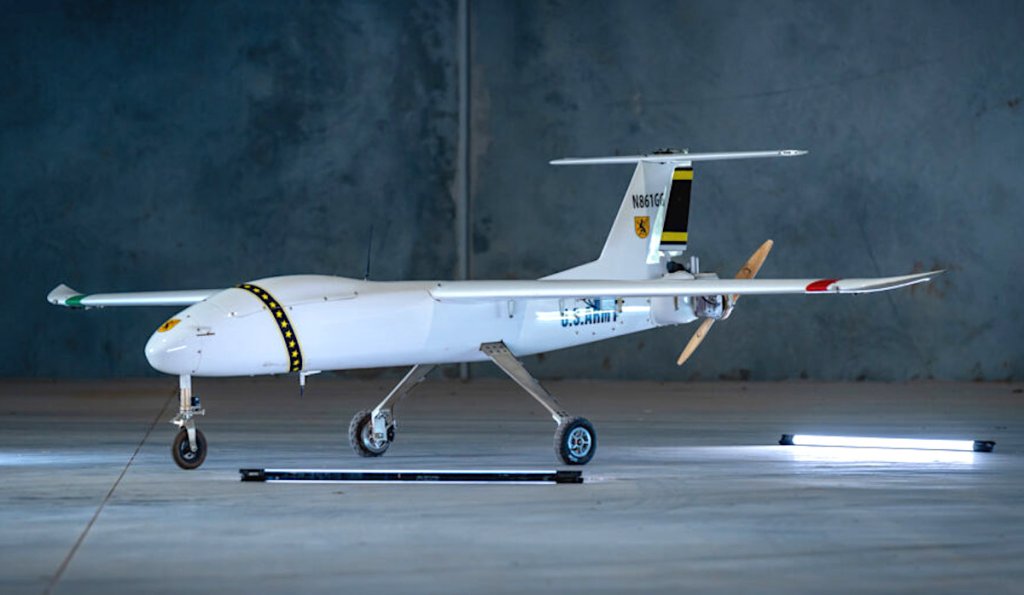
The larger Outlaw family, which traces back to the early 2000s, also includes the Gen 1 MQM-170A, which has a completely different design from the subsequent G2 drone. Griffon also developed a derivative of the Gen 1 design with a twin-boom tail, called the Outlaw Boomer, which the U.S. military designated the MQM-170B. There is also a twin-engine, twin-boom derivative of the Outlaw G2 that the U.S. military has at least tested in the past.
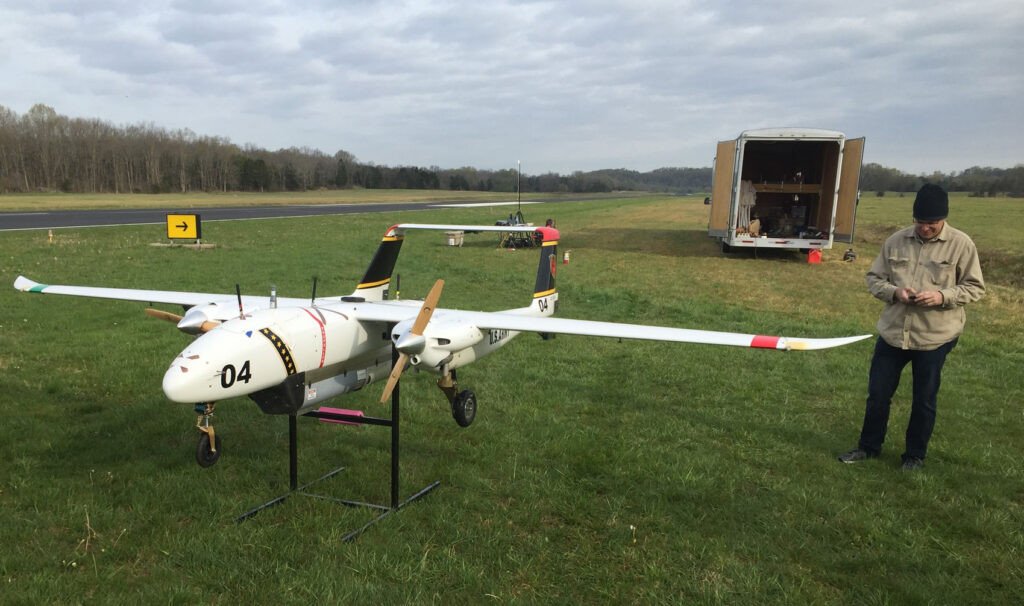
This brings us to the additional matter of a contract the U.S. Army awarded to Griffon Aerospace, valued at nearly $68 million, for the procurement of a Gen 3 version of the Outlaw on June 3. When the Pentagon first announced this deal, it was explicitly said to be “in support of Operation Epic Fury” against Iran. That portion of the announcement was quietly deleted sometime thereafter.
“A company official declined to provide details about the Gen 3 design,” Breaking Defense reported in a story published on June 5.
On August 25, Griffon received an additional contract from the Army, valued at just under $133 million, “to procure Griffon Outlaw systems, support equipment and field service representatives for system use and employment.” That announcement made no mention of operations against Iran.
At the time of writing, Griffon Aerospace’s website does not appear to make any mention of the Gen 3 Outlaw. TWZ has reached out for more information about this drone.
Given the known breadth of Outlaw designs to date, it is possible that the Gen 3 drone is substantially, if not entirely, different from any of the existing types. At the same time, the June contract announcement does establish a link between the Outlaw family and U.S. military use outside of training and testing, and specifically as part of real-world operations aimed at Iran.
There remains the potential that Iran simply captured an Outlaw target drone that U.S. forces lost control of during training or testing in the region. The drone seen in the IRGC video lacks the high-visibility orange markings typically seen on aerial targets, though these could easily have been painted over. Iranian authorities could have still fabricated the recovery, in part or in whole, though there is no firm evidence of that at present, either.
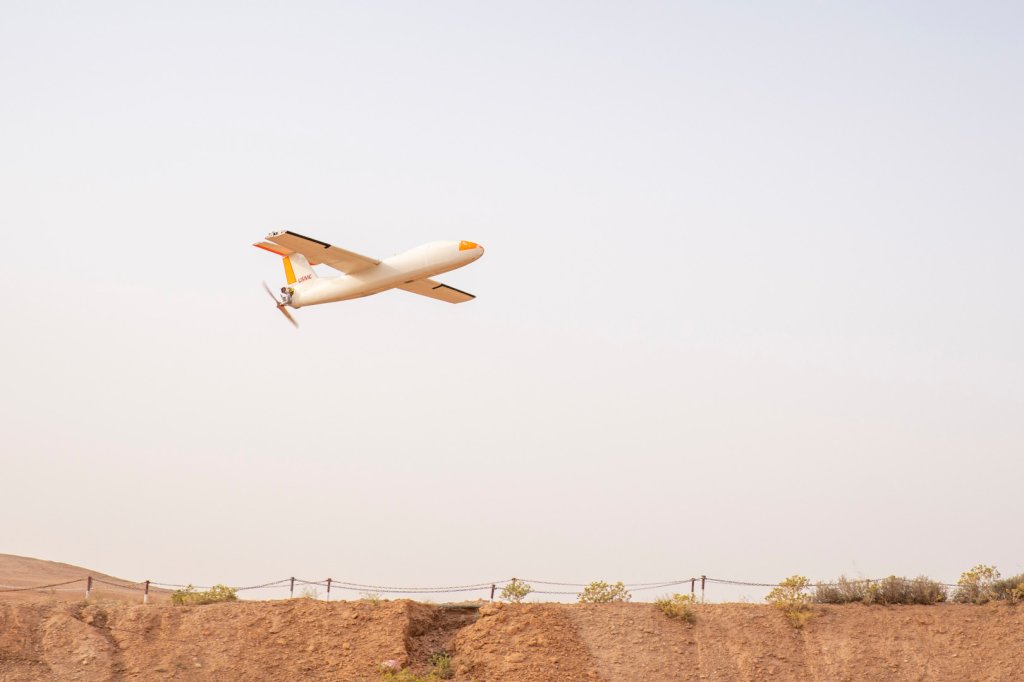
Another non-U.S. operator region could also be employing versions of the Outlaw, including in non-target drone roles, such as for surveillance and reconnaissance, or as decoys.
All of this does now come amid growing signs that the United States, as well as Israel, are preparing to launch a new major campaign against Iran. As TWZ reported recently, stimulating Iranian air defenses to glean key intelligence about their current capabilities and positions would be critical in the lead-up to any such operation.
“Stimulating Iran’s air defenses is critical,” our own Tyler Rogoway wrote on X earlier this month following unconfirmed reports of unusual Israeli air activity. “By Iran operating as if a full scale attack could be coming, their air defenses can be detected, categorized and geolocated. This is absolutely critical prior to a major air operation. Surveilling them during times of lower alert does not provide the same fidelity of actionable intelligence. Knowing where those threats are and how they are operating can mean the difference of life and death and/or will help standoff munitions make their way to their targets as those defenses can be suppressed, destroyed, or avoided entirely via careful mission planning.”
In September, claims had emerged that Iran had shot down a U.S.-made ADM-160 Miniature Air-Launched Decoy (MALD), but that remains unconfirmed. There were also reports of unusual, UAP-like objects flying over Iran, which have similarly not been confirmed.
As we wrote at that time:
“Such reports come amid an increasingly sophisticated use of low-end drones, decoys, and other forms of deception. These kinds of systems can be employed not only to stimulate adversary air defenses, but also to distract populations and probe how information moves out of a denied area. In such an environment, unusual aerial sightings should be viewed with caution — but not necessarily dismissed as irrelevant. We have been talking about how new forms of misdirection and guile will leverage relatively low-end technologies in future conflicts for many years now. While it isn’t clear if this light show in the sky over Iran was such an activity, it is certainly a reminder to keep that possibility in mind.”
It would certainly be plausible for suitably configured Outlaw drones to be in use now as another means of simulating Iranian air defenses. There is precedent even for ostensible target drones to be used operationally to deploy countermeasures and just as decoys in support of major strikes. U.S. BQM-34 Firebee target drones were notably used to spread radar-confusing chaff over the Iraqi capital Baghdad as part of the opening phase of Operation Iraqi Freedom in 2003.
It is also worth noting that the conflict with Iran this year has seen the first U.S. combat use of longer-range one-way attack drones, as well as explosive-laden kamikaze uncrewed surface vessels (USV). However, there is no evidence at present that drones in the Outlaw family have been configured in this way in any context.
Altogether, though still not definitively confirmed, Iran’s claimed recovery of an MQM-170C drone is an interesting development as the prospect that major hostilities in the region could resume soon continues to grow.
Contact the author: joe@twz.com
Loading comments…
Comments couldn’t be loaded. Please refresh the page.