
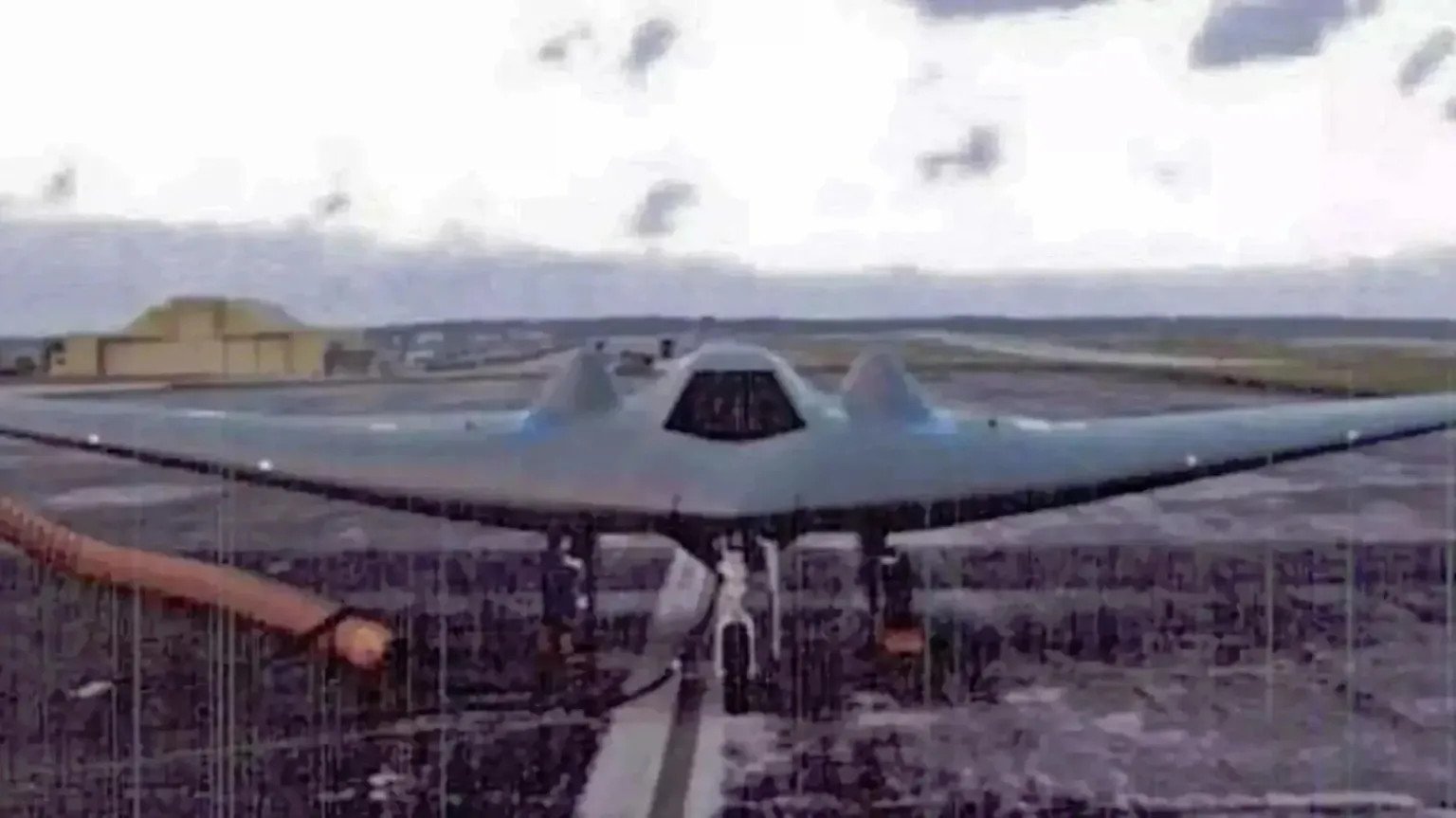
An annual award has gone to one of the U.S. Air Force’s most secretive drone squadrons, offering a very rare window into its activities. The 30th Reconnaissance Squadron is one of two units known to operate the stealthy RQ-170 Sentinel, and it is unusual to hear anything about its operational exploits. Much about the RQ-170 itself remains highly classified 17 years after its existence was first officially acknowledged.
The General Atomics Remotely Piloted Aircraft (RPA) Squadron of the Year award for 2025 was presented to the 30th Reconnaissance Squadron at the Air & Space Forces Association’s (AFA) 2026 Air, Space & Cyber Conference on Tuesday, at which TWZ was in attendance. The AFA’s Mitchell Institute for Aerospace Studies works together with General Atomics’ Aeronautical Systems, Inc. division (GA-ASI) to recognize an Air Force drone unit in this way each year.
“The RPA Trophy is awarded annually at the USAF level for outstanding performance of active duty, Air Force Reserve, and Air National Guard … squadrons in achieving persistent attack and/or reconnaissance over the preceding calendar year,” the Mitchell Institute told TWZ in a statement. “Squadrons are judged on performance across their specified mission sets, exercise participation, and squadron and individual achievements.”

The institute sent an additional statement regarding this year’s particular award to the 30th Reconnaissance Squadron, which is as follows:
“Through relentless combat support, operational agility, and enterprise leadership, the 30th Reconnaissance Squadron – known as the Blackbirds – has set the standard for the remotely piloted aircraft community and strengthened the Joint Force’s intelligence advantage. In 2025, the 30th Reconnaissance Squadron conducted intrusive intelligence, surveillance, and reconnaissance missions across three areas of responsibility, filling critical intelligence gaps and disrupting enemy networks. In the face of urgent deployment requirements, the squadron demonstrated exceptional agility, rapidly pivoting resources to establish forward operating locations and execute critical missions under severely compressed timelines. The Blackbirds’ accomplishments paved the way for future remotely piloted aircraft capability, distinctly identifying them as the Air Force’s most outstanding RPA squadron.“
Larry Stutzriem, the AFA’s Executive Vice President, while presenting the award to representatives of the 30th Reconnaissance Squadron ahead of a panel at the Air, Space & Cyber Conference.
“In 2025, the 30th Reconnaissance Squadron conducted 87 ISR [intelligence, surveillance, and reconnaissance] missions across three different AORs [areas of responsibility], filled critical intelligence gaps, and disrupted enemy networks,” Stutzriem said. “On the unit mobility side, the Blackbirds executed 7.2 million dollars worth of airlift in six movements across four combatant commands, moving 250 tons of personnel, top secret material, and equipment to provide low-observable RPA support for a critical Secretary of War-directed mission.”
“With their deployments, the Blackbirds demonstrated exceptional agility under extremely compressed timelines,” he added.
Furthermore, during 2025, the squadron “also executed six large force exercises to develop tactics, techniques, and procedures; validated joint force tactical objectives in land and maritime environments; and provided combat-relevant training,” according to Stutzriem. “Instructors and evaluators graduated the largest ever combat mission-ready class, 30 percent ahead of schedule, and accelerated mission-ready status 33 percent, while increasing total unit aircrew by 26 percent.”
Though Stutzriem noted that the 30th Reconnaissance Squadron provided “low-observable RPA support,” no explicit mention was made of the RQ-170. Whether or not the squadron may now operate other kinds of low-observable (stealthy) drones is unknown. As mentioned, to date, the Air Force has only confirmed that Sentinels are assigned to two units, the other being the 44th Reconnaissance Squadron. Both the 30th and 44th are assigned to the 432nd Wing at Creech Air Force Base in Nevada. Between 20 and 30 RQ-170s, in total, are understood to be in the Air Force’s inventory.
What three specific AORs the 30th Reconnaissance Squadron operated in during 2025 is also not known.
However, at least one, and possibly two, RQ-170s took part in the mission to capture Venezuelan dictator Nicolas Maduro in January of this year, as you can read more about here. It’s very likely that the Sentinels were tracking Maduro ahead of the operation. In December 2025, Air Forces Southern (AFSOUTH) had also made a post on X that included a picture of an individual wearing a name patch with the silhouette of Sentinel and the sleeve insignia of the 432nd Wing, prompting questions about whether the drones were operating in the region. The post was subsequently deleted.
Further in the past, RQ-170s are also known to have been deployed to the Middle East, Central Asia, and the Pacific. The Sentinel first emerged publicly in Afghanistan in the late 2000s, prompting the U.S. military to confirm its existence in 2009. Sentinels are notably understood to have surveilled Al Qaeda founder Osama Bin Laden’s compound in Pakistan in the lead-up to the raid that led to his death in May 2011.
Later in 2011, one of the drones infamously went down in Iran while presumed to be on a mission to monitor aspects of that country’s nuclear program. With that in mind, it is possible, if not extremely probable, that RQ-170s likely played a role in relation to the Operation Midnight Hammer strikes on Iranian nuclear sites last year. Sentinels could have provided direct surveillance over the sites in question, as well as collecting post-mission bomb damage assessments and other intelligence. These are exactly the kinds of missions the drones were designed for and that operators have trained for.
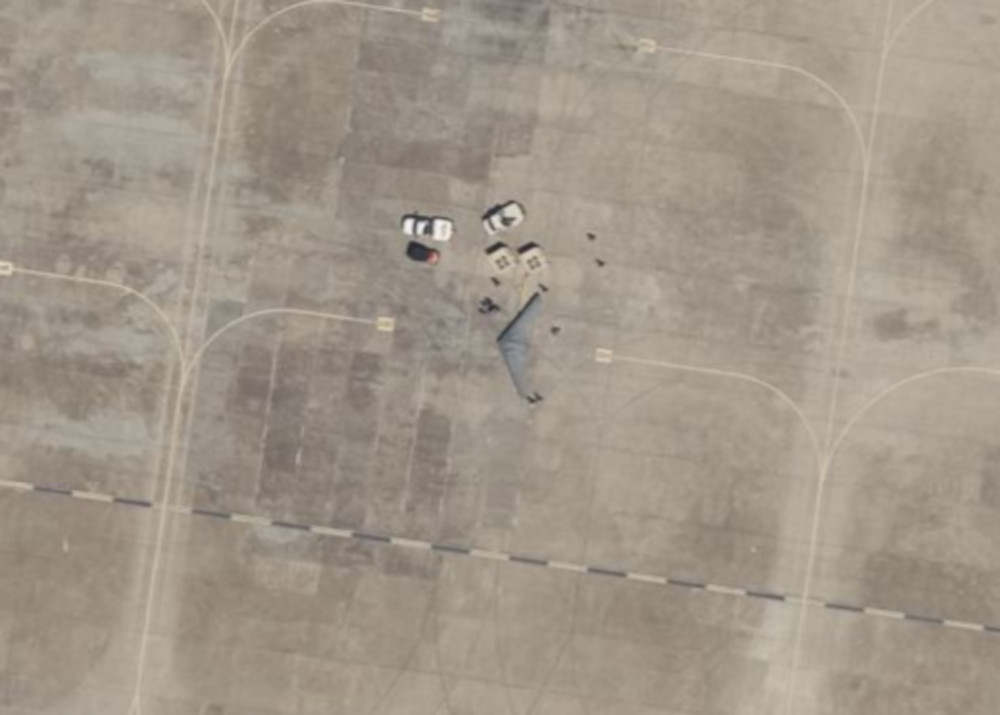
A satellite image available through Apple Maps, seen below, also shows an RQ-170 at Naval Air Station Sigonella in Italy, likely in the 2023-2024 timeframe, based on the state of construction visible elsewhere at the base. It is not known how many Sentinels were deployed to Sigonella and for how long. The Apple Maps image does lend some credence to earlier reports that these drones may have flown missions in the Black Sea region, gathering intelligence on Russian forces on the heavily defended, occupied Crimean Peninsula, between 2022 and 2023.
Overall, the RQ-170 does still appear to be a go-to for performing penetrating tactical reconnaissance missions, especially when there is a need to provide persistent surveillance in denied areas, resulting in extremely important intelligence collection.
Again, it is important to reiterate here that we do not know if the 30th Reconnaissance Squadron operates any other stealthy drones beyond the RQ-170, or has in the past. A very stealthy high-altitude, long-endurance (HALE) surveillance and reconnaissance drone commonly and unofficially referred to as the RQ-180, or an evolution thereof, burst into the public eye in March after it was spotted landing in broad daylight at a base in Greece. Much about the drone, including what units are involved in its operation and where the home base of the fleet is, as well as the reasons for its deployment to the region, has yet to emerge. It does seem unlikely that the 30th would have taken on operation of the RQ-180, which is a larger strategic reconnaissance-focused platform compared to the smaller, tactically-minded, and less exquisite RQ-170. This is also just one example of what could still be lurking in the classified realm.
Whether or not the awarding of the 2025 RPA Squadron of the Year trophy to the 30th Reconnaissance Squadron might now point to a new willingness to talk about that unit’s activities and/or the RQ-170 remains to be seen. Regardless, the award and its description are yet more reminders of just how important the Sentinel remains nearly two decades after it first appeared.
Contact the author: joe@twz.com
Loading comments…
Comments couldn’t be loaded. Please refresh the page.