
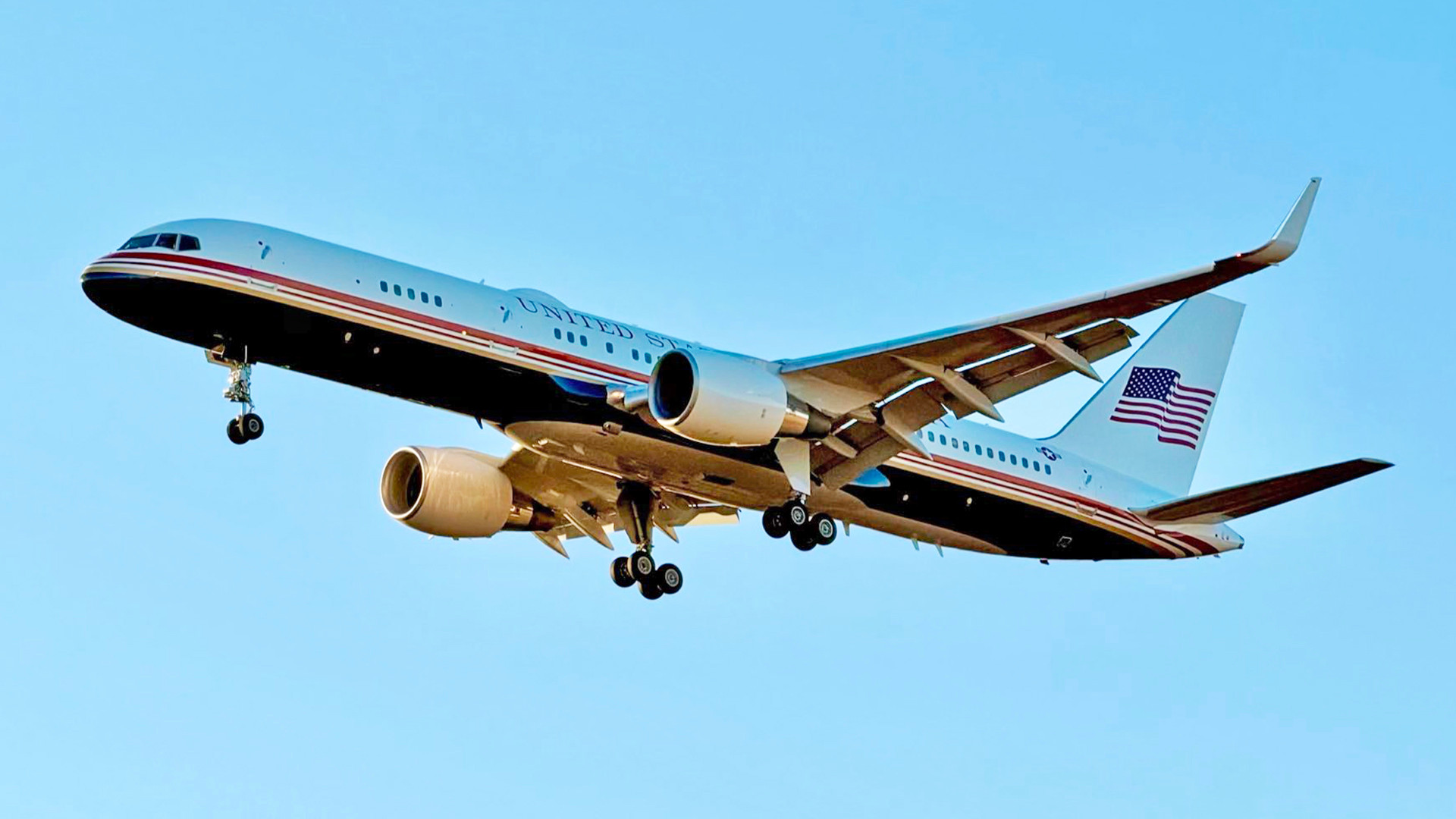
One of the U.S. Air Force’s C-32A VIP aircraft has re-emerged wearing a new red, white, and blue paint scheme. The same livery has recently been appearing on other U.S. government executive jets, and is nearly identical to one President Donald Trump had previously chosen for the future VC-25B Air Force Ones. The C-32As are commonly referred to as “Air Force Twos,” a callsign used when they carry the Vice President, but they are often used to transport the President, as well as other high-level officials and diplomats.
The C-32A with the new paint job was caught flying from Majors Airport in Greenville, Texas, yesterday by an aircraft spotter who goes by the handle @tt_33_operator on Instagram. The aircraft was using the callsign Vader 20 at the time. Online flight tracking data shows that the jet is serial number 99-0003. The Air Force’s Boeing 757-based C-32s are regular visitors to Majors Airport, home of L3Harris’ Mission Integration plant, which is a hub for conversions, upgrades, and other work related to large special mission aircraft.
The jet’s new paint scheme is white over dark blue, separated by red and gold cheat lines. The livery also includes a large American flag, depicted blowing in the wind, on the side of the tail. The flag has the same general style as the one on the tail of Trump’s personal 757, also commonly called “Trump Force One.” “United States of America” is in large lettering and a standard U.S. military ‘stars-and-bars’ insignia is also painted on the side of the fuselage of the C-32A. There is no readily visible serial number, which is in keeping with a policy that Air Mobility Command (AMC) enacted under President Joe Biden’s administration, ostensibly intended to improve operational security.
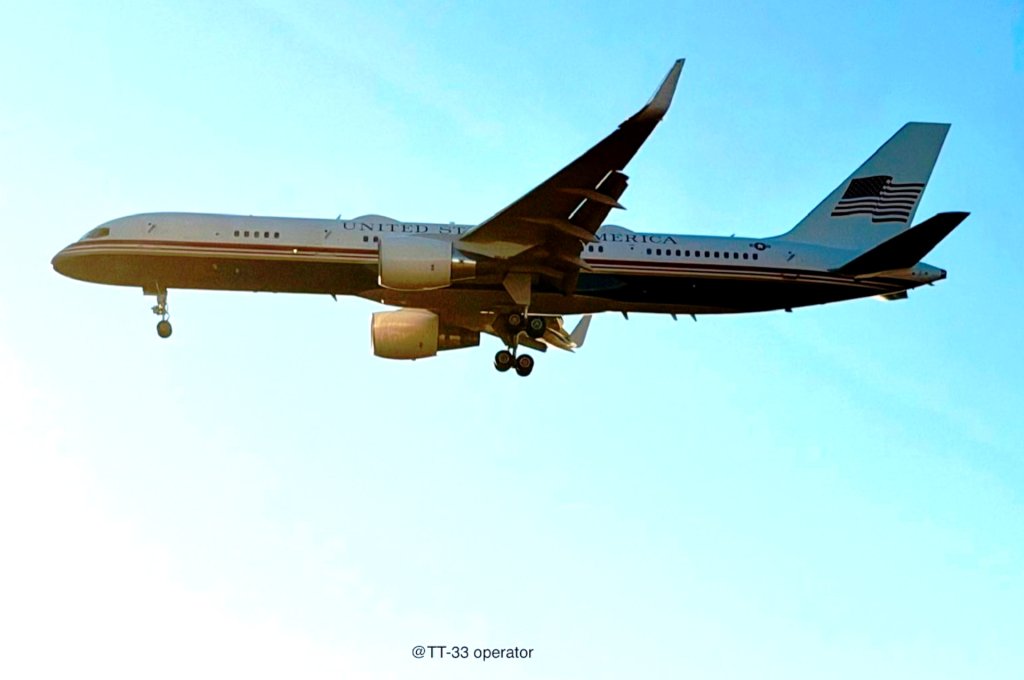
99-0003 has been at Majors Airport since at least last December, according to available tracking data. Spotters caught the aircraft arriving in Greenville on December 8, at which time it was wearing the blue, white and gold scheme typically seen on Air Force C-32s. Earlier this month, it was sighted completely stripped of paint.
The Air Force currently has some eight C-32As in its inventory. The service also operates a fleet of more secretive C-32B Gatekeeper personnel transports, which have overall white paint schemes.
TWZ has reached out to the Air Force for more information about the new livery on 99-0003 and what plans there might be now for applying it to the rest of the C-32 fleet or other aircraft.
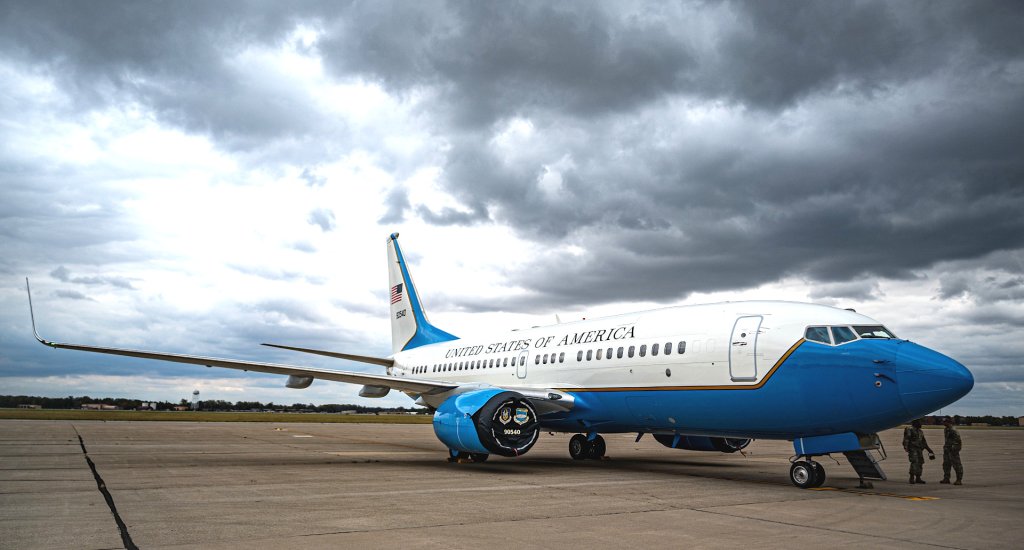
For decades now, the Air Force’s C-32As have worn the same white-over-blue paint scheme, which is also found on Boeing 737-based C-40 Clippers. Other business jet-based executive aircraft the service operates wear similar liveries.
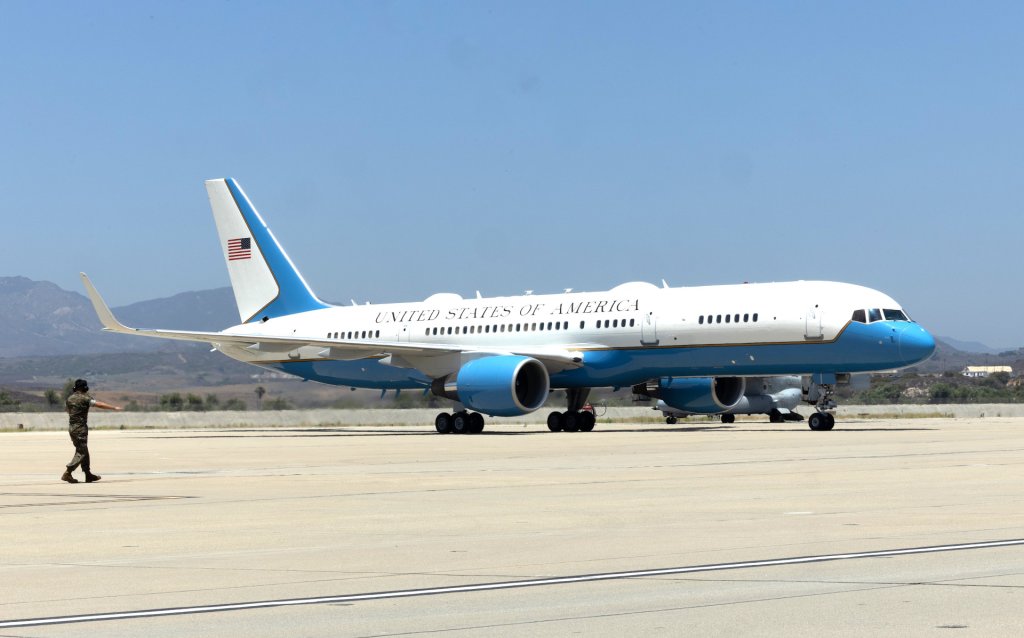
The typical C-32A livery shares distinct similarities with the one currently worn by the Boeing 747-based VC-25A Air Force One aircraft, but there are differences. The famed Air Force One scheme dates back to President John F. Kennedy’s administration, and was created with the help of legendary designer Raymond Loewy at the urging of First Lady Jacqueline Kennedy.
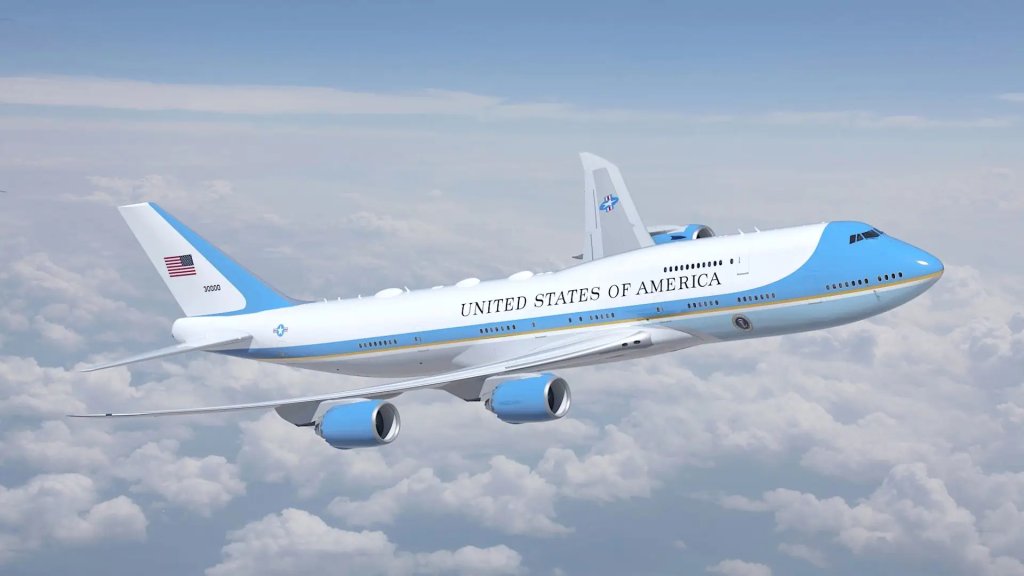
In 2019, during his first term in office, President Trump unveiled a new red, white, and blue scheme for the forthcoming VC-25B Air Force One aircraft. As already noted, the scheme is essentially the same as the one now seen on 99-0003.

President Biden subsequently reversed that decision, with the Air Force rolling out new renders of the VC-25B wearing a version of the Kennedy-era livery in 2023. In August 2025, following Trump’s re-election, the Air Force told Inside Defense it was “implementing a new livery requirement for VC-25B,” but did not elaborate.
There are certainly growing signs that the red, white, and blue livery that has now emerged on an Air Force C-32 is becoming a standard for executive jets across the U.S. government. The first aircraft to appear with this paint scheme was a 737 Boeing Business Jet (BBJ) with a luxurious interior and clear ties to the Department of Homeland Security (DHS). Details about that jet, which carries the civil registration number N471US, and has been flying around the United States and to destinations abroad since December, remain limited.
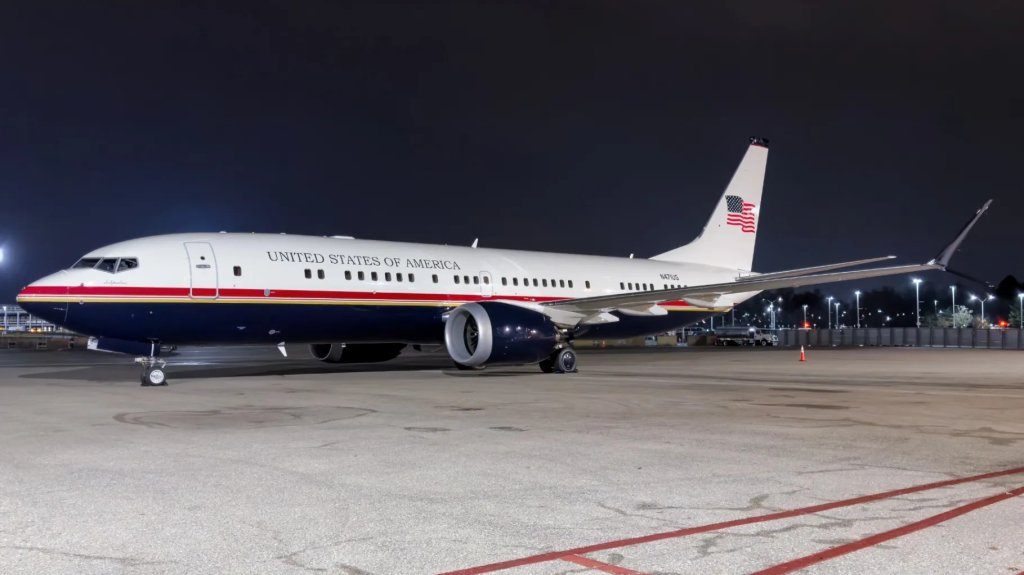
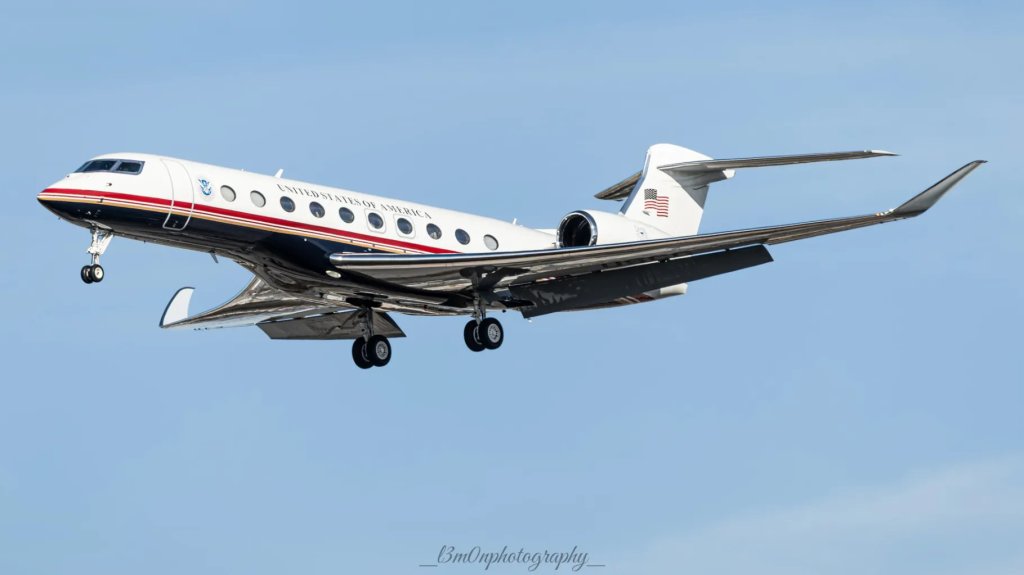
The U.S. Coast Guard, which falls under the purview of DHS, has now received the first of two modified Gulfstream 700 (G700) jets wearing this livery, as well. Also known as Long Range Command and Control Aircraft (LRCCA), the G700s provide VIP transport for the Secretary of Homeland Security (currently Kristi Noem), as well as other senior DHS and Coast Guard officials. The aircraft also fit into continuity of government plans in place to ensure U.S. authorities can keep functioning in the event of a host of different severe contingency scenarios, including major hostile attacks and devastating natural disasters. The Coast Guard already operates two LRCCA jets based on older, out-of-production Gulfstream models, which it says are becoming increasingly difficult to sustain. Older Gulfstream types are still in widespread service elsewhere across the U.S. government, including with the Air Force.
Separate from any deliberations over paint schemes, the Air Force has similarly been exploring various options for ultimately replacing the C-32As in recent years. The very last 757 rolled off Boeing’s production line in 2004, and the type has been in declining use by airlines and other operators globally, which has impacts on residual supply chains.
The Air Force had previously considered rolling a C-32 replacement effort into work on successors for the E-4B Nightwatch and E-6B Mercury command and control aircraft, but subsequently decided against that course of action. The Boeing 747-based E-4Bs are now set to be succeeded by E-4C Survivable Airdrop Operations Centers (SAOC) converted from newer 747-8i airframes, which could also take over some of the roles now performed by the E-6B. The E-4s and E-6s are commonly referred to as ‘doomsday planes’ because of the role they could play in launching nuclear strikes.
A proposed plan to augment the C-32 fleet with additional “large commercial derivative aircraft” was also put forward in the past. Most recently, the Air Force has laid out the possibility of supplanting its C-32s, as well as at least a portion of its C-40s, with a single common platform. Doing so would offer a way to simplify executive airlift operations compared to how things stand now with the two fleets of different narrow-body airliner types.
In the meantime, the Air Force has continued to upgrade its C-32 fleet, including making critical improvements to the jets’ secure communications capabilities and installing new interiors. You can read more about the latter, specifically, here.
There has been a surge of new executive aircraft developments under the current Trump administration, in general. This has been particularly visible in the acquisition of additional 747s in relation to the much-delayed VC-25B program. This includes the purchase of second-hand 747s from German flag carrier Lufthansa to provide training support and as sources of spare parts for the future VC-25Bs. The Air Force is also repurposing a highly-modified ex-Qatari VVIP 747-8i, ostensibly gifted to the U.S. government, as what is now being called a VC-25 bridge aircraft. TWZ has previously raised significant questions about the feasibility of using that aircraft in the Air Force One role.
Time will tell what the future may hold now for the Air Force’s C-32s, but at least one of the jets is now flying with a new paint scheme that is seeing growing use across the U.S. government. By the time the VC-25Bs enter service, they will likely be surrounded by identically painted executive airlift aircraft.
Update: 4:25 PM EST –
The U.S. Air Force has now confirmed that other C-32As are set to receive the new red, white, and blue paint scheme, and that this livery will also be applied to the future VC-25Bs and the ex-Qatari 747-8i.
“The Air Force is implementing a new paint scheme requirement (red, white, gold and dark blue) for VC-25B as well as the additional executive airlift fleet, which will include the new 747-8i and four C-32 aircraft,” a spokesperson for the service told TWZ. “The C-32s will be painted during regularly scheduled maintenance. The first C-32 has been painted and is expected to be delivered to the Air Force in the next few months.”
CBS News had first reported these details, citing anonymous sources, earlier today, following the publication of our initial story.
Special thanks again to @tt_33_operator for sharing the pictures of the C-32A wearing the new paint scheme.
Contact the author: joe@twz.com
Loading comments…
Comments couldn’t be loaded. Please refresh the page.