
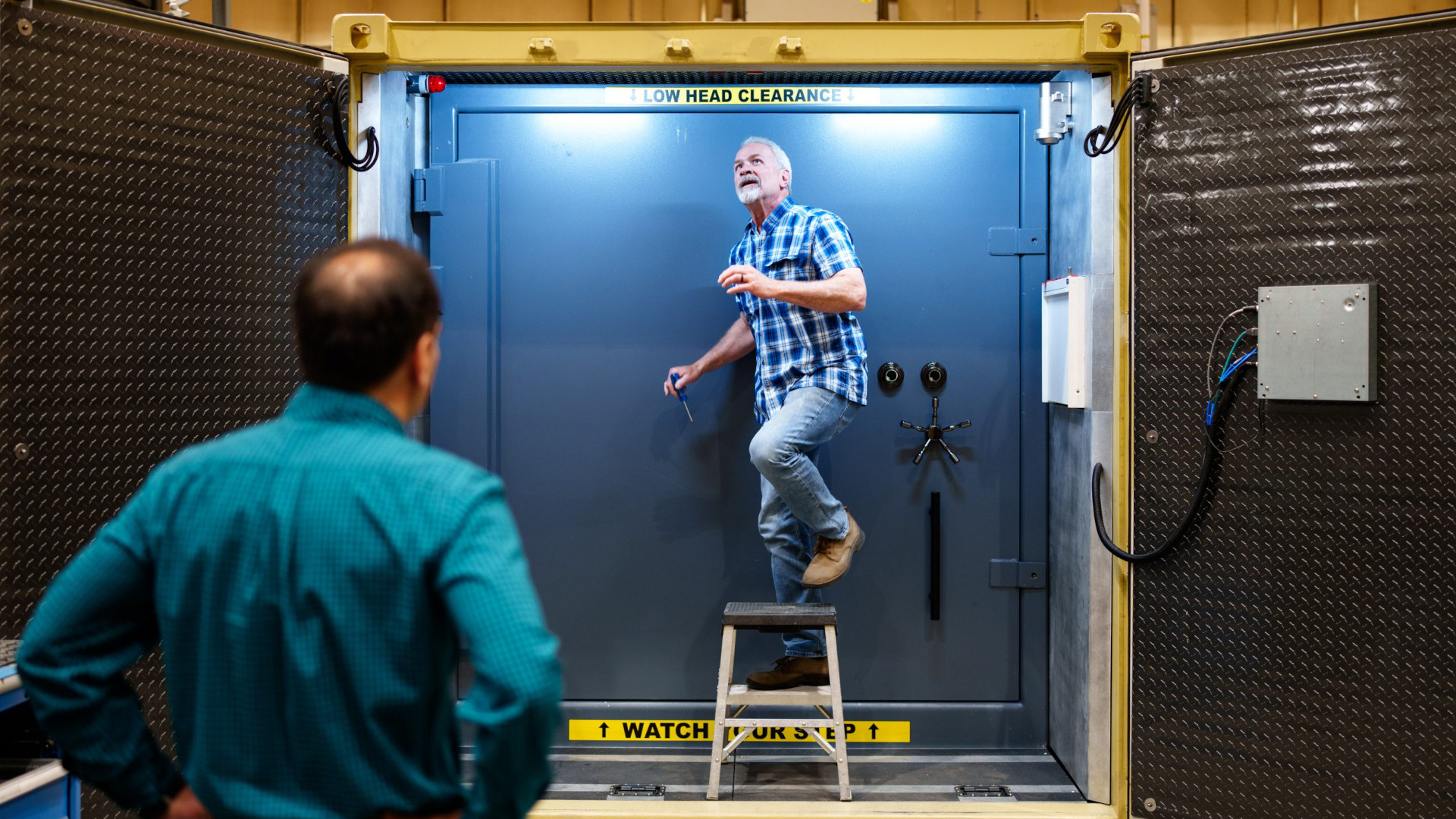
A high-security vault concealed inside a standard 20-foot shipping container is in development to give U.S. military commanders a new way to safely store nuclear weapons and other extremely sensitive assets, even at far-flung locations. Prototypes are set to be demonstrated at an upcoming Gray Flag test and evaluation exercise, events that regularly feature new munitions and other advanced capabilities. For the U.S. Air Force, in particular, the new Mobile Vaults could fundamentally change the equation when it comes to integrating nuclear weapons into future operations involving forces dispersed across a broad area.
Sandia National Laboratories, which resides within the Department of Energy, recently shared details about the Mobile Vault project. The Transportation Safeguards and Surety Program office designed and built the first prototype in just six months following a request from the National Nuclear Security Administration (NNSA). NNSA, which is also part of the Department of Energy, works closely with the U.S. military and is charged with overseeing America’s nuclear deterrent stockpile.
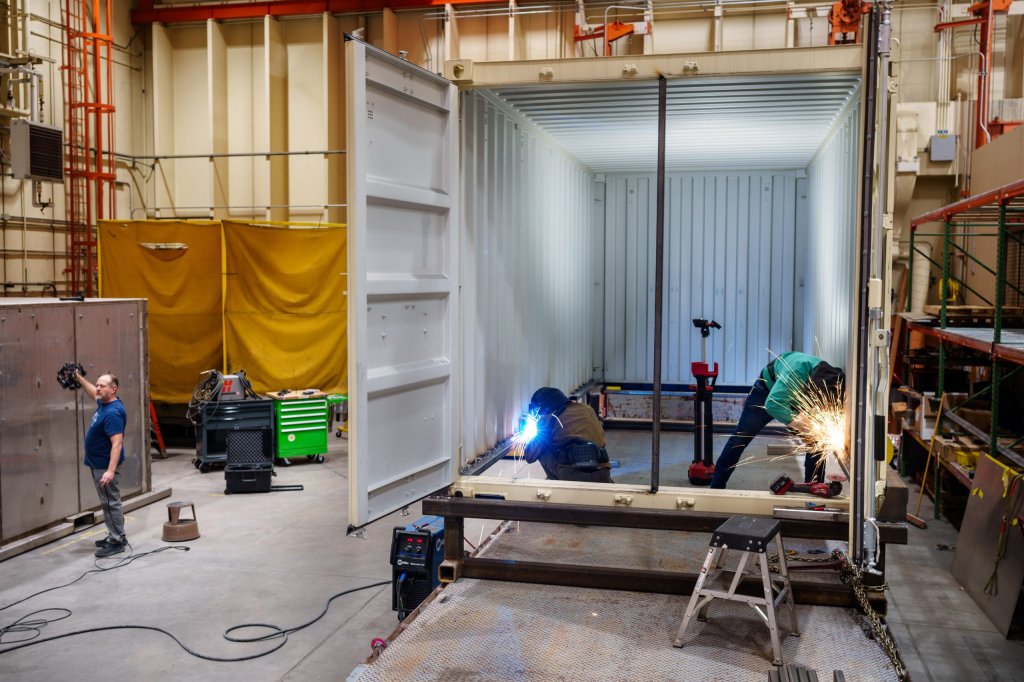
“To meet the compressed timeline, the team adopted a rapid design process that emphasized speed and creativity over rigid specifications. For example, instead of defining a fixed delay time in the project’s requirements, the team focused on maximizing performance within volume and weight constraints,” according to a press release from Sandia. “Within two weeks, the team had selected a final concept from 10 proposed designs.”
“To speed up fabrication of the full-scale prototype, the team used a model-based manufacturing approach. A mechanical engineer developed a 3D solid model, which enabled early procurement of long-lead items like the semi-custom vault door and structural materials before the design was finalized,” the release adds. “Meanwhile, an electrical engineer developed the vault’s access control, backup power, sensors and alarm systems. By combining additive manufacturing, reusable components and off-the-shelf development boards, they delivered a functional prototype in half the usual time.”

Accompanying pictures of a prototype Mobile Vault show it has two combination locks on its main door, but what other security features it might have are unclear. Sandia has also been responsible for the development of highly specialized tractor-trailer trucks for securely and discreetly moving nuclear weapons and other sensitive nuclear material. These trucks are understood to have a number of defensive features that sound like they are pulled straight from a James Bond movie. This includes dispensers along their interior walls that release sticky, adhesive-like foam to immobilize intruders, a set of explosive bolts to shear off the axles of the trailer to prevent thieves from towing it away, an additional emergency braking mechanism, and a means of filling the rear compartment with choking tear gas. You can read more about all of this here.

What specific operational requirements may have driven the development of the Mobile Vault are unknown, but Sandia’s release makes clear that this is about a need for a capability “that can be rapidly deployed to safeguard critical materials in remote or temporary locations.”
“Permanent bunkers and high-security facilities are standard tools for protecting the nation’s most sensitive assets,” it adds. “But in many environments, these options are not available where secure storage is needed most.”
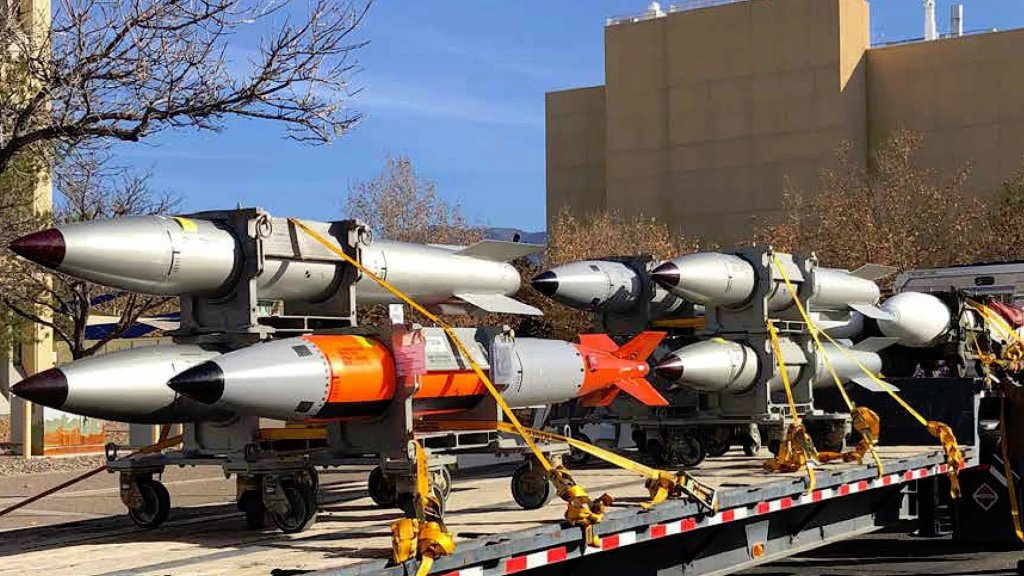
Nuclear weapons are not explicitly mentioned in the release. However, Sandia created a 1:14 scale model of the Mobile Vault to show off the design to potential users, which includes “miniature mock weapons” that are clearly B61-series nuclear gravity bombs.
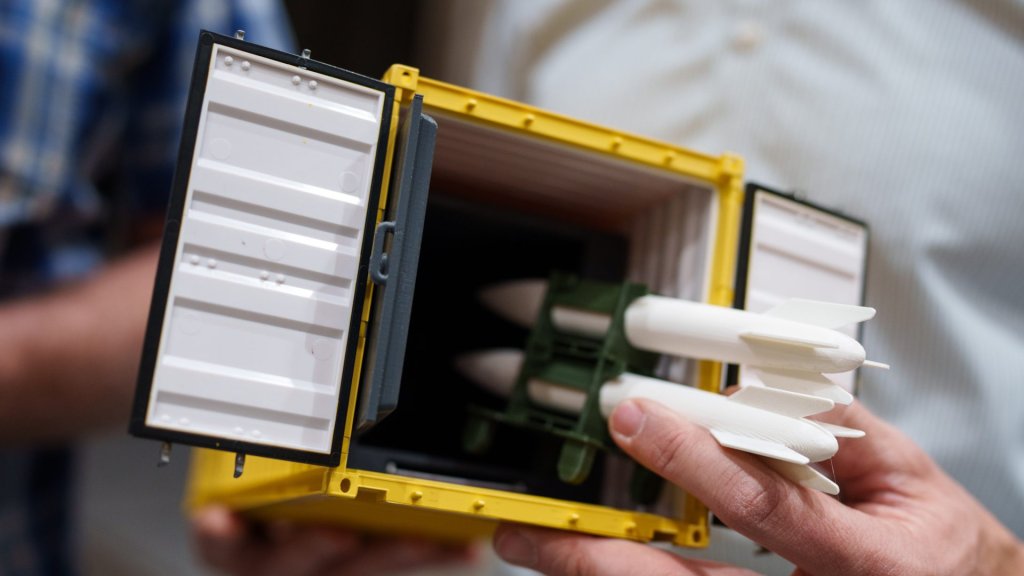
“I brought the model to every meeting during the six-month effort,” Stephen Neidigk, a Sandia manager involved in the project, said in an accompanying statement. “Now, 15 similar models are on the desks of leaders at U.S. Combatant Commands, the Pentagon, and U.S. Strategic Command.”
The B61 is America’s longest-serving family of nuclear bombs, and the first production example of a new variant, the B61-13, was just completed in May. The B61-13 is based on the preceding B61-12, but has a higher maximum yield, which U.S. officials say offers critical additional capacity to hold hardened targets, such as underground command and control facilities, and ones spread across physically larger areas, at risk.
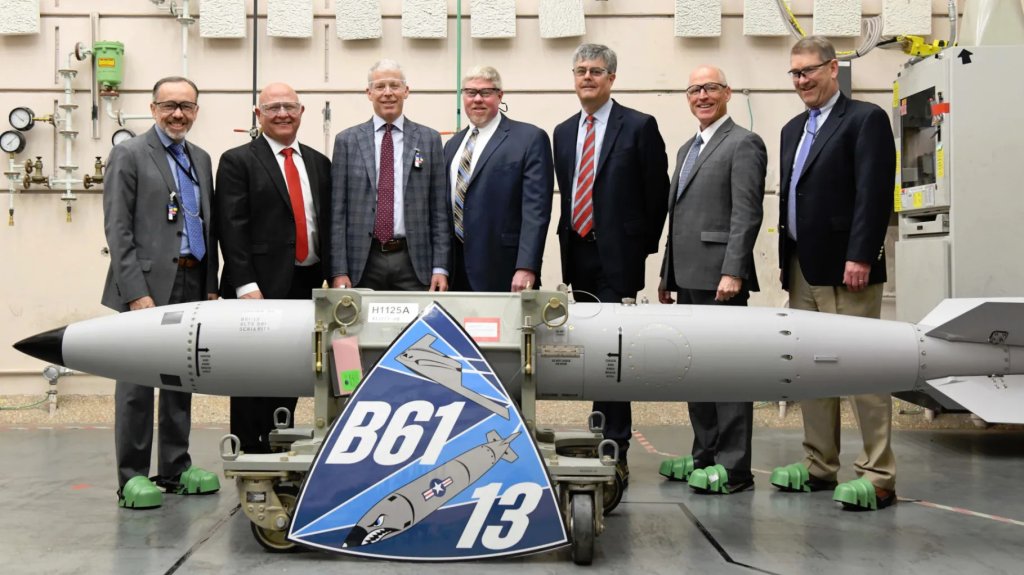
The B61-12 had already offered important improvements over earlier versions of the B61, most notably a precision guidance package inside a new tail kit. However, not all aircraft capable of dropping B61-12s, particularly ones belonging to America’s NATO allies, will be able to make sure of the new precision guidance capability, as you can read more about here.
The video below shows a B61-12 test.
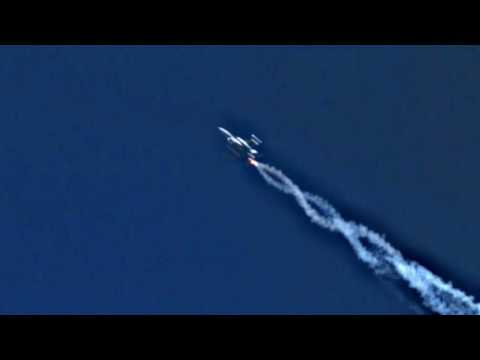
B61-12s are now at least part of the forward-deployed U.S. nuclear arsenal in Europe, which could be made available to select NATO members if authorized. Those bombs are stored inside secure fixed-site vaults at various air bases across the continent, now likely including RAF Lakenheath in the United Kingdom.
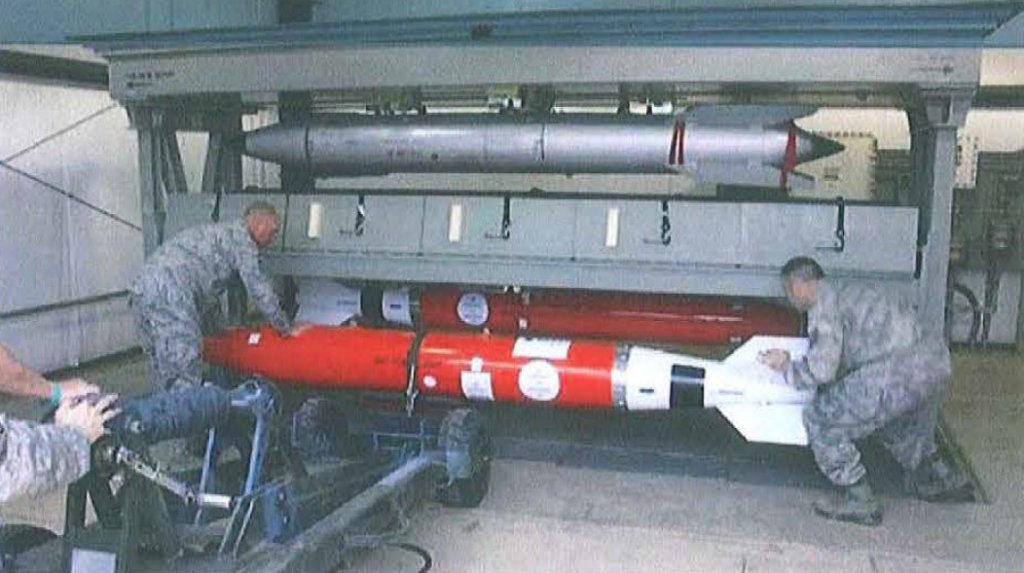
Containerized Mobile Vaults would give U.S. military commanders globally more flexibility to forward-deploy nuclear weapons, and any other highly sensitive assets, if required. This would also present complications for opponents trying to track or target those assets. In a future high-end fight, established bases that host nuclear weapons now would be top targets.
All of this aligns with the U.S. Air Force’s still-evolving Agile Combat Employment (ACE) concepts of operations. ACE is focused heavily on reducing vulnerability through rapid and/or irregular deployments to a disaggregated array of operating locations, including remote sites with limited infrastructure. The U.S. Marine Corps is also envisioning similar distributed deployments in future conflicts as a key element of its Expeditionary Advanced Base Operations (EABO) construct.
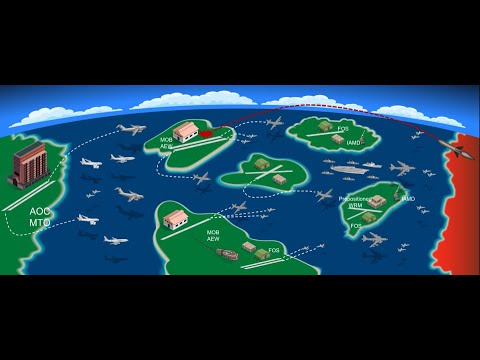
At the same time, the Mobile Vaults offer far less protection than traditional bunkers and other fixed-site storage facilities. Additional security measures would also draw attention to their sensitive contents despite their unassuming outward appearance. Altogether, a new operational playbook for forward-deploying nuclear weapons using these vaults would be required.
The Mobile Vaults could be used to help secure non-nuclear assets at forward locations, as well. Putting the vaults inside otherwise standard shipping containers would also just make them easier to move logistically using existing air, ground, and sea assets.
Sending prototype Mobile Vaults to Gray Flag 2025 will give Sandia and its military partners an opportunity to further explore how they might be used in an operational context. This also raises the possibility that nuclear weapons, or surrogates for them, will be featured in that exercise. As noted, Gray Flag events are typically used to showcase new and advanced weapons and other capabilities, including ones that are still in development. As such, sensitive conventional munitions and other non-nuclear assets warranting a highly secure vault could easily be present. As a prime example, the new AIM-174B air-launched version of the Standard Missile-6 (SM-6), which first emerged publicly last year and remains highly classified, was a prominent feature at Gray Flag 2024.
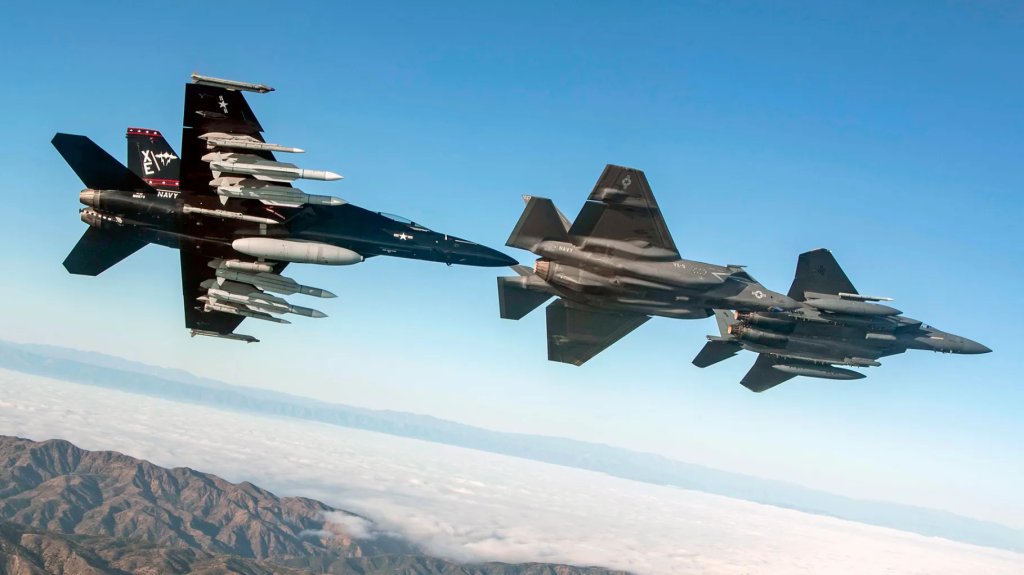
With this in mind, it is interesting to note that the Pentagon publicly issued new guidance around the potential employment of nuclear weapons late last year that put additional emphasis on the use of non-nuclear capabilities to support the nuclear mission.
Sandia’s press release about the Mobile Vaults says that “the team also plans to transition the technology to industry for broader production and use.”
In the meantime, Sandia is now working up to send Mobile Vaults to Gray Flag 2025, and more details about the project could emerge around that event.
Contact the author: joe@twz.com
Loading comments…
Comments couldn’t be loaded. Please refresh the page.