
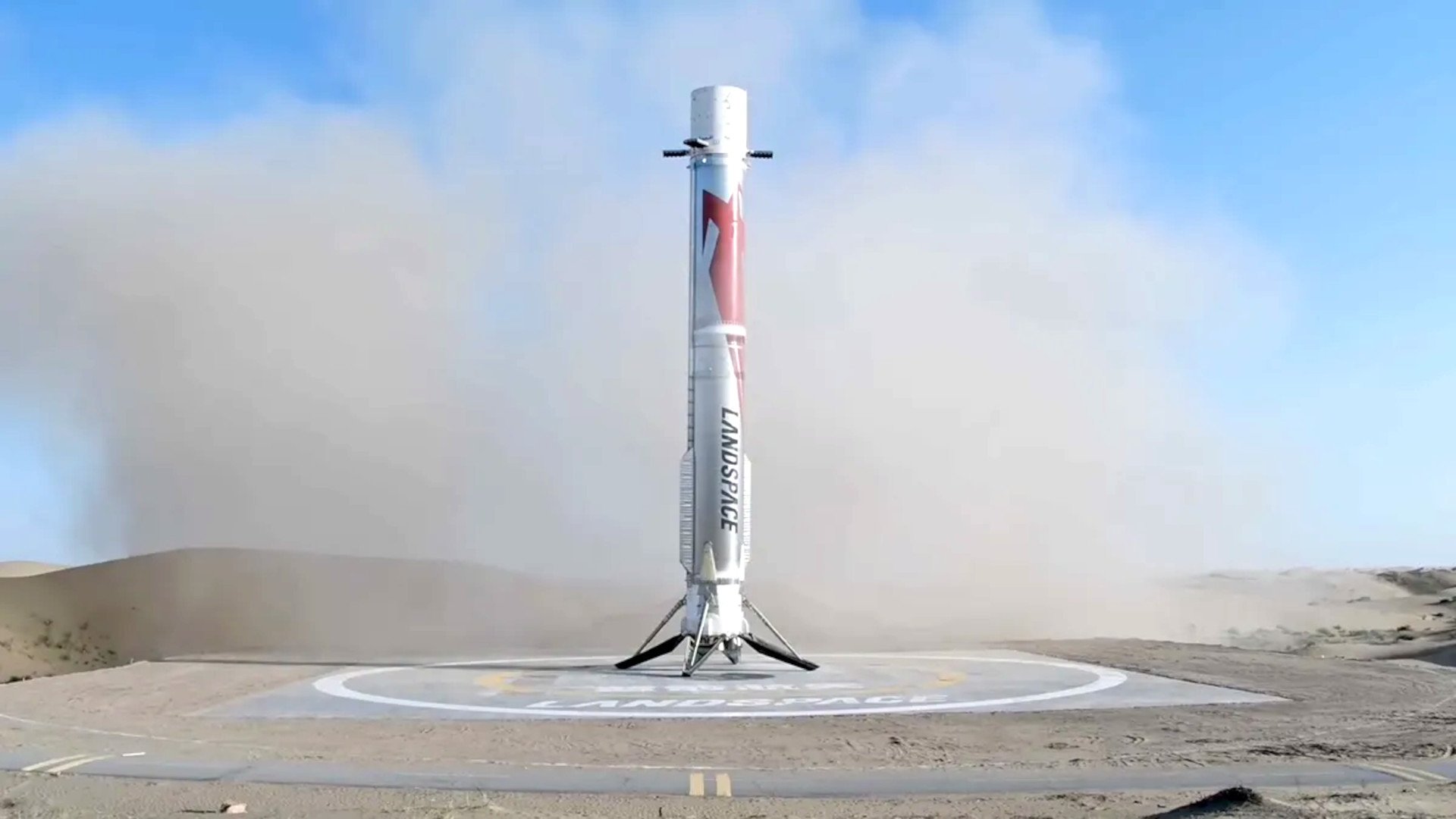
Earlier today, Chinese firm LandSpace achieved the country’s first successful recovery of a reusable space launch rocket booster on land. This follows China’s first-ever recovery of a reusable space launch rocket booster last month, which state-owned China Aerospace Science and Technology Corporation (CASC) conducted at sea using a specially configured ship. Reusable boosters can lower costs and increase the tempo of launches dramatically, which would be extremely beneficial for China’s already massively expanding military and national security space enterprise. It could also go a long way to closing the gap on commercial launch costs with the U.S.
“On August 19, 2026, at 07:35 (UTC+8), the ZhuQue-3 (ZQ-3) Y2 reusable launch vehicle lifted off from the Dongfeng Commercial Space Innovation Pilot Zone. Approximately 137 seconds after lift-off, the first and second stages separated. The second stage continued its flight and successfully delivered the Honghu 03 satellite, independently developed by Hongqing Technology, into its designated orbit,” according to a post from LandSpace’s official account on X. “At approximately 07:41, the first stage performed a successful soft touchdown at the LandSpace Landing Site#1 in Minqin County, Gansu Province, following the planned trajectory – marking the full success of the flight test mission.”

“This mission marks China’s first-ever successful recovery attempt of the first stage of an orbital-class launch vehicle using landing legs, and China’s first successful booster recovery on land,” the company wrote in another post on X. “It is a pivotal flight test for ZhuQue-3 as it transitions from the technological demonstration and verification phase toward the engineering application phase of reusability. This mission further verified the design correctness and reliability of the ZhuQue-3 reusable launch vehicle system, validated its first-stage recovery capability and engineering maturity.”
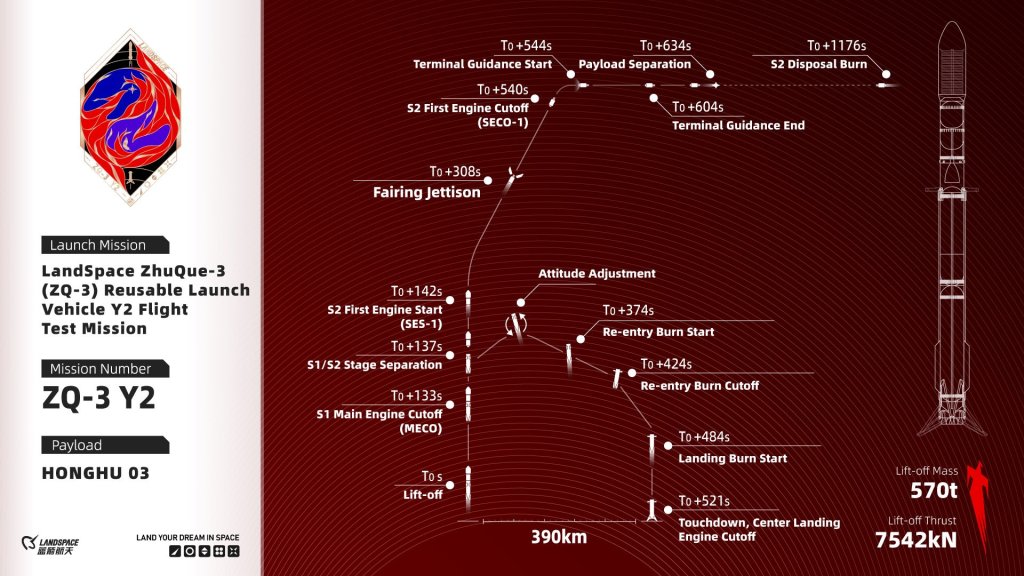
This is only the second-ever launch involving the two-stage ZQ-3. The first launch came last December, and the upper stage successfully reached low Earth orbit (LEO). However, the attempted recovery of the first stage booster failed and it exploded on the pad. “Abnormal combustion occurred during the process, preventing a soft landing on the recovery site,” according to a machine translation of a subsequent report from Chinese state-run media outlet Xinhua.
A complete ZQ-3 space launch rocket is around 216.5 feet (66 meters) long and close to 15 feet in diameter (4.5 meters). It can reportedly loft up to 14.2 metric tons of payload into LEO.
The design of the reusable ZQ-3 booster, including its fold-out landing legs at the base and stabilizing fins at the top, is very reminiscent of U.S. firm SpaceX’s Falcon 9. The ZQ-3 and Falcon 9 (229.6 feet/70 meters tall, 12 feet/3.7 meters diameter) are also similar in overall size, but the latter has a higher stated payload rating (maximum 22.8 metric tons to LEO). SpaceX pioneered reusable space-launch booster technology. The company is currently the top space launch provider globally, by far, with the U.S. government, and more specifically the U.S. military, being its chief customer.
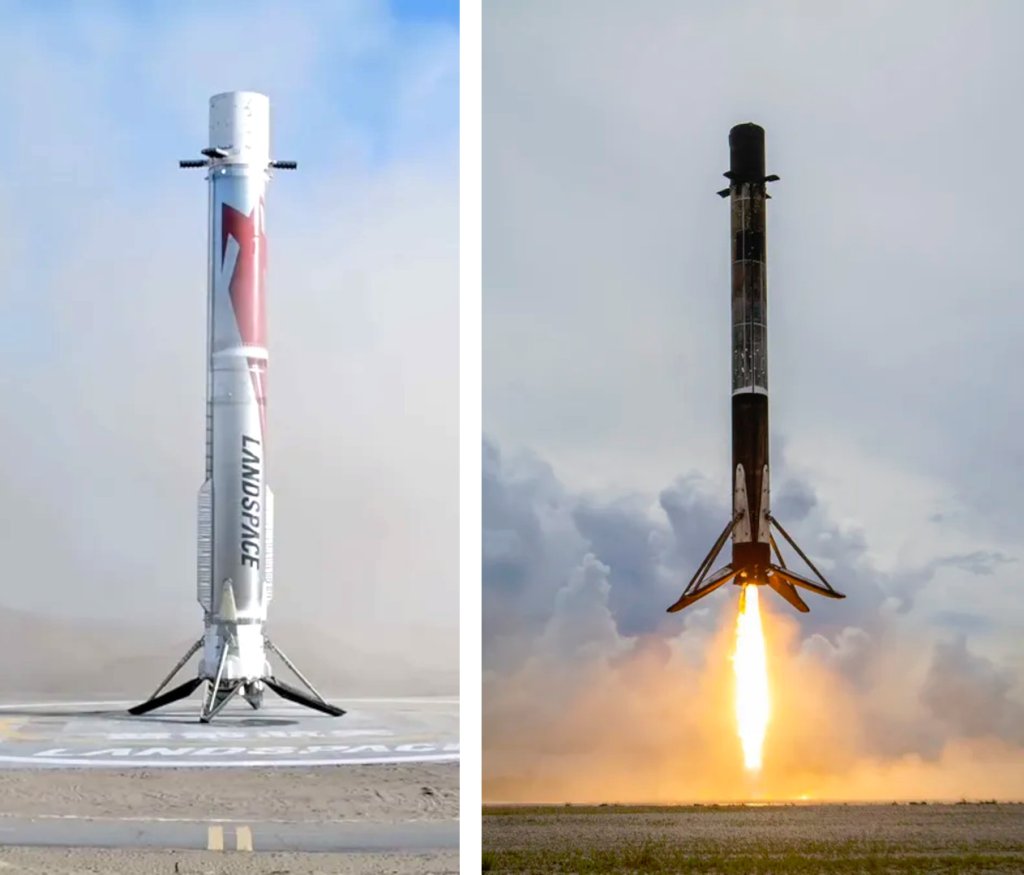
LandSpace has not shied away from comparisons to the Falcon 9, and has reportedly said the primarily stainless steel construction of the ZQ-3 makes it cheaper to produce than its American competitor. It is also worth noting here that other companies in the United States, like Blue Origin, and elsewhere globally are pressing to enter the market place, as well.
The ZQ-3 also notably uses liquid methane as its main propellant. “A methane-liquid oxygen propellant mix offers advantages in performance and reduces issues of soot formation and coking for purposes of reusability,” according to a 2023 story from SpaceNews.
LandSpace has already claimed the title as the first anywhere in the world to get a liquid methane-fueled rocket into space and then into orbit with its earlier two-stage Zhuque-2 (ZQ-2) design. To date, the company has conducted eight ZQ-2 launches, six of which have been successful. The company’s original design was the three-stage ZQ-1, which it attempted to launch just once, without success, in 2018.

As noted, LandSpace’s achievement today follows CASC’s successful recovery of the reusable booster from a two-stage Long March 10B space launch rocket in July. The state-run aerospace firm used a net-like device installed on a ship to ‘catch’ the booster as it returned to Earth. This method of recovery means that the Long March 10B booster does not have, or necessarily need, landing legs, though it does have fins for stabilization at the top.

The Long March 10B is part of a family of space launch rockets with multiple stage and booster configurations. The first-ever launch of a Long March 10-series rocket, a 10A variant, only came in February. In that instance, the booster did return to Earth vertically, but set down in the sea rather than being recovered. CASC is also currently developing reusable versions of its Long March 12 design.
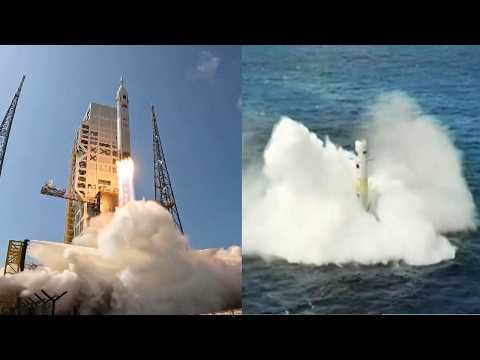
LandSpace’s ostensible focus is on commercial launch opportunities. CASC’s Long March 10 family is generally discussed in the context of China’s nominally civilian space program, including flights to the Tiangong space station and plans for a crewed mission to the lunar surface.
At the same time, it is hard not to see this continued push toward new reusable space launch capabilities having huge impacts on Chinese military and other national security activities outside the Earth’s atmosphere. A mature, reliable reusable space launch capability would drastically accelerate China’s access to space across the board while also lowering costs. This is especially vital for the deployment of new large distributed constellations.
This would also increase China’s ability to compete on price in the commercial space launch market globally. As noted, the United States currently enjoys a decided competitive advantage in this arena worldwide, thanks largely to SpaceX and its reusable launch options. The benefits of securing a greater share of this market could easily feed back into Chinese national security applications by helping further spread cost burdens and fueling accelerating development of this class of space launch systems.
In the meantime, the Chinese government has already been expanding its space-based intelligence gathering and other capabilities at a breakneck pace using non-reusable launch options.
“I think the ongoing greatest challenge is just the speed at which China is moving to rapidly improve their space capabilities and the breadth that that potentially poses,” U.S. Space Force Gen. Stephen Whiting, head of U.S. Space Command, said at the annual Space & Missile Defense (SMD) Symposium last week, at which TWZ was in attendance. “China is moving breathtakingly fast.”
Whiting was responding to a question about what he felt were the greatest challenges facing his command over the next year to 18 months.

What “[China’s] President Xi [Jinping] has decided to do is build the second-best remote sensing architecture in the world from outer space, and that’s now what they have,” Lt. Gen. Gregory Gagnon, head of the Space Force’s Combat Forces Command (CFC), also told TWZ and others at a roundtable at the Air & Space Forces Association’s (AFA) Warfare Symposium in February. “So when 2013 started, and he came to power, he had less than 100 satellites that were the total of what China had in outer space. They have about 1,900 today.”
“Over 500 of those satellites are remote sensing satellites, which are purposely designed and networked to track mobile forces such as U.S. carriers, destroyers, and cruisers in the Pacific, as well as aircraft that deploy around the Pacific. Those have been built with a purpose. The purpose is to cue their long-range fire weapons,” he added.
The U.S. military is now openly calling for new anti-satellite weapons to challenge China’s growing presence in orbit, further underscoring the scale of these developments.
With the new milestones just in the past two months, Chinese aerospace firms now look to be moving very fast in the realm of reusable space launch boosters, which only further fuel its many ambitions in orbit and beyond.
Contact the author: joe@twz.com
Loading comments…
Comments couldn’t be loaded. Please refresh the page.