
On a hazy, humid Sunday morning, just before 9:30 a.m. local time, the USS Theodore Roosevelt sailed out of San Diego Bay for a much-anticipated but little-advertised deployment. The Nimitz class flagship of Carrier Strike Group 9 (CSG-9), nicknamed “The Big Stick,” departed on September 27 and is expected to head to the Middle East to relieve one of the two carriers on station supporting operations against Iran, according to USNI News. As is common with deployments from the West Coast, the departure was not announced by the Navy publicly, although there were several unconfirmed claims on social media that highlighted the impending cruise.
The three-ship Makin Island Amphibious Ready Group (ARG), packed with thousands of Marines who specialize in expeditionary operations, followed Roosevelt’s path out of the harbor the next day. While the Makin Island ARGs ultimate destination is unclear, the Boxer ARG, currently operating in the Middle East, left the United States on March 18 and is due for relief.
Here’s TWZ’s weekly carrier tracker monitoring America’s flattop fleet, including deployed CSGs and ARGs, using publicly available open-source information. Check out last week’s report here.
Theodore Roosevelt Carrier Strike Group Deploys, Reportedly Bound For The Middle East
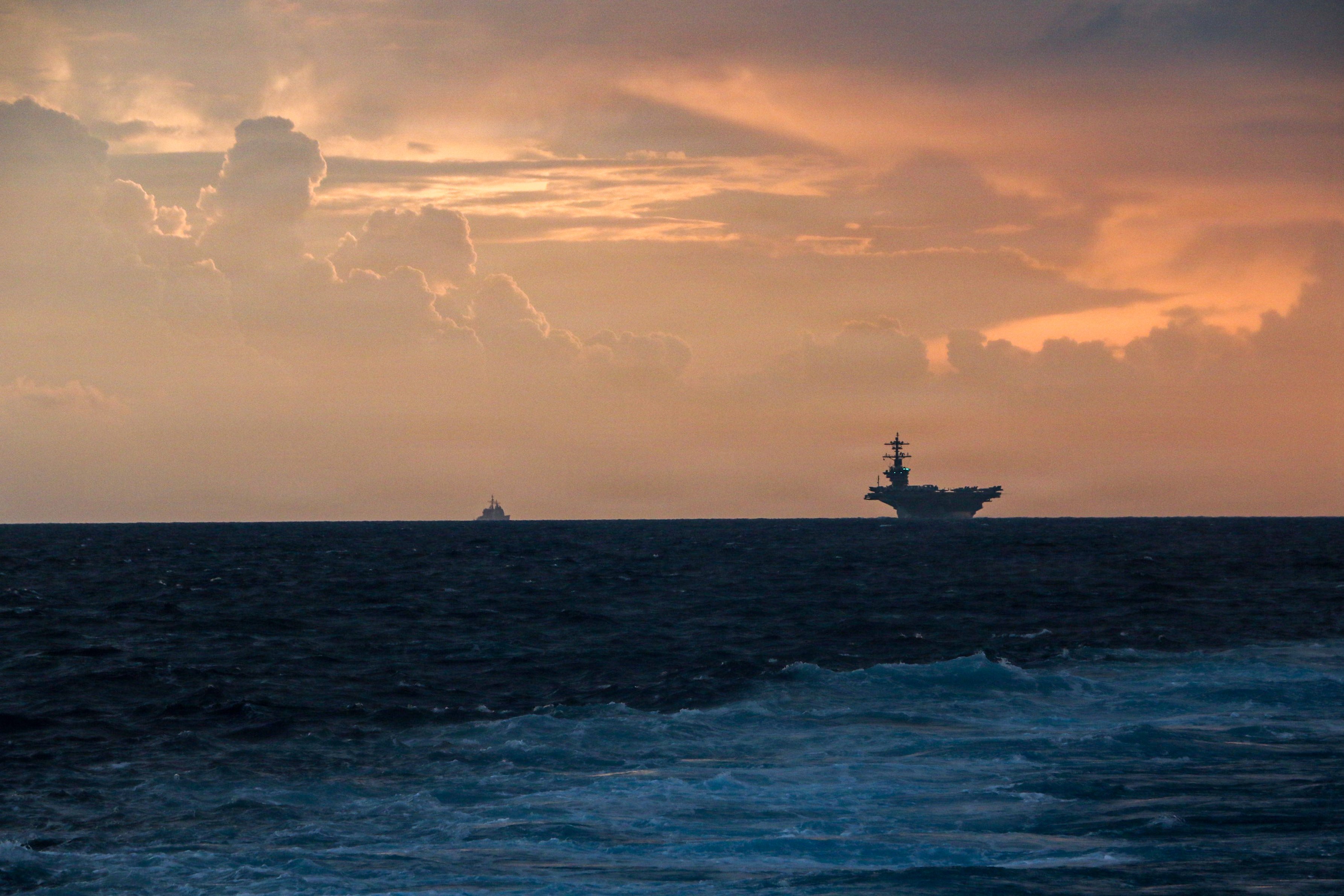
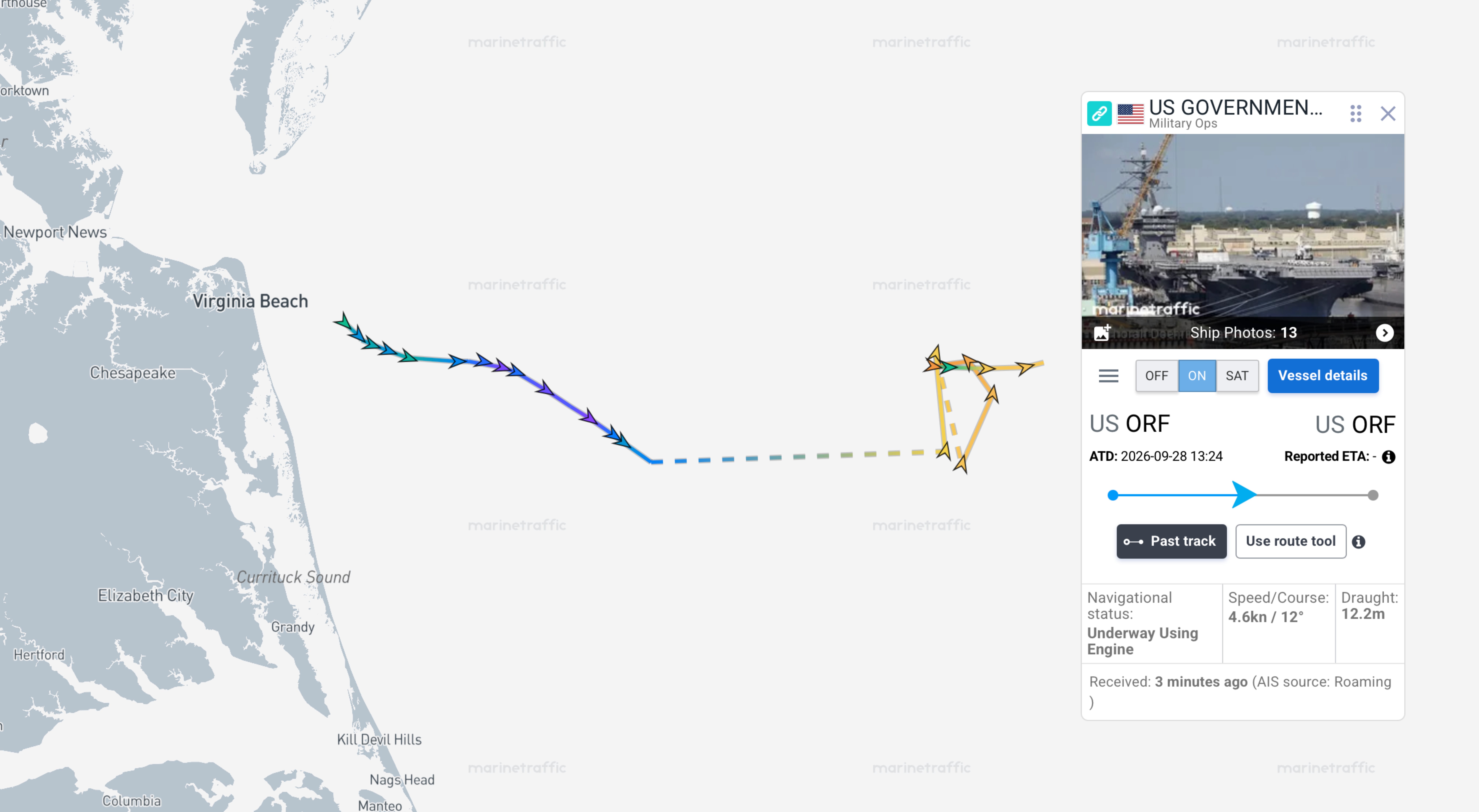
USS Theodore Roosevelt keyed her Automatic Identification System (AIS) transponder on at 9:10 a.m. Pacific Daylight Time on September 27, broadcasting her precise position publicly via MarineTraffic, and got underway less than 20 minutes later with the help of a few tugs. The supercarrier steamed past Point Loma at seven knots before sailing west and picking up speed, topping 24 knots, then made a hard turn south and stopped transmitting on AIS roughly three hours after departing. She briefly flipped AIS back on again, 55 nautical miles southwest of her previous location, but has been dark since.
Three guided-missile destroyers, USS Paul Hamilton, USS Decatur, and USS Carl M. Levin, are part of CSG-9 and will escort the flattop, TWZ has learned. Rounding out the five-ship CSG is Ticonderoga class guided-missile cruiser USS Chosin, which will serve as the Integrated Air and Missile Defense (IAMD) commander for the CSG. The IAMD warfare commander is responsible for coordinating air defense for the entire strike group − a vital role since Roosevelt will be entering an active combat zone. Tico cruisers have 122 Vertical Launch System (VLS) cells, more than the 90 to 96 that Arleigh Burke destroyers are equipped with, and are being retired without a comparable cruiser lined up to replace the aging fleet; however, the newest Flight III Burke destroyers will take on the air warfare commander role.
The carrier has embarked, or is in the process of taking on, Carrier Air Wing (CVW) 11 off the West Coast before beginning the long journey toward the Western Pacific. CVW 11 includes a squadron of stealthy fifth-generation F-35C Lightning IIs, in addition to three squadrons of F/A-18E/F Super Hornets and one of EA-18G Growlers. Support squadrons of E-2D Hawkeyes, MH-60R Seahawks, and MH-60S Seahawks are also aboard, as well as a detachment of CMV-22B Ospreys.
USNI News was the first outlet to confirm the deployment and suggests the CSG is headed to the Middle East. “The Theodore Roosevelt Carrier Strike Group is expected to move to U.S. Central Command to relieve the Japan-based USS George Washington (CVN-73),” they wrote in a report published on Monday.
In response to a request to confirm the deployment, a Navy official told TWZ, “The Theodore Roosevelt Carrier Strike Group is underway conducting routine operations in the U.S. 3rd Fleet area of operations. U.S. 3rd Fleet leads naval forces in the region and provides the realistic, relevant training necessary to execute our Navy’s role across the full spectrum of military operations – from combat operations to humanitarian assistance and disaster response. U.S. 3rd Fleet works together with allies and partners to advance freedom of navigation and overflight, the rule of law, and other principles that underpin security for the region.”
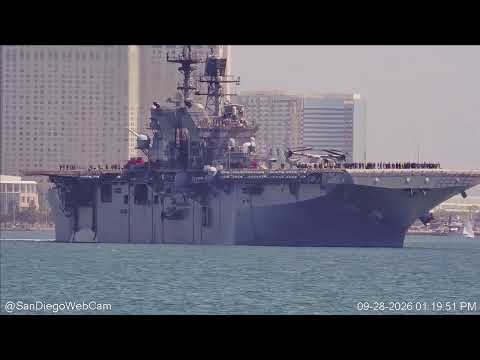
The underway was live-streamed on San Diego Web Cam, which had a few hundred viewers at the peak. TWZ was monitoring the feed at the time after rumors surfaced that a departure was imminent. Notably, Sailors were not spotted manning the rails, which is usually an easy tell that a warship is deploying rather than training. However, several public posts on social media by individual Sailors, as well as their friends and family, pointed to the ship heading on its long-awaited cruise.

Roosevelt has been preparing for the cruise for the better part of a year. The CSG last deployed from January 11 to October 15, 2024, to the U.S. 5th and 7th Fleet areas of responsibility (AOR) in support of Operation Prosperity Guardian. After arriving back home nearly two years ago, the carrier underwent an eight-month Planned Incremental Availability (PIA). Following the PIA, she completed flight deck certification and carrier qualifications from July 23 to July 29, 2025. In 2026, the carrier conducted Composite Unit Training Exercise (COMPTUEX) from April 14 to May 15, and then steamed to Hawaii for the large-scale, biennial Rim of the Pacific (RIMPAC) exercise from June 24 to July 28. Most recently, Roosevelt completed a brief pierside availability prior to deploying, as TWZ first reported.
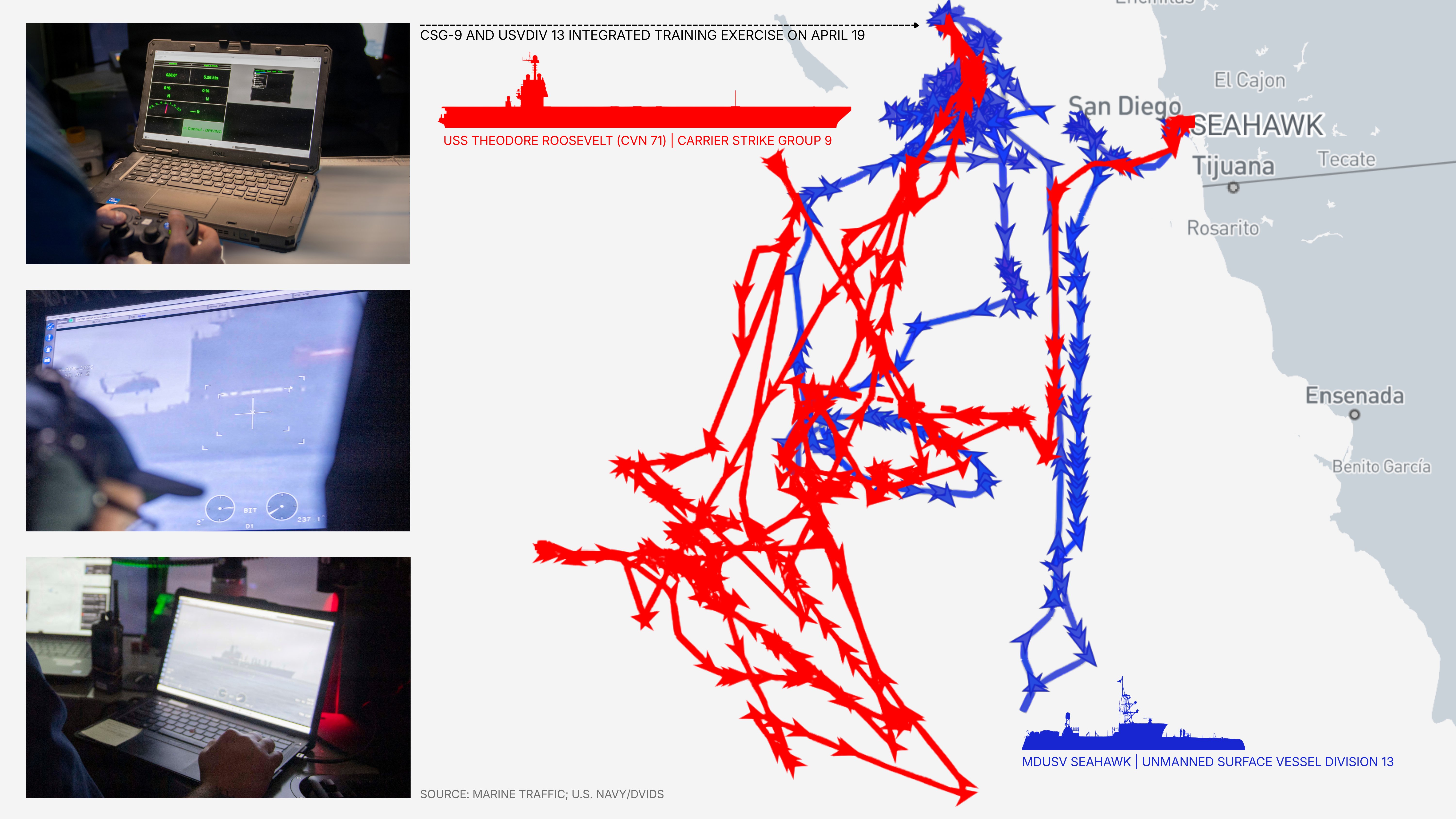
In February, Vice Adm. Brendan McLane told reporters at WEST 2026 that a medium unmanned surface vessel (MUSV) would deploy with the strike group for the first time. During COMPTUEX and RIMPAC, the Roosevelt CSG drilled alongside Leidos’ MUSV Seahawk, which TWZ was the first to report. We asked the Navy to confirm whether an MUSV would accompany the group, but have not received a response. As of publication, Seahawk was still pierside in San Diego, and it’s unclear if the drone boat will operate with the CSG or remain in San Diego.
Makin Island Amphibious Ready Group Also Deploys, Destination Unknown
The three-ship Makin Island ARG, with the 13th Marine Expeditionary Unit (MEU) embarked, got underway for a deployment on September 28, a Navy official also confirmed to USNI News. In addition to the flagship Wasp class amphibious assault ship (LHD), USS Makin Island, two San Antonio class amphibious transport dock ships (LPD), USS John P. Murtha and USS Anchorage, left on the same day and round out the expeditionary group.
No destination has been formally announced. However, there is an obvious candidate for relief: the Boxer ARG. Currently on station in the U.S. Central Command (CENTCOM) AOR supporting blockade and interdiction operations in the Arabian Sea and Indian Ocean, the group has been deployed since mid-March. The amphibious fleet is notorious for experiencing maintenance issues, and these ships have been pushed hard without a port call in months. Amphibious ships move slower than carriers, and if CENTCOM turns out to be the final destination, the Makin Island ARG would have to hustle to arrive before November.
Makin Island embarks short takeoff and vertical landing (STOVL) F-35B Lightning IIs, assigned to the “Wake Island Avengers” of Marine Fighter Attack Squadron (VMFA) 211, and MV-22B Ospreys with Marine Medium Tiltrotor Squadron (VMM) 364 (Reinforced). The Bravos recently conducted a simulated airstrike off the coast of California.
Abraham Lincoln Days Away From Well-Deserved Homecoming
Acting Secretary of the Navy Hung Cao flew out to the flight deck of USS Abraham Lincoln as she was sailing eastbound in the Hawaiian Islands operating area, en route to her homeport in San Diego. “Today, our warfighters aboard USS Abraham Lincoln demonstrated the overwhelming capacity and capability that they brought to bear on our adversaries for the last 10 months,” he wrote in a post on Sunday.
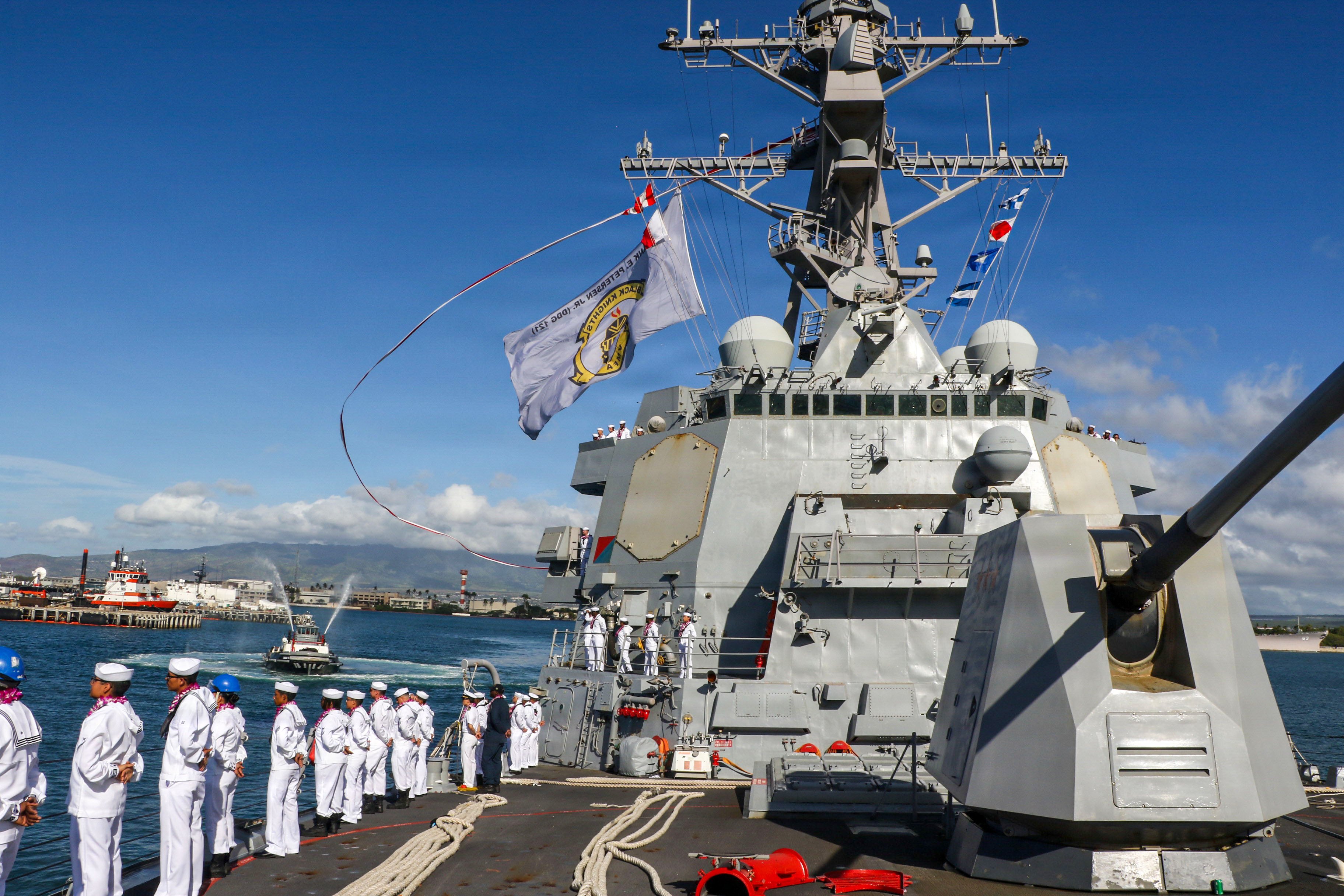
USS Frank E. Petersen Jr., a destroyer that escorted Lincoln throughout the 10-month deployment, peeled off and moored at Joint Base Pearl Harbor-Hickam on Monday. “Over the course of 300 days, Frank E. Petersen Jr.’s crew conducted 45 replenishments-at-sea, sailed over 85,000 nautical miles, safely transferred over 7,544,486 gallons of F-76 fuel and 175,288 gallons of JP-5 fuel, and completed 1,094 hours of flight quarters,” according to a press release. The statement also confirmed that the warship served as IAMD commander for the group. The destroyer defended against more than 100 missile and drone attacks, Stars and Stripes recently reported.
Petersen Jr. and USS Michael Murphy became the first U.S. warships to transit the Strait of Hormuz since the war began when they entered the Persian Gulf in April in support of mine-clearance efforts.
Lincoln is now 314 days into her deployment and less than two weeks shy of surpassing the 326-day record USS Gerald R. Ford set in May. Approximately 2,000 nautical miles separate Hawaii from Naval Air Station North Island, but assuming a straight shot, it does not appear Lincoln will break the record.
Growler Mishap On Dwight D. Eisenhower
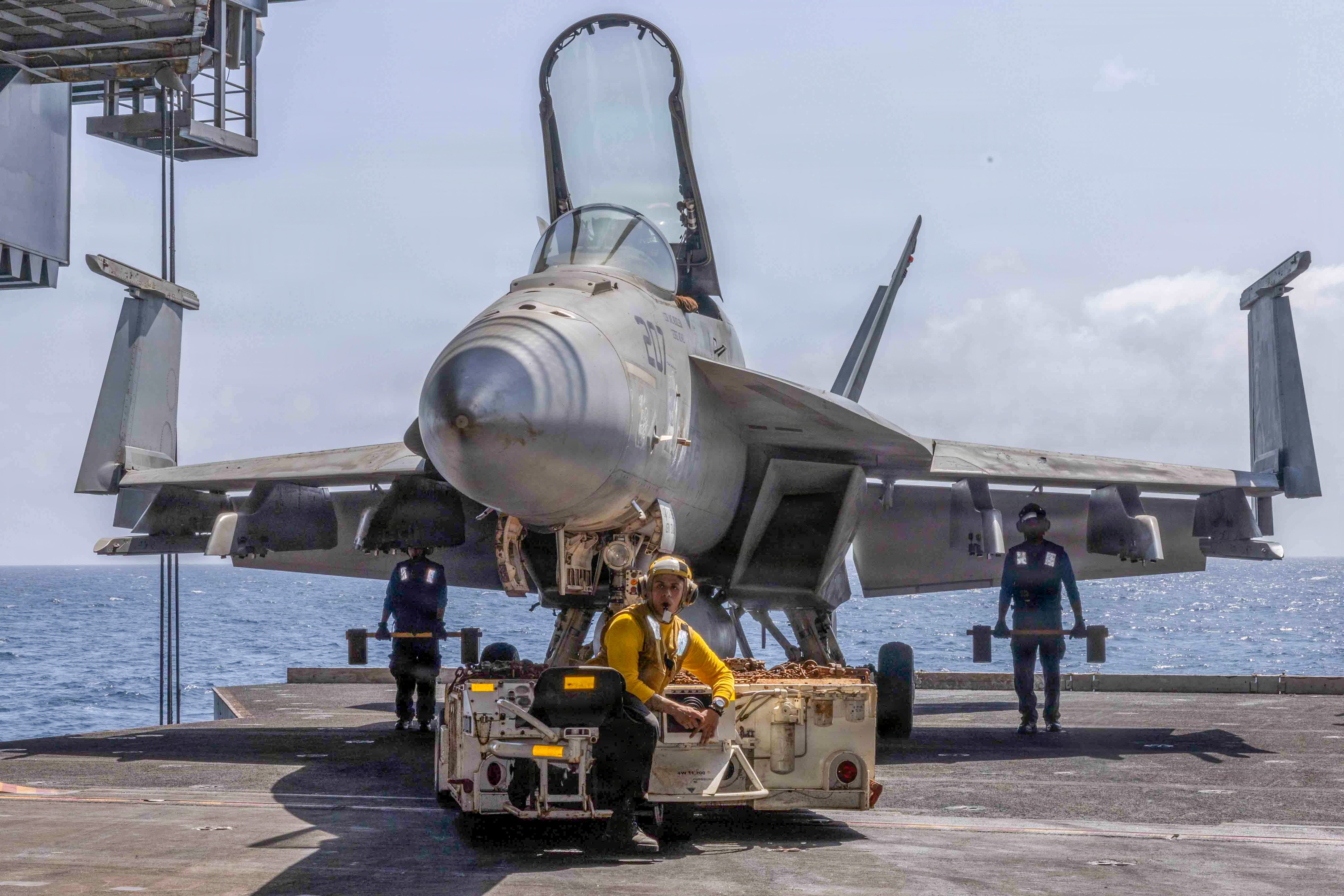
Two crew members from an EA-18G Growler embarked on the aircraft carrier USS Dwight D. Eisenhower (Ike) were rescued after ejecting due to an arresting gear failure, the Navy announced in a statement. The incident took place on Monday around 6:18 p.m. Eastern Daylight Time as the vessel was underway off the coast of Virginia.
The aviators, assigned to the “Zappers” of Electronic Attack Squadron (VAQ) 130 and attached to CVW 3, “safely returned to the ship and are being evaluated by medical personnel,” according to the release. The “Dusty Dogs” of Helicopter Sea Combat Squadron (HSC) 7 recovered the crew using MH-60S Seahawk helos.
Four shipboard personnel “were also injured during the mishap and are receiving medical care,” the Navy said. “One Sailor is being transported to a Norfolk-area hospital for treatment of non-life-threatening injuries,” according to the original statement. In total, eight sailors were evaluated by the ship’s medical team.
The cause of the accident is still under investigation, and it’s unclear whether the aircraft was lost or if there was any damage to the carrier. TWZ has reached out to the Navy to find out more details.

Eisenhower wrapped an extended 15-month PIA earlier this year in April. The flattop had been pierside at Naval Station Norfolk since September 2 after being at sea for 12 days completing Fleet Replacement Squadron and Training Command Carrier Qualifications (CQ) in the Virginia Capes and Jacksonville operating areas. She got underway again on the afternoon of September 28, based on public AIS data, for Tailored Ship’s Training Availability, Final Evaluation Problem, and CQ, one of the final steps before onloading ammunition for COMPTUEX, where the full strike group certifies for deployment.
Ike is working up in preparation for a future deployment scheduled for the first half of 2027, TWZ previously reported.
Reports Surface That George H.W. Bush Is Headed To Thailand For A Port Call
Multiple news outlets in Thailand reported Tuesday that USS George H.W. Bush and destroyer USS Delbert D. Black, which have both been in the Middle East in support of operations against Iran, will make a port call in Phuket in early October. If such a transit occurs, this would leave one carrier, the USS George Washington, on station in the U.S. 5th Fleet AOR for the first time since April. The Navy has not formally made an announcement, and TWZ has not verified the accounts.
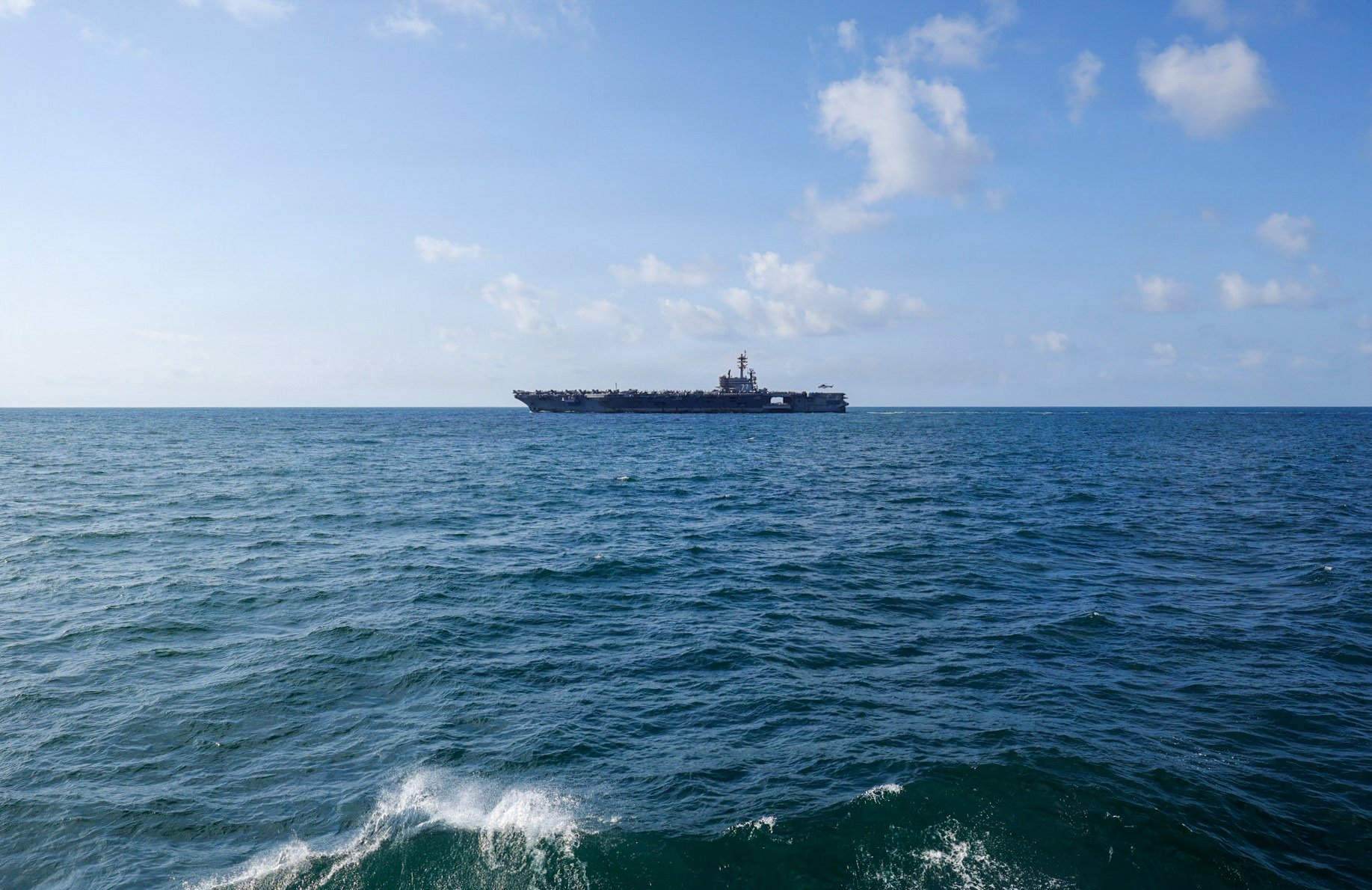
The reports are based on a meeting that representatives of the U.S. Embassy in Thailand allegedly held with the Patong police to discuss security protocols during the stop. “The visit has prompted coordination between Thai authorities and US officials over security, public order, and the movement of visiting military personnel during shore leave,” Phuket News wrote. According to the article, Patong police met with two deputy assistant defense attachés, Lou Pham and Robert Robinson, to discuss the visit. U.S. personnel were advised to comply with Thai laws during their stay, a specific request that may have been triggered by the recent visit of Lincoln.
There are conflicting accounts of when Bush would arrive in Phuket’s deep-sea port, but the visit will likely last five or six days, which is similar to Lincoln’s recent port call in the Southeast Asian country. If the timeline holds, it means Bush is likely already en route from her station in the Arabian Sea, where the CSG was most recently operating as of September 25, according to DVIDS. The Bangkok Post and Thai Examiner also reported the upcoming visit.
Notably, the reports do not mention any of the other warships that have been part of the Bush CSG in the past, including USS Donald Cook, USS Ross, USS Mason, or USS Princeton. The composition of the Bush CSG has shifted throughout the cruise.
Big Deck Fleet At A Glance
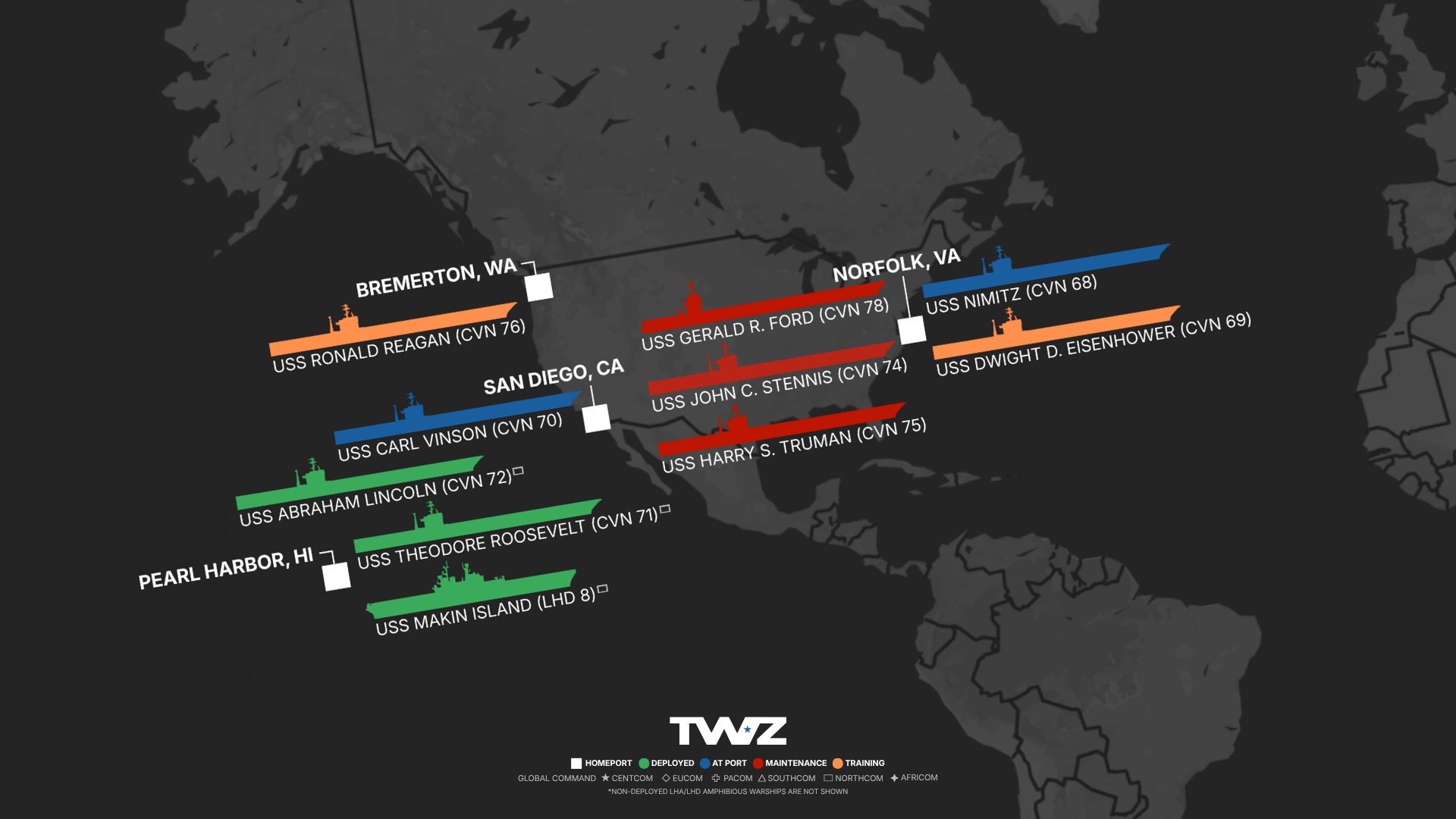
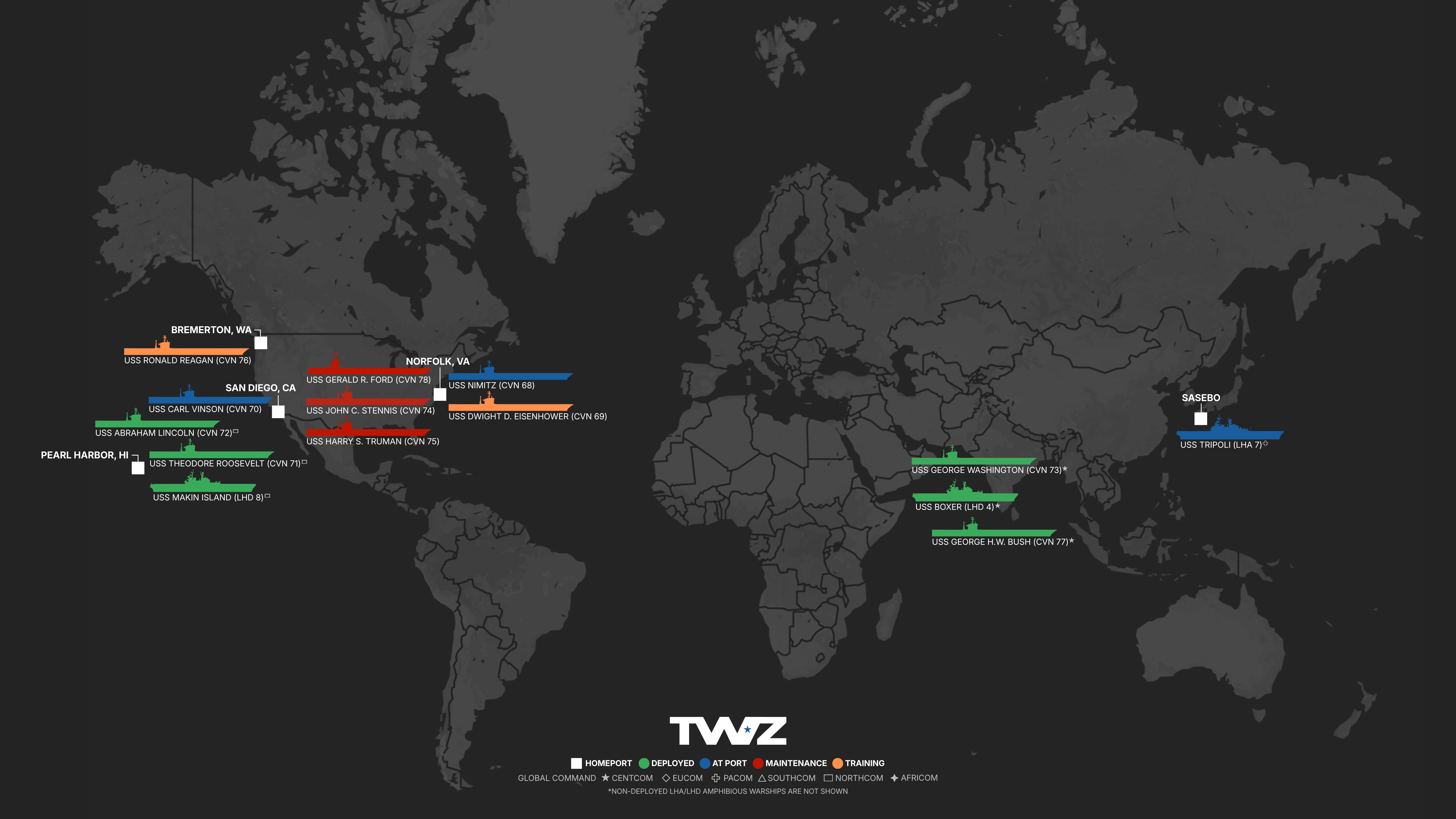
Overall, four U.S. carriers are deployed (with one heading home), three are working up in various states of readiness, three are in current or upcoming maintenance, one is being used primarily for training before deactivation next year, and the future USS John F. Kennedy, the second Ford class carrier, has received preliminary acceptance ahead of delivery in spring 2027. Two amphibious ready groups are deployed, one is forward-deployed, three are working up or in port, and three are in maintenance.
Note: Positions are general approximations. Non-deployed LHA/LHD amphibious warships are not shown.
Contact the author: ian@twz.com or @ianellisjones
Loading comments…
Comments couldn’t be loaded. Please refresh the page.