
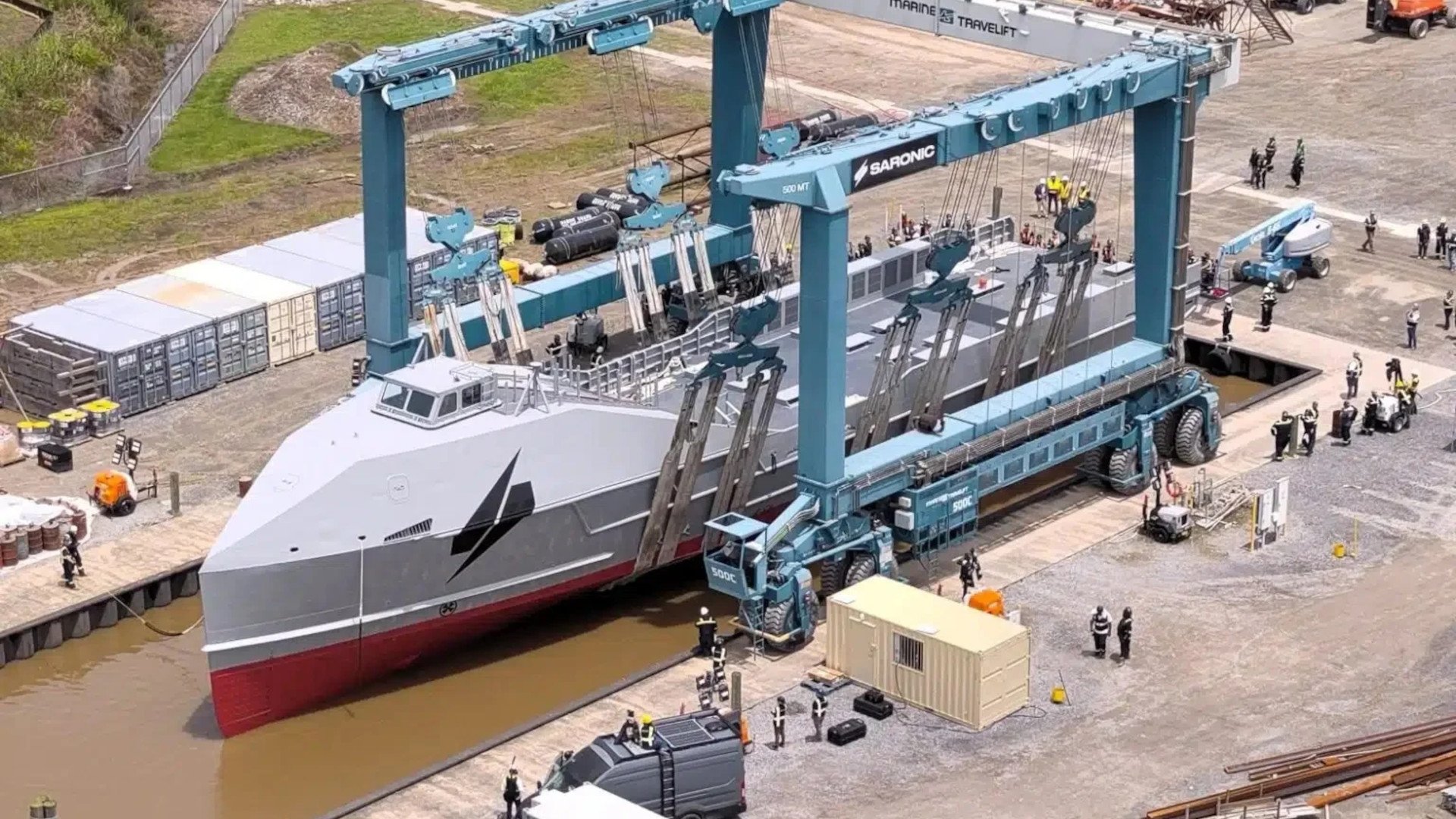
The Navy has announced plans to buy 30 new drone boats, 10 from each of three companies, under its Medium Unmanned Surface Vessel (MUSV) program. The deals are an important step forward for the Navy’s latest attempt to field larger USVs after years of setbacks and shakeups, but it remains to be seen when these new capabilities might actually become operational.
Galliano Marine Services, Huntington Ingalls Industries (HII), and Saronic Technologies each received so-called Other Transaction Authority (OTA) agreements in relation to the MUSV program today. OTA is a contracting mechanism designed to support rapid prototyping and other research and development work without having to use more traditional and often lengthy processes.
The awards “mark a significant step forward in translating the strategic vision into a tangible fleet capability,” Chris Miller, the Navy’s Acting Direct Reporting Portfolio Manager for Robotic and Autonomous Systems (DRPM RAS), told TWZ and others at a media roundtable earlier today. “Each agreement is for the procurement of 10 MUSV at an average procurement cost of $40 million per vessel.”
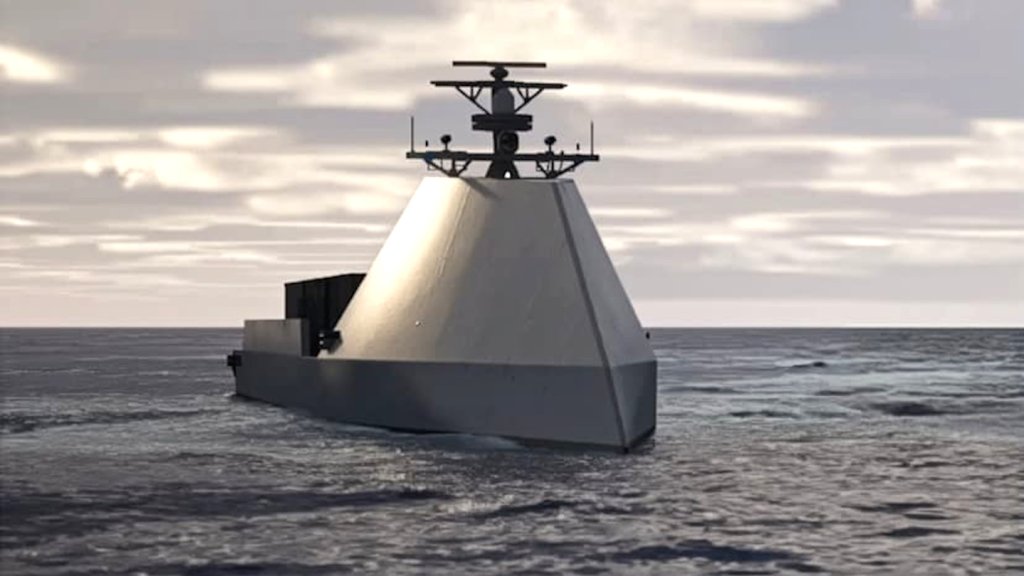
Saronic and HII submitted their Marauder and Romulus designs, respectively, to the MUSV Phase I competition. Galliano Marine Services, which does business as Edison Chouest, does not appear to have announced its entrant publicly. At a unit cost of $40 million, the total price tag for 30 MUSVs, regardless of type, would be $1.2 billion.
“Production will begin immediately at shipyards in Loreauville, Houma, and Franklin, Louisiana, with deliveries starting as early as the fourth quarter of [Fiscal Year] 2027,” Miller added.
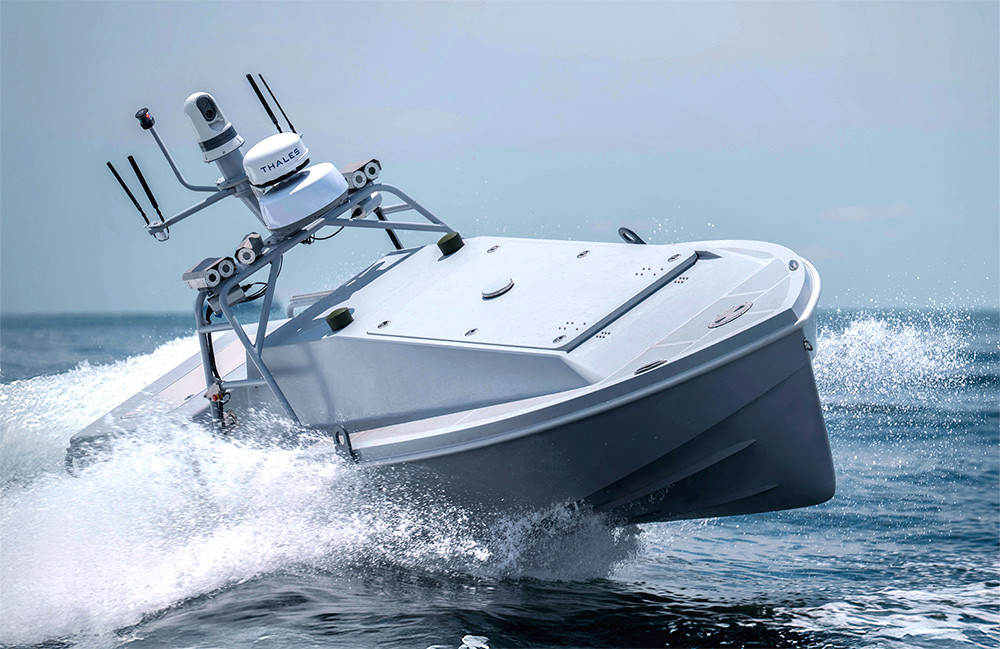
To take a step back quickly, the Navy has used a variety of definitions for what qualifies as a “medium” USV over the years. It’s also important to note that the Navy already fields several speedboat and jet ski-type USVs operationally that are capable of performing various different missions, including employment as one-way attack munitions.
Threshold MUSV program requirements the service put out in March included a range of at least “2500 nm [nautical miles] at 25 knots while carrying a 25 MT [metric ton] load on the payload deck in NATO STANAG 4194 Sea State 4.” Sea State 4 is characterized by wind speeds of 17 to 21 knots and wave heights between four and eight feet, per that NATO standard. The MUSVs also had to be able to carry forty-foot equivalent units (FEU) containerized payloads and refuel at sea at a rate of “2,000 gallons per minute of fuel through deck connections.” Various other operational and sustainment requirements were laid out at that time, as you can read more about here.
The OTAs announced today were awarded “following successful at sea testing” under Phase I of the MUSV program, according to a press release the Navy put out today. A total of seven companies competed in this initial phase, with the others being Birdon, Leidos, PacMar Technologies, and Sea Machines. That work was conducted under an earlier round of OTAs.
“The testing evaluated, among other things, the vessel’s ability to see and understand the surrounding maritime environment, how well the vessels navigated autonomously according to the international regulations for preventing collisions at sea, and the vessel’s ability to conduct a long-duration mission,” the Navy’s Miller said at the roundtable earlier today. “The demonstrations had to prove that the designs were mature enough to meet the Navy’s operational standards and our requirements.”
In terms of the long-duration mission requirements, “the test was that they had to be able to execute [over] roughly 26 hours and over 360 nautical miles with only a single input during that time from a C2 [command and control] station allowed,” Milleter further explained. “So, it basically demonstrated that the vessel could run for an excess of 24 hours at an extended range with very minimal input from the actual operator from a C2 station. This provided basically our input and our ability to assess how truly autonomous the functionality was of the platforms.”
Overall, the OTA awards “were based on the optimal mix of autonomy, performance, design, production schedule, and cost,” he added.
The MUSV Phase II contracting notice outlines additional parameters, including that submitted designs cannot be more than 295 feet (90 meters) long or displace more than 5,000 metric tons. The USVs also have to be able to accommodate “at least 2x Twenty-foot Equivalent Unit (TEU) [containerized payloads] weighing 24,000 kg each and consuming 25 kW each” and be “capable of executing multi-day unmanned operations of at least 10 days.” The drone boats need to be “operable in NATO STANAG 4194 Sea State 4 and survivable in Sea State 6,” as well. The full lists of threshold requirements and desired attributes are reproduced below.
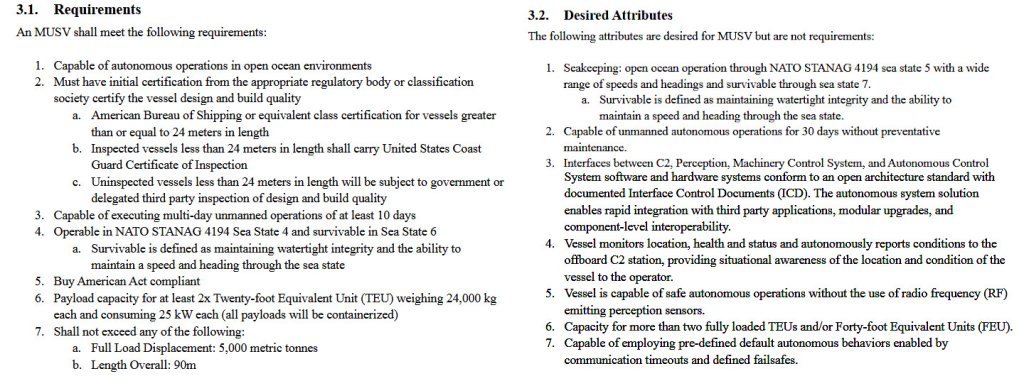
In addition, “to be considered for this Call for Solutions, the proposed MUSV must be ready for operational demonstration at the time of solution submission,” according to the Phase II contracting notice. “An MUSV requiring substantial modifications for the production platform compared to the as-demonstrated platform will not be considered.”
“The Phase II solicitation allows entrants to compete and existing vendors to submit updated product blocks and modular payload configurations,” Miller, the Acting DRPM RAS, said today. “Testing evaluations will begin as early as November 16th, and proposals will be assessed on a continually rolling basis over the next five years.”
Miller also drew attention to the elimination of the speed and at-sea refueling targets previously outlined in Phase I.
“What we learned from Phase I is that as you increase the speed requirements and some of these other things, it does present certain challenges for industry,” according to Miller. “So I’m trying to actually find the sweet spot in the market where there is healthy competition, and there’s opportunities, and we can have more things that potentially are dual use, both military and civilian.”
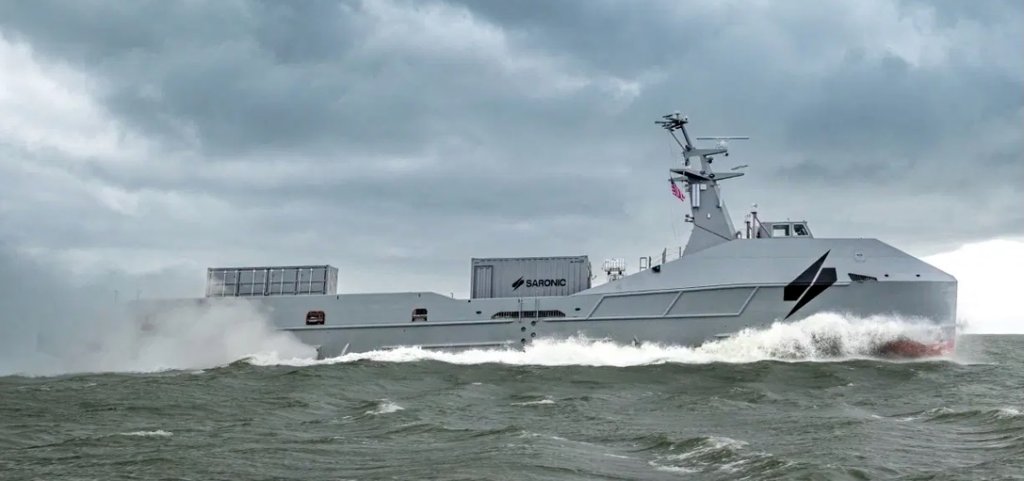
So far, the Navy has only offered limited insights into exactly what specific mission sets it wants the MUSVs to perform, even initially.
The “MUSV Phase I requirements were closely tailored to fulfill operational requirements for a specific mission set focused on demonstrated ability to carry containerized payloads while meeting specific vessel performance requirements for speed and range,” Miller said during today’s roundtable. “However, there is an ever-increasing demand signal that we must be ready to meet. To ensure scalability across the broader mission sets and to support our joint force, we issued a formal call for solutions for MUSV Phase II integration and testing.”
He also stressed that the modularity of the designs being acquired now would allow for the continued evolution of their capabilities as time goes on.
With the focus on containerized payloads, “honestly, inside you could have a sensor, you could have repair equipment for ships,” Rebecca Gassler, who was the Navy’s Portfolio Acquisition Executive for Robotic and Autonomous Systems (PAE RAS) until August, also told TWZ and other outlets back in March. “You could have any number of payloads inside those, and you basically are able to just swap them on.”
In announcing the new OTAs today, as well as discussing the Phase II MUSV plans, the Navy also highlighted continued opportunities for the other companies that had been involved in Phase I.
“Leidos, PAC MAR, and Sea Machines were determined to complete the project provided for in their prototype other transaction agreement and will receive a $15 million award as part of the previously established terms of the prototype OTs,” the Navy’s MUSV announcement today adds. “Alongside the OT awardees, will be accepted onto the Drones.mil hosted Maritime Marketplace, where they are now eligible to receive follow-on production agreements from authorized acquisition authorities across the DOW [Department of War].”
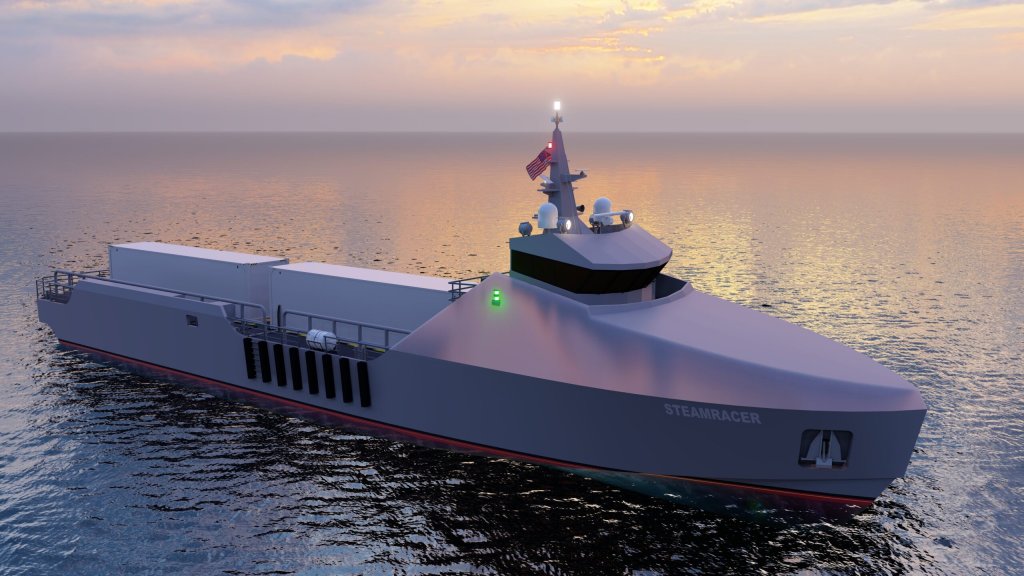
Birdon did not complete the required testing. Based on the terms of the Phase I OTAs, Galliano, HII, and Saronic will also receive $15 million awards and be included in the marketplace. The aforementioned Phase II CFS is intended “to expand its acquisition pipeline through a Maritime Marketplace to broaden offerings and satisfy future MUSV mission sets,” as well, per the Navy.
The Navy stressed the importance of this open-ended “marketplace” model as a way to accelerate the acquisition process when it first outlined the MUSV program to the public back in March, as you can read more about here. Just last week, the service also established a new Robotic and Autonomous Systems Warfighting Development Center (RASWDC) to serve as a focal point for “the development, operational integration, and employment of robotic and autonomous systems (RAS) across the maritime domain,” to include the MUSV effort.
The Drones.mil marketplace also extends to all branches of the U.S. military and beyond just USVs. Miller today did highlight the potential for possible cooperation with other services on drone boat efforts through this framework. He also said the Navy might be willing to consider additional acquisition strategies, including leasing uncrewed platforms, in the future.
Larger USVs have long been seen as key to bolstering the U.S. Navy’s overall operational capacity above the waves, and doing so in a cost-effective and rapidly producible manner. They are also viewed as central to enabling new, more distributed concepts of operations designed to help expand operational coverage and reduce the vulnerability of crewed ships, especially in any future high-end fight in the Pacific with China.
“Unmanned technology is redefining operations and providing our combatant commanders with unprecedented scale, persistence, and risk tolerance,” the Navy’s Miller said at the roundtable.
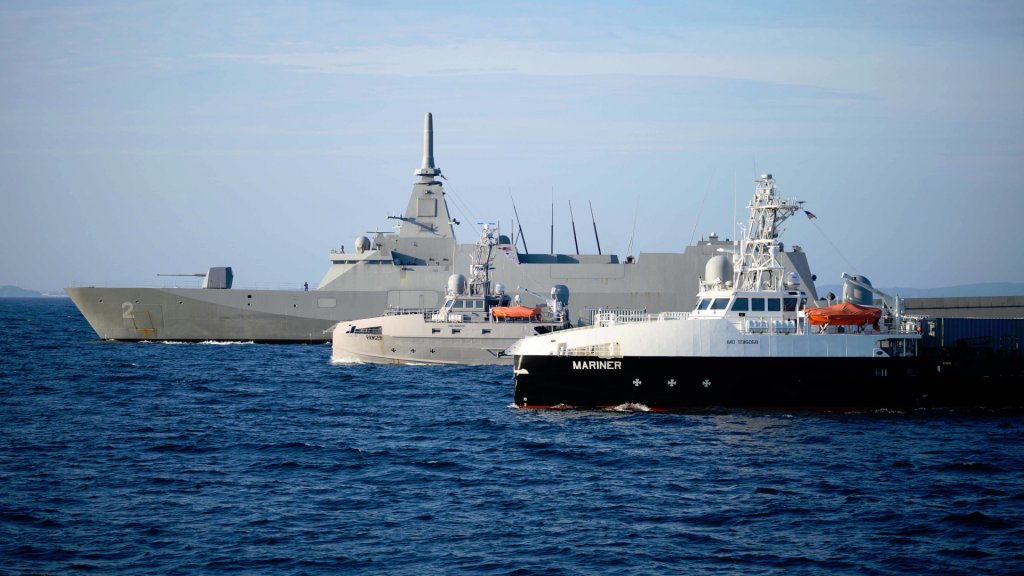
At the same time, as mentioned, the Navy has attempted to acquire operational fleets of larger drone boats in the past without success. Today, the service’s capabilities in this regard remain limited to a pocket force of still largely experimental optionally-crewed designs.
Since the Navy first unveiled it in March, MUSV has already faced certain hurdles. This includes a major leadership shakeup in August that saw PAE RAS Rebecca Gassler, the first person to ever hold that post, removed from her post after just eight months for reasons that are still not immediately clear.
In July, it also emerged that Blue Water Autonomy and Saildrone had filed suit against the Navy over being left out of Phase I of the MUSV competition. The companies alleged that the service did not follow its own selection criteria. That lawsuit is still ongoing. Blue Water Autonomy, among others, had also previously made investments in response to requirements the Navy had laid out for a previous effort called the Modular Surface Attack Craft (MASC) last year. The MUSV program has now fully supplanted MASC.
In speaking at the roundtable today, Miller acknowledged potential budget limitations and other hurdles that could still impact MUSV going forward. “I’m trying to be prepared depending on where that demand goes,” he said.
As said at the start, today’s MUSV announcement is an important new step forward for the Navy’s efforts to acquire fleets of larger USVs, but the service still has to transition these efforts into operational realities.
Contact the author: joe@twz.com
Loading comments…
Comments couldn’t be loaded. Please refresh the page.