
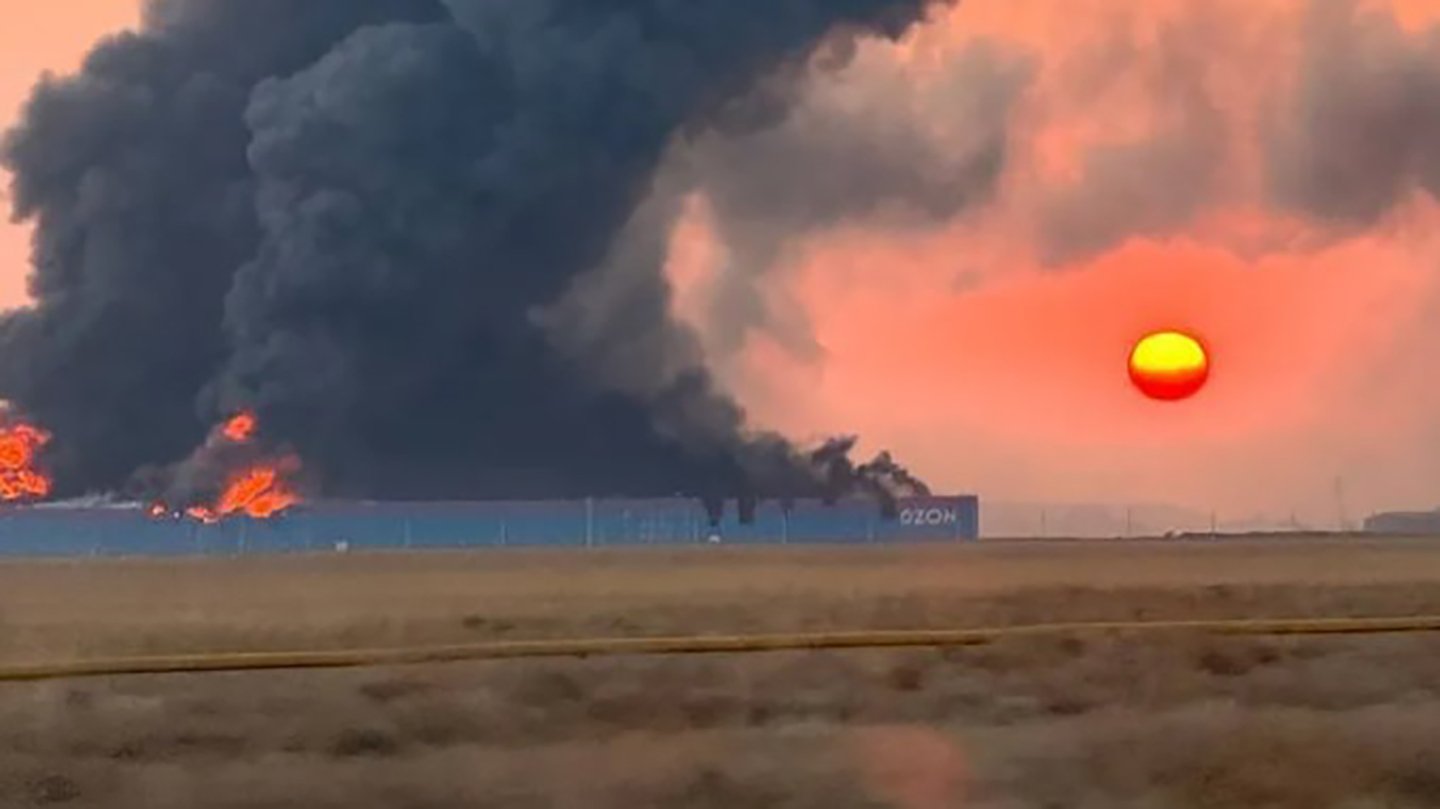
Ukrainian drone attacks on targets deep inside Russia have spurred President Vladimir Putin to allow the government to temporarily seize what it deems commercial critical infrastructure that is not sufficiently protected against such strikes. This follows Russia’s move earlier this year to allow private companies to purchase their own air defense systems to protect their own facilities. Beyond calling for increased defenses, the decree signed by Putin also warns that the government will take over facilities that don’t make needed repairs quickly enough once they have been hit.
These actions come as Russia’s economy is reeling after repeated Ukrainian drone hits on its oil refineries and other energy facilities. A more recent Ukrainian campaign against Russian Amazon-like e-commerce distribution centers has added to the financial woes and growing public frustration.
Kremlin spokesman Dmitry Peskov said Tuesday that “often business owners do not pay enough attention to taking measures to ensure safety, anti-drone safety.”
Given the threat to vital economic infrastructure, “we must take measures, we must ensure our own safety,” he added.
Putin’s decree does not specify what actions these facilities are required to take to provide better protection against Ukrainian drone attacks. As we have written about frequently, due to the demands of the battlefield and repeated Ukrainian attacks across a growing portion of Russia, the Russian military already has a shortage of air defense systems. So it’s not clear how much equipment, and of what capabilities, is even available for private firms to purchase. However, the civilian counter-drone industry in Russia is flourishing. Back in May, Russian authorities authorized private companies “to purchase heavy weaponry to defend industrial facilities against drone attacks,” the RBC news website reported at the time, citing sources linked to the Defense Ministry.
“The new system will allow companies to procure anti-aircraft artillery systems, turrets, radar equipment, specialized vehicles and electronic warfare systems,” the outlet added. “In order to promptly provide newly formed mobile fire groups with everything they need, the relevant decisions were recently adopted at the state level.”
In addition, some refineries have already built metal cages around their facilities to help protect against drone attacks.

The Ukrainian drone attacks on Russia’s oil refineries and Black Sea ports are having a dramatic effect on the Russian economy.
“In the four weeks through Aug. 23, overseas crude flows fell to 3.46 million barrels a day,” Bloomberg news reported, citing tanker-movements data it compiled. “Shipments had previously risen as the strikes on Russia’s refineries left more crude available for export, but that increase is now unwinding, after drone hits on oil tankers cut shipments from the Black Sea.”
“Meanwhile, strikes on Russian oil and gas processing plants continue to be an almost nightly occurrence, sending crude processing rates tumbling and creating domestic gasoline supply issues,” Bloomberg explained. “Falling Russian crude shipments come on top of Kremlin-imposed bans on overseas shipments of key refined products, including most gasoline, diesel and jet fuel supplies, which are further reducing inflows to Moscow’s war chest.”
Ukraine, as we noted earlier, has also targeted Russian logistics infrastructure belonging to major online retailers, such as Amazon-style retail giant Wildberries, to increase the financial pain on other sectors of the Russian economy.
“Ozon, Russia’s second-largest online retailer, is now next in Ukraine’s crosshairs,” CNBC reported. “Shares of the company plunged nearly 30% on the Moscow Exchange on Monday after it reported drone strikes in southern Russia, which brought the number of facilities targeted in the last three days to six.”
Overnight on Monday, Ukraine continued striking inside Russia, attacking the Afipsky Refinery and Gas Separation Units at the Astrakhan Gas Processing Plant, according to the Ukrainian Armed Forces General Staff. The extent of the damage is still being clarified.
“Afipsky Refinery is one of the large oil refining facilities in the Krasnodar region,” the general staff noted. “The project capacity is 6.25 million tons of oil per year. The plant produces, among other things, diesel, gasoline components, and is involved in supplying the Russian occupation army.”
The governor of the Krasnodar region, Veniamin Kondratiev, acknowledged the attack.
“Debris from a drone fell on the territory of the Afipskaya railway station,” he stated on Telegram. “Sadly, two people were killed. I express my deepest condolences to the families. Two more people were injured, and I wish them a speedy recovery. In addition, at least 10 private homes were damaged in the village of Afipsky. A fire broke out in one of them. A fire also occurred on the territory of a refinery. Firefighters and emergency services are currently working at the scene.”
Russia isn’t alone in worrying about Ukrainian drone strikes. Financial Times reporter Christopher Miller noted on X that the Trump administration asked Kyiv not to strike Moscow, St. Petersburg or northern regions of Russia Monday, Tuesday and Wednesday, “when the U.S. would send a plane carrying a senior-level official to the Russian capital.”
On Tuesday, a U.S. Air Force C-17 Globemaster III strategic airlifter arrived in Moscow, reportedly ferrying CIA Director John Ratcliffe. You can read more about that in our initial story here.
Ratcliffe was visiting as the U.S. struggles to end Russia’s full-on invasion of Ukraine and the Iran war, though “the reason for the visit wasn’t immediately clear,” The Wall Street Journal noted. “The U.S. has collected intelligence showing Russia’s early preparations for a possible military mobilization in Ukraine and plans for testing the North Atlantic Treaty Organization’s resolve.”
Analysts said Ratcliffe could meet with Putin to deliver a warning, the newspaper noted.
“It could be to say, ‘We know what you are thinking about doing, and you better not,’” Beth Sanner, a former U.S. deputy director of national intelligence for mission integration, told the Journal. “It could also be about the Iran ceasefire and putting someone else in the discussion,” she said, adding Ratcliffe might also touch upon the Kremlin’s support for Iran following a new U.S. sanctions campaign against the regime.
The Latest
Ukraine is making some small advances in the southern section of the front while Russia continues to put heavy pressure on the Donetsk region in the east. Here are some key takeaways from the latest Institute for the Study of War assessment.
- Sumy: Russian forces continued offensive operations in northern Sumy Oblast on August 23 and 24 but did not make confirmed advances.
- Kharkiv: Russian forces continued offensive operations in northern Kharkiv Oblast, near Borova, Kupiansk and in the Velykyi Burluk direction on August 23 and 24 but did not advance as Ukrainian forces counterattacked.
- Donetsk: Ukrainian forces recently advanced in the Slovyansk direction. Russian forces continued attempts to isolate Ukrainian forces in Mykolaivka (east of Slovyansk), and attacked in the Dobropillya tactical area, the Kostyantynivka-Druzhkivka tactical area, Pokrovsk, Novopavlivka, and Oleksandrivka on August 23 and 24 but did not advance.
- Zaporizhia: Ukrainian forces recently advanced in the Hulyaipole direction and in western Zaporizhia Oblast.
- Kherson: Neither Russian nor Ukrainian forces reported ground activity in the Kherson direction on August 24.
Ukrainian President Volodymyr Zelensky offered some positive news Tuesday about badly needed air defense systems and interceptors.
“We received confirmation regarding several Crotale air defense systems and missiles for them. And AIM missiles, which we use to shoot down enemy missiles. And a little more Patriot missiles have arrived,” Zelensky told reporters. He did not offer specific figures.
Zelensky added that Ukraine had received confirmation from the United Kingdom regarding the production of SCALP long-range missiles.
He added that “French President Emmanuel Macron had confirmed the unblocking of SCALP missiles and the necessary licenses,” the Kyiv Post reported. You can read more about that effort in our story here.
“We will act. I believe this is a strong positive and a strong decision,” Zelensky said.
Zelensky also said Ukraine expects to receive a schedule for the Freya domestic air defense interceptor initiative within seven to 10 days, including information on meetings and areas where cooperation with defense companies is currently blocked.
Earlier this month, we told you about two drone-related incidents at Leipzig/Halle Airport in Germany that represented the most serious threats yet in the wave of small drone incursions that have plagued Europe for the past few years. German police said an explosive-laden drone was located on the ground near a Ukrainian Antonov An-124 Condor cargo jet and that there was a midair collision between an object and another cargo aircraft.
More news about that situation emerged today.
German investigators uncovered a third drone and suspected military explosives thought to be connected to the attempted attack on Leipzig airport, the Guardian reported, citing local media.
“The drone was discovered in Kabelsketal, just to the west of the airport, along with about 50g (1.8oz) of a suspected military explosive on 14 August, 10 days after the unsuccessful sabotage,” the publication stated. The office of the prosecutor general, which is leading the investigation, declined to comment on Tuesday. But the German chancellor, Friedrich Merz, said the government would soon provide information about who it believed was behind the drone attacks.
“They will pay for this,” Merz said, stopping short of naming a suspect, before a cabinet meeting in Brandenburg. He added that the government was “working intensively on this together with the security authorities and we will present our findings and comment on them shortly.”
“Intelligence sources cited by the broadcasters NDR and WDR and the newspaper Süddeutsche Zeitung said they suspected the involvement of Russian intelligence in the attempted attack,” the Guardian added. Moscow has denied involvement.
Leipzig airport is a cargo and military logistics hub used by NATO and Ukraine’s Antonov Airlines for transporting military supplies. As we noted in our initial piece, the Condor, in particular, represents an unsurprising target for Russia. Ukraine’s An-124s are a source of national pride and a big flying symbol of the country’s defiance and survival. They also provide much-needed revenue to Ukraine and strategic airlift to support the conflict. Ukraine’s An-124s have long provided charter cargo services for western militaries, companies and NGOs. Since the war began, Antonov Airlines An-124s have been used to deliver war materiel bound for Ukraine.
Britain has signed a partnership with Ukraine to jointly develop artificial intelligence tools for defense and security, ”giving British researchers access to a Ukrainian battlefield data platform used to train military AI systems,” Reuters reported.
Prime Minister Andy Burnham and Zelensky signed the agreement in Kyiv, making Britain the first international partner to access Ukraine’s Avengers AI Labs, a government statement said.
Avengers Labs “was built around an annotated dataset of 5 million battlefield images, Ukraine’s Defense Ministry said earlier in August, largely drawn from the military’s DELTA combat system – a domestically developed battlefield management and situational-awareness system,” the outlet added. “The platform uses data collected from cameras and sensors across Ukraine’s battlefield, including information on tanks, artillery systems, drones and other military targets.”
The Ukrainian ministry said “AI models trained on the data were already being used in an automated target-detection system that analyses more than 100,000 drone video feeds each month and can identify about 70% of enemy targets in real time,” Reuters noted.
In early 2023, donated tanks began arriving in Ukraine with great fanfare and hopes that additional armor would help turn the tide against Russia.
Fast forward to today and many of those tanks that survived combat “now mostly sit idle, hidden in forests and collecting cobwebs,” according to a New York Times report. “The $10 million machines, procured with great fanfare, proved no match for cheap drones that now dominate the battlefield. Yet Ukraine still maintains them and trains soldiers to use them, while trying to imagine new ways to deploy them.”
“We’re making virtually no use of armored vehicles,” Oleksandr Syrskyi, who until last month was Ukraine’s top general, said recently, the newspaper noted. “This raises the question: How can we neutralize this advantage enjoyed by drones and give our armor a new lease on life?”
The situation has changed so drastically that tanks are being used largely as tractors to tow damaged equipment, the Times proffered. Some of the troops are now more involved with drones than tanks. Newer recruits to a unit that was among the first to receive donated armor “have never even touched a tank. Among them was Korzhyk, 33, who joined the brigade in 2025 and spends his days repairing ground drones in a dark workshop,” the publication added.
Video emerged on social media of a Ukrainian MiG-29MU1 Fulcrum fighter dropping U.S.-made GBU-39/B Small Diameter Bombs (SDB) toward enemy drone operators inside Russia’s Belgorod region.
Ukraine’s mid-range drone attacks against Russian logistics have proven quite successful; however, the following picture shows not every strike resulted in complete destruction. As you can see, a Hornet one-way attack drone got stuck in the windshield of a truck in occupied Crimea.
That’s it for now.
Contact the author: howard@twz.com
Loading comments…
Comments couldn’t be loaded. Please refresh the page.