
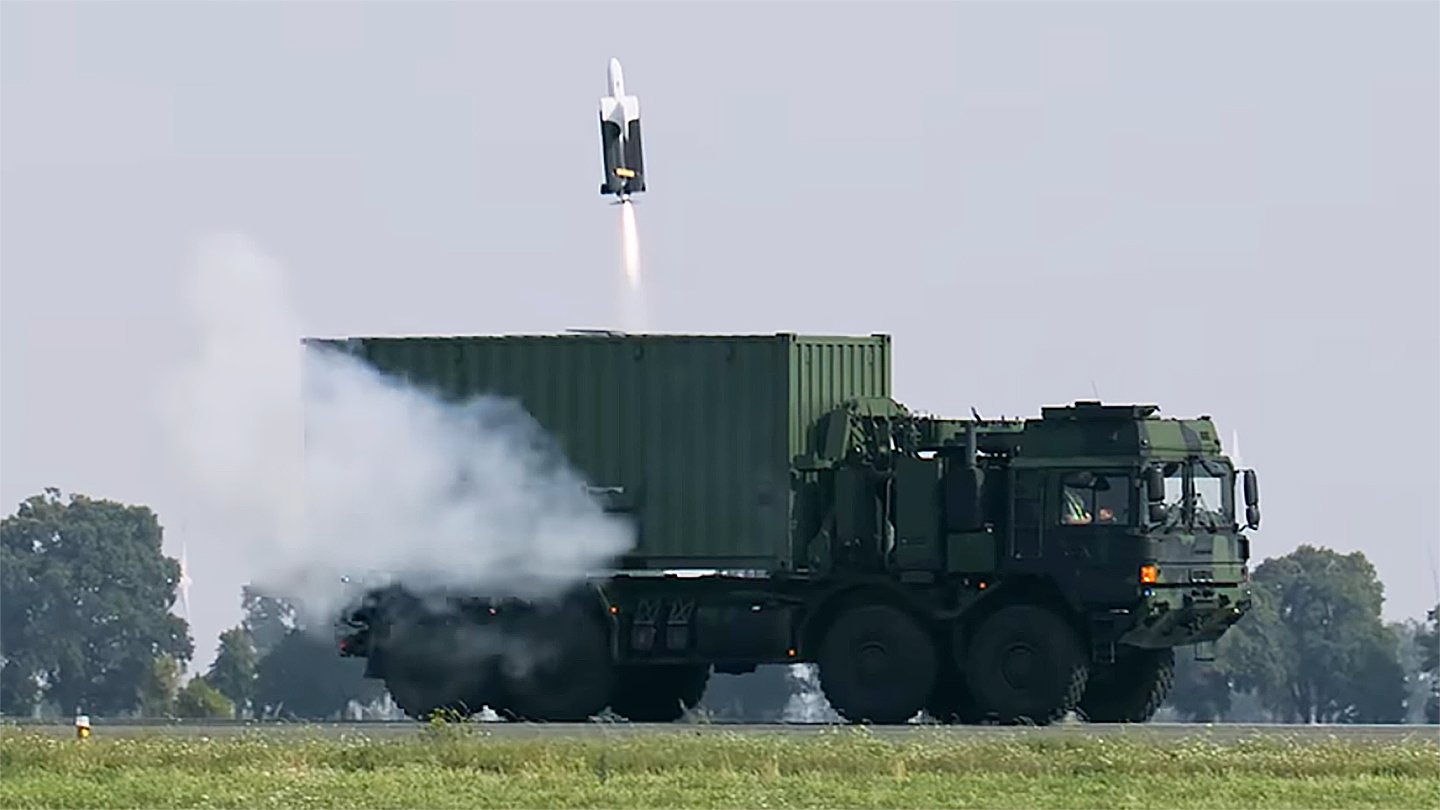
German defense giant Rheinmetall has demonstrated its new FV-014 loitering munition being launched from a containerized launcher mounted on a truck, including while the vehicle was moving. The test marks the first time the FV-014 has been fired from its Containerized Missile Launcher, a modular system intended to carry significant numbers of missiles or loitering munitions.
The demonstration took place in July at the National Test Center for Unmanned Aerial Systems at the German Aerospace Center in Cochstedt, Saxony-Anhalt. The customer demonstration included both stationary and mobile launches from an HX-series truck, followed by simulated operational profiles and attack flights.

The FV-014 is a relatively long-range, truck-launched loitering munition that can perform its own reconnaissance and then conduct a precision attack. Rheinmetall says the weapon has a range of up to 100 kilometers (62 miles) and can remain airborne for as long as 70 minutes.
Like many loitering munitions, this endurance gives the operator considerably more time to search for targets and decide whether to conduct an attack than would be available with a conventional fire-and-forget missile. Rheinmetall describes the system as combining “reconnaissance, target identification and precision strike capabilities within a single system.”
The FV-014 is designed to remain under permanent human control. An operator using the associated ground station can identify and track targets and authorize an attack, while also having the ability to abort an engagement if circumstances change.
As we have discussed in the past, human-in-the-loop architecture is useful when operating against targets that may be moving or difficult to identify in advance.
However, the concept also has significant drawbacks compared to increasingly autonomous loitering-munition concepts in which the system itself can perform much more of the target-detection and engagement process. Human-in-the-loop comes with latency and communications dependencies, as well as operator workload, but it may also be the result of a particular customer demand, whether operational or legal. At the same time, for all its promise, autonomous technology is still in its infancy.
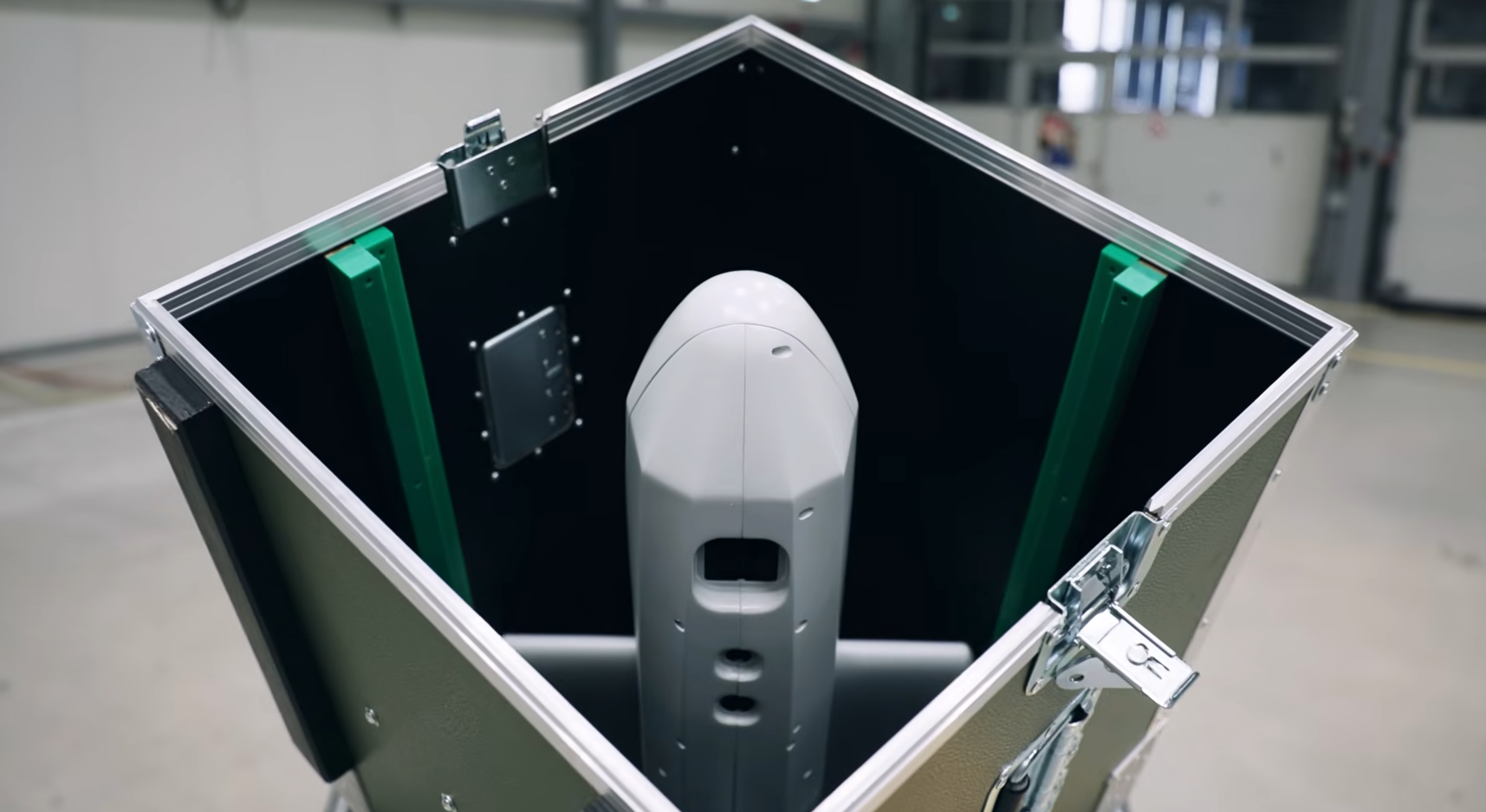
The FV-014 has a launch weight of around 50 pounds, including a payload of approximately 13 pounds. Its HEDP, or high-explosive dual-purpose, warhead is claimed to be capable of penetrating around 24 inches of solid armor steel.
That would give the weapon a substantial anti-armor capability for its size, although Rheinmetall also says the warhead can be used against unarmored targets and infrastructure.
After being ejected from its launch tube using a booster, the FV-014 unfolds its wings and transitions into aerodynamic flight. An electrically driven propeller provides propulsion during the cruise phase. Rheinmetall also says the weapon has been designed with reduced radar and infrared signatures in mind.
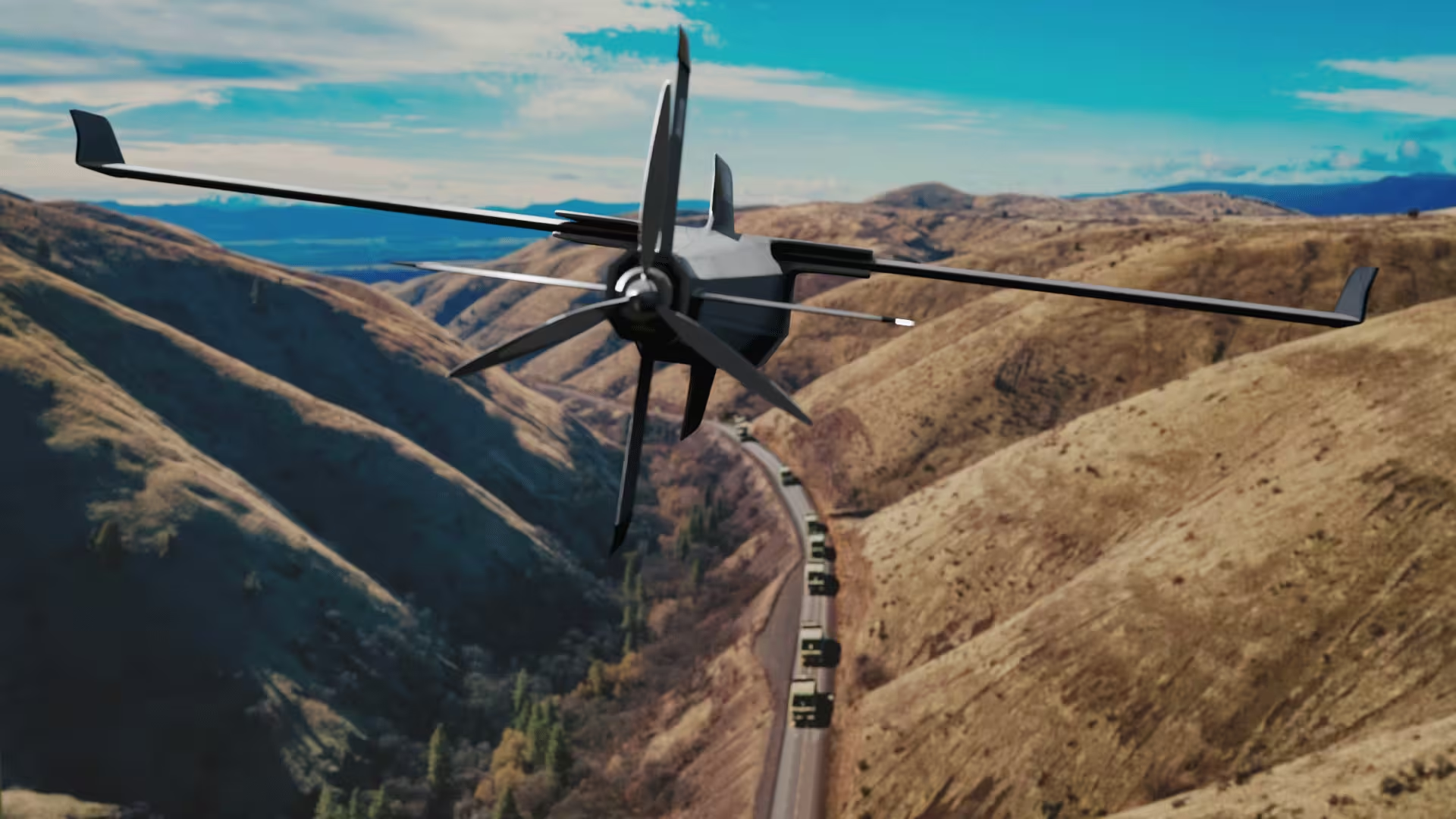
The company is pitching the FV-014 for both individual attacks and coordinated swarm operations. In the latter case, multiple weapons could be used simultaneously against a number of targets or to overwhelm an adversary’s defenses and create outsized, rapid effects on the battlefield.
‘Swarm’ has become something of a catch-all term in the loitering-munition market, however, and Rheinmetall has not provided detailed information about the level of autonomy or coordination available between FV-014s. The company does say that the weapon has network connectivity and a “high degree of autonomy” intended to help it operate in environments where satellite navigation is being disrupted.
This capability is particularly important on the modern battlefield, where electronic warfare systems are routinely used to interfere with satellite-navigation signals. Rheinmetall says the FV-014 is resilient to global navigation satellite system (GNSS) interference, although specific details about its navigation architecture have not been disclosed.
The weapon’s launch system, Rheinmetall’s Containerized Missile Launcher, is built around a standardized ISO container that can be installed on a fixed site, carried by a truck, or potentially integrated onto a ship. In its 20-foot configuration, the company says the launcher can accommodate up to 18 FV-014s.
That is considerably fewer weapons than some other containerized drone-launcher concepts Rheinmetall has previously promoted. In 2024, for example, the company showed a containerized system intended to carry as many as 126 Hero-series loitering munitions from Israeli manufacturer UVision.
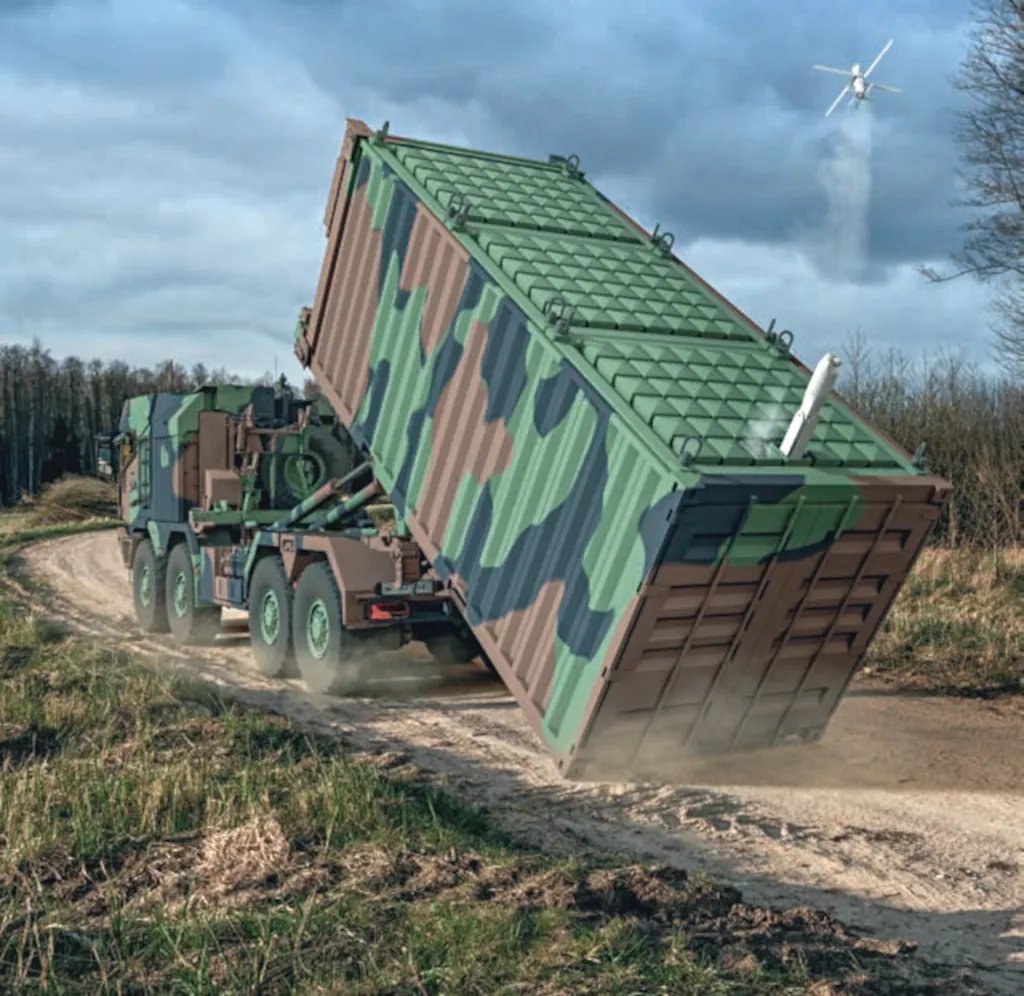
Rather than simply acting as a large rack of launch tubes, the new launch system has its own integrated power supply and can connect to command, control, communications, computers and intelligence networks. It can also be operated locally, through a radio link, or via satellite communications.
The launcher is intended to make extensive use of commercial off-the-shelf components, which should reduce lifecycle costs. It also incorporates what the company calls a “sleeper” capability, allowing the launcher to remain inactive and be remotely activated when required.
The ability to move the entire system on a standard military truck is potentially significant. Rheinmetall has demonstrated the launch of FV-014s from a moving truck, as well as a stationary one. Shooting on the move could be beneficial when defending convoys, engaging targets of opportunity, or offering rapid fire support to units within range. Beyond that, interceptor drones would allow for engagements against drone threats while on the move.
Using a standardized container makes it possible to rapidly relocate a large number of long-range loitering munitions without relying on a dedicated launcher vehicle, and also opens up potential maritime applications. Rheinmetall says future versions are planned for other mobile land platforms and seagoing ones, while the container itself is compatible with existing transportation and logistics infrastructure.
This general concept is already seeing considerable uptake. Containerized launchers provide a relatively discreet way of deploying large numbers of missiles or drones and can potentially turn trucks, ships, or other platforms capable of carrying ISO containers into weapons carriers. TWZ has previously examined the broader appeal of this approach, including Rheinmetall’s earlier Hero-family launcher concept.
In the past, we have also highlighted the immense potential battlefield impact of this type of capability, which other countries, especially China, are also actively pursuing.
The video below shows a test of a Chinese truck-mounted launcher design capable of being loaded with up to 48 kamikaze drones.

In general, containerized launchers offer an unusual degree of concealability: a weapons system housed in a standard shipping container can potentially be moved through conventional logistics networks and deployed without the distinctive appearance of a dedicated missile battery. Rheinmetall has explicitly pitched the standardized container format as supporting “covert operations,” and this immediately calls to mind Ukraine’s audacious Operation Spiderweb that saw several Russian bombers and other aircraft destroyed or damaged by (much shorter-range) drones launched from trucks.
Rheinmetall has not disclosed details about the customer involved in the July demonstration, nor of the targets used, the engagement distances, the number of FV-014s launched, or the extent of autonomy involved in reported swarm operations.
However, with the FV-014 now proven, Rheinmetall can offer a complete system in which a truck can arrive with a sizeable magazine of relatively long-range weapons, launch them individually or in groups, and provide operators with the ability to search for targets before deciding whether to attack. The German company’s mobile containerized launcher and a 100-kilometer-class loitering munition are eye-catching, but the system also enters an increasingly competitive market.
Contact the author: thomas@thewarzone.com
Loading comments…
Comments couldn’t be loaded. Please refresh the page.