
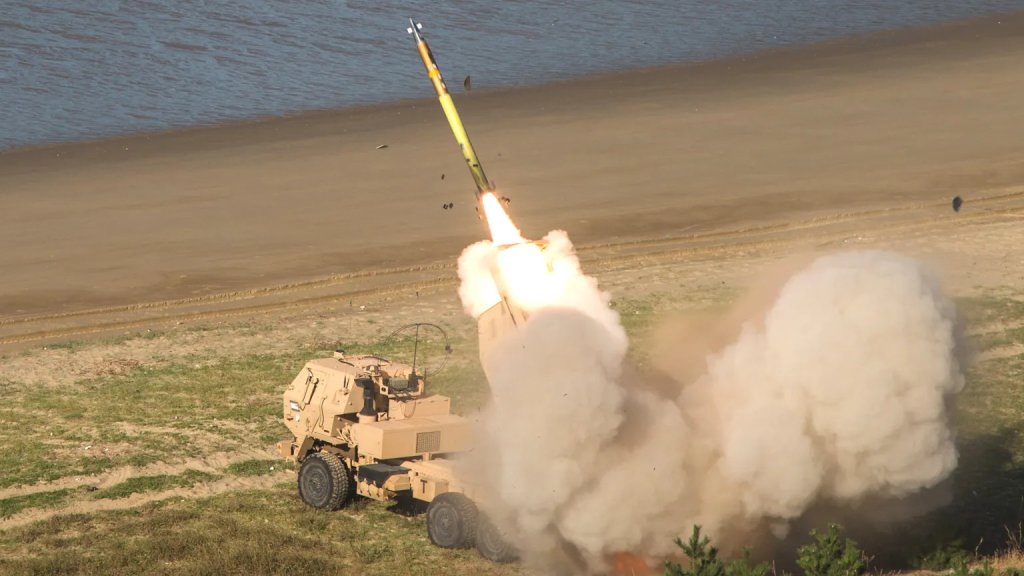
The U.S. Army is on the hunt for a new lower-cost strike missile capable of hitting targets more than 621 miles (1,000 kilometers) away. The Affordable High Speed Strike (AHSS) missile could be more of a traditional ballistic missile-like weapon or feature an air-breathing propulsion system. AHSSs could be fired from new uncrewed launcher vehicles that the Army is pursuing separately, as well as certain existing crewed types like the M142 High Mobility Artillery Rocket System (HIMARS). The service sees these future weapons as offering a particularly important new way to strike enemy air bases, air defense nodes, missile launchers, and other high-value targets within a particular theater of operations.
AHSS was among the many programs the Army’s Combat Capabilities Development Command’s Aviation & Missile Center (DEVCOM AvMC) highlighted at its booth at the annual Space & Missile Defense (SMD) Symposium in Huntsville, Alabama. TWZ was in attendance at this conference, which wrapped up yesterday. Aviation Week was first to report on AHSS from this event.
“AHSS is an entirely new missile,” a DEVCOM spokesperson said, according to Aviation Week. At the same time, the Army is also clearly in the very early stages of defining what it wants from this new weapon beyond general affordability and reach.
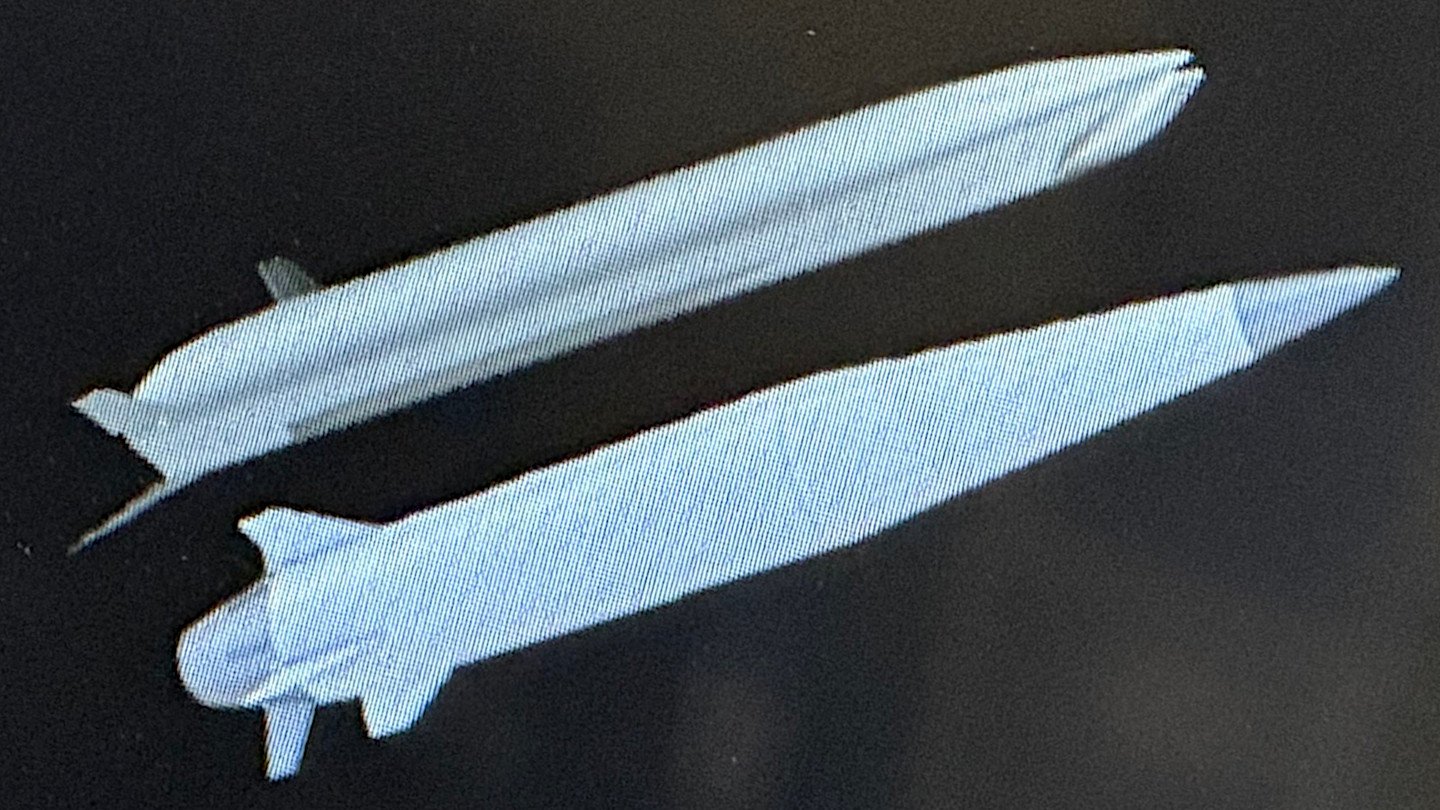
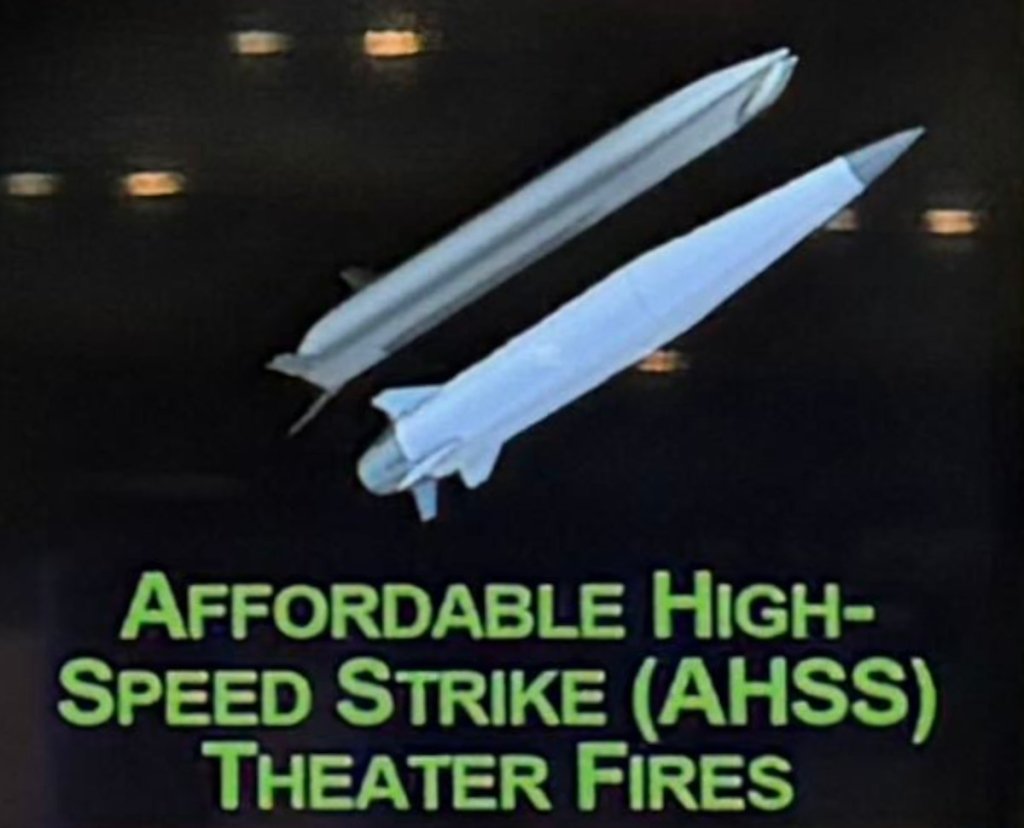
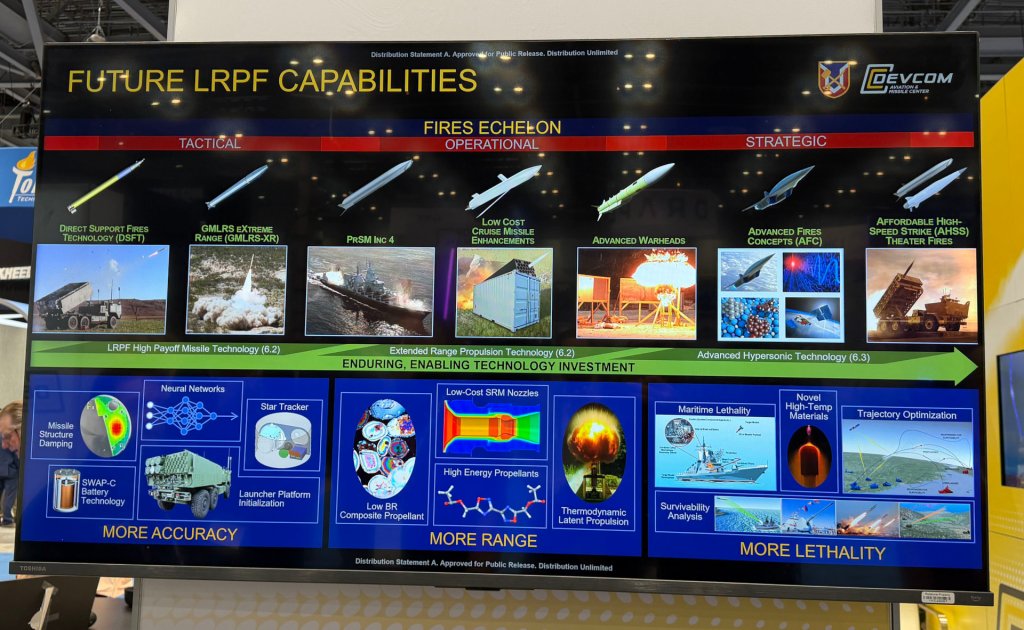
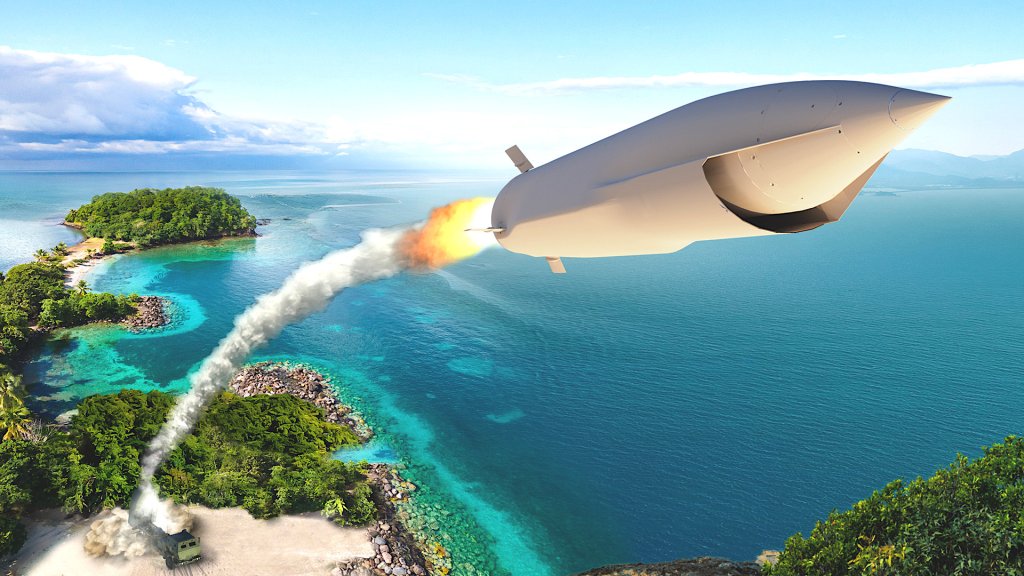
A graphic on display at DEVCOM’s booth at the SMD symposium showed renderings of two distinctly different notional missiles under the AHSS heading, as seen at the top of this story and below. One has a traditional ballistic missile-type design with a cruciform fin arrangement at the tail end. The other notional missile has a more novel design with an air-breathing propulsion system feeding from an intake in the nose. In broad terms, the intake has a style commonly associated with high-speed jet engines such as ramjets and scramjets. It also has a completely different tail configuration, as well as what appears to be a long, slender stabilizing strake visible along the right side of the body.
Aviation Week‘s story also highlights the Army’s current separate development of an entire new family of Common Autonomous Multi-Domain Launcher (CAML) vehicles. However, the current AHSS concept also includes “an option to be launched from a crewed HIMARS,” the DEVCOM spokesperson said, according to that outlet.

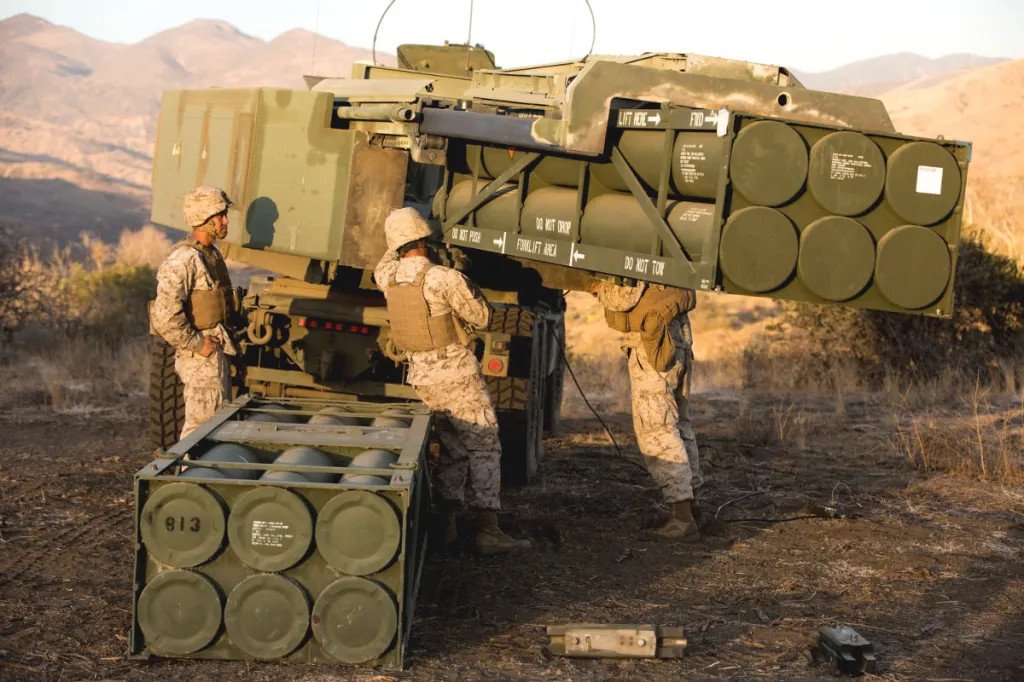
HIMARS, which uses a 6×6 tactical truck as its base, fires munitions via standardized ammunition ‘pods.’ As such, it seems likely that any other launcher that makes use of these same pods, such as the tracked M270 Multiple Launch Rocket System (MLRS), would also be able to fire the future AHSS missile.
“This project directly supports Precision Fires capabilities by developing, maturing, and demonstrating affordable high speed strike missile technologies for responsive, mobile, deployable, survivable, and sustainable Army conventional theater strike weapons,” the Army said about AHSS in its 2027 Fiscal year budget proposal, which was released earlier this year. The program will “provide hardware and software technologies demonstrated, including affordable advanced propulsion, complementary warhead, guidance, navigation and control technologies, and integration onto Army mobile launch platforms.”
“The Army needs affordable, responsive high speed strike capability to attack theater level targets, provide offensive counter-air capability, and be launched from Army mobile, deployable, and survivable platforms,” the Army budget documents add.
The specific mention of the offensive counter-air (OCA) mission set is interesting as it is far more commonly associated with air assets. However, it is simply defined as “offensive operations to destroy or neutralize enemy aircraft, missiles, launch platforms, and their supporting structures and systems both before and after launch, and as close to their source as possible,” according to the January 2020 edition of the U.S. military’s official Dictionary of Military and Associated Terms. Long-range surface-to-surface missiles are very applicable for pursuing these objectives, something we will come back to later on.
It is also worth noting that DEVCOM’s graphic at the SMD Symposium used the exact same air-breathing missile render to represent the planned Increment 4 version of the Precision Strike Missile (PrSM). The baseline version of PrSM, or Increment 1, is a traditional short-range ballistic missile with ability to hit targets at least around 310 miles (500 kilometers) away, if not further. The Army’s current stated plan for Increment 4 is to acquire a new variant or derivative of PrSM with a range of at least 621 miles/1,000 kilometers. For further context, the Increment 2 PrSM, which is in active development now, is an anti-ship-focused variant with a new seeker system, allowing it to engage moving targets. The Increment 3 plan is centered on new unspecified “enhanced” payloads, which could include swarms of loitering munitions.
The Army has also talked in the past about an Increment 5 variation of PrSM with even greater range. This would put it in the same general category, at least in terms of reach, as AHSS. As noted, DEVCOM has stressed that AHSS is distinct from other existing efforts.
Furthermore, AHSS and PrSM are just two parts of a larger array of new longer-range strike capabilities the Army is working to acquire. The service has already fielded a small number of Typhon systems, which are currently capable of firing Tomahawk land attack cruise missiles and Standard Missile-6 (SM-6) multi-purpose missiles. Tomahawks can hit targets roughly 1,000 miles away. The Army is now pushing to field the Long Range Hypersonic Weapon (LRHW), also known as Dark Eagle, as well. Last year, new details emerged that put the maximum range of this weapon at around 2,175 miles.
On top of this, defense startup Castelion is developing a ground-launched version of its Blackbeard missile for the Army. Blackbeard is a lower-cost design said to be capable of traveling at hypersonic speeds. The exact maximum range of this missile is unclear, but the Army has said in the past that it is targeting “80% of the Precision Strike Missile (PrSM) Increment 4 capability.”
A key underlying factor in all of this was the collapse of the Intermediate-Range Nuclear Forces (INF) Treaty in 2019. Under the INF, the United States and Russia were both prohibited from developing and fielding nuclear or conventionally-armed ground-based ballistic and cruise missiles with maximum ranges between 310 and 3,420 miles (500 and 5,500 kilometers). The AHSS section in the Army’s 2027 Fiscal Year budget request specifically mentions that such developments are now “unconstrained by previous treaties.”
Depending on what kind of capability is ultimately pursued under AHSS, as well as PrSM Increment 5, the Army could be on track to field its first new medium-range ballistic missile (MRBM) since the INF went into force in 1988. MRBMs are categorized as ballistic missiles with maximum ranges between 620 and 1,860 miles (1,000 and 3,000 kilometers). Members of Congress have notably been openly supportive of the Army acquiring exactly this kind of long-range capability in the past.
Pairing this capability with new and improved crewed and uncrewed launchers could offer more flexibility for employing these weapons, while also helping to reduce vulnerability to enemy attacks. TWZ has highlighted now on several occasions how uncrewed mobile launch systems would offer even greater advantages for future expeditionary and distributed operations. Uncrewed platforms could be pushed further forward without necessarily exposing human operators to greater risks. This would also allow a smaller force of human personnel to operate a larger number of total launchers, in general.
The broader value of Army ground-based long-range strike capabilities has been demonstrated this year in the course of operations against Iran. PrSM, as well as older Army Tactical Missile System (ATACMS) short-range ballistic missiles, have been so heavily employed against Iranian targets that there are now serious concerns about the adequacy of the remaining stockpiles of those weapons. There are reports that stocks of PrSMs, which the Army only received in quantity in 2023 and that made their combat debut in strikes on Iran, have run especially low.
As such, AHSS also underscores the importance of acquiring new, lower-cost munitions that are also more readily procurable, something that has become a focal point for the entire U.S. military in recent years. As a point of comparison, the unit cost of an Increment 1 PrSM is around $1.5 million. It is also a long-lead item where the time between when orders are placed and deliveries occur is measured in years.
What the timeline might be for AHSS developments to evolve into an actual operational capability is unclear. The Army has asked for just over $94.2 million to support AHSS work in the 2027 Fiscal Year. In its report, Aviation Week also noted that the service has previously disclosed that Australia is an international partner in the AHSS effort. This is a capability that could be of interest to other branches of the U.S. military and other foreign allies and partners. The U.S. Marine Corps, in particular, has an interest in longer-range strike capabilities to support its new expeditionary and distributed concepts of operations, and axed its plans to field Tomahawks fired from uncrewed 4×4 launcher vehicles last year,
With the Army exploring initial concepts for AHSS now, more about its vision for these missiles may begin to emerge.
Contact the author: joe@twz.com
Loading comments…
Comments couldn’t be loaded. Please refresh the page.